Value Decryption: How to Mine the Next Axie Infinity Through Major Web3 Gaming Platforms?
TechFlow Selected TechFlow Selected
Value Decryption: How to Mine the Next Axie Infinity Through Major Web3 Gaming Platforms?
This article will explore the future development direction by analyzing the state of the traditional gaming industry and the crypto gaming industry.
 Navigating Web3 tides with focused insights
By: DeMan
The blockchain gaming industry, one of the most popular sectors in the digital era, has already demonstrated its immense potential and appeal during the previous bull market. The wealth economy formed by blockchain games is also a major reason why they attract widespread attention. As 2023 enters its final month, this sector faces numerous challenges amid market fluctuations and evolving player demands.
The once-annual trend of a breakout GameFi project appears to have stalled in 2023. However, many are looking forward to 2024, with numerous predictions suggesting that certain projects could lead the industry’s resurgence. This article will analyze both traditional and blockchain gaming landscapes to explore future development directions, while highlighting several platforms that help users better engage with Web3.
Web3 Gaming Is Navigating a Bear Market Cycle, Poised for Greater Breakout Opportunities Ahead
In recent years, the overall gaming industry has experienced unprecedented rapid expansion, particularly during the pandemic when global market revenue significantly increased. This growth was driven by people spending more time at home and exploring new forms of interactive entertainment—Axie Infinity's rise was closely tied to this trend. Industry analysts previously projected that the total gaming market could reach an impressive $321 billion by 2026, based on prevailing growth trends and the increasing adoption of blockchain technology in gaming. Blockchain games alone injected remarkable momentum into the broader gaming ecosystem.
However, according to Newzoo’s 2022 Global Games Market Report, last year saw a 4.3% year-on-year decline in global game revenue. This downturn mainly resulted from the post-pandemic return to normal social and work routines, reducing time spent on home-based gaming. Additionally, key game brands postponed major product launches from 2022 to 2023—including fewer releases on Steam, Xbox, and PlayStation—further impacting overall market performance.
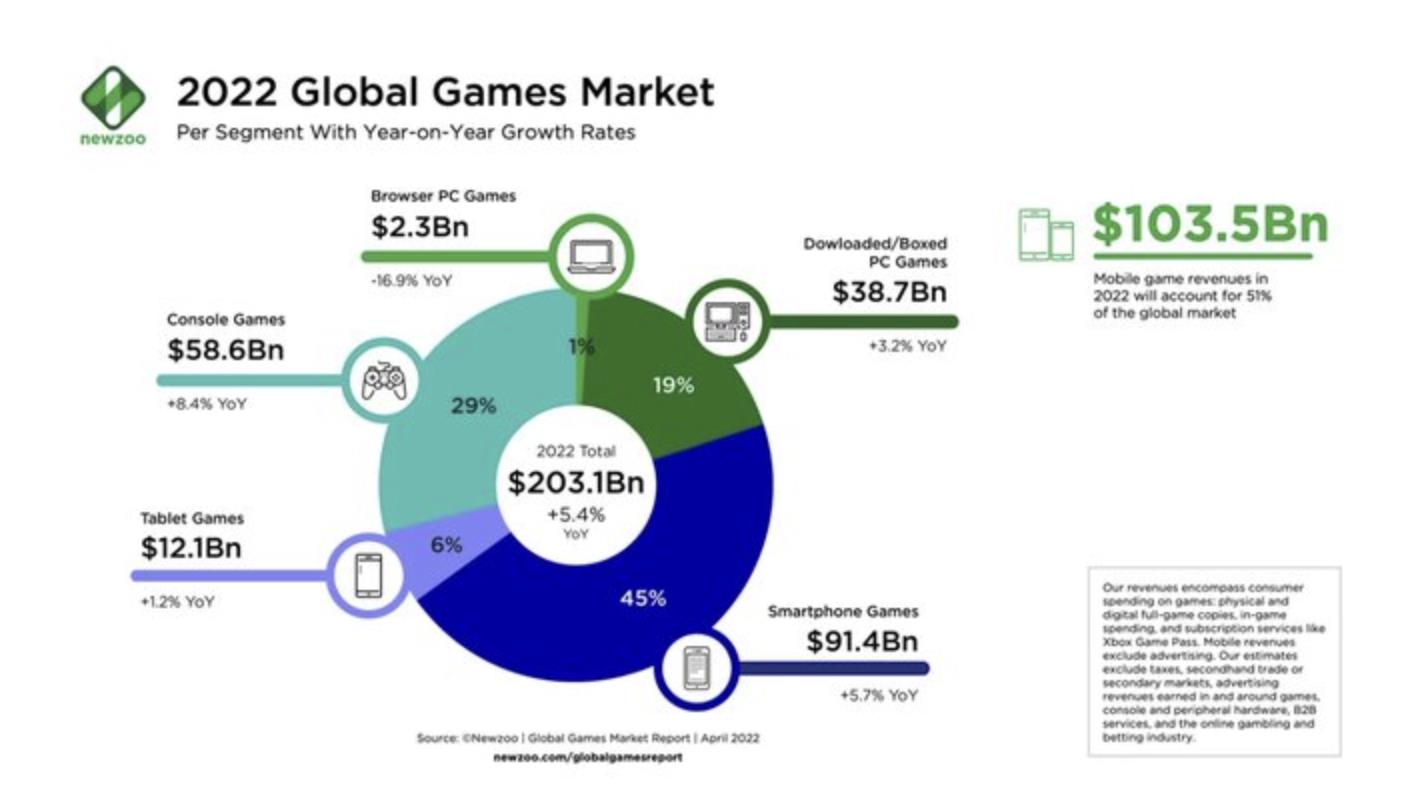
Newzoo market report chart
Moreover, the blockchain gaming sector, which made significant contributions in 2021, has been heavily impacted by the crypto market’s cyclical bull and bear phases, failing to deliver the same positive influence on the broader gaming industry as before. Thus, it's evident that blockchain gaming has become one of the new driving forces shaping the scale and trajectory of the entire gaming market.
Web3 Gaming Solves Many Traditional Gaming Flaws, Offering More Imaginative Growth Prospects
As mentioned earlier, despite underperforming in 2022 and 2023, the latest wave in digital gaming is widely expected to reverse its sluggish trend—and potentially explode in 2024. Whether blockchain gaming can ride this upward momentum is now a focal point of interest.
Blockchain gaming leverages blockchain technology to offer players unprecedented gaming experiences and value creation opportunities. This evolving technology unlocks boundless potential for blockchain-based games.
In traditional gaming, players often face a core issue: frustration after investing substantial time. This typically stems from limited replayability, leading players to eventually abandon the game. Blockchain technology offers innovative solutions to address this problem.
First, one of the most notable innovations in blockchain gaming is the use of in-game NFTs. These blockchain-based non-fungible tokens allow players to truly own, buy, sell, and trade in-game items that hold real-world value beyond the game. This shift in ownership not only enhances player engagement but also adds a new dimension to the game’s economic system. In-game NFTs enable players to own and resell virtual assets such as weapons and skins, thereby assigning tangible value to digital property.
Additionally, the Play-to-Earn (P2E) model rewards player effort with real assets earned through completing tasks or achieving milestones. P2E is transforming how players interact with games. By earning actual rewards, players gain increased motivation, turning gameplay into a viable income source. This economic incentive introduces new business models to the gaming industry and attracts a broader audience.
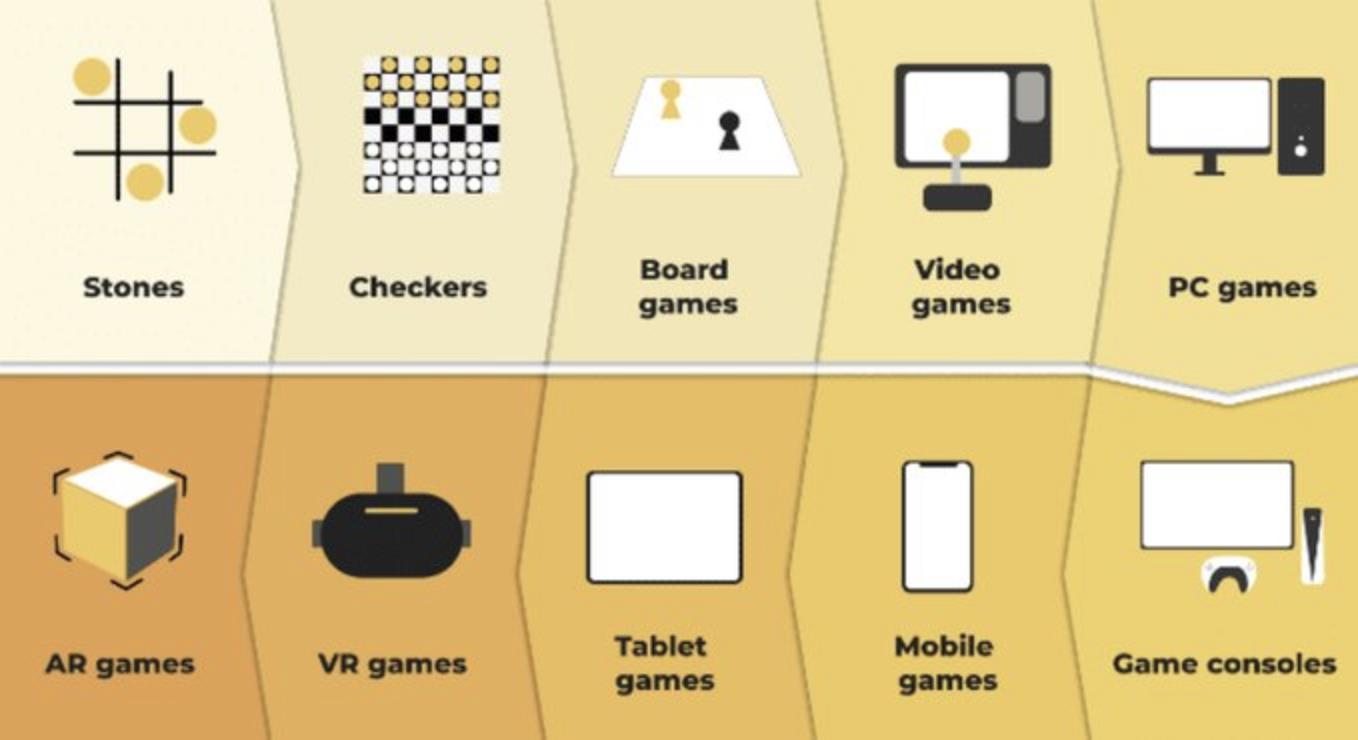
History of human gaming evolution
Another key feature of blockchain gaming is cross-platform compatibility. The interoperability of blockchain games allows seamless integration across PC, console, mobile, and blockchain platforms, enhancing accessibility and interaction. Thanks to blockchain technology, players can enjoy a unified experience across devices and ecosystems, breaking down traditional platform barriers. This cross-platform interoperability improves accessibility and delivers a richer, more cohesive gaming experience.
With continuous technological advancements—especially the integration of VR and AI—the potential of blockchain gaming continues to expand. AI-driven NPCs (non-player characters) deliver personalized experiences, making each player’s journey unique. Meanwhile, integrating VR into blockchain games provides immersive virtual reality experiences. Furthermore, in-game advertising offers developers monetization avenues while creating additional interactive opportunities for players. The convergence of these technologies heralds a future of deeper immersion and personalization, opening up new ways for exploration and engagement. Therefore, blockchain gaming is not just a current industry hotspot—it represents a critical direction for future gaming development. As the market matures and user acceptance grows, blockchain gaming is poised to become a key driver of progress across the entire gaming industry. Together, these innovations greatly enhance the appeal and longevity of blockchain games.
Success Through Tokens, Failure Through Tokens: How Can the Web3 Gaming Industry Overcome Its Challenges?
In the blockchain gaming industry, setting aside gameplay quality, it is often NFTs or native tokens that draw user attention. Yet, token economics remains a prominent challenge. The crux lies in the depreciation many crypto tokens suffer during market volatility—a result of unsustainable economic models, excessive token selling pressure, poor game quality, and bearish market conditions. This “inescapable curse” undermines both player and investor confidence and threatens the long-term health of the industry.
To overcome this, the industry must make comprehensive improvements in three key areas:
1. Product Quality: Companies must prioritize building high-quality games. This means delivering compelling graphics, engaging characters, rich narratives, and above all, ensuring the game itself is fun and entertaining. Players should be motivated primarily by enjoyment, not just financial incentives.
2. Community Engagement: Crypto gaming companies must actively listen to their communities. Players are not just users—they are essential to revenue and success. Developers should incorporate feedback about desired features, technologies, and storylines. Using blockchain-based voting systems can effectively integrate player input, enabling collaborative game development.
3. Tokenomics Design: Most critically, token economic models need to be redesigned for sustainability and stability. This includes implementing deflationary mechanisms, allocating in-game fees to protocol stakers, offering loyalty rewards, optimizing governance voting, prioritizing game quality in reward structures, and imposing holding limits on large token holders. These measures aim to create a fairer, more sustainable economic environment that strengthens token value and stabilizes markets.
In summary, by improving product quality, strengthening community involvement, and reforming token economics, the blockchain gaming industry can overcome current hurdles and achieve long-term, healthy growth. This would not only enhance player experiences but also bring more stable and sustainable development to the entire sector.
Helping Players Quickly Grasp Industry Trends: A Look at Web3 Gaming Data Platforms
Web3 gaming is advancing rapidly despite ongoing challenges. For users trying to evaluate a blockchain game project, the key criteria discussed above—product quality, community dynamics, and tokenomics—are excellent starting points. Today, users can leverage various tools and applications to better discover and analyze promising projects. Market analytics tools, community forums, and project evaluation platforms offer valuable insights, helping users make smarter investment decisions. These tools enable timely capture of market movements and help mitigate risks to protect assets. The following platforms provide direct channels for understanding Web3 projects:
Galxe: A Web3 Task Platform Where Users Earn NFT Credentials by Completing Tasks
Galxe, formerly Project Galaxy, is a standout Web3 task platform. Galxe stands out by distributing diverse Web3 project tasks to users, encouraging active on-chain participation and rewarding them with verifiable NFT credentials.
For users, tasks range from simple actions like following a project’s Twitter account, retweeting, liking posts, joining communities, to more specific interactions such as token swaps, staking, borrowing, and minting. These tasks not only offer reward-earning opportunities but also deepen user understanding and engagement with different projects.
For project teams, Galxe serves as a powerful channel to reach target audiences, especially crucial during early-stage development and feature promotion.
According to Galxe’s official website, the platform has attracted over 11 million unique users and supported the growth of more than 3,000 partners including Optimism, Polygon, and Arbitrum through its incentive programs. Users can search and filter tasks posted by blockchain gaming projects on Galxe’s site to earn airdrop rewards and gain exposure to new initiatives.
Galxe also launched Space, an application allowing users to create community spaces without prior approval, reinforcing its position as one of the largest Web3 task platforms. As of June 24, 2023, Galxe had collaborated with over 2,700 projects/communities, launched over 10,000 tasks, and amassed more than 11 million Galxe ID users. Projects can issue NFTs and grant minting rights to qualified users, leveraging platform data credentials for customized services. Users can easily browse available tasks, identify potential airdrops, join community events, and explore emerging projects.
Galxe also introduced a digital identity system called Galxe ID and On-Chain Achievement Tags (OAT). By analyzing on-chain data, Galxe assigns various behavioral tags to users. Each completed task generates a verifiable credential set exportable to third-party apps—for instance, for token distribution.
In essence, Galxe is more than just a Web3 gaming task platform—it’s an ecosystem fostering knowledge sharing, community engagement, and market discovery. With its growing user base and continuous feature enhancements, Galxe is well-positioned to become a leader in the Web3 gaming space. For average Web3 users, maximizing returns and identifying high-potential projects are key concerns. Galxe addresses these by offering abundant tasks and rewards, enabling better discovery and analysis of promising projects. It helps users build valuable on-chain activity records for informed investment decisions, while giving projects a robust channel to attract and engage potential users, accelerating development.
DeGame: Raised Over $10 Million, With 500K+ Registered Users and 1.8M+ Task Completions
Since its founding in 2021, DeGame has rapidly emerged as a major player in the Web3 gaming landscape. As of October 15, 2023, DeGame has attracted over 500,000 registered users, built over 2,000 communities within its community module, and recorded more than 1.8 million task completions—demonstrating its strong influence and appeal in the Web3 gaming community.
On May 30 this year, DeGame announced a second round of $6.5 million in funding led by Folius Ventures, Kenetic Capital, and A&T Capital, bringing its total disclosed funding to at least $10 million.
Functionally, DeGame offers a comprehensive and rich Web3 gaming discovery and participation experience. The platform lists 4,795 games, 77 blockchains, and 1,356 tokens—covering nearly all major projects and sectors in the Web3 gaming market. Users can easily access and participate in these projects via simple searches or clicks.
Features like Top Communities, Quests, Leaderboard, Gaming, and Events provide users with an intuitive and navigable interface. These modules showcase project communities, reward quests, rankings, app downloads, and online/offline events, enabling seamless switching and participation across multiple projects without needing to jump between platforms.
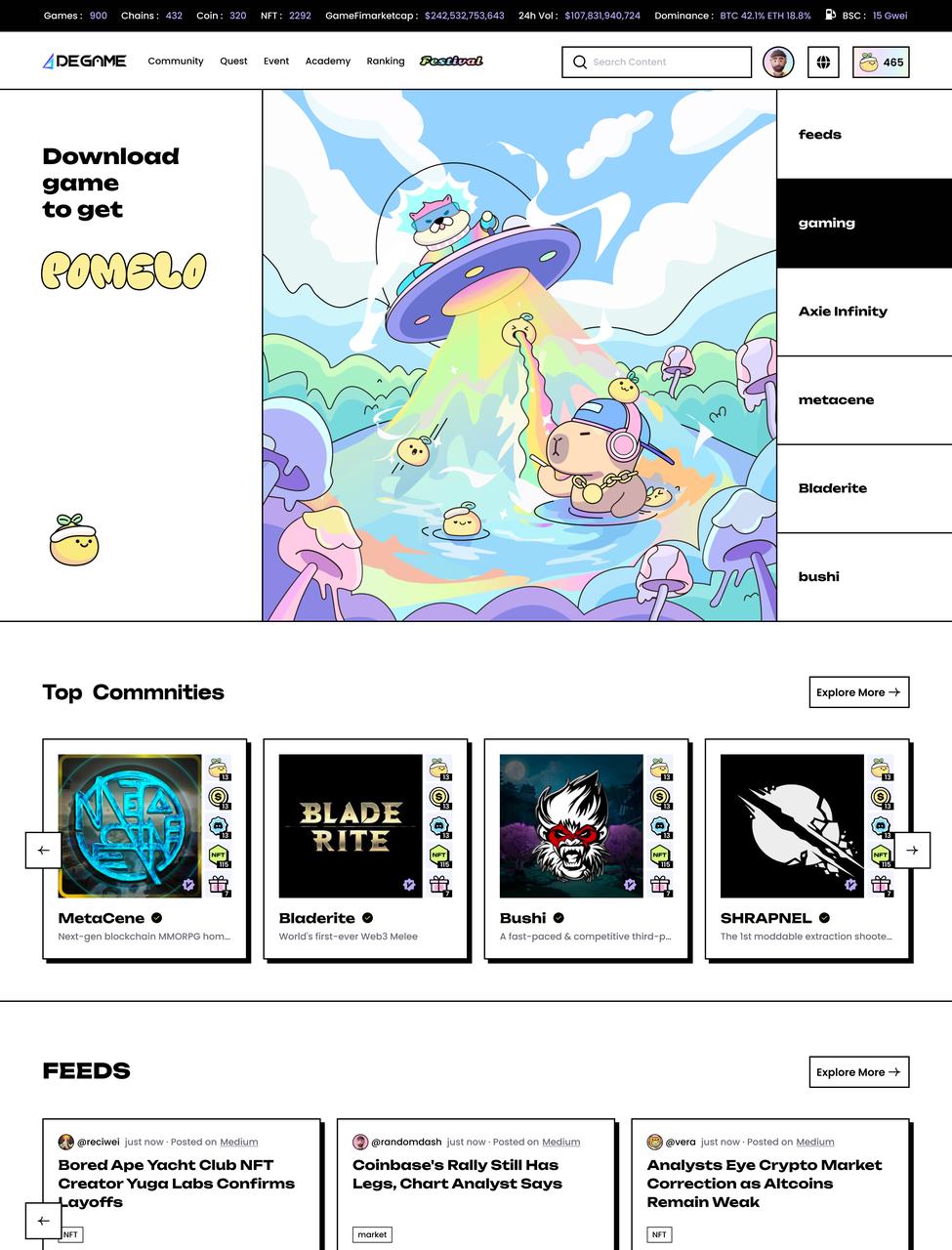
Official webpage screenshot of DeGame's new product
Additionally, DeGame’s Feeds and Academy features emphasize user-generated content (UGC). These allow professional Web3 creators worldwide to share news, insights, videos, and articles, helping users overcome knowledge gaps and information asymmetry. This open, collaborative content ecosystem enhances community interaction and provides a learning and growth platform for users.
In conclusion, DeGame is not merely a Web3 game aggregator—it is an ecosystem promoting knowledge sharing, community engagement, and market discovery. With expanding user adoption and continuous functional improvements, DeGame is poised to become a leading force in the Web3 gaming domain.
As previously noted, Web3 gaming evolves quickly amid associated challenges. Beyond gameplay, for ordinary Web3 users navigating this still-immature market, identifying high-quality projects and maximizing returns remain top priorities. To achieve this, users must rely on tools and applications to better discover and assess promising ventures—market analytics, community forums, and evaluation platforms all offer vital insights for smarter investment decisions. Such tools help users catch macro market trends and manage risks to safeguard assets.
Zealy: A Reward-Based Task Platform Helping Web3 Apps Scale Communities and Boost Engagement
Zealy (formerly Crew3) is a prominent Web3 application aggregation platform that rebranded in early April and successfully raised $3.5 million in pre-seed funding. Its primary goal is to help Web3 applications grow their communities and boost engagement by offering an integrated platform for digital assets, online/offline events, and reward-based tasks.
Zealy’s homepage curates projects across various Web3 verticals—startups, blockchain games, DeFi, infrastructure, NFTs, metaverse, and Web3 education—organizing communities into four main categories: New Communities, Featured Communities, Trending Communities, and Upcoming Communities. Users can easily find blockchain gaming projects on Zealy’s homepage or scout upcoming communities for promising new entrants.
Note that users must connect a MetaMask wallet and complete signature authorization to register on Zealy and unlock full functionality. Positioned as a community-focused platform, Zealy targets organic community growth. Modeled after Web3 Discord, it emphasizes high social interactivity. Within Zealy communities, various activity templates exist—including daily check-ins, content creation, and referral tasks. Compared to other platforms, Zealy offers clearer categorization and a robust points-based ranking system. Some tasks require writing, screenshots, or referrals, filtering out bots and ensuring authentic participation.
Tasks on Zealy are typically project-specific—following Twitter accounts, retweets, joining Discord servers, registering project accounts, answering questions—and serve mainly as marketing tools for projects to attract users. Hence, Zealy’s business model leans toward B2B, functioning as a traffic-oriented platform. By facilitating these tasks, Zealy supports project promotion while offering users reward opportunities, maintaining task diversity and authenticity.
QuestN: A Web3 Task Platform Serving Long-Tail B2B Clients
QuestN (formerly Quest3), incubated by Hogwarts Labs and a GRT14 grant recipient, is a Web3 task and campaign platform. Its distinguishing feature is serving long-tail B2B clients. Unlike mainstream credential platforms like RabbitHole or Galxe, QuestN imposes no entry barriers, allowing smaller B2B clients—such as KOLs, communities, and DAOs—to publish tasks. However, to ensure client quality, the platform requires binding of official websites and social media accounts. For tasks offering token rewards, clients must first deposit those tokens into a treasury for verification.
QuestN’s tasks include typical project-related activities—following Twitter, retweeting, joining Discord, registering accounts—with rewards in tokens, NFTs, or whitelist spots. These tasks primarily help projects market themselves and acquire new users, positioning QuestN as a B2B-focused, traffic-driven platform.
Overall, QuestN gives small B2B clients access to the Web3 task ecosystem, fostering inclusivity. This openness promotes broader ecosystem development while offering users diverse task and reward options.
RabbitHole: A Veteran Decentralized On-Chain Incentive Interaction Platform
RabbitHole is a veteran decentralized on-chain incentive platform. Its offerings fall into two categories: Skills, an educational platform for Web3 newcomers, and Quests, which function as ad campaigns.
Under Skills, RabbitHole offers four tracks: Layer2, DAO, DeFi, and NFT. Each includes fundamental Web3 on-chain operations with detailed tutorials. Upon completion, users receive a non-transferable "Intro to L2" NFT. These tasks are designed to onboard new users and teach basic Web3 interactions.
The second category, Quests, consists of tasks issued by individual projects requiring user interaction with specific protocols. Rewards include NFTs and sometimes project tokens. Notably, tasks offering token rewards usually require BrightID identity verification to prevent Sybil attacks (where one user pretends to be multiple).
Overall, RabbitHole offers thorough introductory education for Web3 on-chain operations, ideal for beginners. However, it partners with relatively few projects and focuses on end-users (C2C), classifying it as an educational initiative. Notably, RabbitHole secured an $18 million Series A round in February 2022 led by Greylock and TCG Crypto, underscoring its significance in Web3 education.
HyperPlay: Raised $12 Million, Achieving Full Interoperability for Web3 Games
HyperPlay is a Web3-native game launcher and store aggregator that automatically connects users’ assets, wallets, and NFTs to every Web3 game they play. The platform recently closed a $12 million funding round in June.
To use HyperPlay, users simply visit the website and click the "Store" button to access the Web3 game marketplace. There, they can browse games by category, select titles of interest, view details, and begin their Play-to-Earn journey.
One of HyperPlay’s strengths is achieving full interoperability across blockchain games. Users only need to link their wallet to the platform to seamlessly access multiple chain games. However, its weaknesses include a relatively limited number of listed Web3 games and insufficient detail on game pages.
Nonetheless, HyperPlay’s successful fundraising highlights its potential in the Web3 gaming space. By simplifying user access, it plays a constructive role in advancing the blockchain gaming ecosystem.
TaskOn: A Web3 Task Collaboration Platform Supporting Marketing and Operational Growth
TaskOn is a Web3 task collaboration platform focused on supporting marketing and operational growth for Web3 projects. Part of the Moonbeam ecosystem, TaskOn offers automation features to streamline processes.
Its API-Verified feature automatically confirms whether participants have completed required actions related to specific products, ensuring task integrity. Additionally, TaskOn enables automatic reward distribution immediately after event completion. Organizers simply create the campaign and deposit sufficient rewards—tokens or NFTs—into their TaskOn account. TaskOn can even create campaigns on behalf of organizers, further reducing administrative burden.
Compared to other Web3 task platforms, TaskOn stands out for its simplicity, ease of use, and rapid growth. It implements strong anti-bot measures, resulting in one of the highest genuine user rates—up to 92.9%—making it among the most trusted platforms.
Overall, TaskOn’s business model caters to B2B clients and operates as a traffic platform. It offers Web3 projects an effective way to drive marketing and growth, positioning itself to play a significant role in the Web3 ecosystem.
Join TechFlow official community to stay tuned
Telegram:https://t.me/TechFlowDaily
X (Twitter):https://x.com/TechFlowPost
X (Twitter) EN:https://x.com/BlockFlow_News