BTC Ecosystem Accelerator: Discussing the Investment Value of $STX from Stacks' Nakamoto Upgrade
TechFlow Selected TechFlow Selected
BTC Ecosystem Accelerator: Discussing the Investment Value of $STX from Stacks' Nakamoto Upgrade
The Nakamoto upgrade is Stacks' next major upgrade, expected in the first quarter of 2024.
 Navigating Web3 tides with focused insights
TL;DR
-
Stacks' long-term value depends on the growth of the Stacks ecosystem and demand for Clarity smart contracts. Currently, Stacks' ecosystem development is relatively slow, with low absolute numbers and growth rates of developers and actual users;
-
Key price drivers for Stacks include: halving narrative, being the only circulating token project among Bitcoin Layer 2 solutions, compliance narrative, upgrades, and sentiment premium driven by the booming Ordinals ecosystem;
-
The Nakamoto upgrade is Stacks’ next major upgrade, expected to launch in Q1 2024, and will be a potential key catalyst for $STX price movements. For Stacks, this upgrade means shared security with BTC, launching sBTC, supporting BTC atomic swaps, faster block production, support for multiple programming languages, and more.
-
The Nakamoto upgrade roadmap consists of three phases. The second phase is currently underway, with Nakamoto consensus live on testnet. sBTC v0.1 has been deployed as a smart contract and early testing in real-time environments has begun. Full rollout is expected in early next year. If progress remains smooth, market speculation around the upgrade could begin earlier than expected.
-
In summary, Stacks is currently a blockchain with technology but lacking commercialization capability, market热度, established ecosystem, or TVL—yet it possesses several high-potential speculative catalysts (upgrades, halving, compliance, status as one of the most prominent and influential BTC Layer 2 projects). It is best viewed as a BTC-related meme or high-leveraged beta play.
1. Characteristics of Stacks
Stacks is a Bitcoin smart contract layer aiming to enable trustless use of Bitcoin as an asset and settlement currency within smart contracts on the Bitcoin blockchain. Key features of Stacks include:
-
Stacks has its own chain, compiler, and programming language called Clarity. It runs in parallel with Bitcoin, essentially building a new chain outside the Bitcoin network, with independent governance and transaction models.
-
Rather than using cross-chain bridges, Stacks integrates with Bitcoin by submitting anchoring transactions to the Bitcoin mainchain. These anchoring transactions contain summaries of Stacks block headers and additional data, broadcasted to the Bitcoin network to ensure immutability.
-
Enables applications and smart contracts to use BTC as assets or currency, settling transactions directly on the Bitcoin mainchain.
-
Stacks uses the PoX (Proof of Transfer) consensus algorithm: miners and transaction validators are separate roles. Validators must stake STX tokens ("mining BTC"), while miners must lock BTC on the Bitcoin mainchain ("mining STX").
2. Project Value Analysis
Stacks’ long-term value hinges on ecosystem growth and demand for Clarity smart contracts because:
-
Higher transaction fees increase mining profitability, incentivizing miners to acquire STX for participation in consensus.
-
STX is designed to pay for transaction fees and smart contract execution. STX stackers stand to benefit from ecosystem growth.
-
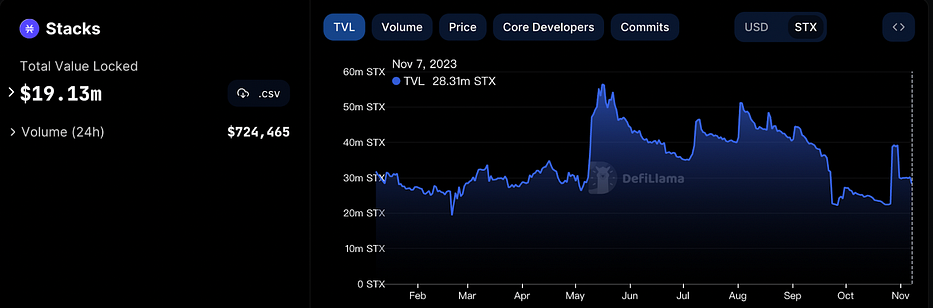
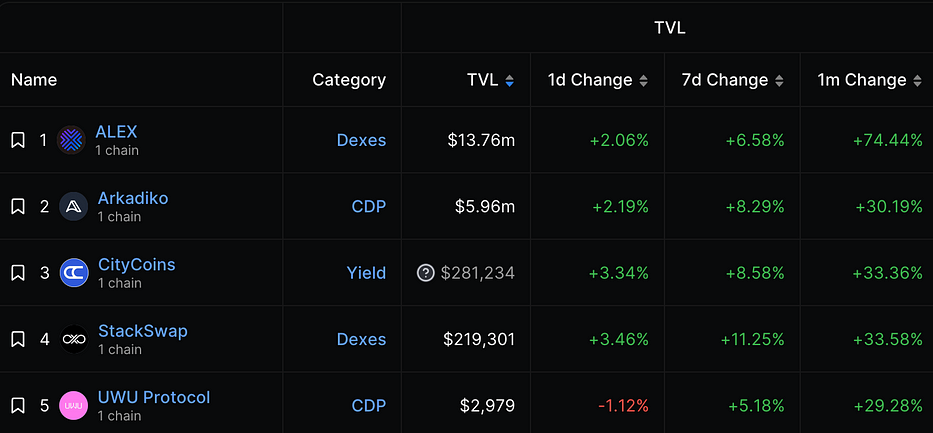
However, currently Stacks’ ecosystem development lags significantly, with almost no standout projects. Both developer count and active user base remain small and grow slowly.
-
TVL: $19.13M
-
Main reasons: high technical development barriers and low market热度.
Source: Defillama (https://defillama.com/)
Source: https://defillama.com/chain/Stacks
3. Stacks Development Timeline and Price Drivers
Key milestones in Stacks’ development history:
-
Stacks originated in 2013, founded by Muneeb Ali and Ryan Shea. It emerged from Muneeb Ali’s doctoral thesis outlining an internet framework built around the Bitcoin blockchain, initially named Blockstack.
-
Participated in Y Combinator batch in 2014, enabling initial research and development. Early funding came from Union Square Ventures, Naval Ravikant, SV Angel, Winklevoss Capital, and others.
-
Raised $47 million via token sale in 2017, followed by $23 million through SEC-qualified Reg A+ and Reg S offerings in 2019. Over 4,500 Stacks holders participated, including USV, Lux, DCG, Winklevoss Capital, Blockchain Capital, Foundation Capital, Hashkey, Fenbushi, etc.
-
Q4 2018: Mainnet launch
-
Q4 2018: Launched official wallet, Hiro Wallet
-
Q2 2019: Submitted application to SEC for $50 million compliant token offering
-
Q2 2019: Released Stacks 2.0 whitepaper
-
Q2 2019: Introduced Clarity smart contract development
-
Q3 2019: Became first SEC-compliant public token offering project
-
2020: Rebranded from Blockstack to Stacks
-
Q1 2020: Implemented Proof of Transfer (PoX) consensus mechanism
-
Q2 2020: Stacks 2.0 testnet launched
-
Q2 2020: Submitted development report to SEC
-
Q4 2020: After Stacks 2.0 launch, STX was no longer considered a security under U.S. law (SEC did not publicly confirm this view)
-
January 2021: Stacks 2.0 mainnet launched, compatible with Clarity smart contracts
-
Q2 2021: Launched Stacks Accelerator ecosystem program
-
Q2 2021: Announced Hyperchain scaling solution
-
Q4 2021: Conducted audit of Clarity smart contracts
-
Q2 2022: Released version 2.05.0.2.0
-
Q1 2023: Released Stacks 2.1
-
Q1 2023: Launched Hiro developer platform
-
Q4 2023: Major update - Nakamoto network release
-
Q4 2023: Major update - sBTC release
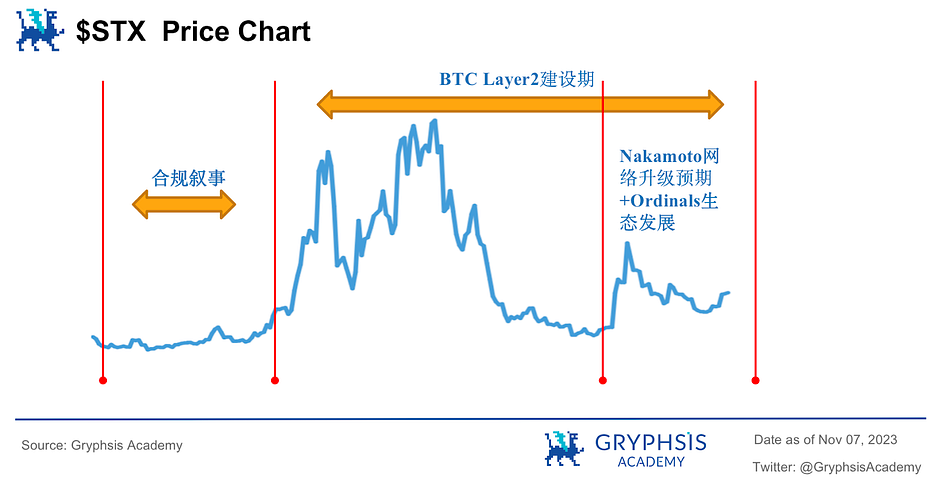
From Stacks’ development timeline, we can identify the following key price drivers:
-
Halving: With the BTC halving occurring in about a year, post-halving security concerns will bring more attention to Bitcoin L2s. The market is also seeking higher-volatility trading opportunities linked to the halving event.
-
Only circulating token project among BTC L2s: STX is currently the most mature BTC L2 and the only one with a circulating token, and its market cap remains relatively small compared to Ethereum L2s.
-
As network efficiency improves and block space becomes more valuable, miners’ BTC costs rise accordingly, increasing returns for STX stakers.
-
Compliance narrative: First SEC-compliant token offering
-
Upgrades
-
The booming Ordinals ecosystem brings capital inflows and sentiment premium to BTC L2s
4. Nakamoto Upgrade
The Nakamoto upgrade is Stacks’ next major milestone, expected in Q4 2023, and will serve as a significant potential catalyst for $STX price movement. Key implications of the Nakamoto upgrade for Stacks include:
(1) Shared security with BTC: Transactions settle on the Bitcoin network. This enhances transaction security and reliability, positioning Stacks as a true Layer 2 rather than a sidechain with independent state.
(2) Launch of sBTC: Introduction of a Bitcoin-pegged asset enabling cheaper and faster smart contract operations, allowing seamless transfer of BTC into and out of the Stacks L2. This supports the development of Bitcoin DeFi markets.
When converting BTC to sBTC: Send BTC to a multi-sig address and initiate a transaction on the Stacks network that triggers a smart contract to send BTC to the multi-sig address and mint an equivalent amount of sBTC on the Stacks network.
To convert sBTC back to BTC: Send a message to the smart contract and initiate another transaction on Stacks, triggering a contract to burn the corresponding sBTC and return BTC to the user.
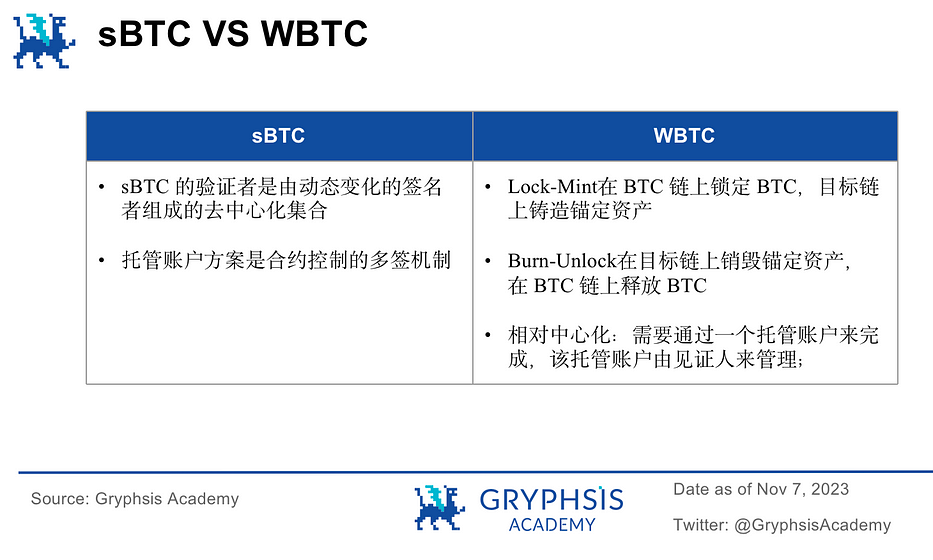
Comparison between sBTC and WBTC:
(3) Support for BTC atomic swaps: Bitcoin addresses can now own and move assets defined on the Stacks layer—such as STX, stablecoins, and NFTs—and transfer them via Bitcoin L1 transactions.
(4) Clarity language: Greatly improves security of on-chain smart contracts
(5) Bitcoin state reading: Enables full access to Bitcoin chain data, including transaction details and state changes, allowing smart contracts to be triggered by Bitcoin transactions. This ensures synchronization between Bitcoin L1 and L2 data.
(6) Faster block times: Current block time is 10 minutes; after upgrade, blocks will be produced every 4–5 seconds, breaking Bitcoin’s 10-minute constraint. Transaction hashes will still be written to Bitcoin during each Bitcoin block to maintain security.
(7) Customizable subnets supporting multiple programming languages: Scalability layers like subnets can make different trade-offs in performance and decentralization compared to the Stacks mainnet. Subnets can support other programming languages and execution environments (e.g., Ethereum's Solidity and EVM), enabling all Ethereum smart contracts to use Bitcoin-pegged assets and settle transactions on the Bitcoin chain.
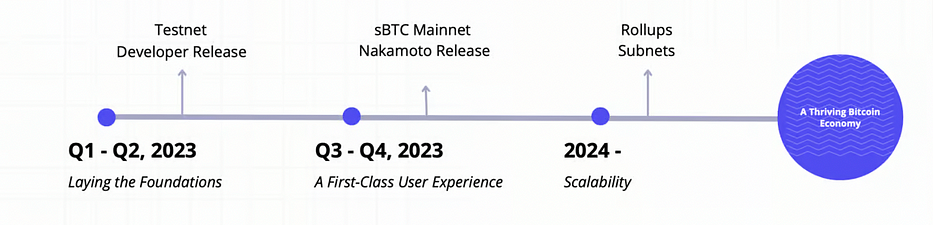
Nakamoto Upgrade Roadmap:
The rollout of sBTC, a centerpiece of this upgrade, is divided into three phases. The second phase is currently ongoing.
Source: https://www.stacks.co/explore/events
Test page:
Source: https://www.stacks.co/explore/events
Phase 1 laid the foundation, launching an MVP of sBTC on testnet and deploying developer versions to both mainnet and testnet, lasting six months. Phase 2 involves mainnet activation of sBTC and release of the Nakamoto network, expected to last six months. Phase 3 focuses on scalability and building an application ecosystem flywheel to expand the Bitcoin economy—this is a medium-to-long-term goal.
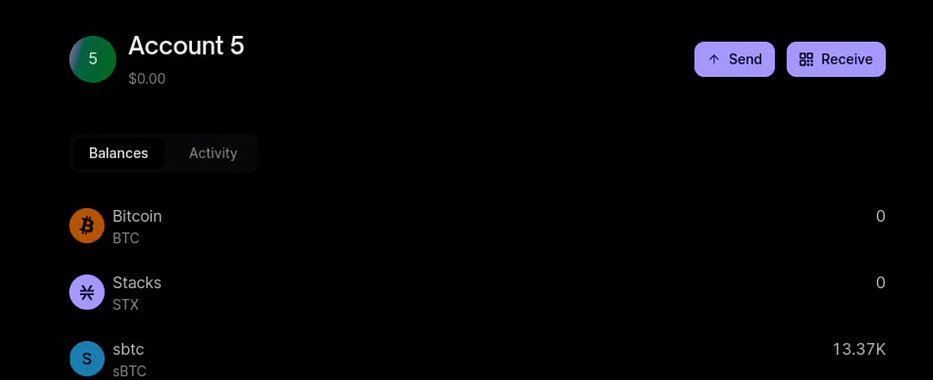
Currently, sBTC is live and undergoing early real-world testing. Full rollout is expected in early next year. If progress continues smoothly, market speculation around the Stacks upgrade may begin earlier than scheduled.
5. Conclusion:
First, evaluating the project itself:
-
Stacks is a long-standing project dating back to 2013, with significant recognition and influence within the BTC core community and Western crypto circles;
-
Technology: Possesses a unique tech stack with its own chain, compiler, and programming language, running in sync with Bitcoin. Effectively builds a new chain outside Bitcoin with independent governance and transaction model. Drawback: relatively high technical complexity;
-
Ecosystem development: 1) Significantly lagging—total TVL is $19M, mostly below $10M since inception; 2) Lacks flagship projects, with slow growth in developer count and active users; 3) Low commercial sensitivity—the boom of Ordinals and BRC-20 brought no tangible benefits to Stacks despite later expressions of interest; 4) Slow development pace across the entire ecosystem; 5) Future focus: Bitcoin DeFi, BTC NFTs, and other applications—but infrastructure development remains gradual.
Next, regarding $STX:
-
Moves in tandem with BTC, acting mostly as a beta to the broader market. Experienced a brief alpha period early this year due to anticipation of the upcoming Nakamoto upgrade;
-
Speculative catalysts: 1) Halving: With BTC halving ~one year away, post-halving security concerns will boost attention to BTC L2s, and traders seek higher-volatility, halving-linked opportunities; 2) Nakamoto network upgrade; 3) One of the few tokenized projects among BTC L2s and currently the most mature; 4) As network utilization increases and block space gains value, miner BTC costs rise, boosting returns for STX stakers; 5) Compliance narrative: First SEC-compliant token offering. In 2021 there was strong hype around compliance: became first SEC-compliant public offering in Q3 2019; in Q4 2020, STX was deemed non-security under U.S. law (SEC did not publicly endorse this, but tacitly allowed it). This narrative is less emphasized today.
Finally, regarding the Nakamoto upgrade:
-
What’s upgrading: 1) Enhanced performance and security for Stacks; 2) Launch of BTC-pegged asset sBTC; 3) Support for multiple programming languages—subnets can support other languages and execution environments (e.g., Ethereum’s Solidity and EVM), enabling all Ethereum smart contracts to use Bitcoin-pegged assets and settle on Bitcoin.
-
Roadmap: Nakamoto is now live on testnet. Full rollout expected in early next year. If progress stays on track, market speculation is likely to begin ahead of the official network upgrade (requires ongoing monitoring).
In conclusion, Stacks is currently a blockchain with technological foundation but lacking commercialization ability, market热度, ecosystem momentum, or meaningful TVL—yet it carries numerous high-potential speculative catalysts (upgrades, halving, compliance, status as one of the most seasoned, well-known, and influential BTC Layer 2 projects). It should be treated as a BTC-related meme or high-leveraged beta exposure.
Join TechFlow official community to stay tuned
Telegram:https://t.me/TechFlowDaily
X (Twitter):https://x.com/TechFlowPost
X (Twitter) EN:https://x.com/BlockFlow_News
 @gryphsisacademy