








TechFlow Deep Dive: xPet.Tech — A Paradigm of Web3 Pet-Raising Games Combining Gameplay and Social Features
TechFlow Selected TechFlow Selected
TechFlow Deep Dive: xPet.Tech — A Paradigm of Web3 Pet-Raising Games Combining Gameplay and Social Features
A blockchain-based mini-game with relatively high maturity.
 Navigating Web3 tides with focused insights
By Yue Xiaoyu

Pet-raising games once enjoyed popularity in the Web2 era—QQ Pet being a notable example. However, in the Web3 world, this genre is just getting started. Overlaying traditional gaming mechanics with a more open and liquid economic model can breathe new life into the concept.
Recently, a Web3 pet-raising game called xPet.Tech has emerged within the Twitter ecosystem, sparking significant interest. The product stands out for its relatively high maturity compared to similar projects, and its economic design is particularly intriguing. This article will provide a detailed analysis of this project.
01 Basic Overview
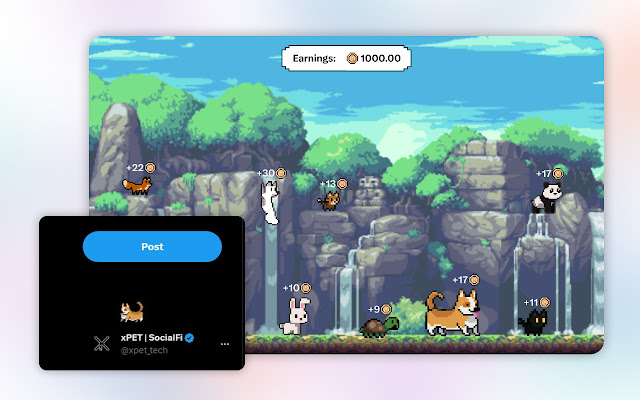
xPet.Tech is a small pet-raising game built on the Arbitrum chain, reminiscent of QQ Pet. Players raise pets to level them up, then put them to work earning tokens.
The typical user journey into the game is as follows:
-
xPet takes the form of a Google Chrome browser extension, so users must first download the plugin. (The lack of a standalone app or web version does limit accessibility for many potential users.)
-
After successfully installing the extension, users connect their Twitter account and enter an invitation code. (Both referrer and invitee receive rewards—a common social virality mechanism. While it restricts access for some, it also creates scarcity and drives interest among motivated users. Overall, benefits outweigh drawbacks.)
-
Based on the user's Twitter account, a wallet is automatically created. (This wallet-onboarding approach is becoming a trend—recent Web3 social and gaming apps adopt this method, eliminating the need for seed phrases or private keys, thus offering a seamless entry point for traditional internet users into blockchain.)
-
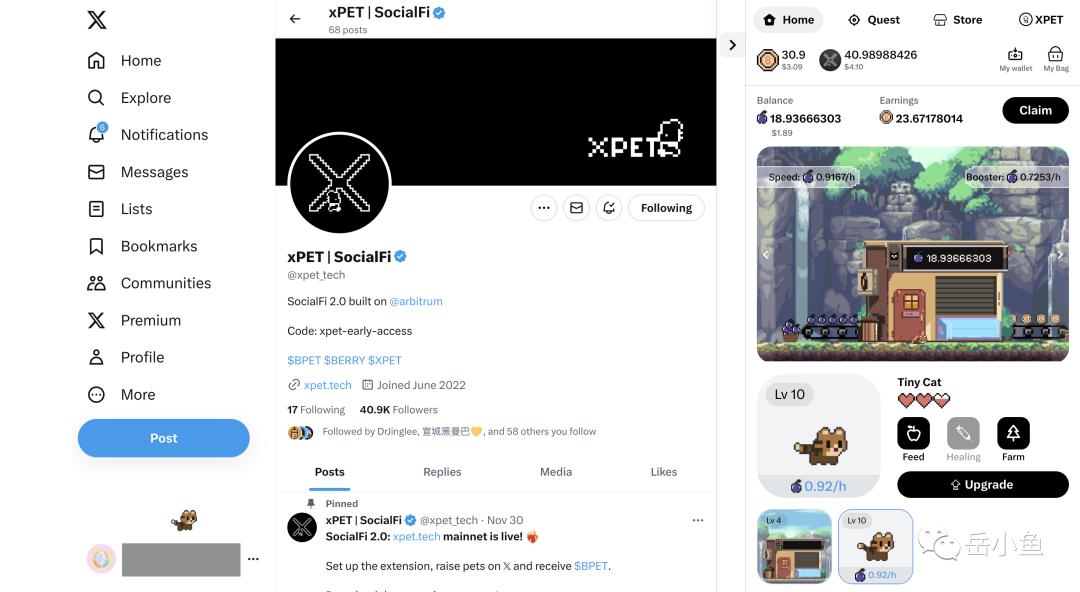
Upon entering the game, users receive a free pet. The main game interface is embedded directly within the Twitter page. (This integration makes sense—pet-raising games are ideal for idle time spent scrolling through feeds.)
From the onboarding process alone, it’s clear that the game is deeply integrated with the Twitter ecosystem—whether it's requiring a Twitter account and invite code for sign-up, or unlocking treasure boxes by interacting with tweets, all activities happen within Twitter.
Next, let’s examine the core gameplay mechanics.
-
Feeding pets: Pets begin generating income once they reach level 7. Higher-level pets yield faster returns on investment.
-
Unlocking treasure boxes: Users can browse the Twitter feed to find hidden treasure boxes. Replying “xpet” under a post containing a box unlocks it, rewarding tokens, food, and other items. (This indirectly promotes content virality and could be leveraged for partnerships or marketing collaborations—an additional revenue stream.)
-
There are two ways to level up pets: spending XPET tokens to upgrade, or purchasing level-7+ pets directly from the store using XPET. (Calculations show that buying higher-level pets outright is cheaper than upgrading from scratch, making direct purchase the more cost-effective option.)
-
The key requirement is XPET tokens. How do you get them? First, deposit ETH into your wallet, then use the lending system to stake ETH and borrow XPET. (The loan-to-value ratio is 85%—for example, staking $100 worth of ETH allows you to borrow $85 worth of XPET.)
-
With XPET, players can upgrade pets and factories. Higher-level pets produce more berries; higher-level factories convert berries into BPET faster—the game’s second token. (XPET and BPET are interchangeable in-game for upgrades.)
-
BPET can be converted back into XPET, which can then be used to repay loans and reclaim staked ETH. After breaking even, any surplus becomes pure profit—making this mechanism function similarly to yield farming.
Overall, raising pets serves as a gameplay layer. While it satisfies some emotional needs, the primary motivation is financial gain—this fundamental difference sets Web3 games apart from traditional ones.
02 Economic Model
For blockchain products, sustainability hinges on the economic model. Let’s take a closer look at xPet.Tech’s design.
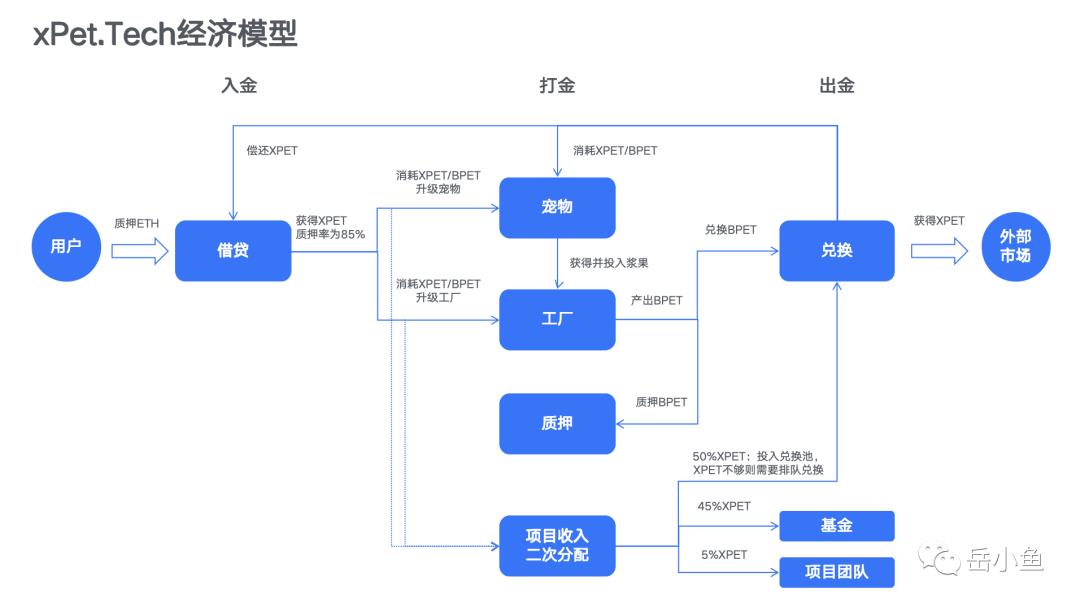
The economy consists of three subsystems: funding in, earning in-game, and cashing out.
Funding In
-
Users fund their accounts primarily via the lending system: staking ETH at an 85% loan-to-value ratio to borrow XPET tokens.
-
Initially, each XPET is fixed at $0.10. Once the XPET trading pool opens, the price floats, and the amount of borrowable XPET adjusts dynamically based on market value.
In-Game Earnings
-
Earnings come from pets and factories: pets generate berries (BERRY), which factories convert into BPET.
-
Higher-level and more numerous pets yield more berries; higher-level factories speed up conversion from berries to BPET. To maximize output, players should balance pet production and factory processing rates.
-
Upgrading pets and factories requires XPET or BPET.
-
Produced BPET can either continue to be reinvested in upgrades, exchanged for XPET, or staked to earn more BPET (staking feature not yet live—expected to reward longer lockup durations).
Cashing Out
-
Players can exchange BPET earned from pets and factories into XPET.
-
Two tokens exist: XPET and BPET. XPET has a fixed supply of 300 million, while BPET is inflationary—continuously minted through in-game activity. Therefore, it’s crucial to convert BPET into XPET as early as possible.
-
Given that XPET supply is fixed but BPET supply grows over time, how can there be enough XPET available for exchange? This is addressed through secondary allocation of project revenues.
-
Revenue redistribution flows in three directions: 5% to the team, 45% converted into BPET and returned to users via a fund, and most importantly, 50% allocated to the exchange system—which supplies the XPET available for BPET-to-XPET swaps.
-
Since the exchange pool depends on incoming user deposits, without new funding, withdrawals slow down significantly (current cap: 100 BPET per transaction, with multi-day queues). This prevents the classic DeFi "mine-sell-dump" cycle. The team has effectively closed the economic loop.
Overall, the controlled inflow, earning rate, and outflow mechanisms achieve initial game balance. However, as user numbers grow and token trading opens, system complexity increases. Whether balance can be maintained remains uncertain and heavily depends on the team’s operational skill.
Additionally, we observe the use of a classic three-token model: game token + governance token + NFT.
-
BPET is the in-game currency: has utility within gameplay;
-
XPET is the governance token: represents ownership and value of the project;
-
Pets are NFTs: represent commodity value, providing emotional attachment or tangible benefits.
Indeed, the three-token model has become a standard framework in GameFi (Game + Finance).
03 Comprehensive Analysis
Let’s review the game’s strengths:
-
Viral marketing: Leveraging the Twitter ecosystem via invite codes and treasure box mechanics created a viral effect, driving substantial traffic;
-
Strong product experience: Compared to contemporaries like FrenPet, xPet offers a smoother, more mature user experience;
-
Closed-loop economy: Adopts a classic DeFi liquidity mining model but adds withdrawal constraints via revenue recycling, creating a self-sustaining, closed system with reasonable longevity.
However, the game also has clear weaknesses: restricting withdrawals causes off-platform XPET prices to trade at a premium. Moreover, both users and the team have strong incentives to push the token price higher—to attract new players and increase perceived value. This shifts focus away from gameplay toward speculation.
Conversely, if XPET’s price becomes too high too early, it may deter new users, ultimately hindering growth.
One solution is to quickly launch the BPET trading pool. As users sell BPET en masse, demand for XPET would rise accordingly.
Introducing external factors can drastically impact a closed-loop system, so the team must carefully manage project pacing.
Now let’s consider the risks.
There are two main types: internal and external. Internally, the team lacks backing from reputable investors, raising concerns about rug-pull risks. Externally, since the entire game operates on Twitter, there’s a risk of platform enforcement actions—Twitter might ban such applications.
Both risks are largely uncontrollable, making large capital investments unwise.
In summary, xPet.Tech is a fascinating project. Its use of social virality, walletless onboarding, yield farming mechanics, and the three-token model exemplify standard patterns in the GameFi space—worth engaging with during early stages.
The project’s future will depend heavily on the team’s ability to manage growth—such as scaling user acquisition and timing asset listings—all of which will critically influence long-term success. We should continue monitoring its development.
Join TechFlow official community to stay tuned
Telegram:https://t.me/TechFlowDaily
X (Twitter):https://x.com/TechFlowPost
X (Twitter) EN:https://x.com/BlockFlow_News








