PoW New Token Overview: A Victory for Miners, Communities, and Mining Equipment Makers?
TechFlow Selected TechFlow Selected
PoW New Token Overview: A Victory for Miners, Communities, and Mining Equipment Makers?
This report briefly analyzes the reasons behind the rise of POW-based projects, reviews new POW projects with market capitalization exceeding 40 million, and examines current existing issues.
 Navigating Web3 tides with focused insights
Author: Duoduo, LD Capital
In September 2022, Ethereum transitioned from Proof-of-Work (PoW) to Proof-of-Stake (PoS), prompting the mining community to seek new PoW tokens and giving rise to several new PoW projects. After more than a year of development, in November 2023, the new PoW project Kaspa saw a significant price surge, surpassing a market cap of $3 billion and entering the top 30 cryptocurrencies by market capitalization. Driven by Kaspa's momentum, newer PoW tokens as a whole experienced strong price appreciation.
This report briefly analyzes the reasons behind the emergence of PoW-based projects, reviews new PoW projects with market caps exceeding $40 million, and discusses current challenges facing these projects.
1. Reasons for the Rise of New PoW Projects
First, Ethereum’s transition from PoW to PoS in September 2022 resulted in a large amount of idle mining power. This excess computational power began searching for new PoW projects. Kaspa launched during this period and quickly gained support from these miners. Some miners from older PoW tokens observed this trend and gradually redirected their hash power toward new PoW projects.
Second, there exists a segment of investors who favor the PoW model, believing it represents the true essence of blockchain technology. These individuals became early participants in PoW project communities, primarily based in Western communities, with many Twitter influencers actively involved in promoting early-stage PoW projects.
Third, new PoW projects typically have low market capitalizations, making them more accessible and appealing to newcomers entering the crypto market. New investors are more willing to invest in low-market-cap projects, anticipating future growth. In contrast, established PoW tokens like BCH and LTC have higher market caps and significant amounts of trapped capital. As for Ethereum-based projects, many were heavily backed by VCs prior to launch, resulting in high valuations—often hundreds of millions of dollars at listing—with long vesting periods and sustained selling pressure, discouraging new investor participation.
Fourth, these new projects incorporate narratives tied to emerging trends. Beyond claims of high performance and smart contract capabilities, most integrate concepts such as artificial intelligence (AI) and the Internet of Things (IoT), introducing the idea of "useful work" or "useful proof-of-work," which helps attract investment interest.
Fifth, Kaspa was initially driven by miners and grassroots communities. By February 2023, it had already gained notable attention within the PoW ecosystem. In March 2023, specialized mining hardware was released by manufacturers, significantly increasing mining efficiency and hash power. The entry of mining equipment manufacturers further boosted network security but also led to a temporary drop in KAS price due to increased supply. However, prices soon resumed an upward trajectory, eventually propelling Kaspa into the top 30 by market cap.
Kaspa’s success expanded the perceived market potential for new PoW tokens. Projects with even modest fundamentals saw solid gains in November.
2. Overview of New PoW Projects
New PoW projects typically start with market caps of just a few hundred thousand dollars. After initial community building, they often list on smaller exchanges such as Xeggex (commonly referred to by the community as “DanSuo” or “the Egg Exchange”). DanSuo hosts numerous PoW tokens with market caps ranging from hundreds of thousands to several million dollars, serving as a hunting ground for early adopters.
Once a PoW project reaches a market cap of $5–10 million, it may get listed on tier-two exchanges like MEXC or Gate.io. Listings on these platforms can boost market caps to between $10 million and $50 million. Achieving larger valuations requires broader financial backing and stronger fundamentals.
By market cap, KAS and TAO form the first tier, each exceeding $1 billion and ranking within the top 50 cryptocurrencies. The second tier—projects over $100 million—includes only one project: QUBIC. Notably, QUBIC has not yet been listed on any tier-two exchange, has very low actual trading volume, and its price may be artificially inflated. The third tier ranges from $10 million to $100 million. The bottom layer consists of numerous tokens under $10 million.
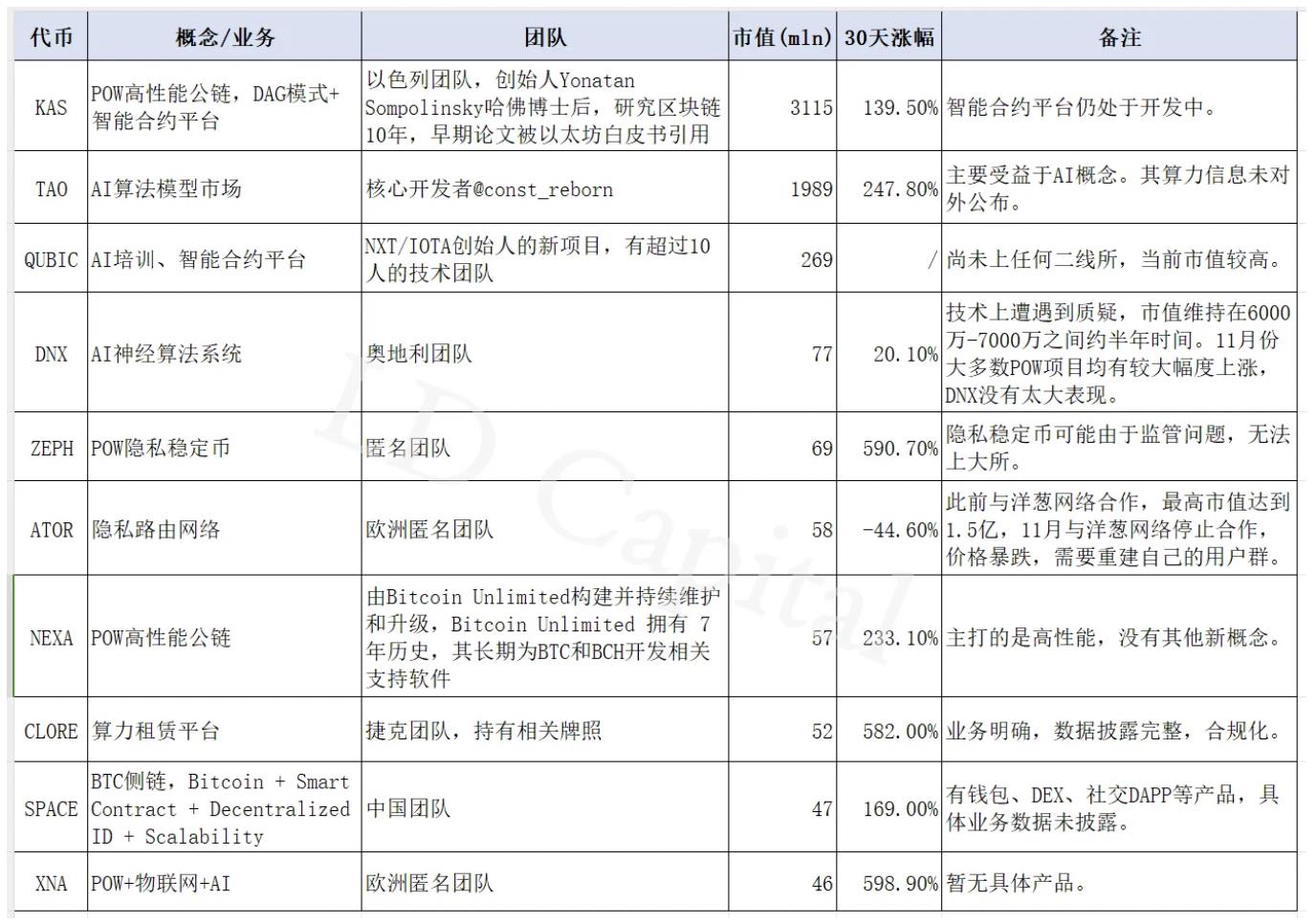
The table below provides a brief summary of PoW tokens with market caps exceeding $40 million.
3. Challenges Facing New PoW Projects
First, most of these projects function as Layer 1 blockchains and are still in early development stages. While they have established mining and token issuance frameworks, their ecosystems and real-world applications remain largely undeveloped. For example, Kaspa’s smart contract platform is still under development. ZEPH is intended as a stablecoin but currently lacks any practical use cases. ATOR is a privacy routing network, but after its partnership with the Tor network ended, it must rebuild its user base from scratch.
Second, early-stage PoW tokens with some fundamental value, now valued between $40 million and $100 million, have generally appreciated 5–10x. Short-term growth expectations have already been priced in, community funding has been partially exhausted, and these projects are now entering a consolidation phase. Tokens under $10 million in market cap mostly remain unlisted on tier-two exchanges, suffer from extremely low liquidity, and are highly susceptible to price manipulation, leading to sharp volatility.
Third, PoW tokens face ongoing token release schedules, with 30%–40% of total supply typically unlocked within the first two years. These tokens are often held by large miners; if major holders decide to sell, the resulting downward pressure could trigger significant price declines.
Fourth, projects that meaningfully integrate AI functionalities tend to attract more investor attention. Both TAO and CLORE combine PoW with AI narratives. TAO operates as a decentralized AI model marketplace where developers worldwide contribute machine learning models, allowing users to select and deploy suitable algorithms. Models that receive higher ratings and usage generate greater rewards for their creators. CLORE functions as an AI computing power leasing platform, equipped with nearly 6,000 mid-to-high-end NVIDIA GPUs available for rent for purposes including mining, rendering, and AI training. Contributors who provide high-performance hardware earn CLORE tokens as incentives.
4. Conclusion
Clearly, the resurgence of PoW-based projects results from a confluence of factors. Fundamentally, miners are seeking new outlets for their computational power, communities are drawn to low-market-cap projects with compelling narratives, and mining hardware manufacturers are looking to back projects with strong community traction. At the same time, the rise of AI has elevated computational power to the status of critical infrastructure in the data era. PoW projects, inherently built around distributed computing resources, naturally align with AI needs, enabling powerful narrative synergies.
However, the space remains crowded with mixed-quality projects. It is essential to conduct thorough research into each project’s narrative, business model, team, and community strength, evaluating both its long-term sustainability and potential to attract institutional or large-scale capital.
Join TechFlow official community to stay tuned
Telegram:https://t.me/TechFlowDaily
X (Twitter):https://x.com/TechFlowPost
X (Twitter) EN:https://x.com/BlockFlow_News
 Cycle Capital Research