








Arthur Hayes: The crypto bull market will arrive as dollar liquidity increases
TechFlow Selected TechFlow Selected
Arthur Hayes: The crypto bull market will arrive as dollar liquidity increases
This article provides an in-depth analysis of the latest developments in the cryptocurrency market and the key factors influencing its trends, including regulatory policies, technological innovations, and market participant behaviors.
 Navigating Web3 tides with focused insights
Author: Arthur Hayes
Translation: Kate, Mars Finance
Arthur Hayes, co-founder and former CEO of BitMEX, has published a new article titled "Bad Gurl," discussing U.S. Treasury Secretary Janet Yellen and how her policies could drive a Bitcoin bull market. In the article, Janet Yellen is referred to as the "Bad Gurl."
"Bad Gurl" symbolizes participants in trading and investing who employ unconventional, aggressive, or innovative methods, willing to take high risks and use radical strategies for profit. Their actions can significantly influence market trends and volatility, often triggering major market movements. A "Bad Gurl" may utilize various tactics, including rapid trading and speculative investments. Given current market fluctuations and certain patterns, a "Bad Gurl" can impact these trends, thereby reinforcing and stabilizing market conditions.
With the rapid development of the cryptocurrency market, investors and market observers are increasingly focused on financial dynamics within this sector. In this article, Arthur Hayes provides an in-depth analysis of the latest developments in the crypto market and key factors influencing its trajectory, including regulatory policies, technological innovation, and market participant behavior. Additionally, the article highlights the risks and challenges inherent in the cryptocurrency market.
While cryptocurrencies offer investors new opportunities, their volatility and uncertainty also expose investors to significant risks. Therefore, before entering the crypto market, investors need to fully understand market conditions, develop appropriate investment strategies, and monitor changes in policy regulation.
Arthur Hayes offers readers a comprehensive financial analysis of the cryptocurrency market, helping people better understand the latest developments and trends in this field.
Bad girl, sad girl, you’re such a dirty bad girl
Beep beep, uh-huh
You bad girl, you sad girl, you’re such a dirty bad girl
Beep beep, uh-huh
– Donna Summer
The world's worst woman might be the second most powerful figure under Pax Americana, resembling a disheveled dwarf. She no longer dances—perhaps never again—but she makes money move. I’m talking about U.S. Treasury Secretary Janet Yellen.
Bad girl Yellen can unilaterally exclude individuals, corporations, and/or entire nations from the global dollar financial system if she chooses. Since possessing dollars is essential for most people to purchase primary energy (oil and natural gas) and food, removal from the Pax Americana financial system amounts to a death sentence. She calls it sanctions; others call it capital punishment.
From a financial perspective, she oversees the rules governing how the dirty fiat financial system operates. Because credit drives the world, and that credit originates from banks and other financial institutions, her decisions significantly impact the global economic structure.
Her most critical responsibility is ensuring funding for the U.S. government. When government spending exceeds tax revenues, she must issue debt prudently. Given the massive scale of recent U.S. budget deficits, her role becomes even more crucial.
But not all is well in bad girl Yellen’s world. Her baby daddy, President Slow Joe, is behind on child support. Unlike a typical deadbeat dad who squanders his paycheck on booze and strip clubs, Slow Joe is addicted to spending—blowing up distant countries chasing… who knows what. He has never met a conflict the imperial war machine shouldn’t back. A proxy war in Ukraine against “evil” dictator Putin and the world’s largest commodities exporter? Hell yeah! Supporting Bombardier Bibi Netanyahu’s campaign to flatten Gaza, permanently displace millions, and kill tens of thousands of Palestinians—even if it risks war with Persia? America!
Boss lady Yellen publicly supports her boss, but privately she’s busy ensuring the empire can issue bonds at affordable rates to feed the kids. Who are the kids? Baby boomers growing old, sick, and needing ever-increasing healthcare and other benefits. The military-industrial complex requires an ever-expanding defense budget to produce more bullets and bombs. Interest must be paid to wealthy savers to fulfill promises to debt holders.
Yellen may be a bad woman, but the market isn’t buying it. Long-term Treasuries (maturity >10 years) are seeing faster yield increases than short-term Treasuries (maturity <2 years). This creates a fatal problem for the financial system known as “bear steepening.” As I wrote in my previous article, The Periphery, this is extremely harmful to the banking system.
What must she do to help her baby daddy—the little daddy who needs to return to the welfare office in November 2024 to reapply for benefits? She needs to design a solution that buys time for the economy. So here is bad girl Yellen’s to-do list:
- Inject liquidity into the system to push up equities. When stocks rise, capital gains taxes increase, helping pay some bills.
- Trick the market into believing the Fed will cut rates, thus relieving selling pressure on non-"Too Big To Fail" (TBTF) bank stocks, which are all insolvent.
- Mislead the market into thinking the Fed will cut rates, thereby creating demand for long-term debt.
- Ensure the injected liquidity isn't so large that it causes oil prices to spike due to a weakening dollar.
The Federal Reserve held rates steady in its recent meeting and signaled further pauses in rate hikes while continuing to assess the impact of prior tightening. Meanwhile, Yellen announced the Treasury will increase issuance of short-term bills—exactly what money market funds (MMFs) want. MMFs will continue withdrawing funds from the Fed’s Reverse Repo Program (RRP) to buy Treasuries, effectively injecting net liquidity into markets.
The remainder of this article focuses on explaining why I believe these policies will lead to the following outcomes:
1. Net injection of $1 trillion in liquidity into global financial markets—equivalent to the current size of RRP.
(A) This liquidity injection will boost U.S. equities, cryptocurrencies, gold, and other fixed-supply financial assets.
(B) All other major central banks—including the People's Bank of China (PBOC), Bank of Japan (BOJ), and European Central Bank (ECB)—will also print money, since U.S. monetary easing allows them to expand without weakening their own currencies.
2. Markets expect the U.S. Treasury yield curve to undergo bull steepening.
(A) This will prevent market selloffs across all non-TBTF bank stocks.
3. Once RRP is depleted by end of 2024, the U.S. Treasury market crisis will reappear.
Ducks and Cowards
Fed Chair Powell is a duck, and his wife is bad girl Yellen. You might think “duck” denotes low status, but in Hong Kong, ducks live pampered, affluent lives. Many say Powell is a millionaire. But no amount of money changes the fact that he’s at best Yellen’s towel boy.
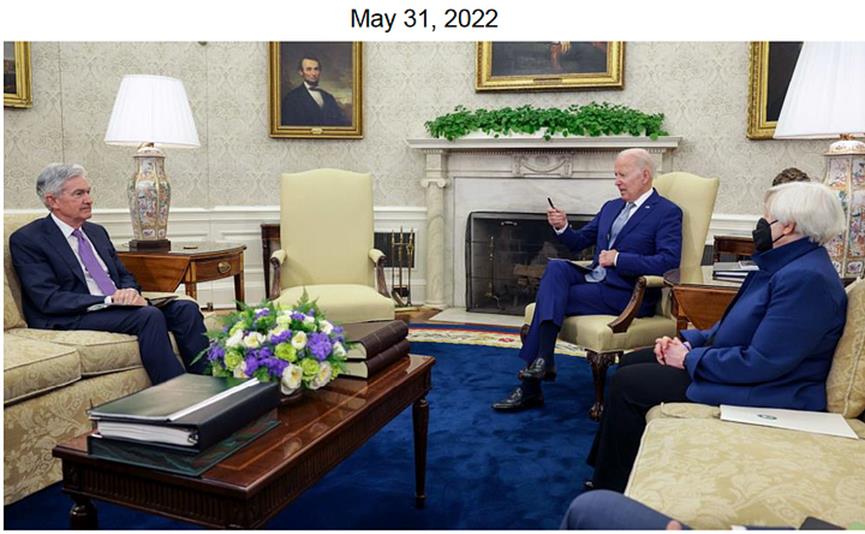
This is one of the most important images for understanding power dynamics at the top of the empire. Slow Joe and Yellen instruct “Duck Powell” to fight inflation at all costs.
The problem with raising interest rates to levels restrictive enough to choke the economy is that it destroys the banking system. Thus, the Fed plays a game—pretending to fight inflation while constantly seeking excuses to justify pausing its monetary tightening. Their easiest (and least honest) method is fabricating misleading inflation data.
Government-reported inflation figures are nonsense. It serves government interests to downplay inflation and convince the public their eyes deceive them at checkout counters. The price shock you feel when buying bread is dismissed as unreliable because officials tell you inflation doesn’t exist. To achieve this, bureaucrats create representative baskets of goods that minimize the weight of food and energy price increases. Misleading inflation metrics are then calculated based on price changes within these manipulated baskets.
The Fed dislikes high Consumer Price Index (CPI) numbers—which include bread for bellies and gasoline for tanks—so they perform fancy calculations. Miraculously, this gives birth to core CPI, or what they prefer to call “core inflation.” Core CPI excludes food and energy. But even core CPI is too high, so the Fed asks staff to strip out “transitory” components to arrive at a better (i.e., lower) inflation measure. After more magical math, they invent the trimmed mean core index.
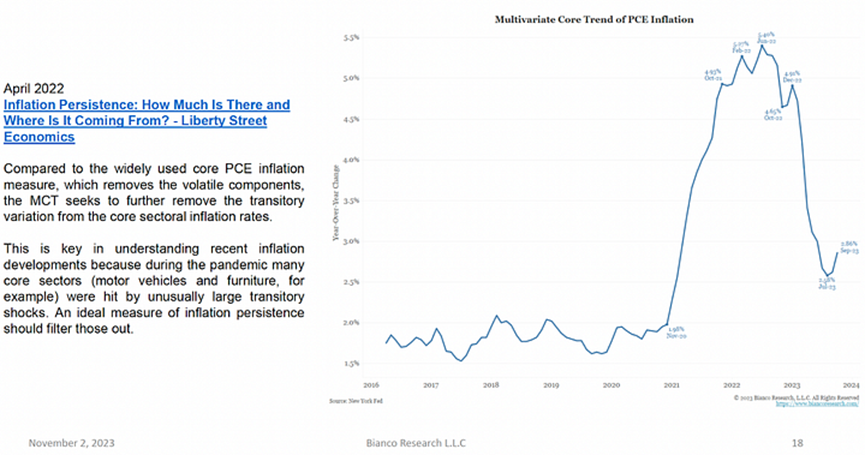
The problem is all these manipulated inflation indicators remain above the Fed’s 2% target. Worse, they appear to have bottomed. If the Fed were truly fighting inflation, they should keep hiking until their fuzzy metrics hit 2%. Yet suddenly, Powell said at his September press conference that the Fed would pause hikes to assess the effects of prior tightening.
My suspicion is Powell received a nudge from Yellen, instructed that Mommy wants him to pause again and signal to markets that the Fed will hold rates steady until further notice. This clever policy response aligns with my thinking.
Markets are willing to believe recession will arrive next year. Recession implies the Fed must cut rates to avoid dreaded deflation—falling prices caused by declining economic activity. Deflation harms the dirty fiat system because asset values backing debt (collateral) shrink, hurting creditors (banks and the rich). Hence, the Fed cuts rates.
As I explained in my last piece, weaker economic forecasts cause markets to buy long-dated U.S. Treasuries en masse. Combined with broad rate declines driven by Fed policy, this means long-term debt holders profit. The result? Bear steepening halts, the curve steepens in inversion, and eventually, when recession hits in 2024, the curve experiences bull steepening. The Fed achieved all this simply by pausing twice—in September and November—and offering a dovish forward outlook. A win for Powell and Yellen: positive market reaction without actual rate cuts.
I’ll illustrate this process using several simple charts. Longer arrows indicate larger magnitudes.
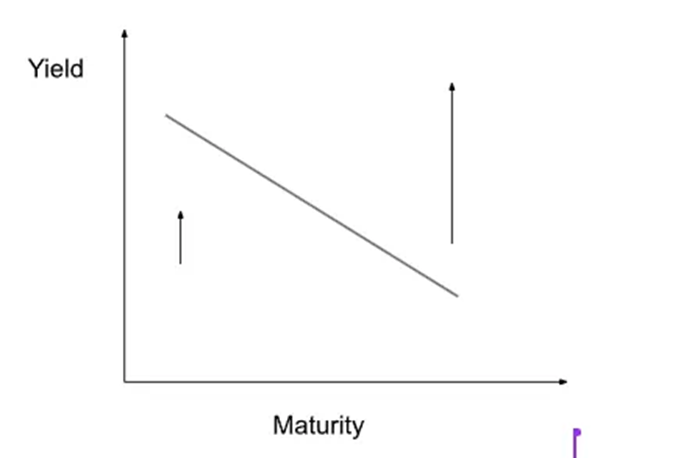
Figure 1: Bear steepening curve. The curve inverts, overall yields rise, and long-term rates climb faster than short-term rates.
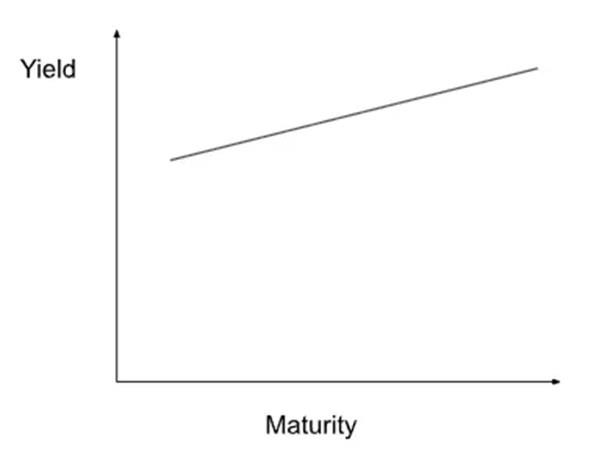
Figure 2: Final yield curve. As bear steepening intensifies, higher rates produce a positively sloped yield curve.
For bondholders and the banking system, this could be the worst outcome. Bad girl Yellen must do everything possible to prevent it.
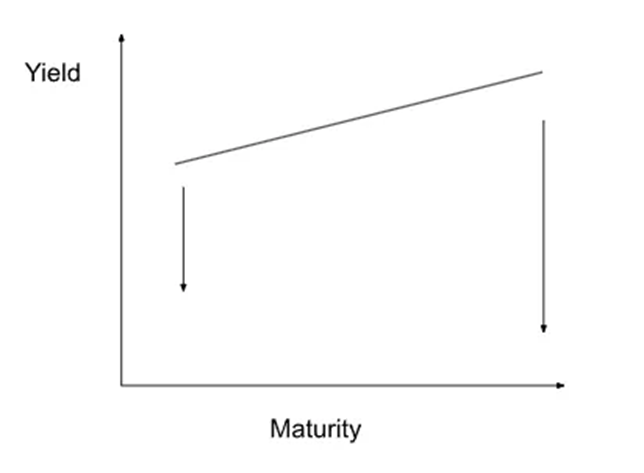
Figure 3: If Yellen’s strategy succeeds, markets buy more long-term bonds than short-term ones, causing the curve to re-invert.
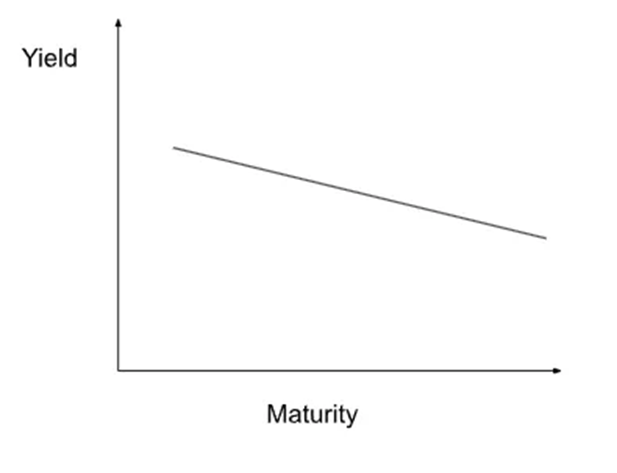
Figure 4: Final yield curve. The curve inverts again—an unnatural state. Market expectations of recession explain why long-end yields fall below short-end yields.
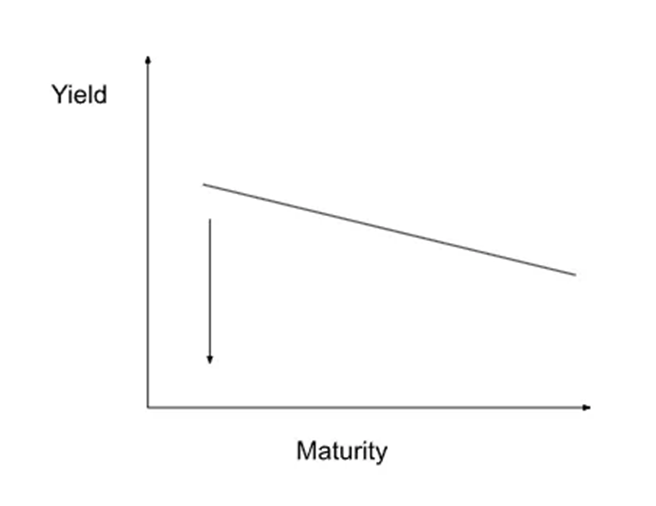
Figure 5: Recession arrives—or some TradFi firm collapses—and the Fed cuts rates, lowering short-term yields while long-term yields hold steady. This steepens the curve.
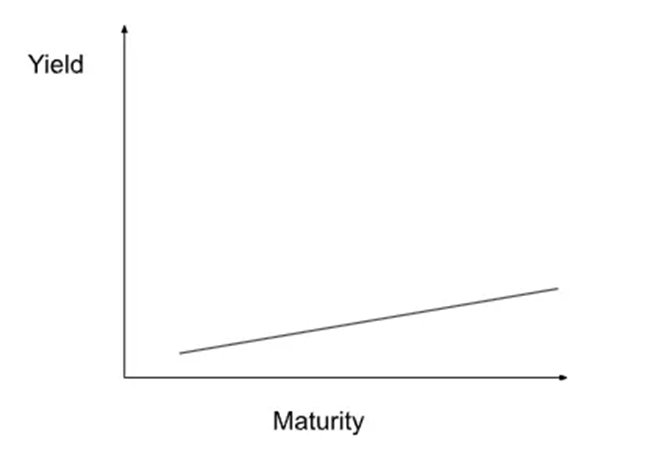
Figure 6: Final yield curve. After all these phase shifts, the curve becomes steeper. It slopes positively—a natural state—with lower overall interest rates. This represents the best possible outcome for bondholders and the banking system.
Banks Saved
The direct effect of renewed yield curve inversion and eventual bull steepening is reduced unrealized losses on banks’ balance sheets for held-to-maturity (HTM) U.S. Treasuries.
Bank of America (BAC) reported $132 billion in unrealized losses in its HTM portfolio during Q3 2023. BAC has $194 billion in common equity Tier 1 capital and $1.632 trillion in total risk-weighted assets (RWA). Recalculating BAC’s capital adequacy ratio (equity / RWA) by subtracting unrealized losses from equity brings it down to 3.8%, far below regulatory minimums. If these losses were realized, BAC would enter receivership like Silicon Valley Bank, Signature Bank, First Republic, etc. The higher long-term Treasury yields climb, the wider the gap. Clearly, this cannot happen. One rule for them, another for us.
The banking system is suffocating under all the government debt accumulated at record-high prices and record-low yields between 2020–2022. Designated TBTF, BAC is effectively a nationalized bank. But the rest of the non-TBTF U.S. banking system is already insolvent due to unrealized losses on Treasuries and commercial real estate loans.
If Yellen devises a policy that pushes bond prices up and yields down, there’s no reason for bank stockholders to sell. This foreshadows an inevitable future: the entire U.S. banking system’s balance sheet moving onto the U.S. Treasury’s books. That would be extremely damaging to U.S. government credibility, as it would require printing money to ensure banks meet deposit withdrawals. Under those circumstances, no one would want to buy long-term U.S. Treasuries.
Any Consequences?
The challenge is that if the Fed cuts rates, the dollar could depreciate sharply. This would exert strong upward pressure on oil prices, which are denominated in dollars. While mainstream financial media and intellectually bankrupt cheerleaders like Paul Krugman try to fool the public into believing inflation doesn’t exist, any seasoned politician knows you’re finished if gas prices soar on election day. That’s why rate cuts at this juncture—when the Middle East teeters on war—are political suicide. By next election day, oil prices could easily approach $200.
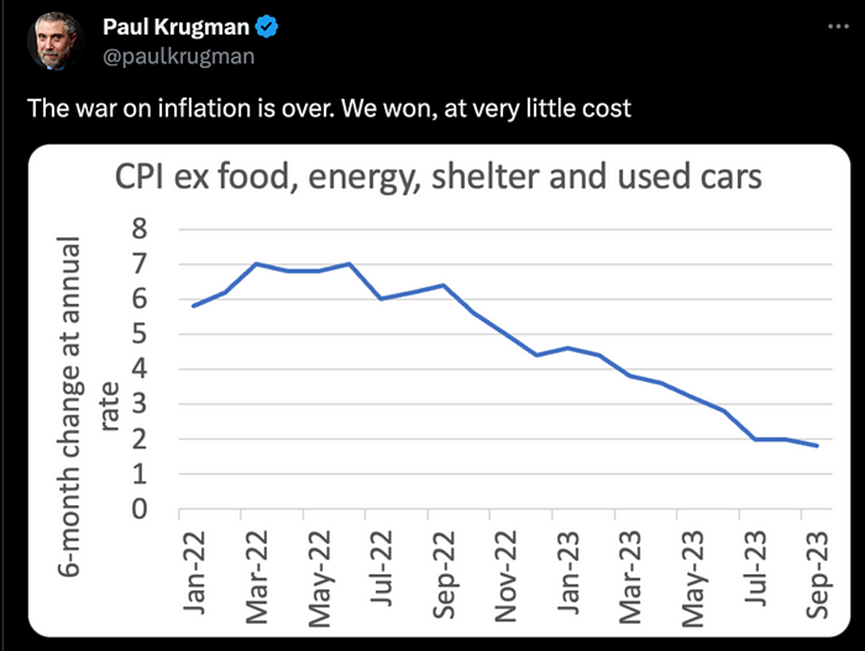
Of course, inflation doesn’t exist—if you exclude everything people need to live and earn a living. What a damn puppet.
But what if inflation has bottomed, and the Fed pauses hikes while inflation accelerates? That’s a possible outcome, but I believe any discontent from rising inflation will be drowned out by strong U.S. economic performance.
Strong Economy
I don’t believe a recession will occur in 2024. To understand why, let’s return to first principles driving GDP growth.
GDP Growth = Private Sector Spending (net exports, investment included) + Government Net Spending
Government Net Spending = Government Expenditure – Tax Revenue
When the government runs a deficit, it drives net positive GDP growth. Conceptually, this makes sense—government spends on goods, pays employees. However, taxation pulls resources out of the economy. So if government spending exceeds tax revenue, it delivers net stimulus.
If the government runs massive deficits, nominal GDP will grow unless the private sector contracts by an equivalent amount. Government spending—and indeed any spending—has a multiplier effect. Let’s take an example Slow Joe gave the American public in a recent speech, illustrating various conflicts the empire engages in.
The U.S. government increases defense spending. Many Americans will manufacture bullets and bombs to kill terrorists—and many more civilians—at the empire’s periphery. I have no objection as long as each terrorist killed results in fewer than ten civilian deaths. That’s a “fair” ratio. Those Americans will spend their hard-earned money in their communities. Office buildings, restaurants, bars—all built for workers in the defense industry. This is the multiplier effect of government spending, stimulating private-sector activity.
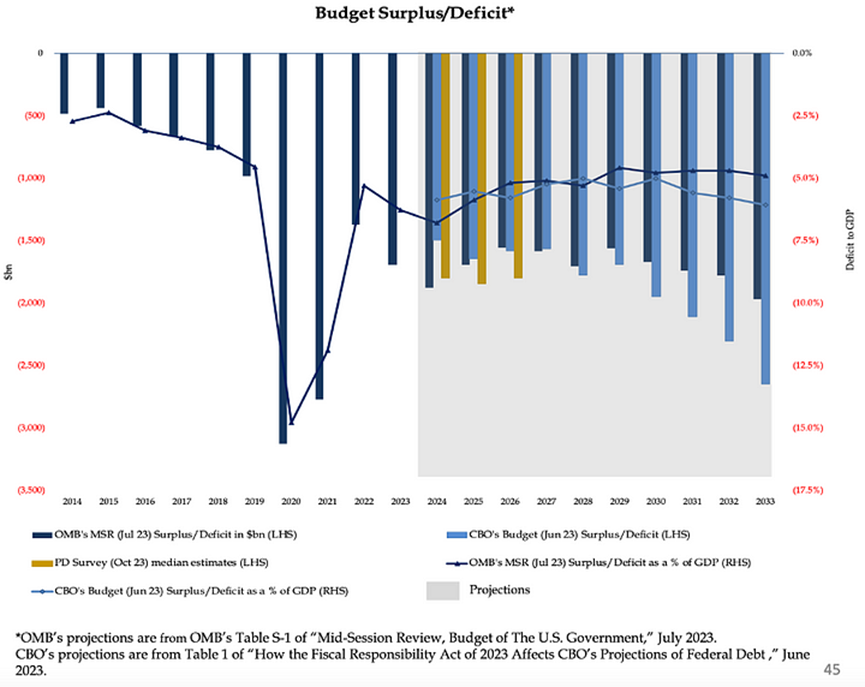
Given this, it’s hard to imagine the private sector contracting enough to offset the government’s net contribution to GDP growth. In the latest Q3 2023 data dump, U.S. nominal GDP grew 6.3%, with an annual deficit nearing 8%. If CPI inflation is below 6.3%, everyone wins because real GDP growth is positive. Why would voters be upset? With CPI inflation in the 3s, in voters’ minds, inflation won’t surpass economic growth for many quarters.
Deficits in 2024 are expected between 7% and 10%. Fueled by profligate government spending, the U.S. economy will perform well. Thus, the median voter will be quite satisfied with rising stocks, strong economy, and subdued inflation.
Short-Term Bills
Yellen isn’t omnipotent. If she shoves trillions in debt onto the market, bond prices will fall and yields will rise. This would destroy any benefit the financial system gained from the Fed pausing hikes. Yellen needs to find a pool of money eager to buy massive debt without demanding higher yields.
MMFs currently hold around $1 trillion in the Fed’s RRP. This means MMFs earn close to the lower bound of the federal funds rate—5.25%. Three- and six-month T-bills yield about 5.6%. MMFs park cash at the Fed due to low credit risk and overnight access. They won’t sacrifice much yield for safety. But if Yellen offers slightly higher-yielding Treasuries, MMFs will shift funds from low-yield RRP deposits to higher-yield bills.
In the latest quarterly refunding statement, Yellen pledged to increase bill issuance. Some argue that without the $2 trillion RRP, long-Treasury selloffs would’ve been worse. Recall that in early June, after U.S. politicians “shockingly” agreed to raise the debt ceiling allowing more spending, Yellen restarted borrowing. At that time, RRP stood at $2.1 trillion. Since then, Yellen has sold record volumes of bills, cutting RRP in half.
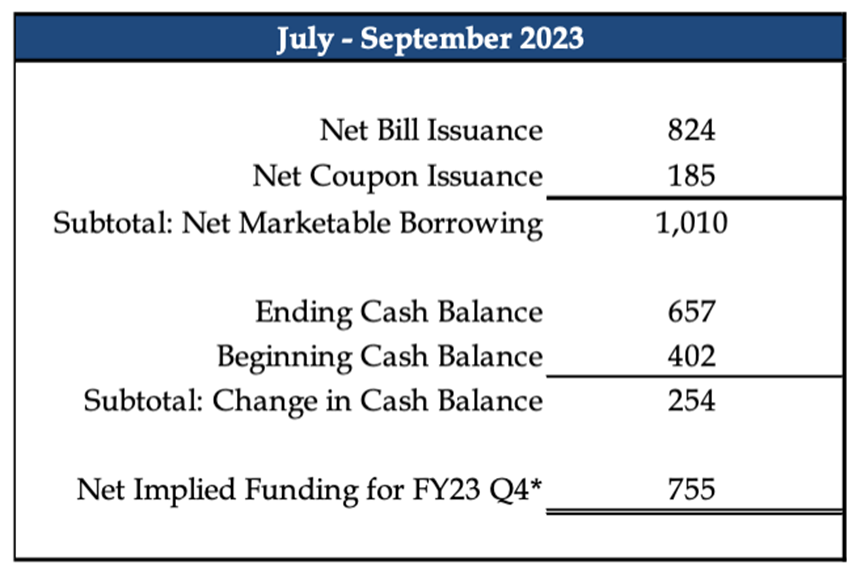
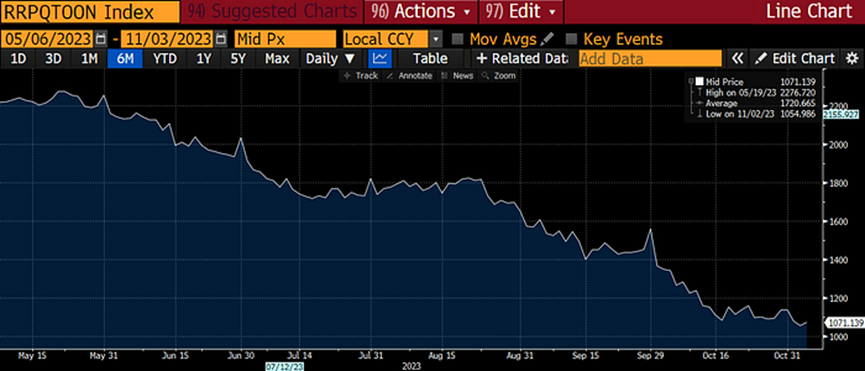
Yellen issued $824 billion in bills while RRP dropped $1 trillion. Success!
Refer to my article on dollar liquidity, “Teach Me Daddy,” to fully understand why falling RRP balances mean rising dollar liquidity. Note: if Yellen increases the Treasury General Account (TGA), it offsets the positive liquidity impact of declining RRP. TGA currently stands at ~$820 billion, above the $750 billion target. So I don’t expect TGA to rise from here—rather, it may stay flat or decline.
As RRP depletes, $1 trillion in liquidity will flood global financial markets. It may take six months to fully drain the facility. This estimate is based on the pace of RRP decline from $2 trillion to $1 trillion and projected bill issuance speed.
Before proceeding to how this money flows into crypto, let me briefly cover how other central banks may respond.
Weak Dollar
When more dollars circulate in the system, the dollar’s price relative to other currencies should fall. This is good news for Japan, China, and Europe. These nations face fiscal problems—different forms, but ultimately requiring money printing to prop up parts of their financial systems and government bond markets. However, not all central banks are created equal. Because the PBOC, BOJ, and ECB don’t issue global reserve currencies, their ability to print is limited by how much their currencies can depreciate against the dollar. All these central banks have long hoped and prayed for the Fed to ease policy so they too can loosen.
Now they can relax monetary policy because the Fed’s moves will dominate due to the sheer scale involved. Relatively speaking, any money printing by the PBOC, BOJ, or ECB will have less impact than the Fed’s actions. When converted, the renminbi (China), yen (Japan), and euro (Europe) will strengthen against the dollar. They can print money, rescue their banking systems, support their government bond markets. Finally, dollar-denominated energy imports become cheaper. This contrasts sharply with recent times, when printing led to currency depreciation against the dollar, increasing dollar-priced energy import costs.
The result? Alongside massive dollar liquidity injections, corresponding infusions of renminbi, yen, and euros will follow. From now through H1 2024, the total supply of fiat credit globally will accelerate.
Dumb and Smart Trades
Given abundant fiat liquidity in global markets, what should one buy to outpace currency debasement?
First, the dumbest thing one can do is buy long-term bonds with a buy-and-hold mindset. As long as RRP > 0, this favorable liquidity condition persists. When RRP = 0, all long-bond problems resurface. The last thing you want is to be stuck in illiquid long-term debt when liquidity conditions shift. So the dumbest trade is buying long-term bonds—especially government bonds—and mentally committing to hold. You’ll enjoy market-to-market gains today, but eventually, the market will start pricing in further RRP drawdowns, pushing long yields slowly higher—meaning prices fall. If you’re not a skilled trader, you’ll smash your golden egg with diamond hands.
A moderately smart trade is leveraged long exposure to short-term debt. Macro god Stan Druckenmiller recently told the world in a Robinhood interview with fellow god Paul Tudor Jones that he bought ultra-long 2-year Treasuries. Great trade, brother! Not everyone is interested in the optimal expression of this trade (hint: it’s crypto). So if all you can trade are manipulated TradFi assets like government bonds and stocks, this is a solid choice.
Slightly better than the medium-smart trade (but still not the smartest) is going long big tech companies—especially those tied to artificial intelligence (AI). Everyone knows AI is the future. That means anything related to AI will thrive as everyone buys in. Tech stocks are long-duration assets that benefit when cash once again becomes trash.
As I mentioned above, the smartest trade is going long cryptocurrencies. Nothing outperforms central bank balance sheet expansion better than crypto.
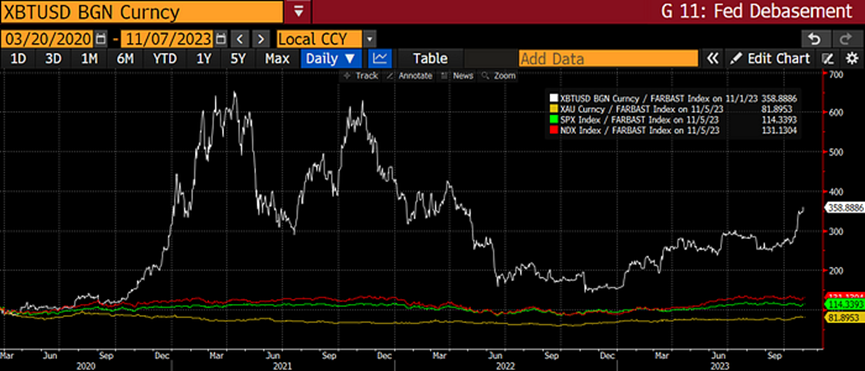
This chart shows Bitcoin (white), Nasdaq 100 (red), S&P 500 (green), and gold (yellow) divided by the Fed’s balance sheet indexed to 100 starting March 2020. As you can see, Bitcoin (+258%) outperformed all other assets during the Fed’s balance sheet expansion.
First stop: always Bitcoin. Bitcoin is money, and only money.
Next stop: Ethereum. Ether is the commodity powering the Ethereum network—the best internet computer.
Bitcoin and Ether are the reserve assets of crypto. Everything else is shitcoins.
Then come other Layer 1 blockchains claiming improvements over Ethereum. Solana is an example. These got crushed during the bear market. So they’ll rally from extremely low bases, offering huge returns to bold investors. But they remain overhyped and cannot surpass Ethereum in active developers, dApp activity, or total value locked.
Finally, various dApps and their respective tokens will launch. This is the most exciting layer—where you get 10,000x returns. Of course, you’re also more likely to go broke, but no risk, no reward.
I love shitcoins, so don’t call me maxi!
The Way Forward
I’m closely watching the [RRP - TGA] net flow to determine whether dollars are flooding into markets. This will decide whether I accelerate Treasury sales and Bitcoin purchases, as confidence grows with expectations of rising dollar liquidity. But I’ll remain agile and flexible. The best-laid plans of mice and men often go awry.
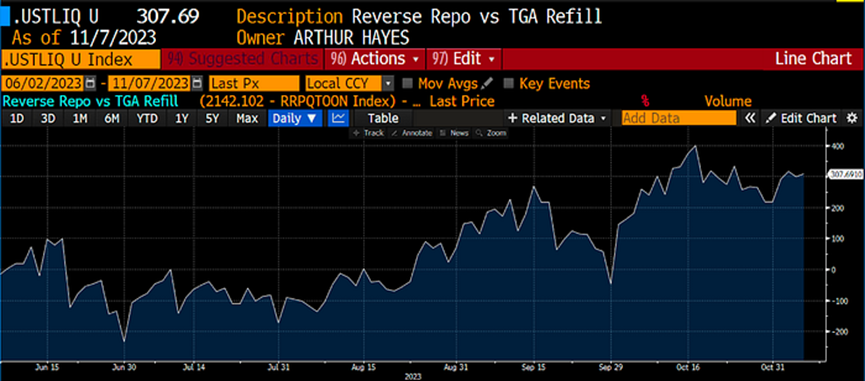
Since Yellen was allowed to borrow again in June 2023, the Fed has net injected $300 billion. This combines RRP drawdowns and TGA increases.
The final wildcard is oil prices and the Hamas-Israel war. If Iran gets drawn into war, we should anticipate some disruption to oil flows into highly leveraged Western nations. Then, the Fed would face political difficulty maintaining a hands-off monetary policy. They might have to hike rates to combat higher oil prices. On the other hand, one could argue the war and rising energy costs will trigger a recession, giving the Fed license to cut. Either way, uncertainty rises, and the initial reaction may be a Bitcoin selloff. As we’ve seen, Bitcoin outperforms bonds during wartime. Even with a weak initial phase, I’ll buy the dip.
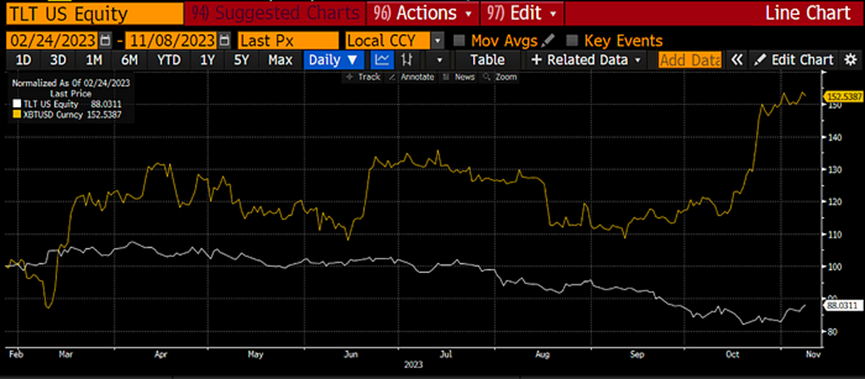
Since the Ukraine/Russia war began, the U.S. long-term Treasury ETF (TLT) is down 12%, while Bitcoin is up 52%.
Join TechFlow official community to stay tuned Telegram:https://t.me/TechFlowDaily X (Twitter):https://x.com/TechFlowPost X (Twitter) EN:https://x.com/BlockFlow_News

 Arthur Hayes










