7 Practical Tips for Crypto Beginners to Succeed in the Next Bull Market
TechFlow Selected TechFlow Selected
7 Practical Tips for Crypto Beginners to Succeed in the Next Bull Market
Unless you're buying BTC or ETH, never adopt a "buy and forget" approach.
 Navigating Web3 tides with focused insights
Written by: The DeFi Investor
Compiled by: TechFlow
In the first few months after I got into cryptocurrency, my portfolio was consistently in the red, costing me a significant amount of money. There were several reasons for this, but the main one was that I had absolutely no understanding of how the market worked at the time.
But after some time, I successfully turned things around and began making profits.
If you're a beginner, you don't need to repeat my mistakes. Here are seven crypto tips I've distilled that can help you succeed in the next bull cycle:
Reduce quantity, focus on key bets
Many people love diversification—while it's a good investment approach, it only helps preserve wealth rather than build it.
Indeed, if you know your investments are spread across 15–20 projects, even if one fails, it won’t significantly impact your overall portfolio—and you can still sleep well at night.
But such an approach rarely leads to substantial wealth growth. For example, if you like 25 projects, instead make larger, high-return bets on the top 6–7 you believe have the most potential.
Managing 6–7 positions is far easier than managing 25.
Don’t sell your “winners”
This is one of the biggest mistakes many investors make. When you see one of your tokens surge while another underperforms, you might be tempted to sell the strong performer—but doing so increases your exposure to losing assets, which isn’t wise.
Let your winners run and ride them through the next bull market! Few things are more painful than selling a token after it doubled, only to watch it rise tenfold in the following months.
So when should you take profits? When the price hits your target, or when your non-crypto friends start calling you asking what tokens they should buy.
In a bull market, understand that “hype > fundamentals”
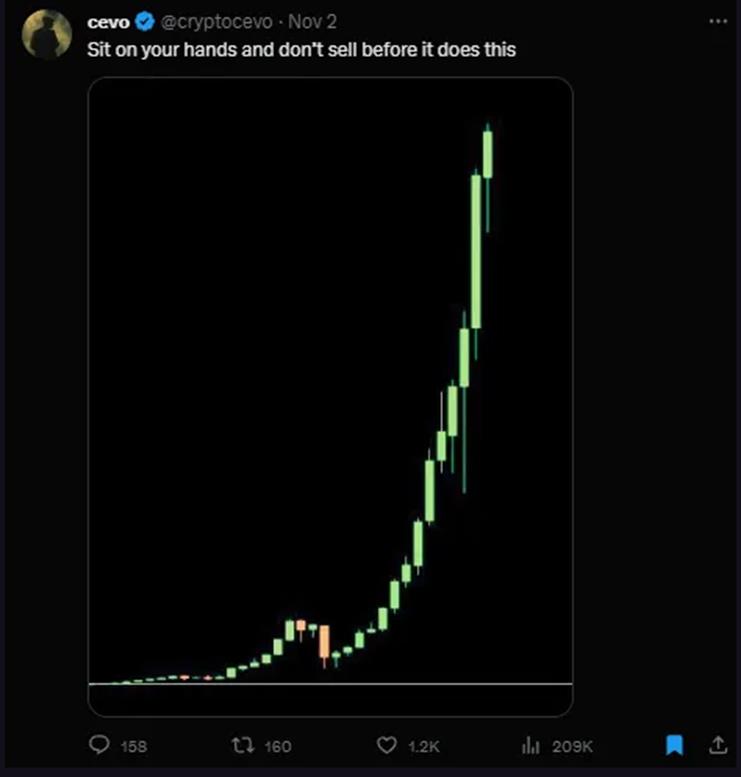
"Pumpamentals" refer to factors that rapidly drive up token prices—such as narratives, catalysts, or favorable sentiment—regardless of actual fundamentals.
During the last bull run, XRP reached an $80 billion market cap—something impossible without its highly active community. Many other tokens also achieved sky-high valuations due to powerful pump dynamics.
While fundamentals will eventually become the primary driver of price appreciation, in my view we’re still far from that stage. Therefore, instead of solely focusing on finding projects with the strongest fundamentals, try to understand what drives retail investors to buy certain tokens—look for simple, compelling logic behind retail investment decisions.
These matter most during bear markets:
-
Fundamentals
-
Revenue generation
-
Product-market fit
But in bull markets, pumpamentals become extremely important:
-
Community leaders
-
Social media hype
-
Narrative-market fit
-
Strong marketing
Previously, I shared more thoughts on "Pumpamentals" in this thread:
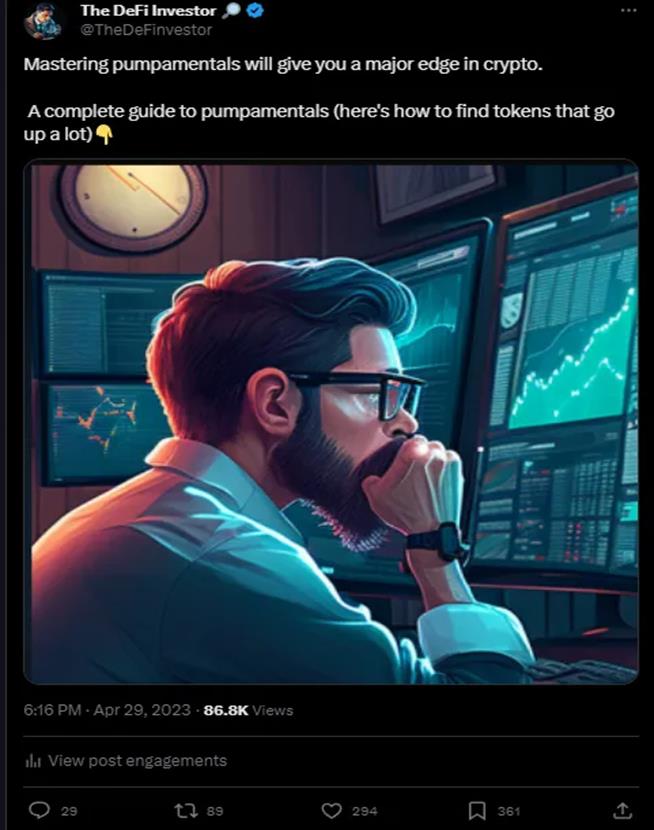
Original thread: The DeFi Investor
Write down your investment thesis
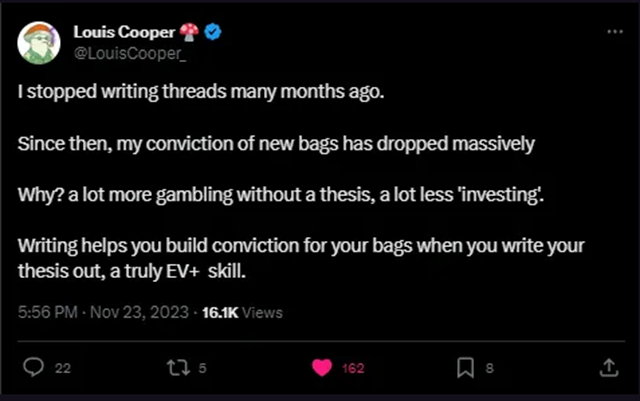
This may seem boring and isn't something many people do. But as Louis Cooper mentioned in the tweet below, writing helps solidify your investment conviction.
It also helps you better understand what you're investing in and identify gaps in your knowledge. Additionally, forcing yourself to write an analysis before buying a token makes it easier to avoid FOMO-driven investments.
Review your portfolio every 1–2 months
Unless you're buying BTC or ETH, you should never just "buy and forget." The crypto space evolves extremely fast—most projects disappear within two years of launch.
Therefore, I recommend regular reviews.
When reviewing projects in my portfolio, I check the following:
-
Recent team progress
-
On-chain metrics (revenue, fees, TVL, etc.)
-
Community strength (are people talking about the project on X?)
-
Roadmap (what’s next for the project you invested in?)
As George Soros said: "It’s not whether you’re right or wrong that matters, but how much money you make when you’re right and how much you lose when you’re wrong."
The only way to minimize losses is to cut early when fundamentals deteriorate.
Stay open-minded to new ideas and perspectives
One way to increase your odds of success is to invest in unpopular or misunderstood projects before everyone starts talking about them.
In a bull market, saying "this will never work" without doing research could be your most expensive mistake.
Constantly experimenting with new things pays off—and you might even earn valuable airdrops.
If you can't easily change your biases when new critical information emerges, you're just a community member—not a real investor.
Accept the fact that you’re sometimes wrong. The greatest traders have no ego issues saying, "My analysis was wrong—I messed up."
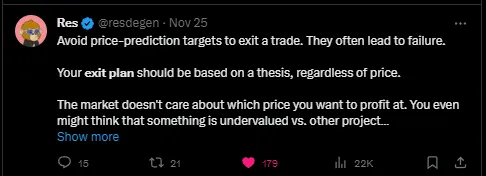
Create an exit strategy
Everyone who failed to take profits in the last bull run vows they’ll do it next time—but it’s easy to get caught up in the excitement.
At the peak of every bull market, 90% of influencers say we’re going higher and that we’ve just begun. Selling becomes stigmatized, and those who take profits are mocked as fools.
That’s why you need an exit strategy—and stick to it.
Selling isn’t easy, and you likely won’t time the exact top—but at least you can lock in some gains and avoid enduring another brutal bear market with nothing to show for it.
A good exit strategy should include:
-
When to take profits
-
When to cut losses
Here’s a great thread on how to build an exit plan:
Alright, that’s all for today.
Finally, my first recommendation is to trade/invest based on strategies and rules derived from your own market experience. As the saying goes: "A trader without a system is just a gambler."
Building wealth is hard; losing it is easy—that’s why having a clear strategy is essential.
Join TechFlow official community to stay tuned
Telegram:https://t.me/TechFlowDaily
X (Twitter):https://x.com/TechFlowPost
X (Twitter) EN:https://x.com/BlockFlow_News
 The DeFi Investor