








Defense priority: How to understand Vitalik's advocated d/acc in simple terms?
TechFlow Selected TechFlow Selected
Defense priority: How to understand Vitalik's advocated d/acc in simple terms?
d/acc, accelerating technological development across different domains to defend against potential attacks and risks in those areas.
 Navigating Web3 tides with focused insights
By TechFlow
Today, Vitalik updated his blog with a long-form article titled "My Techno-Optimism," outlining his views on recent technological optimism, AI risks, and ways to avoid centralization in today's world.
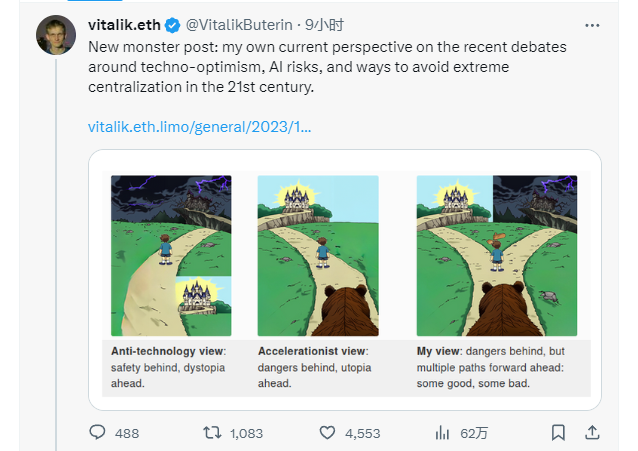
The article itself takes a high-level perspective with broad thematic scope, and due to its length, interested readers are encouraged to read the full translation directly.
Vitalik’s blog is often interpreted as a barometer for technological trends, and the concepts he introduces frequently spark waves of discussion within the crypto community. In this piece, Vitalik brings up an important yet seemingly strange but familiar concept: "d/acc."

What exactly is d/acc, this abbreviation that looks like a code symbol?
Before you can fully grasp it, a trend has already begun sweeping through the crypto space:
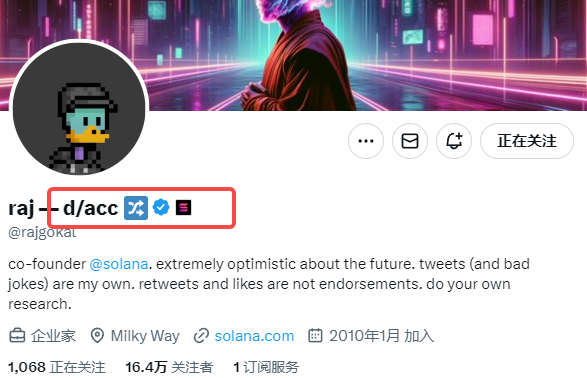
Prominent figures such as Raj Gokal, co-founder of Solana, have already added “d/acc” as a suffix to their names—an echo of when Vitalik changed his Twitter handle to “Tonlin,” prompting many others to follow suit.

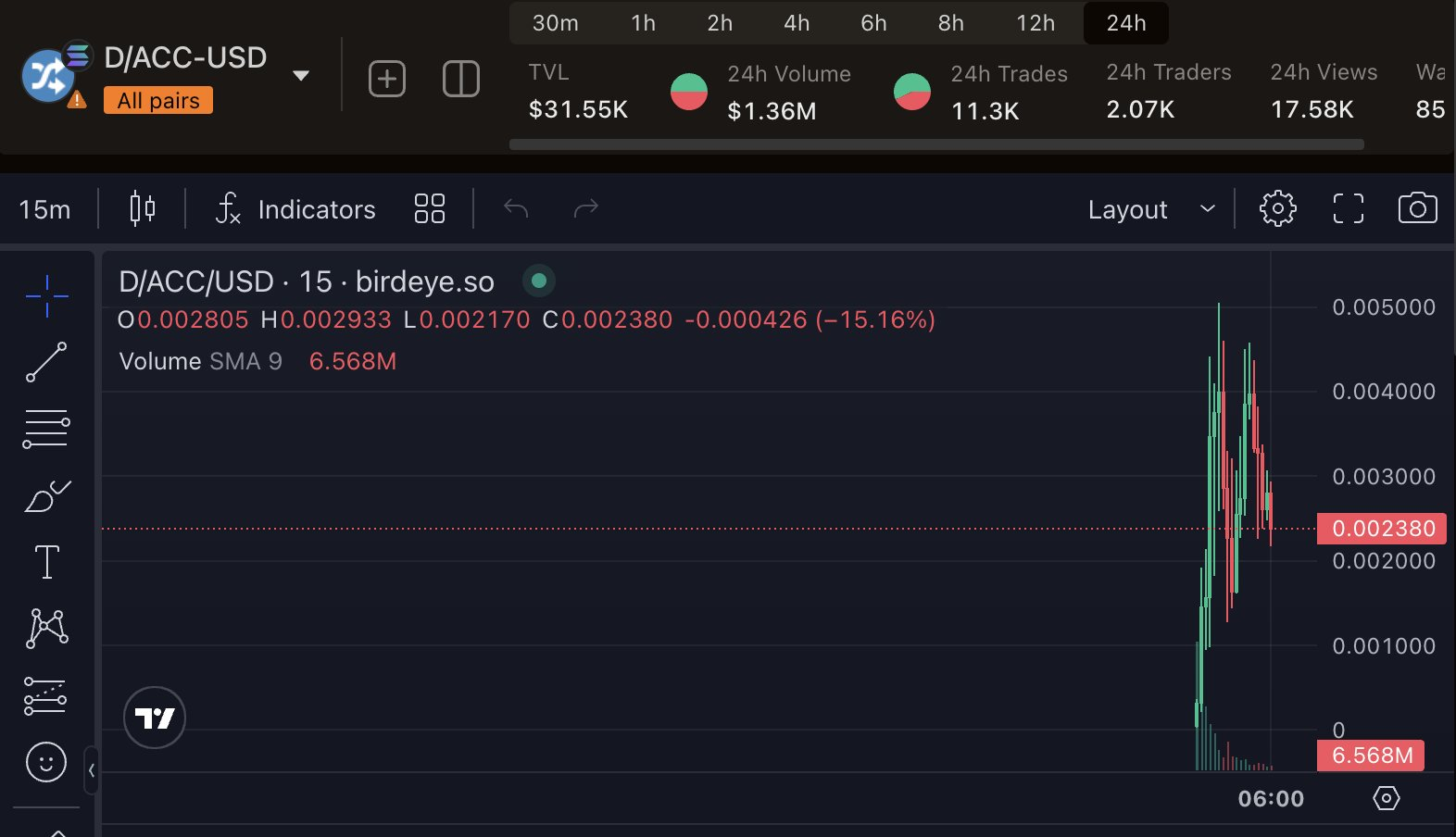
Soon after, meme coins named "d/acc" rapidly emerged on both Ethereum and Solana, becoming new targets for degens. From a blog post idea to a meme symbol, then to a class of crypto assets—the speculation cycle in the crypto world moves incredibly fast.
But beyond speculation, taking a pragmatic approach, we should also understand what Vitalik actually means by d/acc.
A similar term: e/acc
The reason d/acc feels both unfamiliar and familiar is because two to three months ago, a similar term was widely popular—e/acc.
As introduced in our previous article "What Is the 'e/acc' Trend That Silicon Valley Elites Are Chasing?", Marc Andreessen, founder of A16Z, and Garry Tan, CEO of YC, were among the first to append “e/acc” to their social media profiles. Soon afterward, many others followed, adding these letters to their names.

That earlier trend coincided with widespread debates during the GPT and AI boom.
e/acc stands for “Effective Accelerationism.” If that sounds confusing, it can be通俗ly understood as:
You should appreciate the immense benefits brought by technological progress and actively support accelerating this trend to realize those benefits faster.
A typical example is AI—when products like GPT deliver tangible value and amaze users with rapid advancements, the e/acc stance would be to strongly support further AI development, making it smarter and applicable across more domains.
To followers of e/acc, no innovative idea offering potential value should be dismissed—even if it currently seems absurd, far-fetched, or distant.
Thus, appending e/acc to one’s profile serves as a form of “attitude signaling” within tech and venture capital circles.
What Exactly Is d/acc?
Let’s now return to the concept of d/acc mentioned by Vitalik.
First, Vitalik clearly understands the meaning behind e/acc, so he builds upon it by extending the concept: “acc” still stands for “acceleration,” while the letter “d” can represent multiple meanings:
Defense, Decentralization, Democracy, and Differential.
With these combinations, you could interpret it as accelerating defense, accelerating decentralization, accelerating democracy, or accelerating differentiation.
This may sound abstract, but in his blog post, Vitalik narrows down the focus, aligning these different directions under a single worldview—a “defense-first” philosophy.
Vitalik argues that a world oriented toward defense is better—not only because it directly improves security and reduces conflict, but also because it enables healthier, more open, and freedom-respecting forms of governance to flourish.

So, what exactly are we trying to defend against?
Vitalik elaborates from both macro and micro perspectives of our world, suggesting that defense is needed everywhere:
-
Cyberattacks: Enhancing internet security to reduce threats from hackers.
-
Privacy violations: Strengthening cybersecurity to prevent invasions of personal privacy and unnecessary international diplomatic strategies.
-
Information warfare: Combating disinformation and online scams to improve the authenticity and reliability of digital information.
-
Biosecurity and public health: Rapid response to disease outbreaks—such as fast-tracked vaccine development and distribution—to minimize virus spread.
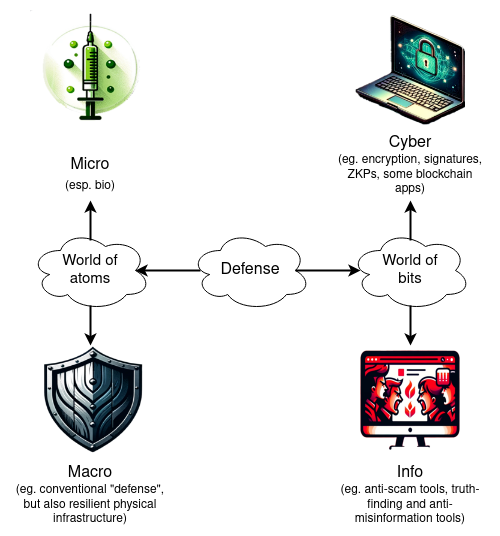
And what tools should we use for defense?
-
Technical tools and applications: Developing personal defense tools, such as software that blocks cyber attackers or browser extensions that detect scams.
-
Data security and encryption technologies: Leveraging blockchain and cryptography to enhance data security and immutability.
-
Smart contracts and decentralized applications (dApps): Using blockchain technology to provide transparent and secure online services and transactions.
-
Rapid response and innovation: In biotech and healthcare, quickly developing and deploying new therapies and vaccines to address health crises.
At this point, we’ve covered the full scope of the d/acc concept: accelerating technological advancement across various fields to defend against potential attacks and risks.
Given that Vitalik offers multiple interpretations for the letter “d”—Defense, Decentralization, and Differential—we can examine how the above methods reflect each interpretation:
Defense
-
Security and protection: d/acc emphasizes strengthening safety and defensive capabilities during technological progress, especially in cybersecurity, information security, and biosecurity.
-
Countering external threats: Employing technical means to defend against cyberattacks, information warfare, and public health threats reflects d/acc’s emphasis on defense.
Decentralization
-
Application of distributed technologies: Utilizing decentralized technologies like blockchain to enhance data security and system resilience, reducing reliance on centralized entities.
-
Enhancing personal privacy and autonomy: Decentralized technologies help protect individual privacy and empower users with greater control over their data and online activities.
Differential
-
Promoting technological innovation and diversity: By encouraging advancements across diverse fields, d/acc fosters a variety of technical solutions to tackle complex challenges.
-
Differentiated defense strategies: Implementing customized defense measures tailored to specific domains such as cybersecurity and biotechnology.
Overall, through these defensive measures and strategies, Vitalik demonstrates the practical application of the d/acc concept, highlighting the need to place greater emphasis on security, decentralization, and differentiation in technological development—ultimately shaping the kind of defensive-oriented world he envisions.
Similarities and Differences Between e/acc and d/acc
Now we can quickly compare the earlier e/acc movement with Vitalik’s d/acc in terms of conceptual similarities and differences:
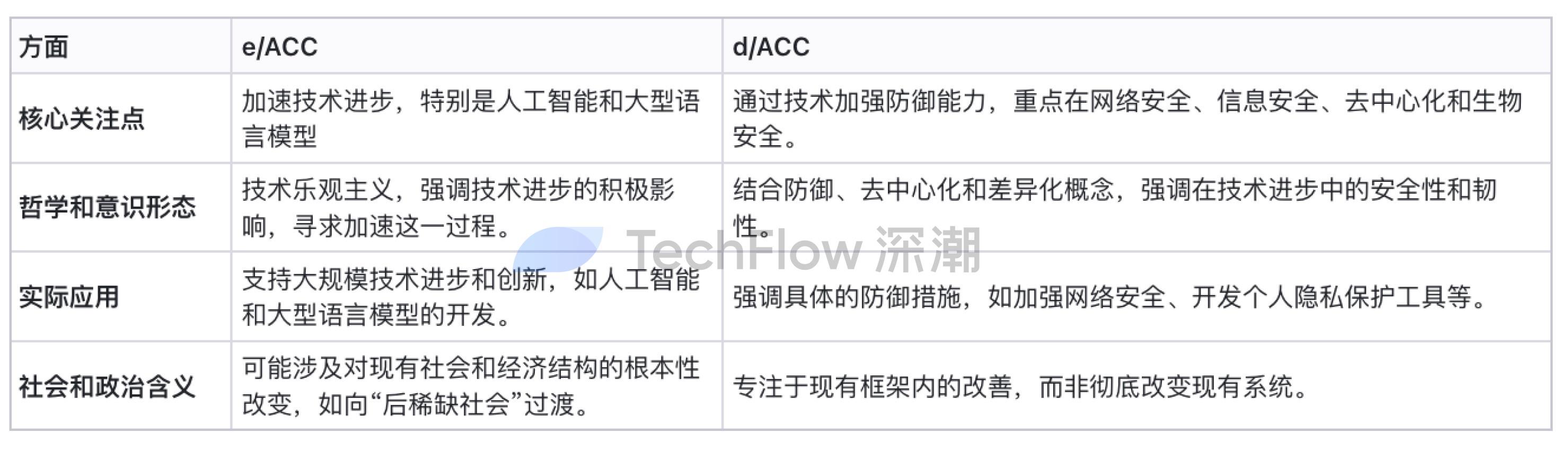
Overall, both e/acc and d/acc emphasize the importance and impact of technological progress, considering how tech development influences social structures and systems.
However, they differ in focus areas and implementation approaches. Vitalik focuses more on improving existing social, economic, and technological frameworks, rather than advocating for radical disruption and unchecked acceleration as e/acc does.
Finally, you might feel these concepts seem disconnected from your own life or the crypto world.
Yet in reality, high-level discussions often subtly permeate every corner of the industry over time. Staying aware and informed is never a bad thing.
Join TechFlow official community to stay tuned
Telegram:https://t.me/TechFlowDaily
X (Twitter):https://x.com/TechFlowPost
X (Twitter) EN:https://x.com/BlockFlow_News
 深潮TechFlow


