








CEO suddenly exits, OpenAI faces major turning point
TechFlow Selected TechFlow Selected
CEO suddenly exits, OpenAI faces major turning point
OpenAI's sudden management upheaval has sparked external speculation about internal positions and factional disputes within the company.
 Navigating Web3 tides with focused insights
Author: Qi Minqian, Tiger Sniff Business & Consumer Group
On the afternoon of November 17, U.S. time, OpenAI, the company behind ChatGPT, announced a major management reshuffle. Sam Altman will step down as CEO and leave the company's board of directors. Mira Murati, the company’s Chief Technology Officer, will serve as interim CEO while the search for a permanent CEO continues.
As one of OpenAI's co-founders, Sam Altman—often referred to as the "father of ChatGPT"—has long been the public face representing OpenAI.
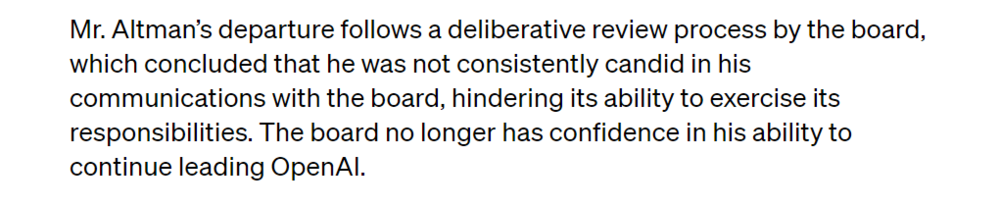
Given how deeply intertwined he is with OpenAI, why did Altman suddenly depart? In its official announcement, OpenAI stated that Altman’s departure resulted from a board decision following deliberation. The board cited concerns that Altman had not been sufficiently candid in his communications with them, which hindered their ability to carry out their oversight responsibilities. As such, the board has lost confidence in his leadership of OpenAI.
Screenshot from official website
In response to this change, Altman briefly commented on his social media, saying he cherished his time at OpenAI and would share more details about his next steps later.
Who Are the Old and New CEOs?
Sam Altman, former CEO of OpenAI, is something of a celebrity in the global tech industry. In 2005, the 19-year-old Altman dropped out after one year studying computer science at Stanford University. He went on to launch his own startup and became a partner at Y Combinator—the renowned American startup incubator—in 2011, later rising to president of YC Group. During his tenure as YC president, he established YC China and invited Lu Qi to serve as CEO.
In 2015, Altman co-founded OpenAI together with Elon Musk, Greg Brockman, and others, aiming to build safe and beneficial artificial general intelligence (AGI) for humanity. In 2019, YC announced that to allow Altman to focus fully on OpenAI, his role at YC would shift from president to chairman of the board.
Mira Murati, who is temporarily stepping into Altman’s role, does not have nearly as deep a history with OpenAI nor has she held as central a position within the company. According to foreign media reports, Murati was only promoted to CTO of OpenAI in 2022, overseeing the commercialization of OpenAI’s products and refining them based on user feedback.
As stated in OpenAI’s announcement, Murati has been part of the company’s leadership team for five years and possesses an in-depth understanding of its values, operations, and business. She was chosen as interim CEO primarily due to her long tenure, close involvement across all aspects of the company, and extensive experience in AI governance.
Six-Member Board Reduced to Four Members
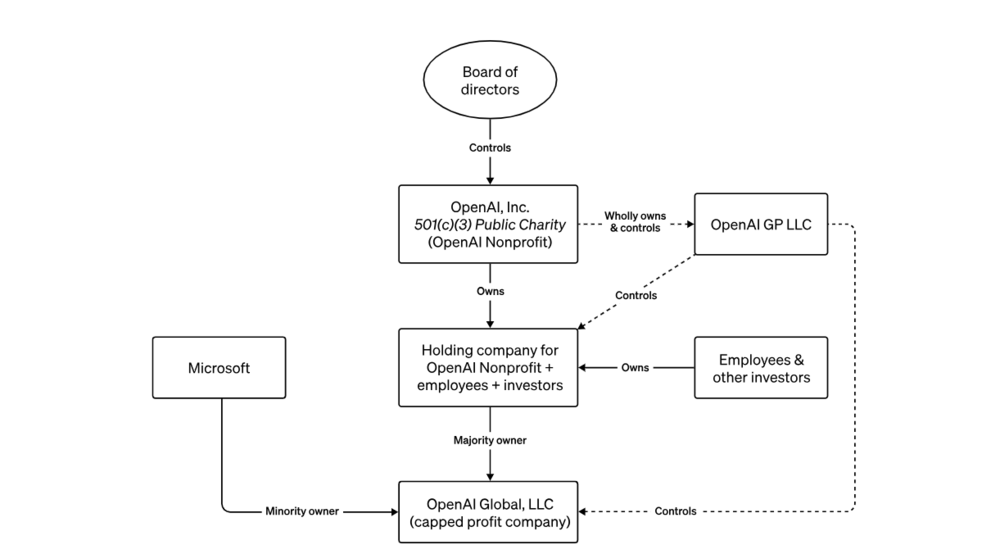
As a nonprofit organization, OpenAI’s board of directors serves as its ultimate governing body. Following this management shake-up, the board will temporarily shrink from six members to four.
According to OpenAI’s official website, the board previously consisted of six members: three current employees and three non-employee external directors. The three employee directors were Chairman and President Greg Brockman, former CEO Altman, and Chief Scientist Ilya Sutskever.
After this round of upheaval, OpenAI co-founder Greg Brockman, like Altman, was removed from the board. Subsequently, he announced he would fully depart OpenAI and no longer hold any position at the company.
According to OpenAI’s latest announcement, the board now comprises just four members: Chief Scientist Ilya Sutskever and three other non-employee external board members.
Screenshot from official website
OpenAI’s sudden management turmoil has sparked widespread speculation about internal factions and ideological divides. While various theories remain unconfirmed, one thing is certain: despite being at the forefront of artificial intelligence, OpenAI still has significant room for improvement in corporate governance.
Beyond internal management, another major debate surrounding OpenAI centers on the tension between its nonprofit mission and commercial ambitions. When OpenAI was founded in 2015, it was initially established as a nonprofit entity. However, developing AI technology and applications requires massive capital investment. OpenAI began with a donation-based model, initially securing $1 billion in funding commitments from backers including YC, followed by additional donations totaling around $130 million.
Yet these donations proved insufficient. In 2019, the company introduced a “capped-profit” structure, creating a new for-profit subsidiary under the nonprofit umbrella and securing investment from Microsoft.
Following the recent executive upheaval at OpenAI, Microsoft shares briefly plunged during the final trading session, ultimately closing down nearly 1.7%. In a statement, Microsoft said it maintains a long-term partnership with OpenAI and remains committed to its investment, expressing "tremendous confidence" in OpenAI.
Join TechFlow official community to stay tuned
Telegram:https://t.me/TechFlowDaily
X (Twitter):https://x.com/TechFlowPost
X (Twitter) EN:https://x.com/BlockFlow_News


