








Wall Street “Takes the Temperature” for OpenAI’s IPO—Are Investment Firms Unenthusiastic?
TechFlow Selected TechFlow Selected
Wall Street “Takes the Temperature” for OpenAI’s IPO—Are Investment Firms Unenthusiastic?
Investors widely acknowledge OpenAI’s leading position in the AI competitive landscape, yet remain cautious about whether it can achieve a reasonable valuation in the public market.
 Navigating Web3 tides with focused insights
By Dong Jing
Source: WallStreetCN
OpenAI may still be at least six months away from going public, but Wall Street’s pre-IPO preparations have already quietly begun. Several investment banks are proactively reaching out to public-market investors to gauge sentiment toward the ChatGPT parent company’s IPO prospects—and the responses they’re receiving are far cooler than expected.
On March 9, according to tech publication The Information, insiders revealed that multiple banks vying for OpenAI’s IPO underwriting mandate have begun “sounding out” public-market investors. To this end, The Information interviewed 11 such investors, most of whom do not currently hold OpenAI equity.
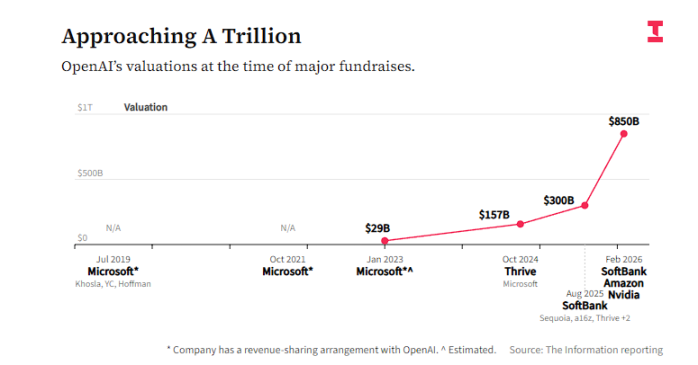
Respondents generally adopted a cautious stance toward the IPO, citing two primary concerns: first, uncertain profitability—OpenAI itself forecasts it will continue burning cash through at least 2030; and second, an excessively high valuation—the company is currently raising funds at an $85 billion valuation, equivalent to roughly 28x its projected 2026 revenue, far exceeding NVIDIA’s current price-to-sales (P/S) ratio of approximately 12x.
The report notes that this “chill” in market sentiment reflects a deeper tension underlying what could become the largest IPO in history: while investors broadly acknowledge OpenAI’s leadership position in the AI competitive landscape, they remain skeptical about whether the company can achieve a reasonable valuation in the public markets. Meanwhile, the strong rise of rival Anthropic is further diverting investor attention and enthusiasm.
Valuation Debate: Why Is a 28x P/S Ratio So Expensive?
OpenAI is currently raising funds at an $85 billion valuation, with participants including NVIDIA, Amazon, and SoftBank. This figure has already deterred many public-market investors—and the IPO pricing could climb even higher.
Based on projected 2026 revenue, the $85 billion valuation implies a P/S ratio of roughly 28x. By comparison, NVIDIA—widely viewed as the benchmark for AI investments—currently trades at a P/S ratio of about 12x.
According to Bob Lang, founder of trading firm Explosive Options:
“I truly believe OpenAI is an excellent company with a strong moat—but I don’t think any first-day IPO valuation would represent good value for investors.”
He added he likely won’t invest in OpenAI’s public offering, especially given its valuation multiple exceeds NVIDIA’s.
Lang also noted that the real beneficiaries of this IPO will be early investors and hyperscale cloud providers who already hold shares—and who will now gain an opportunity to cash out.
Jim Chanos, a prominent short-seller, questioned OpenAI’s valuation logic by referencing NVIDIA:
“NVIDIA essentially monopolizes the market, enjoys rapid growth, boasts extremely high margins, and generates abundant cash flow. So why should OpenAI command a higher valuation?”
Profitability Pathway: Burning Cash Through 2030—Will Public Markets Buy In?
According to reports, OpenAI projects it will remain unprofitable through at least 2030—a timeline that unsettles public-market investors accustomed to scrutinizing profitability.
Some investors worry whether funds raised from the IPO will suffice to sustain the company until it reaches profitability—or whether additional fundraising will be needed later, diluting existing shareholders’ equity.
Mark Malek, Chief Investment Officer at Siebert Financial, said that even though OpenAI is unlikely to generate significant profits in the near term, he would still consider establishing a position post-IPO—but would strictly limit position size, echoing his strategy when investing in Palantir years ago.
Palantir currently trades at a P/S ratio as high as 49x and grows significantly faster than peers, yet Malek considers Palantir less risky than OpenAI due to its more flexible cost structure.
“If Palantir loses a government contract, that’s bad—but they can lay people off. If you spend five years building a data center, you can’t just say, ‘Never mind, let’s scrap it.’ Palantir drives a Formula 1 race car; OpenAI steers a fully loaded cargo ship.”
In a January report, JPMorgan analysts noted that OpenAI’s introduction of advertising into ChatGPT helps retain users—but also observed that client sentiment toward OpenAI turned “mixed” following the company’s announcement of large-scale chip and data-center spending plans.
Not everyone is waiting on the sidelines—some investors have explicitly stated they plan to short OpenAI’s stock upon its listing, betting that public markets will tolerate its long path to profitability only to a limited extent.
Chanos holds a similar view. His core message to clients is: “You should go long on chip output and short chip storage.” In other words, operating data centers itself is not a high-return business—and OpenAI’s business model is heavily dependent on massive investments in compute infrastructure.
Chanos also pointed out that financial information about OpenAI remains severely scarce, making deep analysis difficult. Yet he expects that once OpenAI formally files its IPO application, public markets will engage in intense debate over its competitive positioning:
“Is this a winner-takes-all market? Or will it resemble cloud computing, where the market is fragmented? Or more like search engines, where one company becomes the standard and maintains dominance long-term? Right now, models keep leapfrogging each other.”
Anthropic’s Disruption: Competitor Diverts Capital and Attention
OpenAI’s IPO journey also faces potential pressure from rival Anthropic.
At Morgan Stanley’s annual Technology Conference this week, Anthropic CEO Dario Amodei disclosed that the company’s annualized revenue run rate has doubled to $20 billion. Anthropic recently completed a new funding round at a $38 billion valuation, and its enterprise-grade AI coding tools—including Claude Code—are gaining strong traction in sales.
As previously reported by The Information, Anthropic expects its AI model training and operational costs over the coming years to be significantly lower than OpenAI’s. Some investors are beginning to believe that Anthropic’s long-term profitability may surpass OpenAI’s, thanks to its success in the enterprise customer segment—where clients are willing to pay a premium for AI services.
With Anthropic also preparing for an IPO, the two companies’ listings could compete head-to-head, further fragmenting investor capital and enthusiasm. Investors like Chanos have explicitly stated a preference for Anthropic’s relatively restrained compute-investment strategy, viewing it as a more prudent and sustainable commercial approach.
Join TechFlow official community to stay tuned
Telegram:https://t.me/TechFlowDaily
X (Twitter):https://x.com/TechFlowPost
X (Twitter) EN:https://x.com/BlockFlow_News


