Spacemesh: Mineable by Hard Drive, Accessible to Everyone—Claimed to Be the People's Currency
TechFlow Selected TechFlow Selected
Spacemesh: Mineable by Hard Drive, Accessible to Everyone—Claimed to Be the People's Currency
Permissionless, requiring no special equipment and with low barriers to entry, anyone can participate in mining is Spacemesh's greatest feature.
 Navigating Web3 tides with focused insights
Written by TechFlow
The blockchain structure introduced by Bitcoin is simple and elegant, and most other cryptocurrencies use the same structure. However, these blockchains have some inherent flaws.
First, consensus guarantees in blockchain protocols similar to Bitcoin rely on frequent time intervals during which only one block is created, and the length of this interval is limited by network latency. This fundamentally limits the transaction throughput such blockchains can support, as well as how frequently miners can generate blocks.
This also leads to higher transaction fees and incentivizes miners to form more centralized mining pools, reducing both the expected time and variance in receiving rewards.
To overcome these issues, the blockchain field has proposed DAG (Directed Acyclic Graph) structures to replace the linear chain topology in cryptocurrency protocols. For example, early projects like IOTA, and currently trending ones like KAS, are protocols where miners perform PoW calculations to create DAG blocks.

Second, traditional PoW mechanisms have inherent drawbacks because PoW itself tends toward centralization due to the advantage of specialized hardware (ASICs) over general-purpose computing devices, leading easily to upstream monopolies by mining equipment manufacturers and causing environmental concerns.
Ethereum transitioned from PoW to PoS, but still requires miners (stakers) to invest significant capital to provide economic incentives—essentially allowing the rich to get richer.
To address these two challenges, Aviv Eyal and Tomer Afek founded Spacemesh in 2017 in Israel—a new blockchain network.
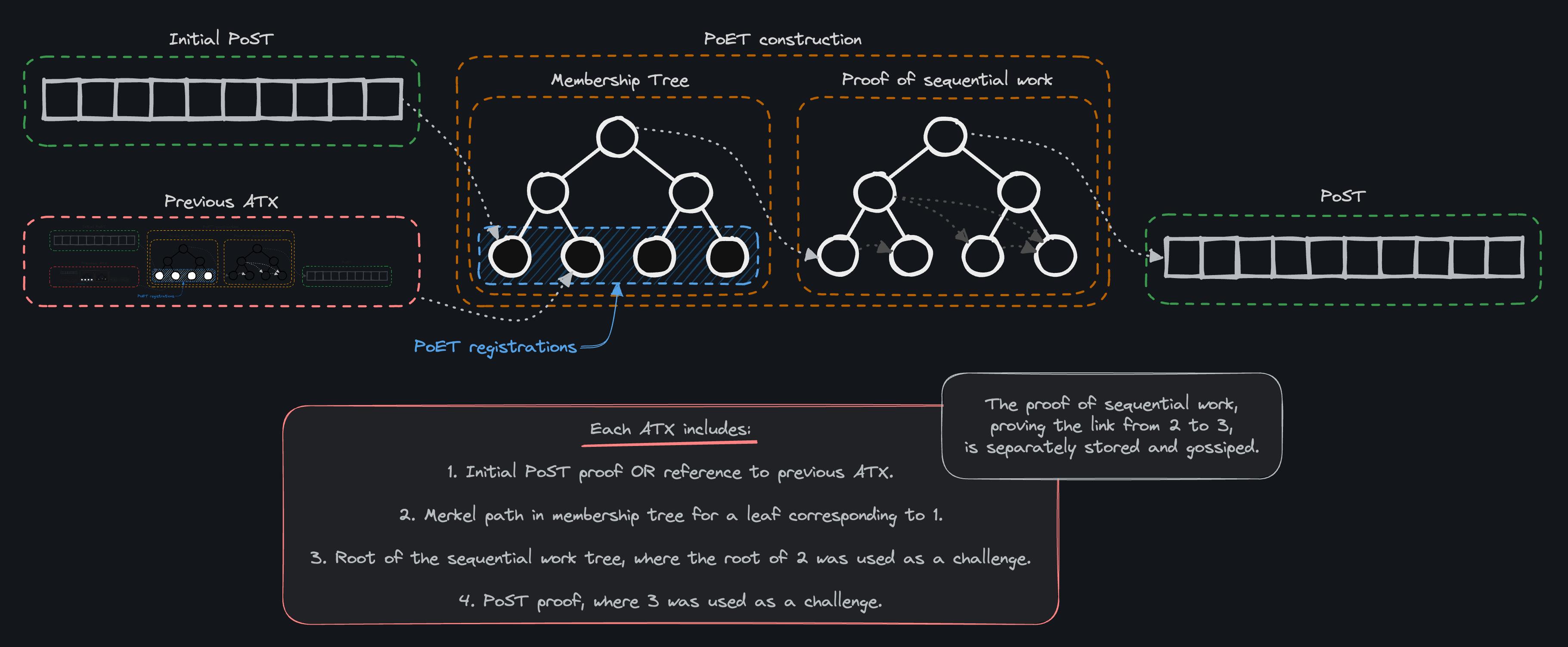
Spacemesh adopts a completely new consensus mechanism—Proof of Space-Time (PoST)—which ties the protocol to real-world physical resources: storage space. Anyone with free disk space can participate, using a block mesh structure (layered DAG) instead of a single blockchain to order transactions.
Permissionless, requiring no special machines, low barrier to entry—anyone can participate in mining. This is Spacemesh’s greatest distinguishing feature. The Spacemesh team believes that PoST is more resource-efficient, easier to decentralize, and more secure than Proof-of-Work (PoW) and Proof-of-Stake (PoS).
Below are the minimum requirements for running a node:
CPU: Intel or AMD x86-64 or 64-bit ARM, including Apple Silicon (but excluding Raspberry Pi), with at least 1GiB of memory.
Operating System: Windows 10/11, MacOS, Ubuntu 22.04+, or Fedora 36+.
Disk: At least 50GiB of available disk space.
Internet Speed: A persistent, unlimited internet connection with download speed of at least 5 Mbps and upload speed of at least 1 Mbps.
More details can be found on the official website.
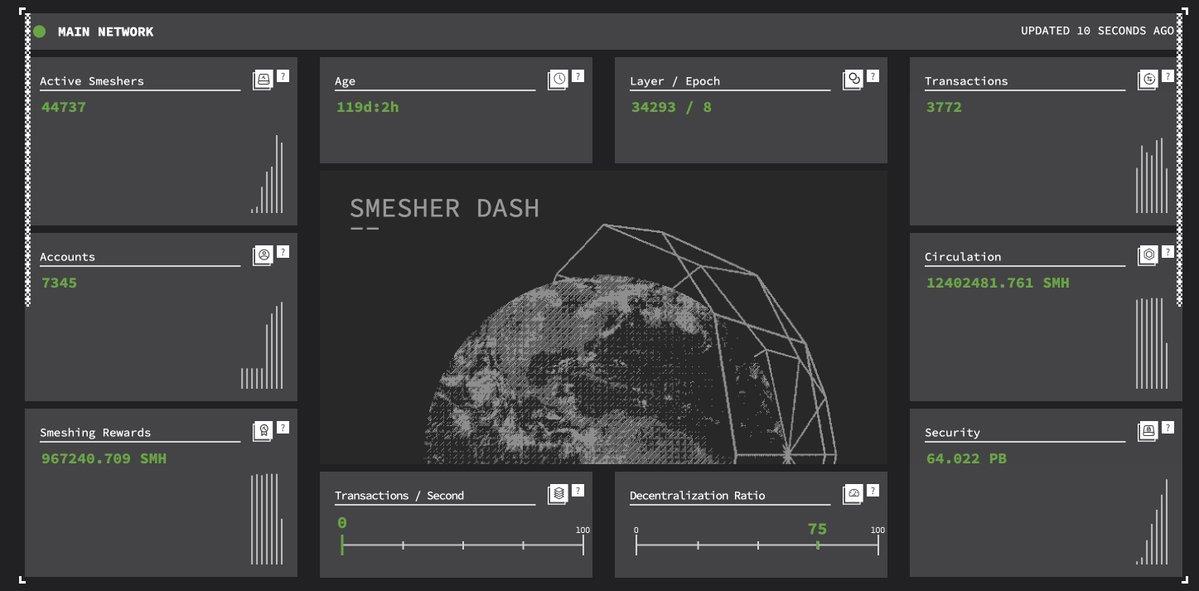
Additionally, the project discourages purchasing dedicated equipment for mining, as there is no guarantee users will recoup their investment. Spacemesh recommends participants utilize already-available hard drive space they own.
To protect the Spacemesh network from takeover by attackers, the system uses a mechanism based on Smeshers who allocate space over time. To qualify for participation and rewards, individuals must prove they actually possessed the required storage capacity over a period of time.
This consensus mechanism may remind you of a past project—Chia—which also used hard drives for mining. Chia mining primarily involves creating "plots" that occupy hard drive space and participate in block generation through proof of space and proof of time.
Spacemesh mining follows the same process as Chia: P-plotting (using CPU or GPU to fill a hard drive with hash data via a unique algorithm; this process is called P-plotting). Larger storage space means higher rewards, and plotting speed depends on threads.
However, according to investors who have participated in actual mining, Spacemesh's P-plotting speed is relatively slow—the bottleneck isn't hard drive space, but rather the number of GPUs.
Secondly, in addition to the PoST consensus mechanism, Spacemesh also incorporates DAG to ensure security and high scalability in its decentralized network.
Team and Funding
Consensus Protocol Founder: Professor Tal Moran, an Israeli with a postdoctoral background from Harvard;
Team Members: Aviv Eyal, co-founder, experienced in building full-stack systems and startups; Tomer Afek, co-founder and CEO, with strong experience in advertising and investing.
In May 2018, during its early stages, Spacemesh attracted $3 million in seed funding from companies including BRM Group, iAngels, Alignment, and Bancor. In September 2018, Spacemesh secured $15 million in funding led by Polychain. Other investors include MetaStable, Paradigm (the new fund by Matt Huang and Fred Ehrsam), Coinbase Ventures, Bain Capital, 1kx, Arrington XRP Capital, DHVC, Gumi Crypto, Electric Capital, Collaborative Fund, and Jack Herrick.
In December 2021, Spacemesh raised another $4 million in new funding from investors including Leland Ventures.
Overall, this is an Israel-based project with a long history spanning two market cycles.
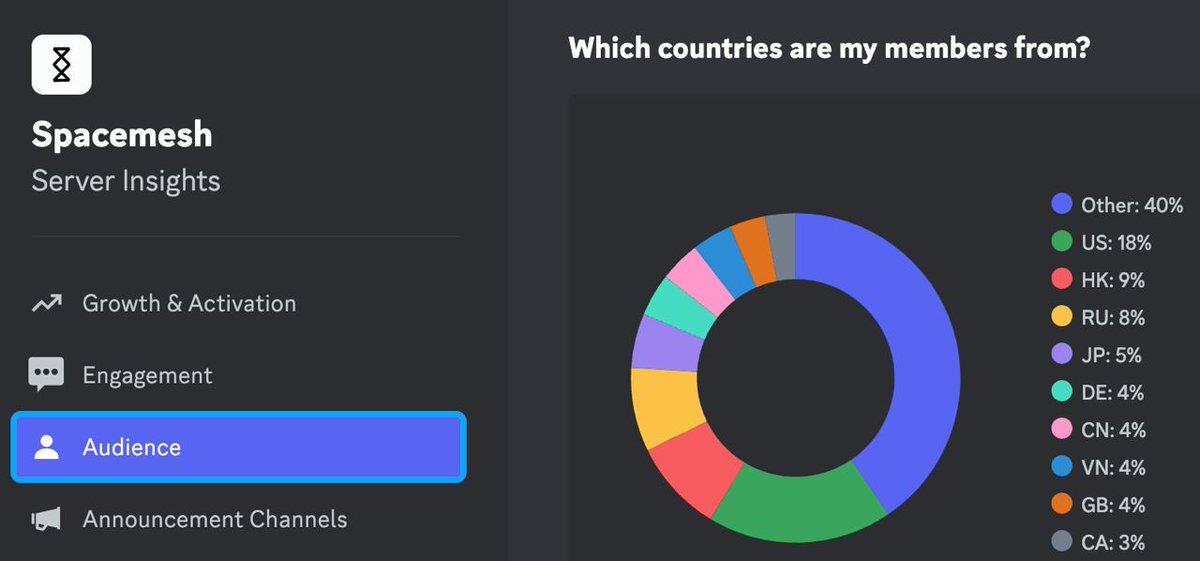
Unlike mining projects mainly driven by Chinese communities, Spacemesh's community distribution is highly diversified:
United States: 18%; Hong Kong: 9%; Japan: 5%; Germany: 4%; China: 4%; Vietnam: 4%; United Kingdom: 4%; Canada: 3%; Other regions: 40%.
Vision: The People’s Coin
Opening Spacemesh’s official website, one immediately sees a bold slogan—On a quest to become the people’s coin!
Tomer Afek, co-founder of Spacemesh, once said, “Spacemesh’s low entry barrier and incentive compatibility rekindle the original vision of true decentralization since Bitcoin’s inception.”
Driven by this vision, Spacemesh chose July 14—the French National Day, historically when Parisians stormed the Bastille—to officially launch its mainnet.
When reading Spacemesh’s documentation or official blog posts, one can clearly sense the team’s “artistic” and even slightly dramatic tone. For instance, in the article “You and I Can Change the World,” Spacemesh raises a powerful call to resist systemic control and rebel against authority and the establishment:
“We may not be able to change the world alone, but change always begins with our choices.
We matter, our voices matter, our decisions matter—we are not just cogs in the ‘system.’”
This gives Spacemesh a slight meme-like quality. On the technical front, Spacemesh has released its technical roadmap (2023–2026+), covering five phases including virtual machine development, ecosystem growth, and mobile device testing. For example, the team aims to enable Spacemesh to run on various devices, including smartphones.
However, the team also notes that this roadmap is not set in stone—it is a dynamic document that will continue evolving over time.
Project Token: SMH
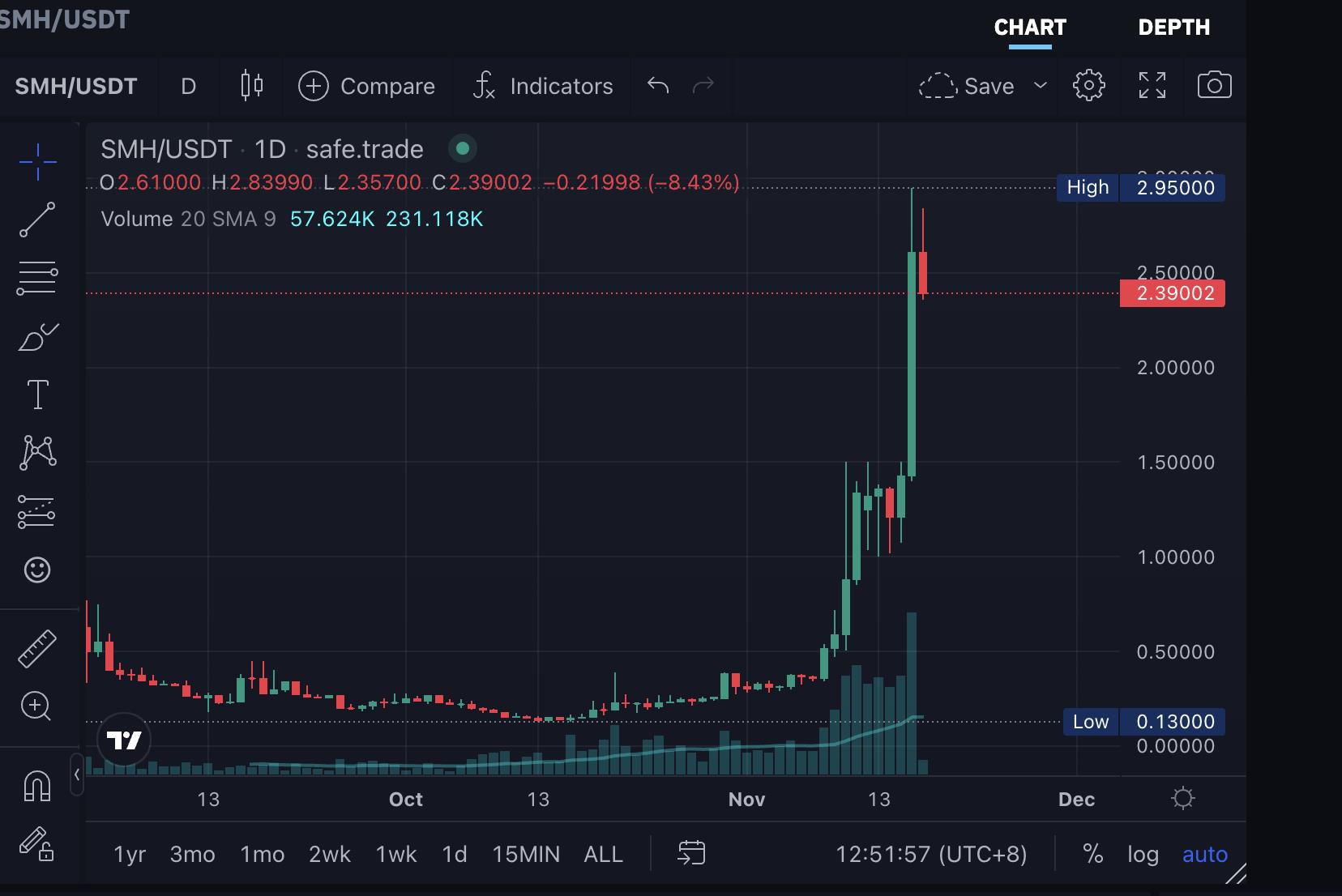
SMH is the protocol’s native token, which recently experienced a massive surge—priced at $0.55 on November 10, it soared to $2.40 by November 17, gaining over three times in just one week.
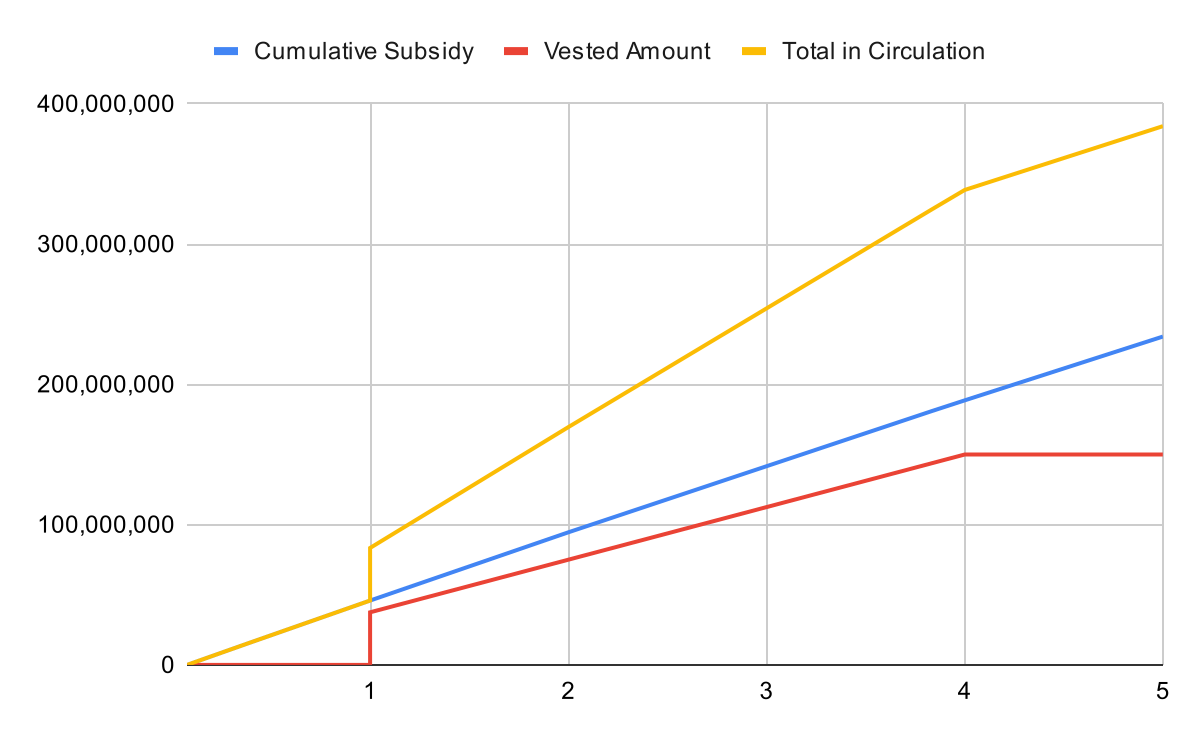
The total supply of SMH is capped at 2.4 billion, to be issued over 941 years, with 2.25 billion tokens (94.75%) allocated to Smeshers (Spacemesh miners), and no pre-mine.
Additionally, 150 million tokens (6.25%) will go into a treasury for early investors and the team, with no initial release—vesting gradually after one year and fully released within three years.
This means that in the first year, only miner-held tokens will circulate. But by the fourth year, team and investor tokens will account for nearly 40% of the circulating supply. Miners’ share will then gradually diminish, and by the tenth year, team and investor holdings will make up 25% of the circulating supply.
Unlike Bitcoin’s halving every four years, Spacemesh’s halving cycle is approximately 29 years—about 7.3 times slower than Bitcoin. The final Bitcoin is expected to be mined around 2140, while the last Spacemesh coin won’t be issued until around 2899.
Overall, Spacemesh’s rise represents a challenge to traditional blockchain architectures.
By introducing the PoST mechanism, Spacemesh breaks the limitations of traditional mining, enabling home desktop users to participate in blockchain mining and consensus without requiring specialized hardware—making blockchain more inclusive and accessible to ordinary people.
Join TechFlow official community to stay tuned
Telegram:https://t.me/TechFlowDaily
X (Twitter):https://x.com/TechFlowPost
X (Twitter) EN:https://x.com/BlockFlow_News
 深潮TechFlow