








OKX exclusively launches Yield Hunter, signaling potential large-scale growth for crypto options users
TechFlow Selected TechFlow Selected
OKX exclusively launches Yield Hunter, signaling potential large-scale growth for crypto options users
OKX Yield Hunter is as simple as a wealth management product, allowing users to easily participate in options going forward.
 Navigating Web3 tides with focused insights
For most users, options products are difficult to understand and too complex to use effectively.
As an effective hedging tool, options allow users to cap their maximum risk while pursuing higher profits. They are widely used by institutional and professional investors in traditional finance, but in the relatively nascent crypto industry, they still need broader adoption and improved liquidity. Currently, many crypto users lack financial expertise, and the non-linear payoff structure of options, along with sophisticated pricing models, creates high barriers to entry, leaving their needs unmet.
To address these challenges, on November 15, OKX announced the launch of a new product built on options—Yield Hunter. With a clean, visualized profit curve, it simplifies user understanding; through streamlined order processes for option sellers and annualized yield displays, it lowers participation barriers, enabling even beginners to easily earn high annualized returns.
In simple terms, OKX’s Yield Hunter is as easy to use as a wealth management product, allowing ordinary users to effortlessly participate in options trading. The introduction of OKX Yield Hunter reduces the barrier to entry for crypto options, paving the way for broader user adoption.
An Overview of OKX Yield Hunter
OKX Yield Hunter is a non-principal-protected trading product designed to help users achieve high annualized returns. It is built on selling options—when users invest, they sell option contracts and receive premiums. Their returns depend on the relationship between the settlement price and the target price. Users can choose between two types of products based on their market outlook: “earn if not up” or “earn if not down.”
For example, with BTC- and ETH-based options, users can select from BTC Earn If Not Up, BTC Earn If Not Down, ETH Earn If Not Up, and ETH Earn If Not Down. After selecting a suitable investment product and placing an order, users may hold until expiration for settlement or close their position early.
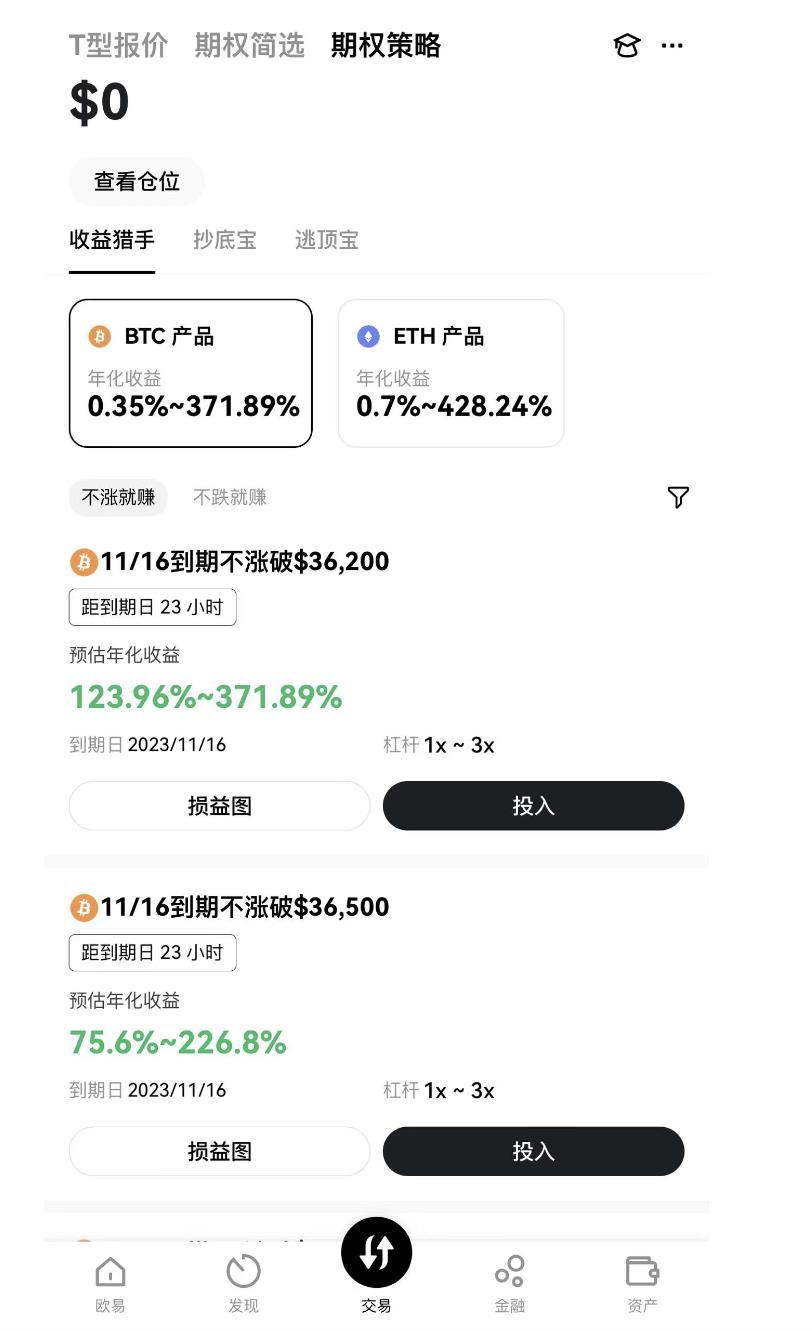
On OKX Yield Hunter, returns are displayed as estimated annualized interest rates, making profitability transparent. Participation is straightforward—invest USDT to earn USDT, or invest crypto to earn crypto—eliminating cumbersome conversion steps. Users enjoy flexibility in selecting underlying assets, target price ranges, expiry dates, and expected yields. Additionally, leverage ranging from 1-X倍 enhances capital efficiency.
With OKX Yield Hunter, users who previously lacked the ability to construct multi-leg options portfolios, struggled with pricing mechanics, or were unsure how to select appropriate options can now participate effortlessly. By simplifying both comprehension and participation, OKX significantly improves accessibility and overall user experience.
Moreover, it's worth noting that OKX Yield Hunter not only dramatically lowers the usability barrier for options but also offers relatively high annualized returns. While not principal protected, its displayed estimated annualized yield typically exceeds that of conventional financial products. How is this achieved?
To answer this, we first need a basic understanding of options.
Understanding Options in One Diagram
An option is a right—the right to buy or sell a specific asset at a predetermined price on a specified future date.
There are numerous options strategies—such as collar options, seagull options, bull spreads, bear spreads, etc. Despite appearing complex and hard to grasp, most of these strategies are fundamentally composed of simple single-leg positions. Basic single-leg strategies include: buying call options, buying put options, selling call options, and selling put options.
Using the sketch below, let’s briefly analyze these four basic strategies and their associated risks and rewards. The horizontal axis represents the underlying asset price, the vertical axis represents profit/loss, A denotes the strike price, and P represents the premium. For instance, suppose Zhang San pays a premium P to buy a BTC call option with a strike price of A—this means that at expiration, Zhang San has the right to buy BTC at price A.
If the BTC price at expiration exceeds A, theoretically, the profit increases linearly with the price rise. However, considering the cost (premium P), actual profit begins only when the BTC price exceeds A+P. As long as the price is above A, exercising the right is profitable. Conversely, if the BTC price falls below A, losses could theoretically increase with the drop. But Zhang San can simply choose not to exercise the option, limiting the loss to the premium P. The same logic applies to other strategies.
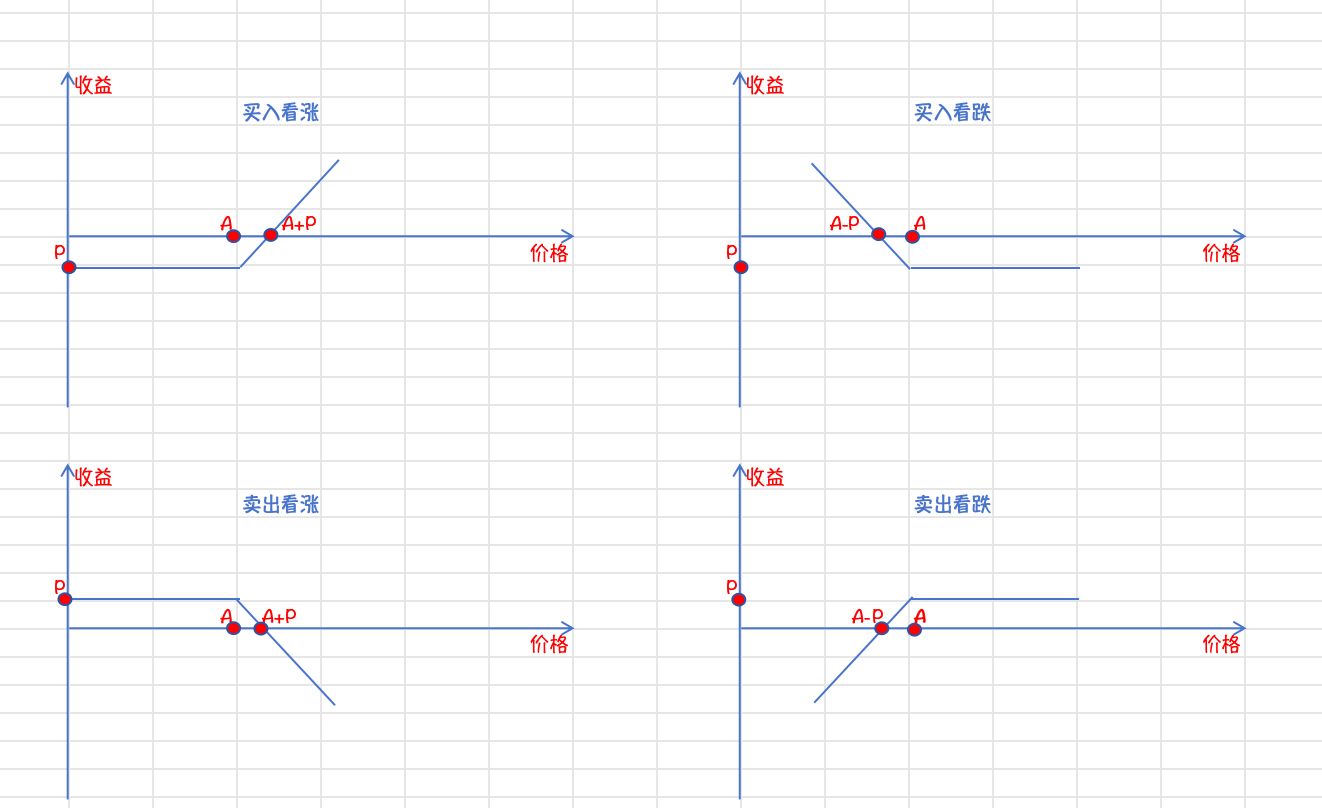
The underlying mechanism of OKX Yield Hunter is based on selling options. As shown in the diagram above, the two basic short option strategies are selling calls and selling puts. Selling a call means losing money if BTC rises, but earning the premium P if it doesn’t go up. Selling a put means losing money if BTC falls, but earning the premium P if it doesn’t go down.
Although short options have a high probability of earning the premium P, the value of the premium (i.e., option price) is determined by multiple factors: the underlying asset price, strike price, volatility of the underlying, time to expiration, and interest rates. These variables collectively influence the option’s value and market price. Take volatility, for example—given that options offer limited downside and potentially unlimited upside, higher price volatility increases the chance of large gains while capping losses, thus increasing the option’s value.
Today’s markets feature a wide array of options strategies. Through diversified combinations and precise calculations, these can be tailored to various market conditions—even generating profits under principal protection. This explains why OKX Yield Hunter is positioned as a non-principal-protected product capable of delivering high annualized returns.
OKX Builds an Ultra-Simple Trading Tool
Like futures, options are derivative instruments offering risk management, price discovery, and portfolio allocation functions. Compared to futures, however, options provide greater strategic flexibility and allow for pre-calculated risk exposure.
Yet for the majority of crypto users accustomed to spot or futures trading, the learning curve for options remains steep. OKX Yield Hunter bridges this gap by offering an extremely user-friendly and effective hedging instrument, accelerating the mainstream adoption of options in the crypto space.
Currently, OKX’s financial products lead the industry. Throughout nearly two years of bear market conditions, they have become the preferred tools for users seeking to hedge risk and generate stable returns.
Looking at OKX’s suite of financial offerings—from Yield Hunter to earlier launches like Dual Asset Products and Shark Fin options—the platform continues to innovate by transforming complex trading tools into simplified, accessible solutions, thereby lowering user barriers and delivering exceptional trading experiences.
After all, "Simplicity is the ultimate sophistication—because it's simple, it's efficient."
Join TechFlow official community to stay tuned
Telegram:https://t.me/TechFlowDaily
X (Twitter):https://x.com/TechFlowPost
X (Twitter) EN:https://x.com/BlockFlow_News
 OKX
OKX






