Progressive Ownership: A New Token Distribution Model Driving User Loyalty
TechFlow Selected TechFlow Selected
Progressive Ownership: A New Token Distribution Model Driving User Loyalty
In the progressive ownership model, revenue sharing will stimulate growth and strengthen loyalty, ultimately leading users to actively choose ownership, ensuring only the most loyal users become stakeholders.
 Navigating Web3 tides with focused insights
Written by: Li Jin and Jesse Walden
Compiled by: TechFlow
Our founding thesis at Variant is that the next generation of the internet will transform users into owners through tokenization. Using tokens to incentivize users has proven highly effective in bootstrapping infrastructure networks like Bitcoin and Ethereum. However, we have yet to see a validated model for using tokens to grow application-layer networks. Instead, there are many examples where token distributions attracted more speculators than genuine users, hindering sustainable growth and retention, and muddying product-market fit.
Because of these failures, many view the use of tokens in applications as a category error—but we disagree. Instead, we believe the answer lies in continuously iterating on token design to achieve more bottom-up, opt-in models of ownership distribution, which we call "progressive ownership." This approach focuses on deepening user loyalty among app users through product-market fit.
Within this framework, we outline the mechanisms of the first three eras of token distribution—PoW mining, ICOs, and airdrops—along with their key lessons and shortcomings. Then, we propose high-level steps and strategies for a new token distribution model that we believe can sustainably grow applications through early product-market fit. By applying this playbook, apps can leverage user ownership to deepen loyalty among existing users and pave the way for further growth and retention.
The Three Eras of Token Distribution
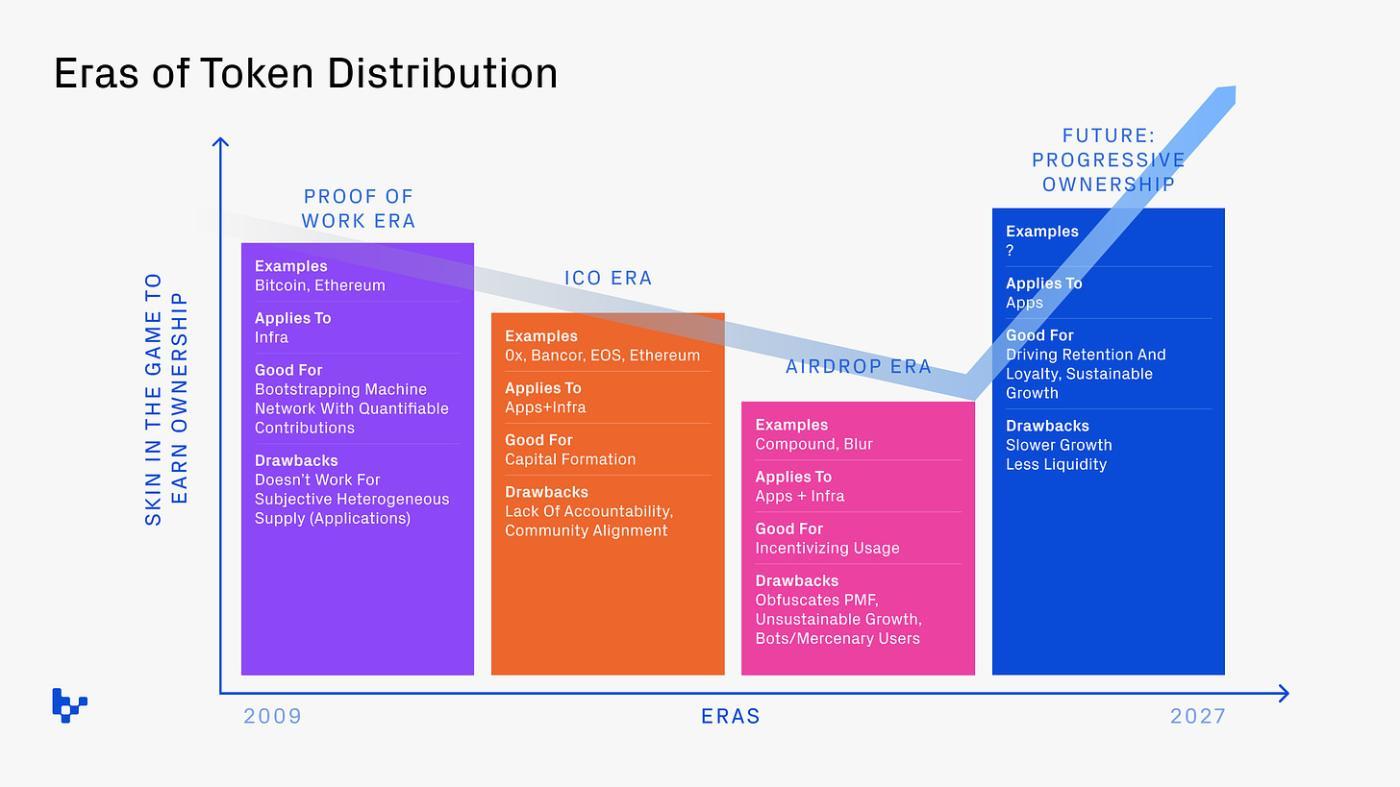
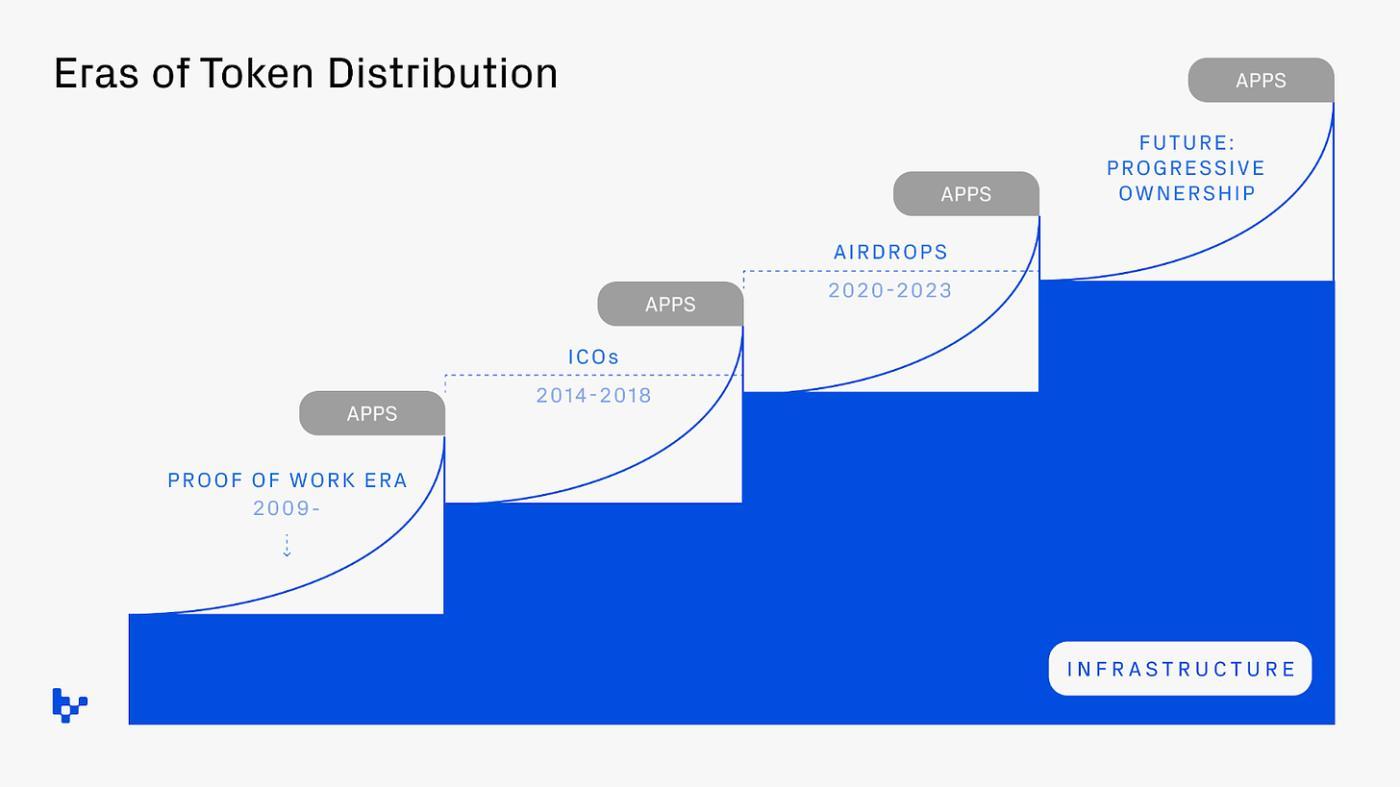
Cryptocurrency token distribution has evolved through three major eras:
-
Proof-of-Work (2009–present): Hardware formation
-
ICOs (2014–2018): Capital formation
-
Airdrops (2020–2023): Bootstrapping usage
Each model lowered barriers to participation while expanding access, and each era naturally coincided with a new wave of growth and development in the space.
1. The Proof-of-Work Era (2009–Present)
Bitcoin pioneered the idea that anyone willing to run software (“mining”) on their machine could operate a permissionless network in exchange for tokens representing ownership. Miners who contributed more computational power had a higher chance of earning rewards, encouraging specialization and meaningful investment in computing resources.
The PoW era demonstrated that token incentives are highly effective at bootstrapping network supply when value contributed—such as compute power—can be quantified. Crucially, capital assets (hardware) were distinct from financial assets (BTC), forcing miners to sell their financial assets to cover costs. As specialized hardware became necessary, miners had to invest more heavily, but this also excluded average users.
2. The ICO Era (2014–2018)
The ICO (Initial Coin Offering) era marked a significant departure from the PoW distribution model: projects raised funds and distributed tokens by directly selling them to potential users. In theory, this allowed projects to bypass intermediaries like VCs and bankers, reaching a broader base of participants who could share in the benefits of the products and services they would use.
This model’s promise attracted entrepreneurs and investors alike, sparking a wave of speculative interest. Ethereum launched partly via an ICO in 2014, setting a blueprint for many projects in the following years, including large 2017–2018 ICOs such as EOS and Bancor. But the ICO era was rife with fraud, theft, and lack of accountability. The failure of many ICO projects, coupled with strict regulatory scrutiny, led to its rapid decline.
ICOs highlighted blockchain’s potential for permissionless, global capital formation. But the era also underscored the need for more thoughtful token design and distribution models that prioritize community coordination and long-term development over mere capital supply.
3. The Airdrop Era (2020–2023)
In 2018, an SEC official stated that BTC and ETH were not securities because they were “sufficiently decentralized.” In response, many projects designed tokens with governance rights and broadly distributed them to users to achieve sufficient decentralization. Unlike ICOs, which distributed tokens in exchange for monetary investment, airdrops rewarded historical usage. This model kicked off the 2020 “DeFi Summer,” popularizing liquidity mining (providing liquidity in financial markets to earn tokens) and yield farming (selling earned tokens for short-term gains).
While airdrops represented a shift toward more user-centric and community-driven ownership models, there was little skin in the game. Most recipients simply converted their received tokens into income by selling the majority immediately.
Many projects used airdrops before establishing real product-market fit. Tokens attracted bots and short-term, profit-driven users incentivized only by speculation—not aligned with the project’s long-term success. This behavior obscured signals around product-market fit and led to boom-bust price cycles. Some projects rushing to launch tokens even saw their founding teams step back prematurely to meet the vague regulatory bar of “sufficient decentralization.” This forced decisions into governance votes, most token holders lacked time or context to fully understand. Projects need founders to keep moving fast—even after, and especially before, achieving product-market fit. Airdrops often proved mismatched between growth strategy and startup execution.
We believe the main lesson of the airdrop era is that the pursuit of sufficient decentralization caused many projects to lose focus on product-market fit. Instead, token distribution should be more thoughtfully targeted at core users—weighted more heavily—after early product-market fit has been validated.
A Novel Token Distribution Framework: Progressive Ownership
Progressive ownership builds on progressive decentralization, which argues that tokens cannot substitute for product-market fit. This approach uses gradually increasing economic incentives to boost user loyalty and retention, culminating in ownership. In this model, users are initially incentivized with revenue-share payouts (e.g., ETH or stablecoins), but can choose to convert that personal income into tokens representing a pro-rata share of community revenue.
This benefits users by enabling a smoother transition between income and ownership—requiring fewer steps than previous models where tokens were automatically converted to income. It also allows users to tailor their level of economic engagement and risk based on their individual circumstances.
It also benefits builders, who can use revenue-sharing incentives to drive growth, build loyalty, retain control, and iterate quickly—without being distracted by premature full decentralization. Additionally, founders can still aim for liquidity via tokens, while mitigating risks associated with broad, undifferentiated token distribution.
Progressive ownership is an option only for projects that already have early product-market fit and revenue to share. While most crypto projects today have relatively small revenue streams, the list of those meeting this threshold is growing. Optimism has generated approximately $30 million in revenue year-to-date. MakerDAO collected $16 million in fees in October alone, with a 25% monthly compound average growth rate in revenue over the past year. ENS (Ethereum Name Service) generated $1.1 million in revenue last month.
Progressive ownership shifts token distribution from an opt-out to an opt-in model, potentially creating stronger loyalty and network effects due to greater stakeholder alignment. As loyal users upgrade to ownership, they become economically aligned with the network’s success and are more likely to encourage others to join—creating a virtuous cycle of growth. Users or developers who choose ownership are more likely to act as long-term stakeholders, much like startup employees with stock options.
Conversely, in the airdrop model, most users opt to sell tokens and convert them to income, eroding loyalty and creating downward price pressure. Research shows that customers who suffer losses as shareholders report lower satisfaction and loyalty toward companies. By opting into ownership, networks can mitigate these boom-bust cycles and the erosion of goodwill that follows.
Strategies for Progressive Ownership
Progressive ownership involves three steps:
-
Build a product that meets user needs;
-
Use on-chain revenue sharing to drive growth, retention, and resilience;
-
Allow core users to upgrade to economic ownership (e.g., trading revenue shares for tokens).
1.Build a Product That Meets User Needs
This is the hardest step. The foundation of progressive ownership begins with developing products and services that serve users in novel ways. As Li recently wrote: “Successful startups offer step-function improvements in functionality that enable people to fulfill core needs.”
By fulfilling needs ranging from income to recognition, applications can find product-market fit—and even cultivate psychological ownership.
2.Use On-Chain Revenue Sharing for Growth, Retention, and Defense
Projects can adopt on-chain revenue-sharing models that allow users to participate in the success of a product or service, deepening their interest and commitment.
A prime example is Zora’s protocol rewards, which distribute a portion of revenue to creators and developers to incentivize NFT minting. This approach not only improves user retention but also strengthens defensibility.
Some projects stop here—in fact, this is the standard playbook for Web2 companies, from Substack to OnlyFans to YouTube and X/Twitter. Revenue sharing is a powerful incentive with clear scaling effects.
But going beyond revenue sharing makes sense: economic ownership can align users more meaningfully with the platform’s long-term success, rather than short-term gains. Users with economic ownership better understand how their contributions drive platform growth. This mirrors Silicon Valley’s long-standing strategy of incentivizing startup employees.
3.Allow Core Users to Upgrade to Ownership
Finally, the most loyal users can opt into ownership via tokens that include economic and governance rights. This transition is not automatic or passive—it’s a choice. For example, the most valuable users (measured by generated revenue) could choose either 1) to receive revenue shares in ETH/stablecoins, or 2) to receive an allocation of the project’s native token instead.
By choosing the latter, users exchange some of their personal income for a share of the community’s total income. If the network grows, so does community revenue, and tokens should enable proportional participation. Additionally, tokens may grant governance over key protocol parameters (like fees or revenue share variables) to ensure long-term alignment.
More implementation details remain to be worked out. (Should users stake tokens to earn platform fees? Should tokens vest?) But without diving too deep, here are a few hypothetical examples:
Returning to Zora, protocol rewards have distributed about 1,008 ETH so far (nearly $2 million at time of writing). These rewards are revenue shares, primarily given to NFT creators driving minting activity, but also to developers and curators. Under a progressive ownership model, top Zora earners could choose to claim hypothetical Zora tokens instead of ETH protocol rewards. How many creators and developers would do so? Likely a small proportion—but those who do would have a meaningful stake in the game and could become more active and motivated to grow the network.
Another example is Farcaster, which charges individual users around $7 per year to store data. Imagine if the protocol shared revenue with developers building attention-grabbing clients. Developers could then choose whether to pass that value on to end users—similar to rebates—or convert part of their revenue share into protocol tokens, allowing them to participate in ecosystem growth and governance over key protocol parameters.
Precedents in Web2 Loyalty Models
The progressive ownership model closely relates to the “Loyalty Ladder” proposed by business researcher James Heskett in 2002, which includes four stages: “loyalty (repeat purchase), commitment (willingness to recommend), apostolic behavior (willingness to persuade others), and ownership (willingness to suggest improvements).”
Progressive ownership recognizes that customer loyalty requires increasingly deeper levels of psychological ownership. As users climb from revenue-sharing to tokens, they may experience rising degrees of psychological ownership, culminating in stronger advocacy—acting like true owners and taking greater responsibility for the product’s ongoing success.
This emotional connection can be cultivated through financial levers (revenue sharing) and product elements (personalized experiences, interactive features, and user input), making users more inclined to become long-term stakeholders.
Using economic ownership to solidify user loyalty also aligns with research in public equities, which shows that equity ownership increases brand loyalty among existing customers. As Li wrote:
A study from Columbia Business School found that in a fintech app where users chose certain brands or stores to receive stock after shopping, weekly spending at those brands surged by 40%… Users deliberately selected their stock positions and spent time consuming at those brands to earn stock rewards.
Moving Toward a New Era of Token Distribution
Progressive ownership represents a significant departure from prior eras of token distribution. While ICOs and airdrops were primarily bootstrapping tools, they often proved ineffective at incentivizing organic user engagement. As a result, entrepreneurs were frequently misled away from finding true product-market fit.
In the progressive ownership model, revenue sharing stimulates growth and cements loyalty, and ultimately, users actively opt into ownership—ensuring only the most committed become stakeholders. This paves the way for a community of advocates dedicated to the network’s long-term success. While this model may face unforeseen challenges, it strongly aligns with precedents showing that economic ownership increases loyalty.
The relationship between progressive ownership and compliance frameworks around full decentralization is another topic altogether. The industry needs novel compliance arguments that allow teams to keep building great products while upgrading advanced users into owners through ownership. This is work we plan to advance at Variant.
Innovation in token distribution continues to catalyze new waves of growth and development within the ecosystem—the playbook is far from finished. We’re excited to see future iterations of token distribution unfold.
Join TechFlow official community to stay tuned
Telegram:https://t.me/TechFlowDaily
X (Twitter):https://x.com/TechFlowPost
X (Twitter) EN:https://x.com/BlockFlow_News
 @ljin18