Variant Partner Li Jin: Reinventing the Cryptographic Social Ecosystem of Love and Reputation
TechFlow Selected TechFlow Selected
Variant Partner Li Jin: Reinventing the Cryptographic Social Ecosystem of Love and Reputation
So far, crypto social has mainly been about love (helping users form and monetize deeper connections) rather than reputation.
 Navigating Web3 tides with focused insights
Written by: Li Jin
Compiled by: TechFlow
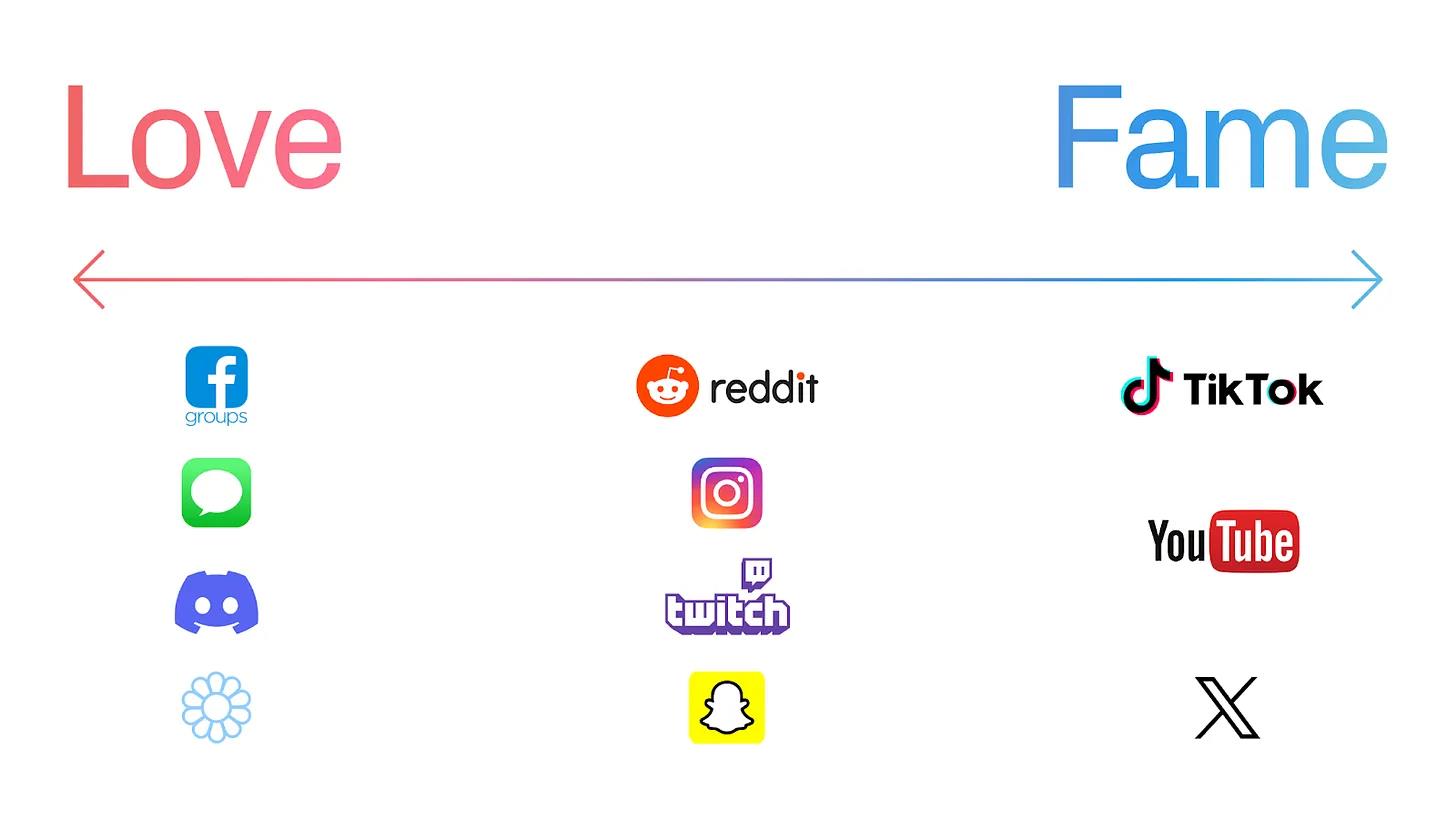
Although "social" is often treated as a single, monolithic category, today’s social apps are actually quite diverse.
One lens I like for analyzing social networks is the degree to which they serve users’ desires for love and fame.
Years ago, Twitch co-founder Kevin Lin told me that Twitch delivers value to creators across three dimensions: love, fame, and money. For the purpose of this article, I’ll set aside money—or the possibility of monetization—for now, as it’s an orthogonal dimension, which I’ll explain in more detail later.
All Social Apps Fall on a Spectrum from Love to Fame
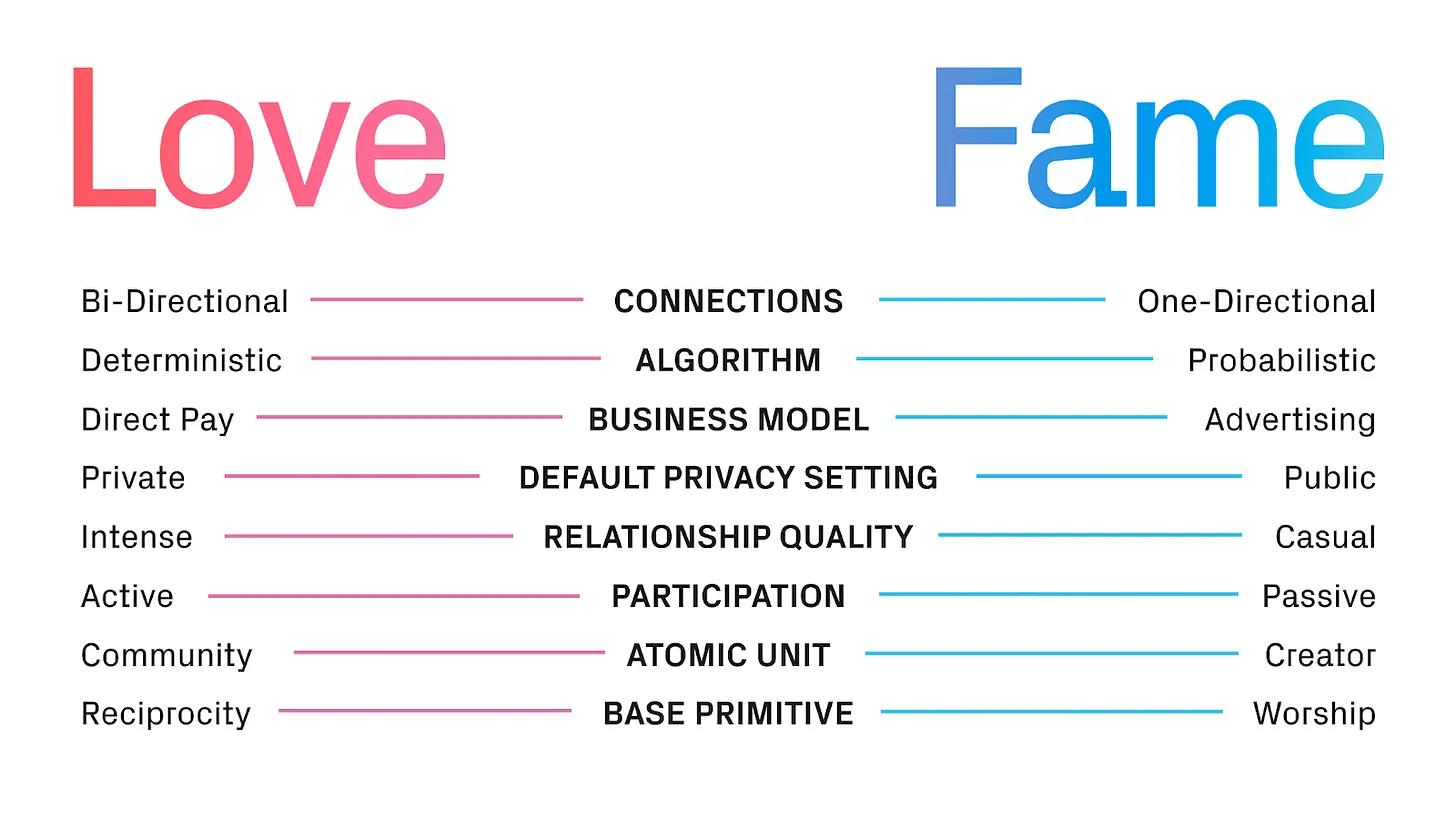
On the side of love, some products focus on deepening connections with others. Examples include iMessage, WhatsApp, early Facebook, and Discord. Their value proposition centers on more intentional connection with others—cultivating existing relationships and enhancing intimacy. These products are typically characterized by bidirectional relationships, such as friends on Facebook or iMessage. When users engage with products like Discord or WhatsApp, they usually do so for a specific community or person, rather than for discovering new content. These products reinforce this value through deterministic algorithms—if A sends something to B, the other always receives it.
On the side of fame, some products help users gain recognition or influence. These are built around the discovery of new content and creators. Fame-centered social products include YouTube, Instagram, TikTok, and Twitch. They feature one-way relationships (or “followers”). Influential users specialize as creators and reach increasingly large audiences—a dynamic absent in bidirectional networks. These platforms use probabilistic algorithms that surface content based on likelihood of engagement, meaning users aren’t guaranteed visibility among their followers.
These two extremes can be summarized as social networking versus social media.
There is an inherent tension in building products for love versus fame, rooted in the zero-sum nature of time and attention: users have limited time to spend on any given app, so platforms that emphasize discovering new content from creators over interacting with content from existing connections are, by definition, more fame-oriented than love-oriented.
A case in point is TikTok’s default “For You” feed: it downweights the following graph and defaults to showing users new creators and recommended content.
The love-fame dichotomy exists on a spectrum; most platforms contain elements catering to both. Instagram—over time shifting toward fame—includes both fame features (Explore, Reels) and love features (DMs, Stories, Close Friends). Reddit’s homepage functions as a fame product when used to browse trending content across Reddit, but if users engage with specific subreddits where members share mutual intimacy, they’re using it as a love product. This blend of features increases retention, as platforms lacking enough compelling love content struggle to keep users engaged. Pure love tools like WhatsApp, Messenger, and iMessage have remained largely unchanged due to strong network effects, but most other social apps have had to add fame-oriented features to boost retention.
The Broad Trend of Social Products Tilting Toward “Fame”
I often hear people say they feel, on a broader level, that social networking is shifting toward social media; apps once focused on friends are now oriented toward entertainment, and everyone is expected to become a creator. Instagram, once used to follow friends’ lives, is now mostly used to follow creators and brands.
I think this makes sense—and it’s driven by business models and incentives rooted in network effects. Bidirectional social networks hit a ceiling on network effects once users reach the limit of people they know. The utility of products like iMessage or early Facebook doesn’t scale with total user base growth. Instead, it plateaus after users connect with all their friends. In contrast, fame-based products enjoy more unbounded network effects: users can consume content from anyone, and utility grows as more users join. Under ad-driven business models, maximizing user attention over time is paramount, and fame-driven models are better suited to scaling both attention and revenue.
Interestingly, love-focused social products typically don’t monetize well via ads: users understandably don’t want ads injected into messages sent to friends or small communities. Instead, subscription-based models dominate love products—either for the platform (e.g., Discord Nitro, or WhatsApp’s original $1/year fee) or for specific creators or communities (Twitch subscriptions). This is even more pronounced in dating apps, where subscriptions for Hinge, Bumble, and Tinder cost significantly more. People are willing to pay more for more serious relationships and connections.
Successful fame platforms also feature a skill-based status game, as Eugene Wei described in his essay on status as a service. In contrast, such status games are less prominent in love products, confined to smaller networks. Most love-based social products resemble feature-rich communication tools rather than platforms for social climbing. They provide utility in users’ lives by connecting them with friends or groups, not by serving as stages for performance. Clearly, some products introduce status games into love platforms—imagine upvotes/downvotes on Reddit posts—but these games tend to be relatively small in scope.
Many users have pointed out that the meaningful shift in atmosphere on X (formerly Twitter) reflects its transformation from a love-focused platform to a fame-centered one. While the previous default timeline prioritized tweets from accounts you followed, the new algorithm floods feeds with people you don’t know. The new default “For You” tab surfaces posts algorithmically determined—based on likelihood of engagement—that you might like. Analysis of its open-sourced algorithm also reveals that X Premium (formerly Twitter Blue) subscribers receive ranking boosts in the feed. This design de-emphasizes the carefully curated following graph users built over time, shifting instead to a more engagement-driven, recommendation-based model that meaningfully alters the platform’s tone—transforming it from a handpicked collection of creators into a more viral, trend-driven platform.
As we see in mature social networks, the trend toward fame creates opportunities for new networks focused on deepening connections. Love-based products have room to serve smaller communities and groups, especially as established players reliant on ad-based business models seek ever-increasing user attention to grow their businesses.
Newer social media apps often start with a narrow use case targeting a smaller group. Apps like BeReal, Retro, and Lapse each offer unique takes on fostering deeper connections with friends—something fame-based social media tends to overlook (with varying degrees of success). However, apps focused on niche use cases often struggle with monetization and may become victims of their own success—as they grow and novelty fades, they erode the very value proposition of deep connection with small groups.
Crypto Social: New Business Models for Love and Fame
So far, crypto social has been more about love—helping users form and monetize deeper connections—than fame. Compared to Web2, where ad-based business models pressure platforms toward social media and entertainment, crypto enables love-based networks to uniquely survive and thrive. I’ve written before:
Crypto social networks can thrive by enabling new business models that make the existence of smaller, high-context groups possible. Today, most web2 social platforms prioritize growth at all costs, aligning with their ad-based business models. This means products focused on smaller groups—like Facebook Groups, Twitter Communities, or the defunct Path—lack viable business models.
Crypto can change this by allowing these smaller communities to exist and flourish sustainably. This could take the form of shared treasuries (Nouns DAO or FWB), creating alignment around maintaining community health, or minting on-chain artifacts of the community as a way to generate revenue (such as Crypto, Culture & Society DAO, a learning community).
A few years ago, Facebook experimented with a feature allowing group admins to charge entry or membership fees to support the cost of managing and maintaining their communities (for many, a full-time job). For some reason, this feature was discontinued, and FB Groups remain poorly monetized. I believe users are willing to pay to support smaller, healthier communities, but lacked the infrastructure to do so. With crypto, these communities can more easily choose and configure their own business models—and with that, we may see a flourishing of smaller communities.
Zooming out, the biggest wins in social have historically come from creating new types of networks: from real-life friend-based networks (Facebook) to interest-based (Reddit, TikTok) to knowledge-based (Quora). Crypto has the opportunity to experiment with building a new kind of ownership-based network, leveraging on-chain assets as the foundation for new communities. We call this idea socioeconomic networks (rather than purely social networks).
These communities can deepen ties between users through shared ownership, helping them find their tribe. In the real world, shared ownership is often the basis of connection—from neighbors to co-workers at startups. DAOs and NFTs are early examples of high-affinity communities built on on-chain shared ownership. In October 2023 alone, over 17 million NFTs were minted on Ethereum and L2s; as user activity grows, imagine inferring user interests from on-chain behavior and surfacing connections based on rich activity histories.
Fame and influence are trickier value propositions in crypto, given there are only about 400,000 active wallets on Ethereum daily. That said, the number is steadily growing and is already large enough to build discovery-focused platforms—especially those monetizing through non-ad models. To build a sticky social product that attracts fame, the key is leveraging user psychology and the desire for social status. This means introducing a new kind of skill-based game.
Skill-based games in crypto often center on earning the most, spending the most, or other financially related metrics. For example, Friend.tech’s leaderboard can be seen as a status game where rank is determined by highest key price or number of holders. I believe money-based status games are inherently exclusive—they favor those with more capital and can be intimidating to newcomers. Consider how a new TikTok user might feel they can win the app’s core status game—creative video—while a newcomer to a financialized social network might feel at a disadvantage from the start.
Crypto can enable a new type of lower-barrier status game: “proof of first”—who did what first, who discovered whom, or who minted what first—all verifiable through on-chain activity.
An example is Sound.xyz’s “First” view, which highlights the earliest supporters of an artist. This behavior has precedents in Web2, where users like to comment “first” or “early” or “invested at [#] likes” to signal they were among the first to discover something. On a crypto social app, user actions are timestamped on-chain, so such “proof of first” moments can not only be self-reported but automatically surfaced and gamified around.
As mature social networks tilt further toward fame, there’s space for new networks to focus on deepening connections within communities. Crypto’s unique characteristics create opportunities for new networks to thrive across the entire love-fame spectrum, enabling users to connect over shared ownership and interests. I believe new business models will emerge to support diverse and smaller networks—not just relying on ad-based models—to meet human needs for status and connection in novel ways.
Join TechFlow official community to stay tuned
Telegram:https://t.me/TechFlowDaily
X (Twitter):https://x.com/TechFlowPost
X (Twitter) EN:https://x.com/BlockFlow_News
 @ljin18