








Why is the new narrative of "intent" expected to transform blockchain and Web3?
TechFlow Selected TechFlow Selected
Why is the new narrative of "intent" expected to transform blockchain and Web3?
This article will guide you through understanding "intent," and share several promising standout projects.
 Navigating Web3 tides with focused insights
Author: veDAO Research Institute
A new Web3 concept—"intent"—proposed by Paradigm has drawn significant attention in the industry, followed by the emergence of dappOS built around this idea. Prominent VCs such as Sequoia Capital and Binance have flocked to this space. Paradigm’s Series A project was valued at $400 million with $35 million raised, while dappOS secured $50 million in seed funding. Why has this new concept of "intent" attracted so much capital? Could it be a milestone-level innovation? This article will help you understand what "intent" is and highlight several promising projects in this space.
What is Intent?
As a Web3 user, while marveling at the birth of novel technologies and innovations, do you also feel overwhelmed by the vast array of choices—uncertain about which platform best suits your needs, how to secure the optimal price, whether you’ve switched to the correct blockchain, or if your signatures are safe? These questions can leave you lost in the dazzling world of Web3 despite knowing exactly what you want.
In daily life, entering a large marketplace presents similar challenges. Imagine having a shopping list but facing a massive market—you’d spend considerable time figuring out where to start. But if you had a friend who knows the market well, all you'd need to do is hand over your list, and they’d handle everything efficiently. In blockchain, something similar exists—this is called "intent-centric" design.
Intent is a design philosophy that emphasizes the central role of “user intent,” focusing on users’ goals and desires. It encodes these intents into executable instructions via smart contracts or protocols, enabling automated execution and interaction.
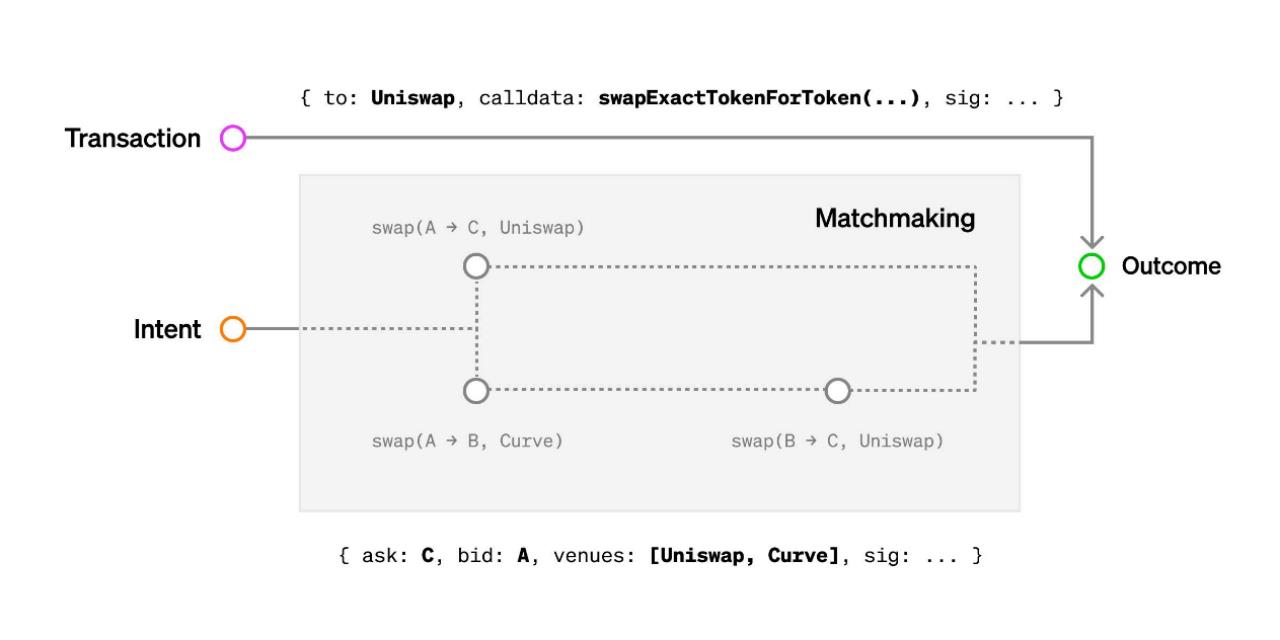
Think of intent like a chef in a restaurant. The user only cares about their desire—ordering a dish—and the end goal—eating it. The chef handles all cooking steps and techniques; you just wait for the meal instead of instructing every detail.
In the Web3 world, intent works similarly. Users simply state what they want, rather than giving step-by-step commands. For example, instead of saying, “I want to transfer funds from account A to B using method XX,” the user says, “I want to send 50 USDC to Old Wang.” The system understands the user's “intent” and takes necessary actions accordingly. This idea of “intent-based transactions” simplifies processes and could revolutionize blockchain and Web3.
How Can Intent Transform Blockchain and Web3?
By comparing the limitations of current transaction models with the advantages of intent-based transactions, we can appreciate how “intent” simplifies complexity in blockchain and Web3.
1. Limitations of Current Transaction Models:
-
Opacity in transaction execution—When submitting a transaction, outcomes heavily depend on network congestion, miner/validator behavior, and overall blockchain state at execution time. This lack of transparency exposes users to attacks such as front-running, back-running, and other forms of Maximum Extractable Value (MEV).
-
Complex cross-network paths—Users often require results that involve atomic coordination across multiple domains, protocols, and decentralized applications.
-
Risks in signature control—By signing raw transactions, users cede significant control and authority to complex smart contract codes and backend infrastructures, granting excessive power to dApps and their creators.
-
Lack of readability—Current models force users to deal with low-level details like nonces, gas fees, and other blockchain intricacies. They offer limited ability to express intent in simple terms aligned with human mental models.
-
Limited flexibility—Transactions provide minimal native support for cross-domain composability, privacy, and other progressive features.
-
Centralization risks—Transactions grant miners, validators, and relayers high discretion, allowing them to easily extract value through reordering, censorship, and other tactics. Lack of visibility into execution amplifies user vulnerability to MEV exploitation.
2. Advantages and Importance of Intent-Based Transactions:
-
Increased user control—Users set constraints without surrendering full authority.
-
Customizable personalization—Users can define personalized parameters such as privacy, atomicity, counterparties, and fees when expressing intent.
-
Flexible cross-domain composability—Intents seamlessly specify outcomes across apps, protocols, and blockchains, expanding possibilities and maximizing user benefits.
-
Mitigation of MEV—Encryption and programmability hinder solvers from extracting value.
-
Enhanced outcomes—Specialized solvers compete to optimize intent fulfillment.
-
Improved readability—Intents align more closely with users’ intuitive mental models of transactions.
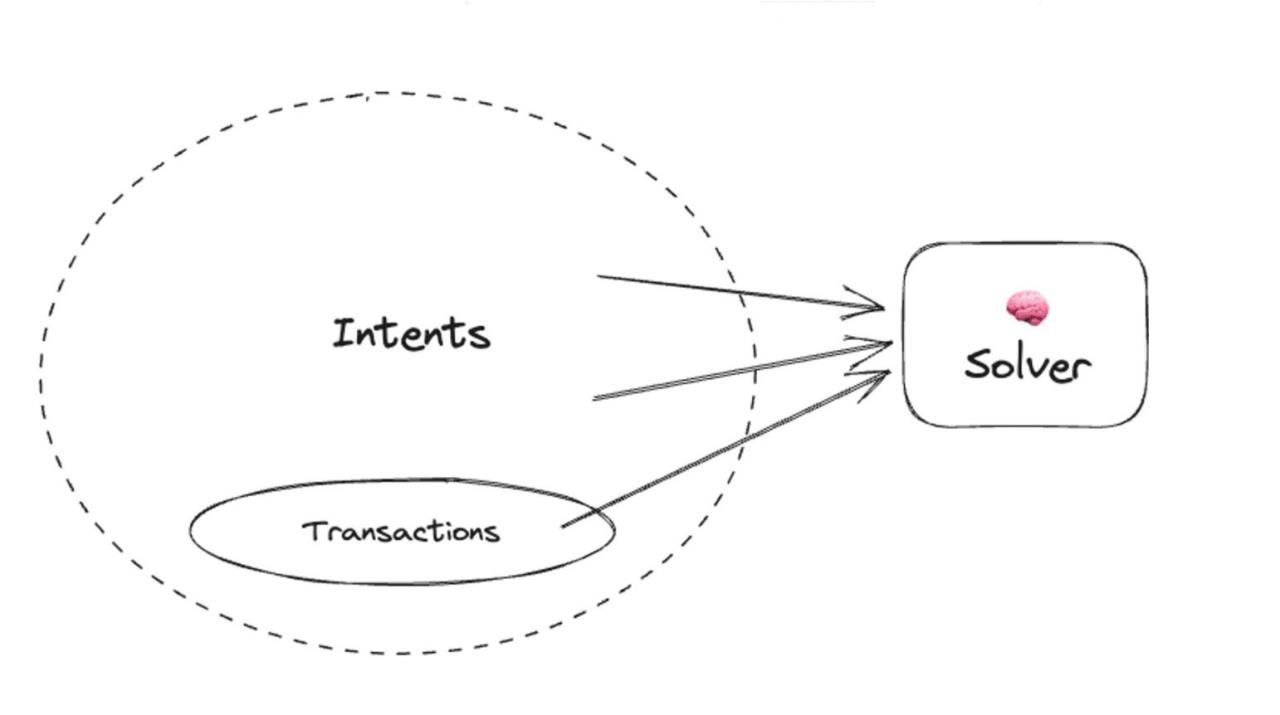
Therefore, the emergence of the intent narrative aims to transform blockchain experiences from manual, step-by-step processes into intuitive, outcome-oriented approaches. It enables smoother transactions, faster execution, and more user-centric experiences—making it a strong candidate to reshape blockchain and Web3.
Featured Projects
1. DappOS
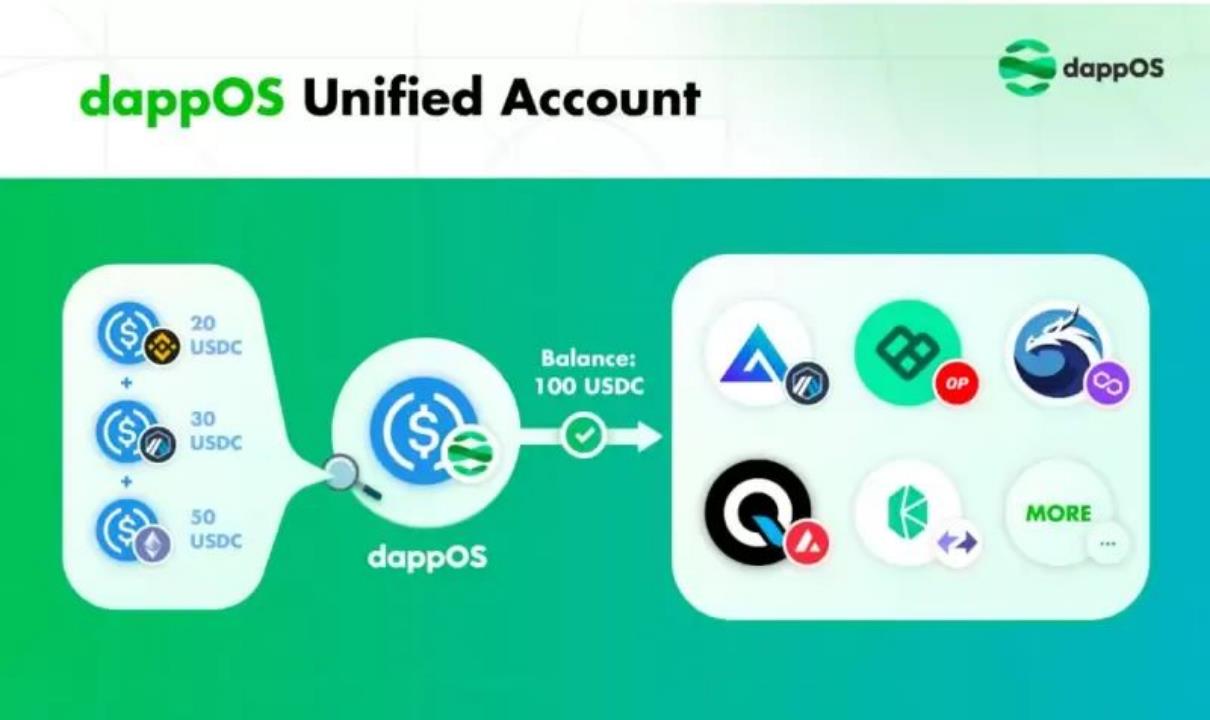
DappOS is an intent-centric protocol designed to help users manage interactions with dApps. As a unified Web3 operations protocol, dappOS introduces an additional layer between users and blockchain infrastructure—including public chains and cross-chain bridges—virtualizing blockchains to deliver one-click, seamless user experiences.
For developers, the platform functions like an App Store: projects deploy once and instantly access traffic across all chains. For users, accessing different Web3 applications via dappOS is as convenient as launching mini-programs within WeChat—requiring only one wallet account to seamlessly interact with apps across various chains.
Key features include:
-
Enhanced account security and recoverability: Features include recovery of accidentally deleted mnemonics and account reset via alternative devices or third-party KYC services.
-
Simplified verification and authorization: One-click completion of complex operations eliminates tedious steps and repeated confirmations, greatly enhancing convenience and reducing friction during dApp usage.
-
High accessibility and user-friendliness: dappOS simplifies complex dApp operations to the extreme, enabling anyone—even those without deep crypto knowledge—to easily access decentralized applications, potentially broadening participation in blockchain and decentralization.
-
Autonomy: DappOS allows users full control over their data and assets, free from third-party interference or restrictions.
Core technologies include dappOS Account and dappOS Network, providing virtual wallet and cross-chain service capabilities. Product offerings such as dappOS SDK and the mini-program platform provide multi-chain deployment solutions for enterprises (B2B) and multi-chain access for end-users (B2C).
In terms of funding, dappOS was selected into Binance Labs’ fifth incubation cohort in November 2022 and received Pre-Seed funding from Binance Labs on June 20, 2023, though the amount was undisclosed. On July 21, 2023, the Web3 operating protocol dappOS announced completion of a seed round at a $50 million valuation, led by IDG Capital and Sequoia China, with participation from OKX Ventures, HashKey Capital, KuCoin Ventures, and others.
2. Anoma Network
Anoma Network is a privacy-preserving, intent-centric protocol for decentralized counterparty discovery, negotiation, and multi-chain atomic settlement. Through smart contracts or protocols, Anoma automatically finds optimal trading solutions for users while ensuring reliability and privacy. Its core intent-driven transaction flow includes:
-
User Interaction: Users broadcast transparent, private, or protected intents via Anoma’s intent gossip layer.
-
Intent Collection and Matching: Solvers collect intents, compute balanced state transitions, and match counterparties. A solver is a smart contract that identifies optimal trade solutions based on user intents and network conditions, generating corresponding transaction data.
-
Transaction Processing: Matched transactions are submitted to an encrypted mempool. Validators receive blocks proposed by proposers and send them to the execution environment, where validity is verified before updating the state root. The execution environment is a secure runtime supporting transparent, secret, and encrypted data types, along with cross-application data interactions.
Anoma’s founding team is highly impressive, co-founded by Brink, Awa Sun Yin, and Christopher Goes, who met while working at All in Bits (also known as Tendermint), the company behind the Cosmos network. All three are co-founders of the Anoma project.
The Anoma team also boasts strong technical expertise, independently developing core technologies including Taiga, Typhon, MASP, Vamp-IR, and Juvix—covering areas such as private computation, cross-chain communication, and circuit programming—demonstrating deep experience in distributed systems and cryptography. Additionally, Anoma maintains rapid product iteration, quickly responding to market demands and launching new products. For instance, Namada, a privacy-focused sharded ledger currently under development, will support Ethereum and IBC chains, enabling assetless interchain privacy communication. With a complete technical stack and solid foundation, Anoma is well-positioned to maintain leadership in cutting-edge fields like intent computing.
Funding-wise, Anoma raised $6.75 million in a private round led by Polychain Capital in 2021, followed by a $26 million raise also led by Polychain. In May 2023, it completed another $25 million round led by CMCC Global.
3. Bob the Solver
Bob the Solver is middleware for intent-based transactions, integrated into wallets and applications to deliver intent-centric user experiences. It consists of two main components:
Interaction Layer:
This layer combines an AI chatbot, an Intent Classifier, and a Transaction Optimizer to accurately recognize and interpret user intent. Once a user expresses their intent, the Solver determines the optimal path to fulfill it.
-
The AI chatbot engages users in conversation, listening to their needs and questions to infer intent. This enables a more natural and intuitive way to interact with blockchain, mimicking human dialogue to help users articulate their intentions clearly.
-
The Intent Classifier is a key technical component that categorizes user intents, grouping different types of user requests. This classification improves accuracy in identifying user intent and passes it efficiently to the Transaction Optimizer.
-
The Transaction Optimizer is the final step in the interaction layer. After intent recognition and path determination, it constructs a series of transactions and sends them to the AA (Account Abstraction) wallet.
Execution Layer:
Composed of the AA wallet system, bundler (a transaction batching smart contract), and LianGuaiymaster (a gas fee management smart contract).
-
The AA wallet system follows EIP-4337 standards, designed for efficient transaction execution. It offers a powerful and streamlined wallet experience for users.
-
Within the AA wallet system, the bundler collects and organizes transactions sent by the Solver. It batches these transactions together to improve efficiency and speed—similar to consolidating packages for faster delivery. This batching mechanism optimizes transaction execution.
-
Another critical component is LianGuaiymaster, a gas fee management smart contract. In blockchain, each transaction requires gas fees. LianGuaiymaster manages these costs, improving both execution efficiency and economic viability through intelligent fee handling.
Bob the Solver gained notable attention at EthCC for its intent-centric approach, leveraging AI as a collaborative third party. This expands the future potential of Solvers and demonstrates a new paradigm of AI+blockchain synergy.
4. Essential
Essential builds intent-based infrastructure and tools to accelerate the shift from value extraction to intent fulfillment, reduce centralization threats posed by MEV, and enhance user satisfaction. The project aims to minimize extractive behaviors, helping users better protect their interests and reduce unfair value loss. Its mission is to advance the transition toward intent fulfillment, improving the efficiency and sustainability of blockchain systems.
In funding news, Essential closed a $5.15 million seed round in September 2023, led by Maven11, with participation from Robot Ventures, Karatage, Batuhan Dasgin, Skip, James Prestwich, Brandon Curtis, Neel Somani (founder of Eclipse), and others. By reducing extractive practices, Essential aims to foster a fairer and more sustainable blockchain ecosystem.
Join TechFlow official community to stay tuned
Telegram:https://t.me/TechFlowDaily
X (Twitter):https://x.com/TechFlowPost
X (Twitter) EN:https://x.com/BlockFlow_News
 @TrendX_official




