Interpreting Satoshi Nakamoto's Early Vision for BitDNS: Independent Network, CPU Sharing, Incentives, and Domains
TechFlow Selected TechFlow Selected
Interpreting Satoshi Nakamoto's Early Vision for BitDNS: Independent Network, CPU Sharing, Incentives, and Domains
BitDNS and Bitcoin can be used separately; users do not need to download all content in order to use either one.
 Navigating Web3 tides with focused insights
I collected all of Satoshi Nakamoto's posts regarding BitDNS to better understand his views on using the Bitcoin network for domain names.
BitDNS/Namecoin is an early derivative project of Bitcoin, proposed by Satoshi Nakamoto in April 2010. Below are translations of Satoshi’s original forum posts:
Post 1
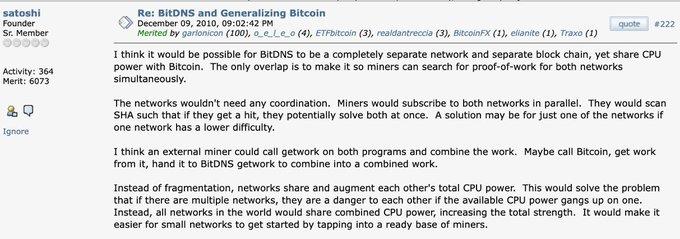
“I think BitDNS could work as a completely separate network and independent blockchain, but sharing CPU power with Bitcoin. The only overlap would be allowing miners to simultaneously search for proof-of-work for both networks.
The two networks don’t need any coordination. Miners can independently subscribe to both networks. If they get a hit while scanning SHA, they might solve both networks at once. If one network has lower difficulty, it may only solve that one.
I think an external miner could call getwork from both programs and merge the work. Perhaps call getwork from Bitcoin and pass it into BitDNS’s getwork to create a combined workload.
This way, different networks can share and increase total CPU power instead of fragmenting it. This addresses the danger posed when multiple networks exist—available CPU power could gang up and attack one network. Instead, all networks worldwide would share combined CPU power, increasing overall strength. This makes it easier for small networks to launch by leveraging the existing mining base.”
Question from a user: Miners would essentially have to do “extra work.” If mining bitdns doesn't yield rewards for this extra effort, what incentive do miners have to include bitdns (or any other sidechain)?
Post 2
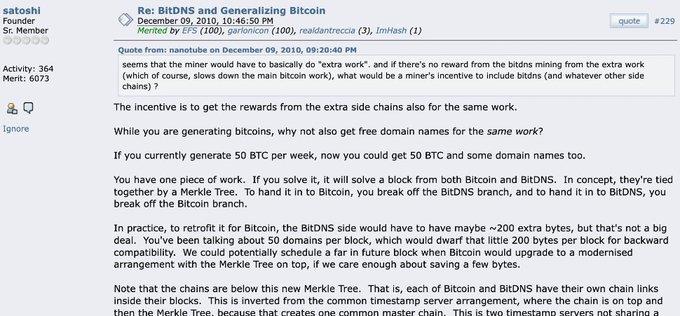
Satoshi: “The incentive is earning rewards from the sidechain for the same work.
When you generate Bitcoin, why not get free domains for the same work?
If you currently generate 50 BTC per week, now you could also get 50 BTC plus some domains.
You have one piece of work. If you solve it, it will solve blocks from both Bitcoin and BitDNS. Conceptually, they’re linked together via a Merkle tree. To submit to Bitcoin, you’d detach the BitDNS branch; to submit to BitDNS, you’d detach the Bitcoin branch.
In practice, modifying for Bitcoin might require about 200 extra bytes on the BitDNS side, but that’s not a big issue. You’ve been talking about 50 domains per block, which would dwarf the backward compatibility of 200 bytes per block. If we cared enough about saving bytes, we might arrange a future upgrade where Bitcoin adopts a Merkle tree structure at the top.
Note that the chains sit beneath this new Merkle tree. That is, Bitcoin and BitDNS each maintain their own chain within their respective blocks. This contrasts with the common timestamp server arrangement where the chain sits on top and the Merkle tree below, since that creates a public main chain. Here we have two timestamp servers that don’t share a chain.”
Post 3
Regarding BitDNS fees, here’s a potential design for the distant future:
“You deliberately write a double-spend. You can write it with the same inputs and outputs, but this time include a fee. When your double-spend enters a block, the first spend becomes invalid. The recipient doesn’t really notice because at that moment the new transaction becomes valid, the old one invalid, and the new one simply replaces it.
Easier said than done. It requires substantial work to make clients correctly create double-spends, manage two versions in wallets until one is chosen, and handle all edge cases. Every assumption in the existing code assumes you won’t try to create double-spends.
Some changes are also needed on the Bitcoin miner side to accept double-spends into the transaction pool, provided inputs and outputs match and the transaction fee is higher. Currently, the transaction pool never accepts double-spends, so each node effectively witnesses whichever transaction it sees first by including it in a block.”
Post 4
“Stacking every proof-of-work system in the world into one dataset isn’t scalable.
Bitcoin and BitDNS can operate separately. Users don’t need to download both to use either one. BitDNS users probably don’t want to download everything that unrelated networks decide to pile on later.
Networks need to have different destinies. BitDNS users could freely add any large data features since relatively few domain registrars are needed, while Bitcoin users might increasingly impose strict limits on chain size to keep it accessible for large user bases and small devices.
Concerns about securing domain purchases with Bitcoin are distractions. It’s easy to exchange Bitcoin for other non-repudiable goods.
If you’re still concerned, you can conduct risk-free trades cryptographically. Both parties set up transactions such that when both sign, the second signer’s signature triggers the release of both. The second signer cannot release one without releasing the other.”
Post 5
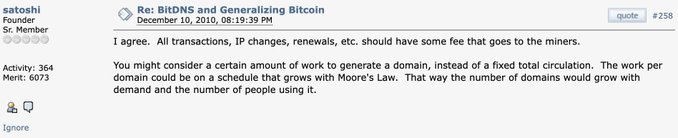
“I agree. All transactions, IP changes, renewals, etc., should charge miners a fee.
Instead of a fixed total supply, consider requiring a certain amount of work to generate domains. The work required per domain could follow a schedule aligned with Moore’s Law. This way, the number of domains grows along with demand and user adoption.”
Summary
Satoshi highlighted several key points:
1. BitDNS can be a fully independent network and independent blockchain (Satoshi believed BitDNS should not run on the Bitcoin network), yet share CPU power with Bitcoin. The only overlap is enabling miners to simultaneously search for proof-of-work on both networks.
2. External miners can call the getwork method from both programs and merge the workloads. They could fetch work from Bitcoin and pass it to BitDNS’s getwork to form a combined workload.
3. Different networks can share and strengthen their collective CPU power rather than fragment it. This avoids the danger of multiple networks competing, where concentrated CPU power could threaten weaker ones. Instead, all global networks would share merged CPU power, enhancing overall security. This allows smaller networks to bootstrap more easily by leveraging existing miners.
4. Miners can earn rewards from both Bitcoin and BitDNS through the same work. Why not get free domains while generating Bitcoin?
5. BitDNS and Bitcoin can be used independently—users don’t need to download both chains entirely to use one. BitDNS users likely wouldn’t want to download content piled on by unrelated networks.
6. A longer block interval than 10 minutes would be more suitable for BitDNS.
7. Fees should be charged to miners for transactions, IP record updates, renewals, and similar actions.
8. Domain generation should require computational work rather than rely on a fixed total supply. As demand increases, the number of domains would grow accordingly.
Join TechFlow official community to stay tuned
Telegram:https://t.me/TechFlowDaily
X (Twitter):https://x.com/TechFlowPost
X (Twitter) EN:https://x.com/BlockFlow_News
 @off_thetarget