








The Sea of Change in Cryptocurrency: Industry Trend Predictions for the Next Decade
TechFlow Selected TechFlow Selected
The Sea of Change in Cryptocurrency: Industry Trend Predictions for the Next Decade
This article primarily considers how the future of crypto will be shaped.
 Navigating Web3 tides with focused insights
Written by: 0XKYLE
Translated by: TechFlow
Following Howard Marks' concept of a "Sea Change," I've been compelled to reflect on an intriguing cognitive dissonance that seems widespread among investors. As Marks wisely noted, "self-deception causes people to hold onto their views long after information contradicting those views has arrived."
Over the past six months, a persistent unease has taken root in my thoughts—particularly regarding the future of cryptocurrency. I'm immersed in Crypto Twitter, surrounded by optimism—by individuals who, due to their professional roles or environments, are compelled to remain loyal to the industry. This distorts our perception and inherently biases the information we consume daily.
Take Arthur Hayes as an example. He writes many insightful pieces about macroeconomic conditions, yet his narrative inevitably culminates in reverence for the great "Satoshi." Why wouldn't it? Someone who once founded a crypto exchange and now runs a family office fund investing in the "decentralization of everything" must maintain a bullish stance on crypto, right?
This is precisely where the dissonance lies. The nagging discomfort in my chest pushed me to step back and ask myself: What's different this time?
Howard Marks calls this a Sea Change. Today, as we move toward an uncertain geopolitical future and a more turbulent economic environment, I believe it is prudent—and even necessary—to re-evaluate our beliefs about the crypto market.
As investors, and more importantly, as individuals placing a significant portion of our future on crypto, we must constantly question what we believe. We cannot and should not settle into complacency, assuming "the next halving will give us momentum."
Thus, this article serves as my thinking journal, reflecting on how the future of crypto might unfold.
Let’s begin with some simple but high-probability facts.
1. The future is likely non-zero interest rates
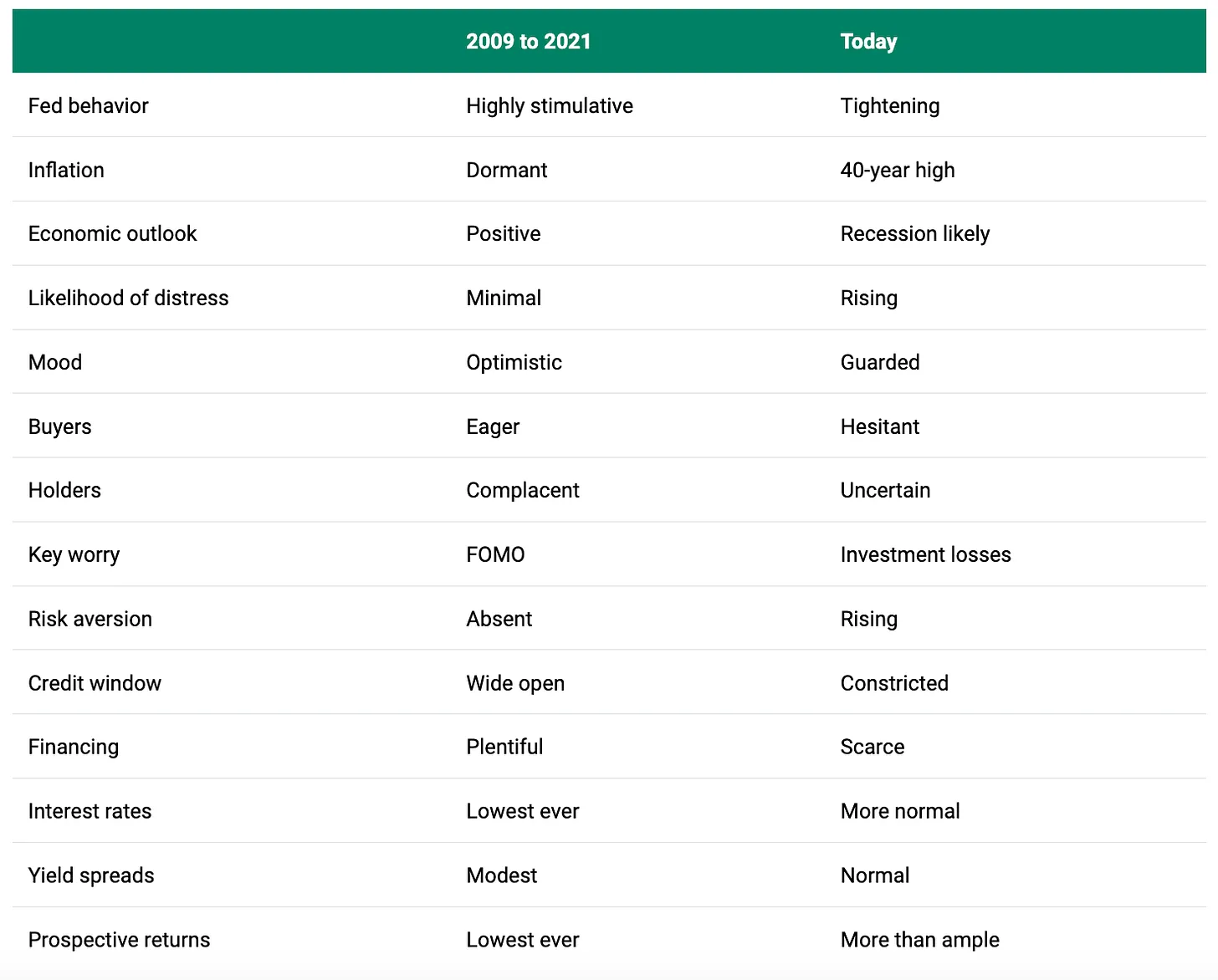
Consistent with Howard Marks’ insightful observations in “Sea Change,” the likelihood of the Federal Reserve returning to a zero-interest-rate era appears increasingly slim. For over four decades, we’ve benefited from declining interest rates. The argument for maintaining a “neutral rate”—one that neither stimulates nor restrains the economy—now seems more reasonable. This stance would preserve flexibility for future economic stimulus measures, a concept the Fed clearly wishes to retain.
The path forward may involve a shift from the current rate environment. The key question is the degree of decline—I lean toward a 0–2% trajectory rather than a 2–4% range.
2. Therefore, a bull market like 2020–2021 won’t repeat
This point is crucial because, as investors, we must adjust our expectations.
The 2020–2021 bull run wasn’t just a zero-interest phenomenon; it was a confluence of multiple factors: venture capital inflows, billion-dollar exchanges, algorithmic stablecoins, and highly leveraged hedge funds.
Around every corner, in every café you entered—people were talking about crypto. Even if we return to zero interest rates, replicating a bull market of similar scale and speed seems unlikely.
3. Returns will be lower, but crypto’s selling point remains its superior performance
This isn’t to say we won’t experience bull markets. Adjusting expectations is prudent. Anticipated returns will be more concentrated and less sustained.
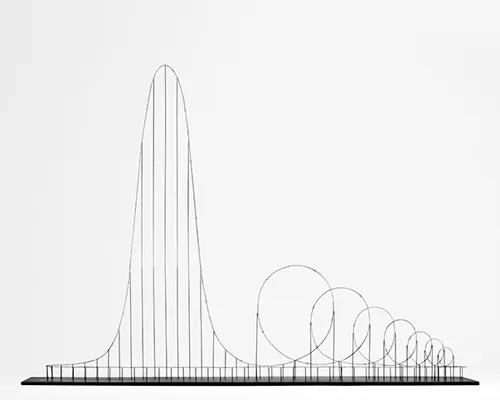
This doesn’t negate the intrinsic appeal of the crypto market. The total market cap of the entire crypto industry is still 23 times smaller than Apple’s market cap. Given such substantial growth potential, its value proposition shouldn’t be underestimated—a whole industry, whose technological applications are still in early stages, priced at roughly the same level as a single FAANG company.
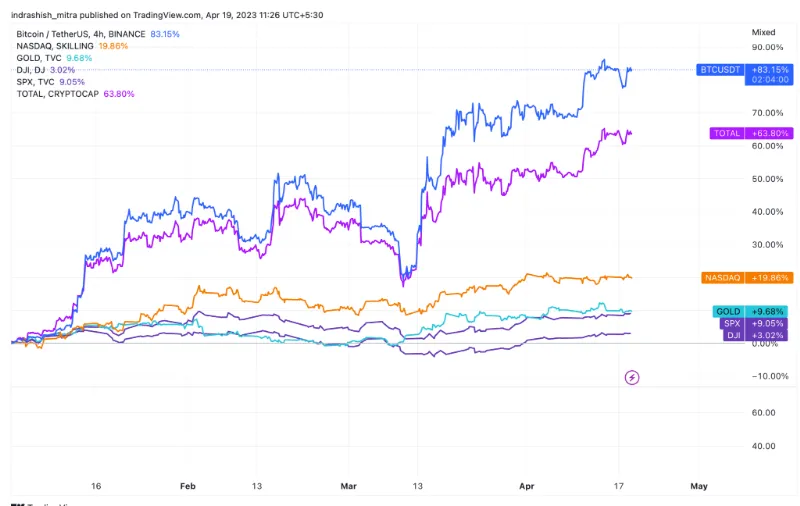
Add to this the fact that Bitcoin has outperformed nearly all other assets year-to-date, making its case difficult for investors to ignore. This trend is pushing asset managers to seriously consider introducing clients to Bitcoin investments within regulatory compliance frameworks.
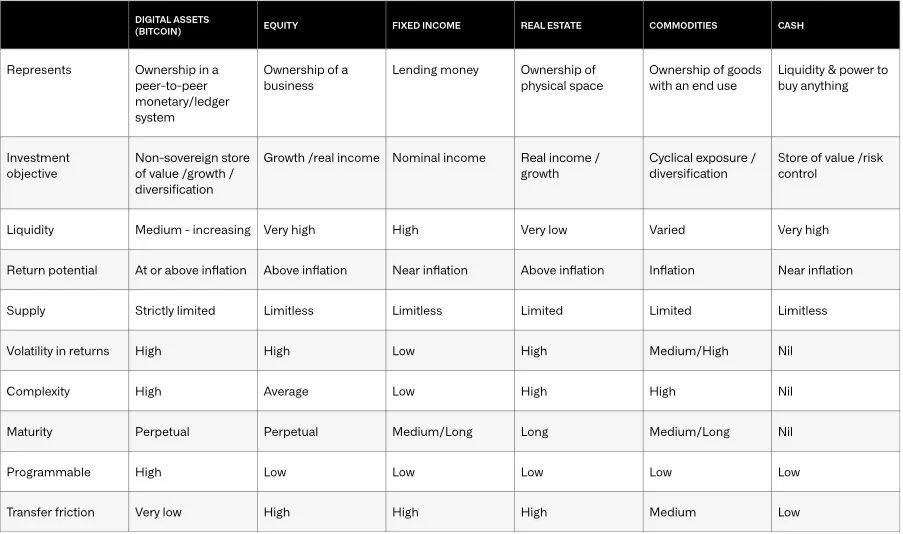
Digital assets have emerged as a new asset class, akin to commodities in the 1990s—both faced immense skepticism regarding investment suitability.
4. Traditional finance wants in on the game
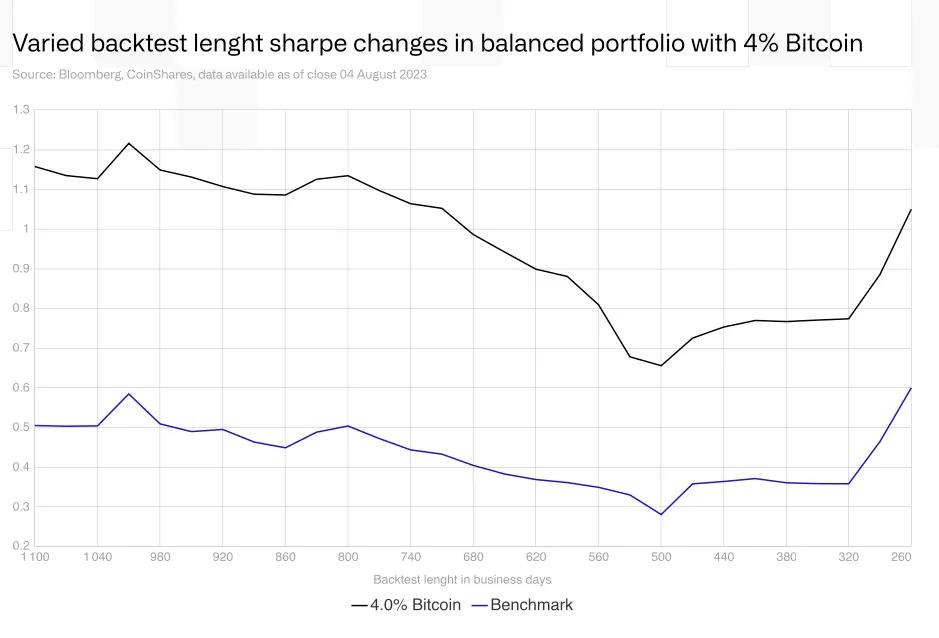
Therefore, I believe increasing adoption of digital assets in portfolios has become standard. In a high-interest-rate environment, where the benchmark is the 2-year Treasury yield, crypto offers excess returns above other assets with manageable risk—as shown above, a 4% allocation to Bitcoin does not materially increase maximum drawdown relative to other assets, while delivering nearly double the annualized return.
Specifically, CoinShares reports:
-
A small Bitcoin weight significantly improves the Sharpe ratio compared to other alternative assets;
-
A small Bitcoin weight also substantially enhances portfolio diversification relative to other alternatives;
Longtime crypto natives have long heard the phrase “traditional finance is coming” and responded with skepticism. After all, it’s repeated in every cycle.
But I genuinely believe the coming decade will see gradual, sustained inflows of capital from traditional financial institutions, as regulatory frameworks and supporting infrastructure begin to take shape. Indeed, surveys show investors cite regulation as the biggest barrier to purchasing digital assets.
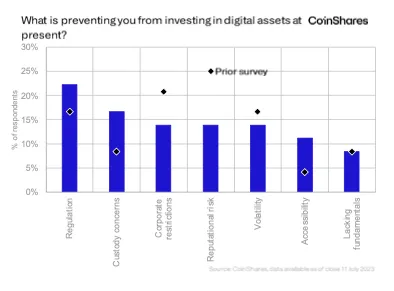
I believe the green light they’re waiting for is the approval of a Bitcoin ETF—one whose impact depends not only on its submission but also on the reputation of the proposing entity. Participation by financial giants like BlackRock carries profound significance. It signals growing confidence from traditional institutions in the digital asset space.
5. With TradFi comes a shift in narratives
Bitcoin has had two primary narratives so far:
-
In its growth phase, Bitcoin behaves like a tech stock;
-
In its mature phase, Bitcoin acts as a store of value.
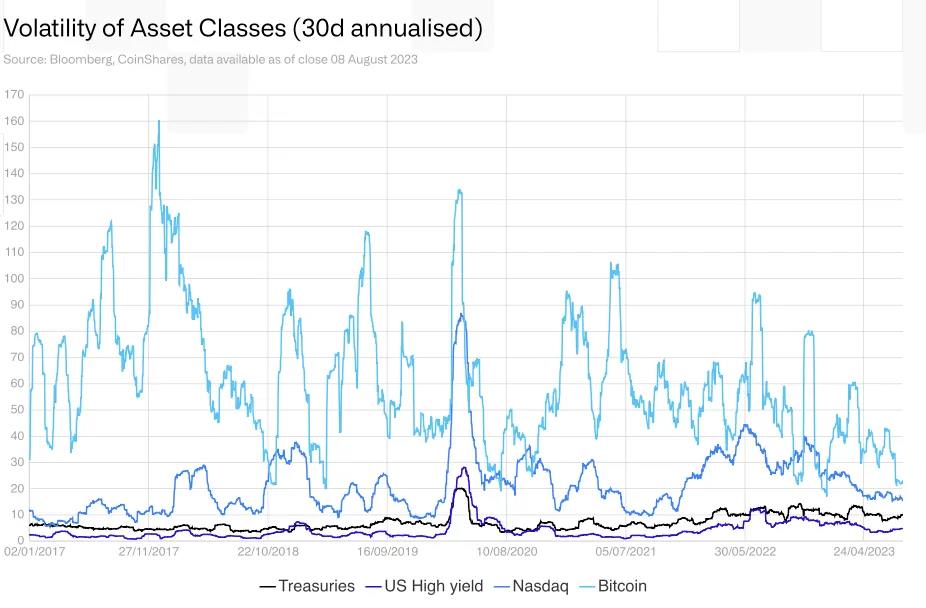
I believe that in the coming years, amid rising economic turbulence, the second narrative will dominate. As Bitcoin matures, this suits it well—declining volatility strengthens its case as a “store of value.”
Narratives play a pivotal role in crypto—they’re often driven by price dynamics. But evolving environments demand enlightenment and adaptability.
6. Many tokens will converge toward their fundamental value
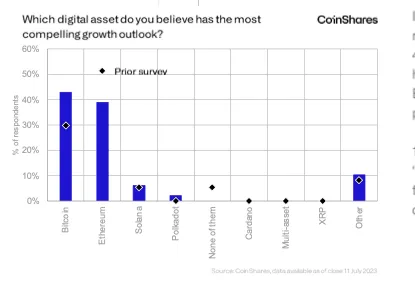
This will be a consequence of Bitcoin—and the industry as an asset class—maturing. As the survey above shows, many traditional investors aren’t particularly interested in altcoins.
The entry of traditional finance will bring more typical valuation models from the traditional financial world. This shift could prompt a reassessment of digital assets’ fundamental value, potentially revealing that many governance tokens are indeed worthless.
Other less certain ideas
The five points I’ve listed form what I believe are the solid foundational pillars upon which digital assets will stand as they enter the next decade. From these foundations, I derive the following predictions—clearly more speculative, yet I include them nonetheless.
The future is permissionless and private
Large financial institutions will need private blockchains to meet client demands and may not be able to rely too heavily on existing public chains, where a single mistake could result in millions of dollars in losses.
DeFi emerges as a distinct “asset class” separate from traditional digital assets
However, I do think the chance of DeFi remaining unregulated is small—but rather, traditional finance will simply be prohibited from doing business with it.
Smaller nations will adopt Bitcoin in sovereign wealth funds
The narrative of Bitcoin as a store of value is self-fulfilling. I wouldn’t be surprised if certain countries begin buying Bitcoin as a substitute for dollars or gold.
RWA tokenization, AI x crypto, and energy x blockchain will become central
I believe these three narratives have the potential to become the most dominant over the next decade. In particular, the energy market has seen some interesting innovations in carbon credits (e.g., KlimaDAO), and I see strong innovation potential here.
Validators as a source of yield
This seems most plausible for Ethereum. Clients seeking yield-bearing digital asset exposure could purchase an “LSD-style” product denominated in ETH, offering staked ETH APY.
That concludes my outlook for the next decade. The coming ten years will be a pivotal moment when digital assets take center stage, and I look forward to seeing my ideas come to fruition.
Join TechFlow official community to stay tuned
Telegram:https://t.me/TechFlowDaily
X (Twitter):https://x.com/TechFlowPost
X (Twitter) EN:https://x.com/BlockFlow_News
 @0xkyle__






