








In-depth Analysis of South Korea's Digital Currency Trading and User Preferences
TechFlow Selected TechFlow Selected
In-depth Analysis of South Korea's Digital Currency Trading and User Preferences
This report was prepared by the Korean Financial Intelligence Unit based on information submitted by 35 virtual asset businesses.
 Navigating Web3 tides with focused insights
Compiled & Written by: Karen, Foresight News
This week, South Korea's Financial Services Commission's Financial Intelligence Unit (KoFIU) released its 2023 first-half report on virtual asset businesses. The 20-page report covers 35 virtual asset firms—26 exchanges and 9 wallet and custodial service providers—to present an overview of the current state of South Korea's virtual asset market.
This report is compiled by KoFIU based on data submitted by these 35 firms, offering a relatively accurate reflection of market conditions. Foresight News has summarized and distilled ten key takeaways to help readers understand the real state of South Korea’s virtual asset market and local investor preferences.
TL;DR:
-
During the first half of the year, the 26 South Korean exchanges recorded an average daily trading volume of $2.168 billion, down 1.3% quarter-on-quarter, with the KRW market dominating overwhelmingly while non-KRW market volumes were negligible.
-
The total operating profit for the 26 virtual asset exchanges was $170 million, up 82% quarter-on-quarter.
-
The 26 exchanges employed a total of 1,915 staff, with part-time workers accounting for 32.8%.
-
South Korea's domestic virtual asset market cap stands at approximately $21.2 billion, up 46% from the end of last year.
-
XRP remains highly attractive to Korean users, second only to Bitcoin.
-
The 26 exchanges had around 9.5 million registered users (including duplicates), with 6.06 million active traders.
-
73% of Korean users hold less than $747 in virtual assets, while only 0.7% hold more than $74,600.
-
Wallet and custodial services reported an operating profit of $2.61 million in the first half, down 71% quarter-on-quarter.
1. Average Daily Trading Volume at Korean Exchanges Was $2.168 Billion in H1, Down 1.3% Quarter-on-Quarter
In the first half of 2023, the 26 virtual asset exchanges recorded an average daily trading volume of 2.9 trillion KRW (approximately $2.168 billion), a 1.3% decline compared to the second half of 2022.
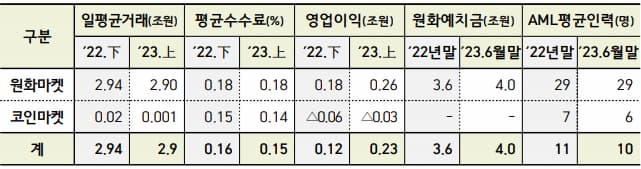
Trading within the KRW market dominated overwhelmingly, while trading volume in token markets (non-KRW) was negligible. Five exchanges recorded average daily token market trading volumes below 1 million KRW ($747).
As shown in the monthly chart below, trading volumes at Korean exchanges have been on a continuous downward trend since February this year.
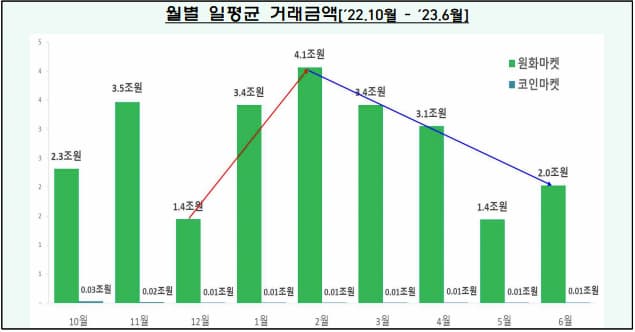
Trend in average daily trading volume at Korean exchanges from October 2022 to June 2023 (monthly data)
2. Total Operating Profit for Korean Exchanges Was $170 Million, Up 82% Quarter-on-Quarter
In the first half, the 26 virtual asset exchanges posted a total operating profit of $170 million, up 82% from $93 million in the second half of 2022 (which included a particularly low profit in Q4 2022).
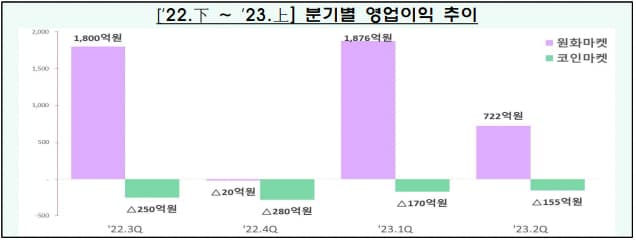
Quarterly operating profit trends (purple represents KRW market, green represents token market)
As seen in the chart above, operating profits from the KRW market dominate. Among the 21 exchanges operating token markets, 10 charged zero fees for token market transactions, and 18 were operating at a complete capital loss.
Fee rates at Korean exchanges range from 0.01% to 0.25%, with an average fee rate of 0.15%, down 0.01 percentage points from the second half of 2022. The average fee rate for the KRW market is also 0.15%.
3. Exchange KRW Deposits Near $3 Billion, Up 11% Since Year-End
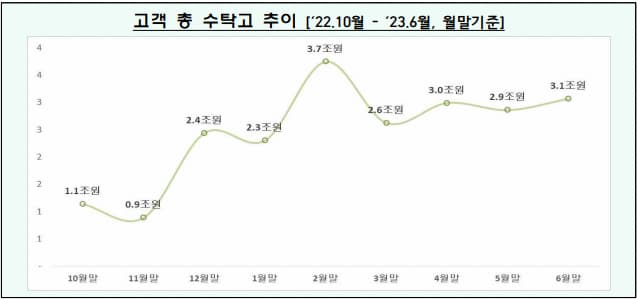
As of the end of June, exchange KRW deposits totaled 4 trillion KRW (nearly $3 billion), an 11% increase from the end of last year.
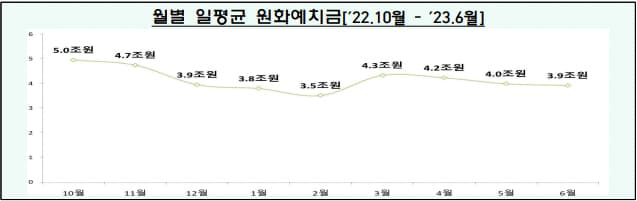
Average daily KRW deposit amounts by month (in trillion KRW)
4. 26 Exchanges Employed 1,915 Staff, with Part-Time Workers Accounting for 32.8%
The 26 exchanges had an average of 74 employees each, totaling 1,915 staff—178 fewer than at the end of last year. Of these, 269 (13.5%) worked in anti-money laundering (AML) roles. Additionally, part-time workers accounted for 32.8% of total staff.
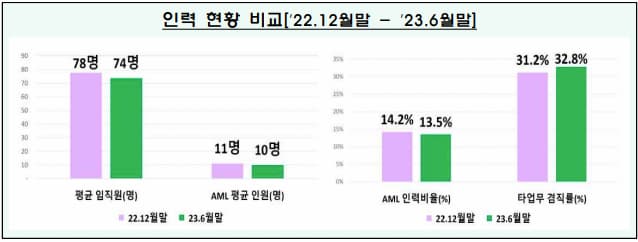
Exchange staffing status (green indicates data as of June 2023, purple indicates data as of November 2022; left chart shows average number of employees and AML staff per exchange, right chart shows proportion of AML and part-time staff)
5. 26 Exchanges Listed a Total of 622 Unique Virtual Assets
After removing duplicates, the 26 exchanges listed 622 unique virtual assets, similar to the previous reporting period. The largest number of virtual assets listed by a single exchange was 236, while the fewest was 3. On average, exchanges supported 163 tokens in the KRW market and 28 in the token market.
Among them, 366 virtual assets (59%) were listed exclusively on just one Korean exchange. There were significant changes in listings and delistings during the first half of 2023: exchanges added 169 new tokens (including duplicates), up 128% quarter-on-quarter, and delisted 115 tokens (including duplicates), up 47% quarter-on-quarter. Of the delisted tokens, 66% were previously available only on a single Korean exchange.
Key factors considered for delisting include project risk, investor protection risk, market risk, and technical risk.
6. Which Tokens Are Preferred by Korean Users?
South Korea's domestic virtual asset market cap is estimated at around $21.2 billion, up 46% from the end of last year. KoFIU defines this figure as the sum of each virtual asset held by Korean exchanges multiplied by its market price.
Six of the top ten virtual assets by market cap in Korea are also among the global top ten: BTC, XRP, ETH, DOGE, ADA, and SOL. As shown in the chart below, XRP is particularly popular among Korean users, ranking second only to Bitcoin.
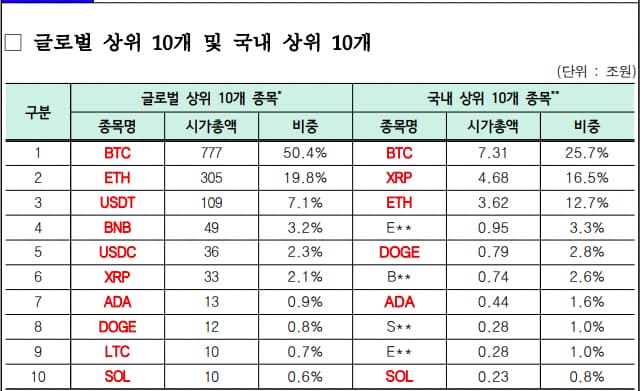
From left to right: top ten virtual assets by market cap globally and in Korea (in trillion KRW)
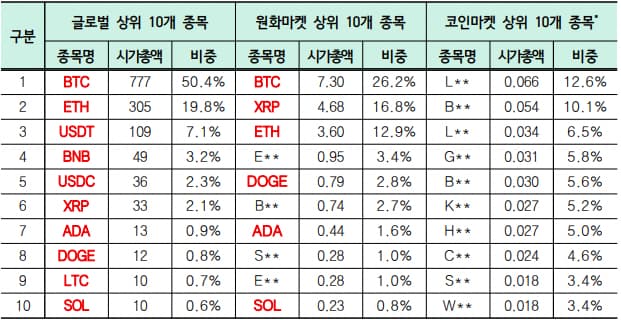
From left to right: top ten virtual assets by market cap globally, in Korea's KRW market, and in Korea's token market (in trillion KRW)
In Korea’s token market top ten by market cap, all but one asset (W**) are exclusive to a single exchange.
7. Inter-Exchange Virtual Asset Transfers in Korea Totaled $22.2 Billion, With 22% Complying with Travel Rule
In South Korea, when users transfer virtual assets valued over 1 million KRW ($746) between domestic exchanges, they must provide sender and recipient information (effective March 25, 2022). For transfers to overseas exchanges or personal wallets, such transactions are permitted only if both parties are verified and the receiving address is pre-registered (whitelisted).
Regarding inter-exchange transfers within Korea, the total value transferred reached $22.2 billion, down 3% from the second half of 2022. Of this amount, transfers complying with the Travel Rule totaled approximately $4.9 billion.
For transfers to foreign exchanges and personal wallets, the total value of single transactions exceeding 1 million KRW sent to pre-registered overseas addresses amounted to $16.5 billion, suggesting these transfers may be used for arbitrage or other trading strategies.
8. Exchange User Statistics: 9.5 Million Registered Users, 6.06 Million Active Traders
In terms of users, the 26 exchanges had approximately 9.5 million registered users in the first half of 2023 (including duplicates, excluding dormant accounts), down 19% quarter-on-quarter, possibly due to an increase in dormant accounts or users consolidating multiple accounts into one.
However, the number of active trading users was 6.06 million (including duplicates, excluding dormant accounts), down 3% quarter-on-quarter. Of these, nearly 5.97 million traded in the KRW market, while only 95,000 traded in the token market.
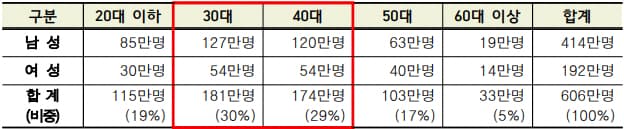
By age group, users in their 30s were the largest cohort, numbering 1.15 million (30%), followed by those in their 40s (29%) and 20s (19%). Among trading users, males numbered 4.14 million (68%), while females accounted for 1.92 million.
9. 73% of Korean Users Hold Less Than $747 in Virtual Assets, 0.7% Hold Over $74,600
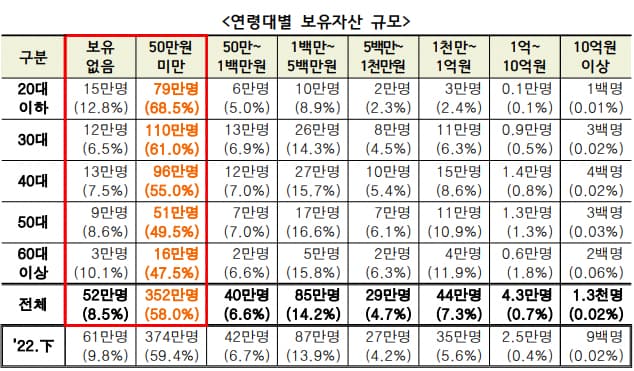
Regarding user holdings, 67% of users hold less than 500,000 KRW ($373) in virtual assets, and 73% hold less than 1 million KRW ($747). Users holding over 10 million KRW ($7,463) account for 8%, while those holding over 100 million KRW ($74,600) represent 0.7% (approximately 44,000 users).
10. Status of Wallet and Custodial Services: Operating Profit of $2.61 Million in H1, Down 71% Quarter-on-Quarter
The nine virtual asset wallet and custodial firms managed a total value of $2.313 billion, up 29% from the end of 2022. By user type, corporate clients held $2.239 billion in custody (average of $18 million per company across 122 companies, with 60 holding zero), while individual users held about 0.1 trillion KRW ($75 million), averaging $268 per person among 303,000 individuals. By service type, custody services held $2.164 billion, while wallet service deposits totaled $75 million.
Additionally, the nine wallet and custodial firms reported an operating profit of 35 billion KRW (approximately $2.61 million), down 71% from 118 billion KRW in the second half of 2022.
These nine firms employed a total of 272 staff, including 28 working in AML-related roles.
Join TechFlow official community to stay tuned
Telegram:https://t.me/TechFlowDaily
X (Twitter):https://x.com/TechFlowPost
X (Twitter) EN:https://x.com/BlockFlow_News
 Foresight News










