Monolithic vs Modular: Who Holds the Future of Blockchain?
TechFlow Selected TechFlow Selected
Monolithic vs Modular: Who Holds the Future of Blockchain?
Perhaps modular chains will ultimately win, or perhaps the monolithic architecture will prove to be the better design.
 Navigating Web3 tides with focused insights
Author: Kodi, espresso
Translated by: TechFlow

In 1992, computer scientist Andrew Tanenbaum declared that Linux was dead. If you're unfamiliar with Linux, it's an operating system popular among hardcore computer users.
Tanenbaum claimed Linux was doomed because of its kernel design. The kernel is like the engine of an operating system, responsible for carrying out various tasks that keep a computer running.
Linux uses a monolithic kernel, meaning the entire operating system runs as a highly integrated unit.
But in the 1990s, Tanenbaum and others believed microkernels might replace traditional monolithic kernels. In a microkernel architecture, the core kernel stays minimal, while most services provided by monolithic kernels are instead implemented as small, independent modules.
A project called GNU Hurd aimed to replace Linux’s monolithic kernel with a microkernel alternative.
So how did things turn out?
If you happen to be reading this article on an Android phone, then you're actually using a modified version of the Linux kernel.
Although not dominant in personal computing—where Microsoft Windows and Apple Mac prevail—Linux powers 40% of embedded systems (computers designed for specific tasks, such as traffic light controllers), 70% of smartphones, and 80% of all web servers.
Oh, and all 500 of the world’s fastest supercomputers run Linux too.
Meanwhile, GNU Hurd remains under development to this day.
If this already sounds familiar, then you understand that a similar debate is now raging in the cryptocurrency space—one with major implications for the future of Ethereum and other Layer 1 blockchains.
Monolithic vs Modular
In blockchain architecture, there are two primary approaches. The first is monolithic design. As the name suggests, this means a single blockchain handles all functions.
We can break down a monolithic chain into four functional components: execution, settlement, consensus, and data availability.
Let’s walk through the steps of an Ethereum transaction to better understand them.
Suppose you buy an NFT. First comes execution: nodes process the transaction, transferring the NFT to your wallet.
Next is settlement—recording the transaction irreversibly onto the blockchain. Proof that the transaction occurred is now permanently stored and tamper-proof.
Then comes consensus, where decentralized network nodes validate the transaction as legitimate.
Finally, data availability ensures transaction details are published across the peer-to-peer network so all nodes can access the data as needed.
Now you own your NFT, everyone agrees you own it, and anyone can verify it.
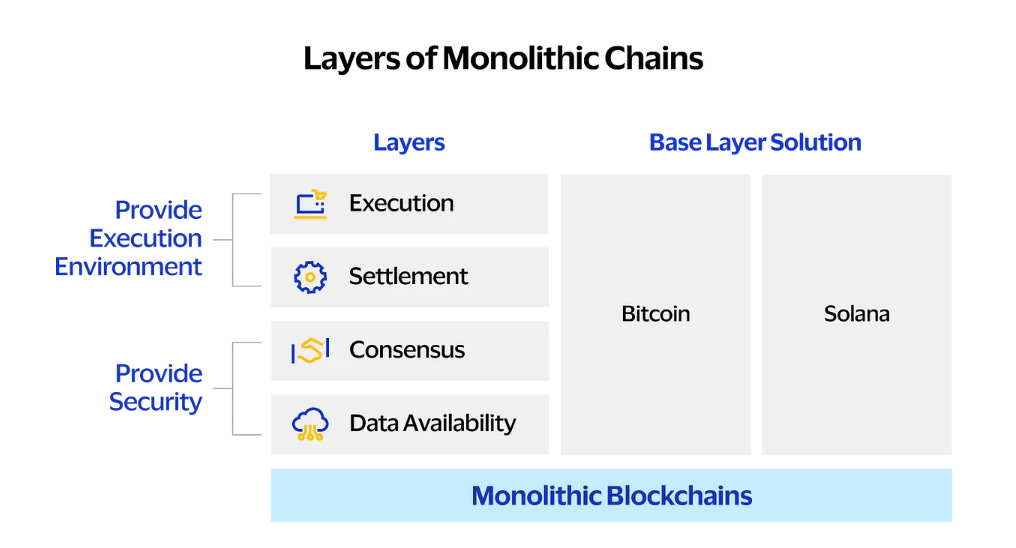
Early blockchain projects like Bitcoin, Ethereum, and Solana use monolithic architectures—handling all these steps within one unified system.
But early blockchain designs are like the first pancake you ever baked as a kid: messy, inefficient, full of compromises and suboptimal choices. So far, nearly all blockchains have failed to deliver decentralization, security, and scalability at reasonable cost.
This makes them poorly suited for mass adoption.
The clearest example is Ethereum. Revolutionary as the first general-purpose smart contract platform, Ethereum has struggled to scale due to low transaction throughput and high fees.
Seeing Ethereum’s limitations, many in crypto have turned to modular blockchains as a potential solution.
Modular architectures assign different responsibilities to specialized chains.
Why force one chain to handle everything—consensus, execution, data availability? Specialized modular chains can focus on doing one thing well.
For example, you could leave consensus and data availability to one chain, while delegating execution and settlement to another. That’s what sovereign rollups look like.
The rollups you typically see on Ethereum—like Arbitrum or Optimism—are modular chains specializing in execution, while relying on Ethereum for settlement, consensus, and data availability.
Ethereum’s ultimate goal, as envisioned by Vitalik, is to become a foundational settlement layer for other rollups. This design is widely seen as best practice in blockchain architecture.
Proponents of modularity argue that breaking blockchains into Lego-like components enables greater customization and scalability.
But I believe the enthusiasm for modular design stems largely from where Ethereum currently stands.
The reality is, Ethereum cannot handle large volumes of activity. Even the most loyal Ethereum fans would agree on this.
Yet Ethereum has accumulated massive capital—both financial and human. It secures the highest settlement value, hosts the most innovation, and attracts top talent.
Therefore, it’s no surprise that significant resources are being invested in advancing Ethereum toward a modular future, rather than building a superior monolithic chain.
Ethereum advocates will tell you the debate is over—that modular blockchains are inherently superior to monolithic ones. Monolithic chains, they claim, are incompatible with high-performance, decentralized, secure systems.
However, as we’ll see below, modular architectures come with their own hidden costs—and may fail to deliver on their promised benefits.
The Core Flaw of Modular Chains
First, monolithic blockchains outperform modular ones.
I'll say it outright.
I know this may contradict mainstream opinion, but there is no evidence that modular chains are superior to monolithic ones.
As I mentioned earlier, the highest-performing computers run monolithic kernels. Blockchains aren’t fundamentally different. If you look at today’s fastest public chains—Solana, Sui, Aptos—they’re all monolithic.
Partly because all transactions on a monolithic chain execute on a single, integrated chain. Transactions flow internally like pipelines without waiting for data across separate chains. The absence of fragmentation allows for efficient processing.
Monolithic chains are also simpler. Simplicity is good—especially for highly complex systems.
Users and developers only need to interact with one system, avoiding coordination across multiple complex modules.
Monolithic chains are also inherently more secure. By keeping validators within the same network, they reduce the attack surface compared to modular chains. Not to mention how insecure cross-chain bridges are.
Finally, monolithic chains reduce communication overhead by avoiding excessive cross-chain messaging. Modular systems require extensive inter-chain communication to coordinate activities, introducing bandwidth, latency, and cost burdens.
In short, monolithic integration improves performance, simplicity, security, liquidity, and operational costs.
Simply modularizing functions doesn't automatically make a system better.
Moreover, modular chains—at least in Ethereum’s current vision with rollups—have a critical flaw that monolithic chains have already solved, as explained by Solana co-founder Anatoly Yakovenko:
Solana was designed from the start to handle concurrent programs with different requirements without interfering with each other.
I think modularity doesn't solve the problem of handling concurrent use cases—each L2 is a single-threaded runtime facing the same issues Ethereum L1 faces today.
What Anatoly means is that Ethereum, particularly the Ethereum Virtual Machine (EVM), processes transactions sequentially—one after another. Even when validating and settling transactions from L2s, it still executes them in sequence.
This severely limits throughput and scalability, even with advanced hardware.
Therefore, to improve performance, blockchains need parallelization—the ability to process multiple transactions simultaneously.
Most modern computers already have this capability—especially the highest-performing ones.
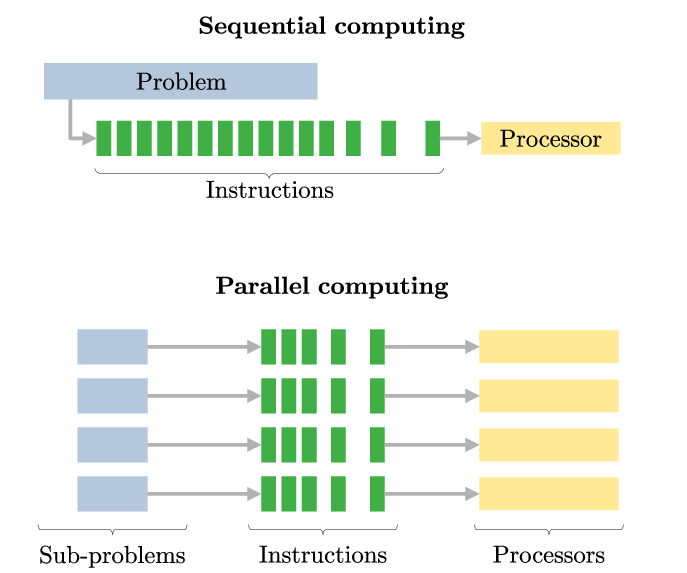
Blockchains are no exception. Chains capable of parallel transaction processing—like Solana, Sui, and Aptos—significantly outperform Ethereum.
Even if one Layer 2 rollup achieves parallel execution, it could absorb nearly all—or even all—activity, making other rollups and even Ethereum itself redundant.
EVM Is Dead, Long Live EVM
The emerging Monad chain builds on improving the EVM.
By enabling parallel transaction processing, Monad addresses what is arguably the biggest flaw in EVM design.
But that’s not all.
Monad also introduces a new storage backend called MonadDB to accelerate contract and state access. Every time a transaction is executed, the chain must retrieve data from storage. But the EVM’s current storage model makes this a slow process.
MonadDB enables much more efficient storage. And because Monad supports parallel execution, it can also implement asynchronous input/output (I/O)—allowing the chain to continue executing transactions while reading from or writing to storage.
Additionally, Monad separates the consensus layer from the execution layer. This allows consensus to run ahead of execution in parallel, rather than bottlenecking transaction processing.
Oh, and Monad implements a new consensus algorithm too. Now, nodes can reach consensus faster and more efficiently.
Through these and other optimizations, Monad makes significant improvements to the EVM.
Of course, all of this remains theoretical—for now. We haven’t seen Monad running in production yet.
Who knows—maybe Monad will fail to deliver on its promises. But by challenging mainstream architectural paradigms, projects like Monad can push the collective progress of blockchain technology forward.
Perhaps modular chains will ultimately win. Or perhaps monolithic architecture will prove superior. But neither holds a monopoly on innovation or wisdom. Real breakthroughs require open exploration of ideas beyond conventional thinking or narrow dogma. If cryptocurrency is to fulfill its promise, architectural decisions must be based on evidence—not ideology.
Join TechFlow official community to stay tuned
Telegram:https://t.me/TechFlowDaily
X (Twitter):https://x.com/TechFlowPost
X (Twitter) EN:https://x.com/BlockFlow_News
 JarvisLabs