









LayerZero's Security Outlook and Ecosystem Opportunity Capture
TechFlow Selected TechFlow Selected
LayerZero's Security Outlook and Ecosystem Opportunity Capture
In addition to cross-chain infrastructure, projects on LayerZero are mainly various DeFi derivatives, NFTs, GameFi, and tooling projects such as yield aggregators built around it.
 Navigating Web3 tides with focused insights
Author: Kyle Liu, Investment Manager at Bing Ventures
Key Takeaways
-
LayerZero has high processing throughput; as long as the cross-chain throughput is sufficient, the intermediate layer will not become a bottleneck.
-
LayerZero’s design philosophy aligns well with current lightweight trends, offering developers a simpler, more efficient, and flexible development experience. The outlook for liquidity providers and applications on LayerZero is highly promising.
-
Since end users cannot identify the security of cross-chain operations, “user-facing” projects must carefully integrate protocols like LayerZero to avoid contamination from malicious applications within the same ecosystem—leading to an “all rise together, all fall together” dynamic in ecosystem development.
-
Bridges should ultimately be abstracted away from the user experience—a much larger market opportunity. Existing bridges require multiple wallet changes, custom processes, and repeated clicks, while Stargate acts as a wrapper contract enabling users to receive desired assets on target chains with just one click, without needing gas or additional steps on the destination chain.
-
Reviewing top projects in the LayerZero ecosystem, most are currently focused on DeFi infrastructure, NFTs, GameFi, and cross-chain bridge solutions. The “omnichain” paradigm enables a more unified and collaborative blockchain ecosystem. We are particularly optimistic about cross-chain message relaying protocols incorporating zero-knowledge proofs (ZKP), which would enhance secure liquidity flow and trustless interoperability across different blockchain networks. DeFi and NFTs stand to benefit significantly—enabling greater flexibility and liquidity in yield farming and lending protocols, and improved access to on-chain derivatives and advanced investment strategies in asset management.
LayerZero is a developer-friendly, easy-to-use, and highly scalable omnichain development framework. Its technical architecture provides a certain level of security, effectively distributing risks while maintaining exceptional flexibility to meet diverse application needs. As such, LayerZero holds vast potential in the omnichain application space.
LayerZero is advancing toward becoming a trustless cross-chain framework—the most perilous yet captivating frontier in today’s blockchain landscape. Can it withstand security storms? And what opportunities should we pursue amid this wave of omnichain narratives? This article explores LayerZero’s growth potential through the lens of cross-chain evolution.
I. LayerZero's Technical Architecture
LayerZero is a protocol designed to achieve comprehensive cross-chain interoperability. Its technical architecture consists of Ultra Light Nodes (ULN) and block header relays (Oracle). LayerZero aims to build a simple, secure, and reliable blockchain development framework, featuring two key architectural advantages:
-
The worst-case security of this architecture equals the best-case security of the selected Oracle. For example, if Chainlink is chosen as the Oracle, even in the worst-case scenario where Oracle and Relayer are controlled by the same entity and collude—maliciously or otherwise—the base-level security remains equivalent to Chainlink’s own security.
-
Even if the Oracle turns malicious and colludes with Relayer A, only applications using that specific Relayer would be affected. Applications using other relayers or Oracles remain completely unaffected. This characteristic disperses risk and exponentially increases the cost of attacks.
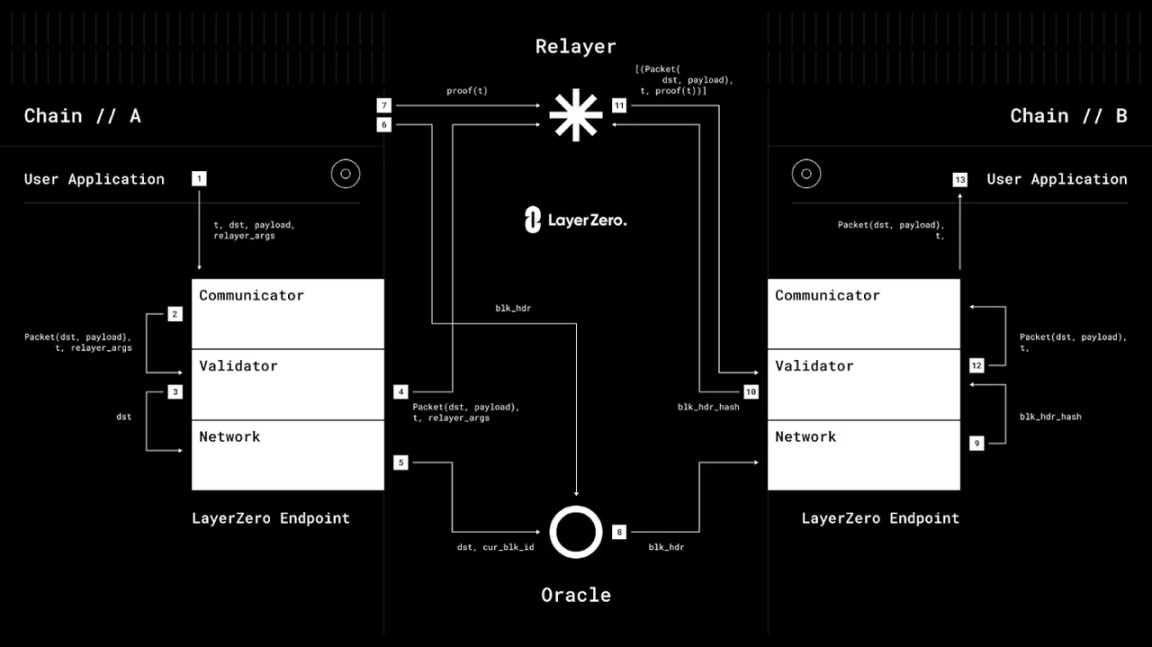
From a security standpoint, these are unique advantages not found in existing solutions. Thus, LayerZero’s architecture is highly appealing, with tangible benefits demonstrated in the following aspects:
Improved Cross-Chain Efficiency
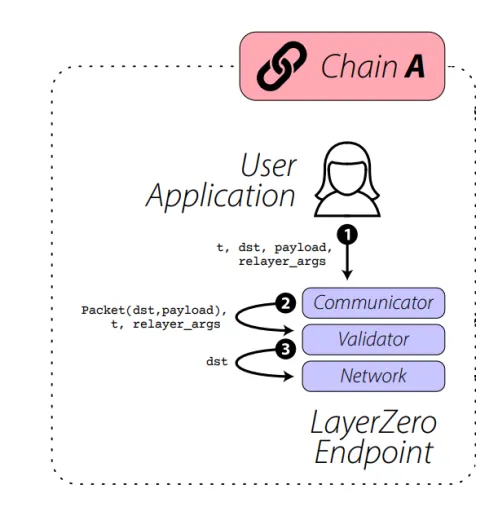
LayerZero’s greatest strength lies in enhancing cross-chain transaction efficiency. During message transmission at the intermediate layer, there is no consensus formation or validation process, meaning no added complexity. Compared to other solutions, LayerZero’s intermediate layer is extremely lightweight, allowing Oracles and Relayers to efficiently forward transaction proofs. Consequently, LayerZero achieves very high processing throughput—provided the underlying chains have sufficient capacity, the middle layer won’t become a limiting factor.
By performing direct on-chain verification, LayerZero ensures transaction safety and reliability with excellent scalability, delivering a better user experience for cross-chain transactions. However, some limitations persist—such as block size constraints—due to inherent characteristics of the base chains themselves. LayerZero’s design goal is to minimize additional overhead while preserving the trustworthiness of cross-chain interactions.
More Than Just Asset Transfers
In today’s blockchain ecosystem, most attention centers around asset transfers—such as decentralized exchanges and cross-chain bridges. But with LayerZero, developers can now build new types of applications, including shared-state apps enabling cross-chain yield aggregation and portfolio rebalancing. Unified governance also allows voting power to be distributed across the entire protocol instead of being confined to a single chain. Furthermore, LayerZero plays a vital role in use cases like lending and gaming, making cross-chain operations simpler and more efficient.
LayerZero can also be viewed as a novel data messaging protocol—not merely a tool for transferring digital assets. It opens up entirely new design possibilities for developers to create applications previously unattainable on isolated blockchains. As LayerZero gains adoption and expands into broader application scenarios, it is poised to drive transformative change.
Developer-First Approach
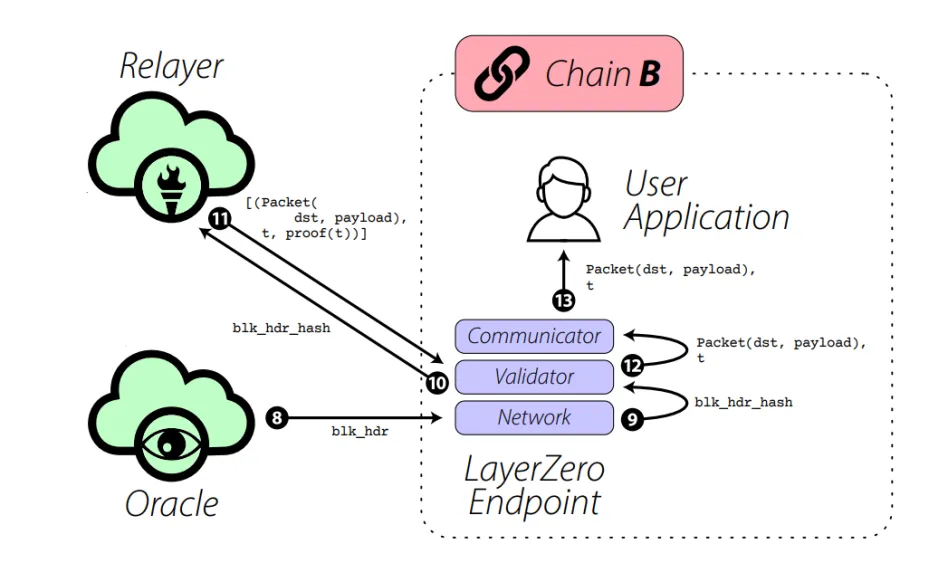
LayerZero follows a developer-first design philosophy. Applications need only implement two functions: sending and receiving. They send generic byte payloads and parse them upon receipt. Developers can use languages like Solidity or Rust to build any on-chain application and operate seamlessly across multiple chains, benefiting from a highly modular architecture. This approach aligns perfectly with current lightweight development trends, offering developers a simpler, more efficient, and flexible experience. Compared to existing solutions like intermediary chains or IBC-style cross-chain systems, LayerZero’s ultra-light nodes offer distinct advantages:
-
Higher Security: Unlike intermediary chain models, LayerZero does not rely on a third-party chain for communication, eliminating associated security risks;
-
Lower Cost: Unlike IBC-based systems, LayerZero only requests a single block header rather than syncing entire blockchains, significantly reducing costs.
However, it should be noted that LayerZero requires an Oracle to relay block headers for cross-chain communication, potentially introducing added complexity and centralization. Although LayerZero employs a layered architecture and open relay network to enhance security, collaboration with Oracle and relay providers remains necessary. In this process, LayerZero adopts a decentralized risk model: applications can choose their preferred Oracle and relay combinations to mitigate potential risks.
Moreover, LayerZero uses a modular implementation, allowing different relays to be integrated and combined, further improving overall security and reliability. LayerZero’s security rests on multiple pillars—including decentralized risk structures, user control over applications, and modular design—all working together to form its robust security framework.
II. Security Controversies and Outlook Analysis
LayerZero’s security model relies on two independent actors—Oracle and Relayer—whose coordinated actions ensure protocol integrity. When a message is sent from one chain to another, the Oracle waits for the transaction to finalize on the source chain before writing relevant information to the destination chain. Then, the Relayer sends a proof to the destination chain verifying that the stored block header contains the message. LayerZero’s foundational security assumptions include:
-
Independence between Oracle and Relayer is fundamental to security.
-
Users can select different Oracle/Relayer combinations to diversify risk exposure.
-
Users can run their own Relayer to protect their assets.
Customizable Risk Structure
LayerZero uses a layered architecture to solve blockchain interoperability challenges. A core security feature is its decentralized risk structure: each operating entity bears its own risk, meaning different applications and liquidity providers may have varying trust assumptions. Another critical aspect is the open relay network—anyone can operate a relay, giving applications full control over security parameters, including choice of Oracle and relay. Applications can also determine how many confirmations they require from the source chain, thereby managing their own risk levels. This decentralized design safeguards application security and avoids the vulnerabilities of centralized control architectures.
However, LayerZero assumes that Oracles and Relayers are independent and honest actors. If they collude, message validation could fail. While LayerZero claims its design eliminates collusion incentives, in reality, each application defines its own Relayer and Oracle choices. Therefore, LayerZero itself cannot guarantee independence or prevent collusion—these assurances must come from the application side. If an app chooses compromised components, LayerZero has no mechanism to stop it. By default, any user application can change its Relayer and Oracle at any time, completely altering its security model. Hence, a one-time security audit of any given app is insufficient.
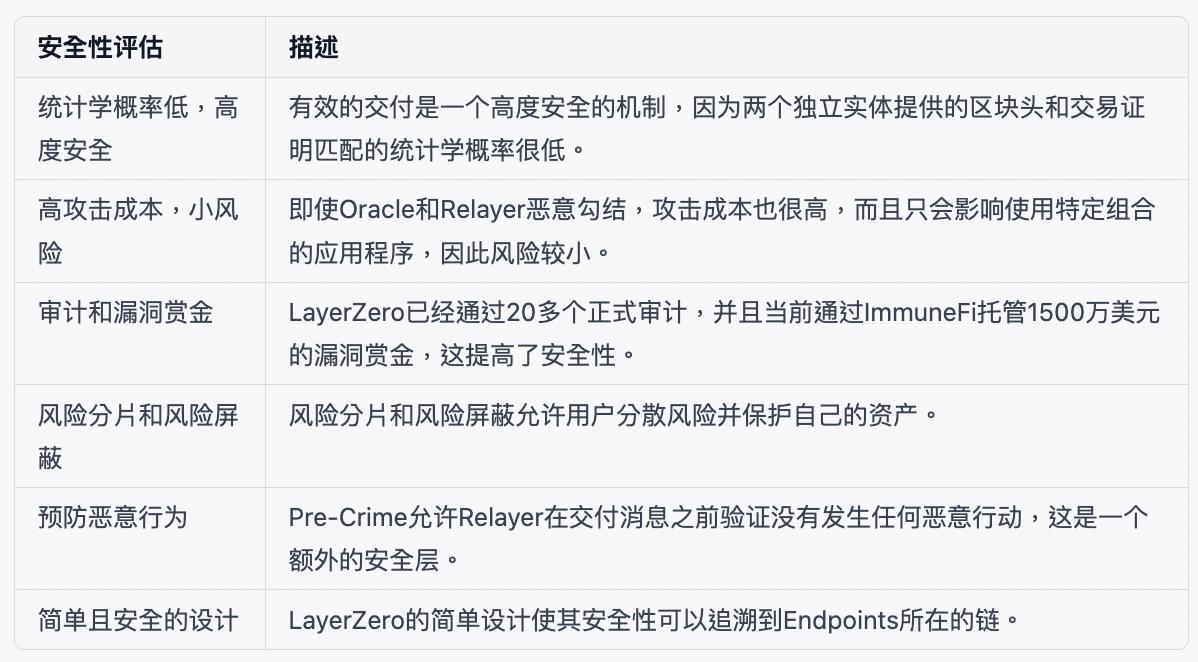
For liquidity providers and application developers, LayerZero’s development prospects are highly favorable. Developers retain full control, enabling them to sidestep risks posed by malicious Relayers or Oracles. Liquidity providers can reduce risk further by running their own relays based on personal preferences. LayerZero’s layered architecture also ensures isolation between blockchains, preventing attack propagation and vulnerability exploitation. Overall, LayerZero’s security is built on decentralization and an open relay network, with applications retaining full control—delivering greater convenience for both liquidity providers and end users.
Risk of Collusion
At its core, LayerZero is an “ultra-light” cross-chain solution whose architecture consists of Relayers and Oracles. The Relayer serves as a message-passing intermediary, while the Oracle monitors the Relayer. LayerZero’s trust assumption hinges on the independence of Oracle and Relayer—only then can invalid messages be prevented. The bridge model requires applications to specify the Relayer on the destination chain, placing significant importance on the Relayer’s integrity within the protocol. While such projects are lightweight, code-minimal, and fast to deploy, several issues remain:
-
Reduced node validation lowers overall security;
-
The assumption of Oracle-Relayer independence cannot be guaranteed indefinitely, leaving room for potential collusion;
-
LayerZero only handles message transmission—it does not assume responsibility for application-level security.
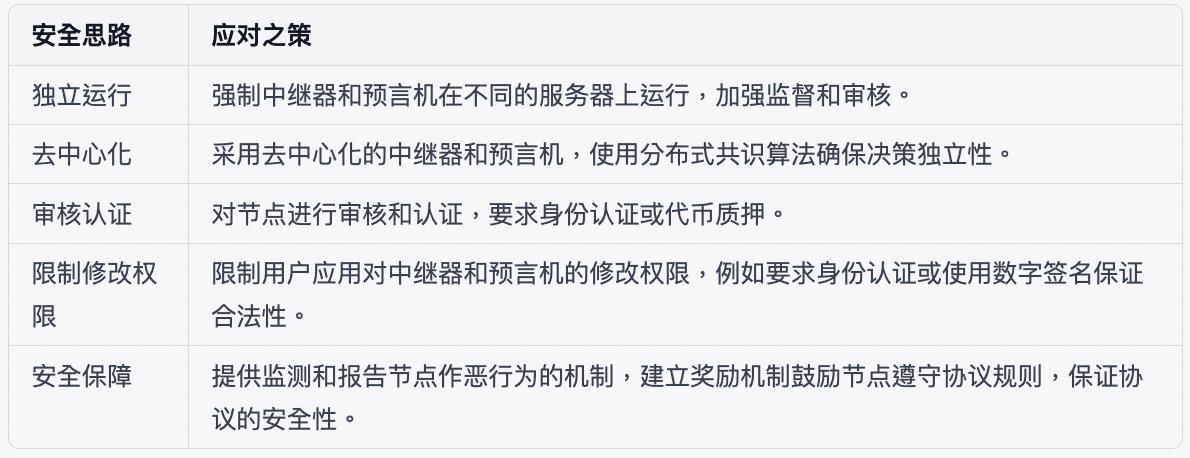
Opening the Relayer to public operation does not resolve these concerns and may introduce new risks. If attackers can modify configurations of LayerZero nodes, they might replace legitimate nodes with rogue ones to forge messages.
Mitigating Malicious Behavior
Since end users cannot assess cross-chain security, “user-facing” projects must proceed cautiously when integrating protocols like LayerZero, to avoid contamination from malicious apps within the same ecosystem. This creates an “all thrive or all perish” dynamic in ecosystem building. Therefore, LayerZero’s security issues demand serious attention. Two approaches can help address these concerns:
First, increase the number of validating nodes to improve security. LayerZero reduces dozens of node validations down to a single Oracle check, naturally lowering security. Increasing validator count becomes crucial. Building on multiple validators, consensus algorithms could be introduced to raise the difficulty and complexity of on-chain verification, thereby enhancing security.
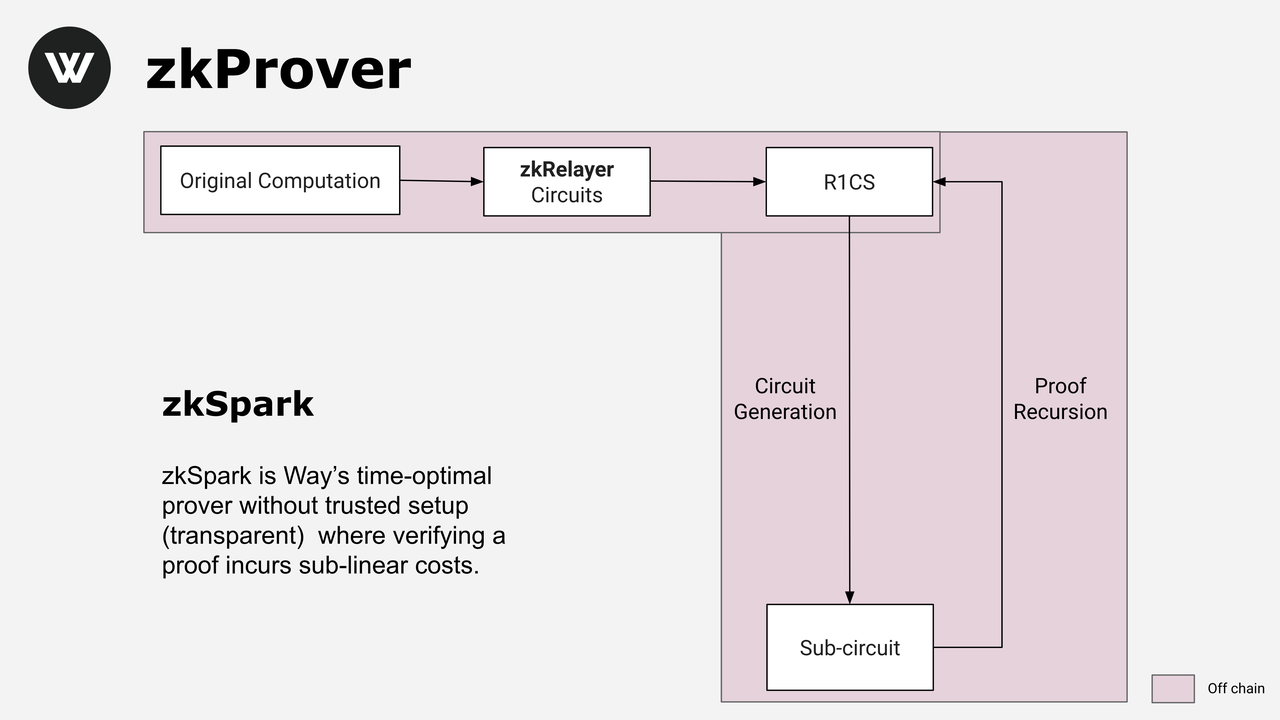
Second, establish a trusted relay mechanism. Since LayerZero’s primary vulnerability stems from reliance on Oracle-Relayer trust assumptions, a credible relay system is needed. Zero-knowledge proof (ZKP) technology offers a viable path—leveraging blockchain’s decentralization and immutability to build verifiable, trustworthy relays and strengthen LayerZero’s security.
III. Key Product: Stargate
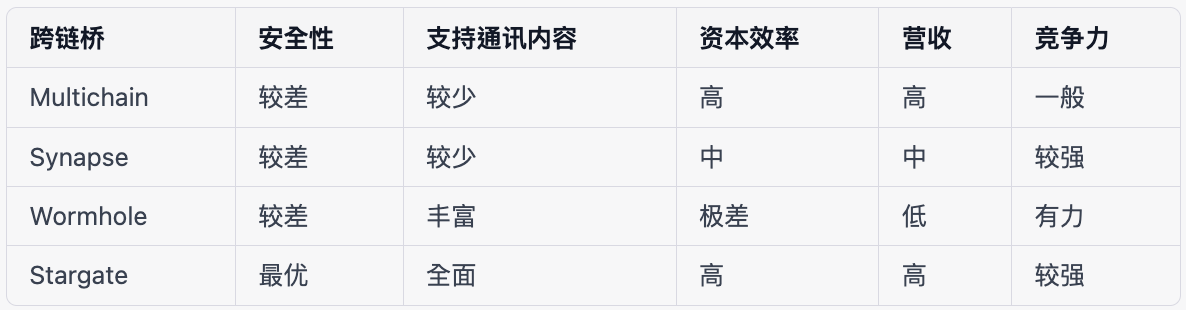
Stargate is a cross-chain bridging protocol enabling rapid asset transfers between chains without altering existing protocols or liquidity pools. In decentralized finance, cross-chain transactions have long been challenging. There are three ideal goals for cross-chain asset transfer: instantaneity, security, and capital efficiency. Most existing bridges compromise on one or two of these objectives.
Stargate allows users and dApps to transfer native assets across different blockchain networks without relying on wrapped tokens or intermediaries. It employs a “lock + mint” and “burn + redeem” mechanism, ensuring instant finality since assets minted on the destination chain carry no reversal risk. Additionally, Stargate leverages composable design to establish bidirectional connections between any two smart contract-enabled blockchains, enhancing both security and capital efficiency.
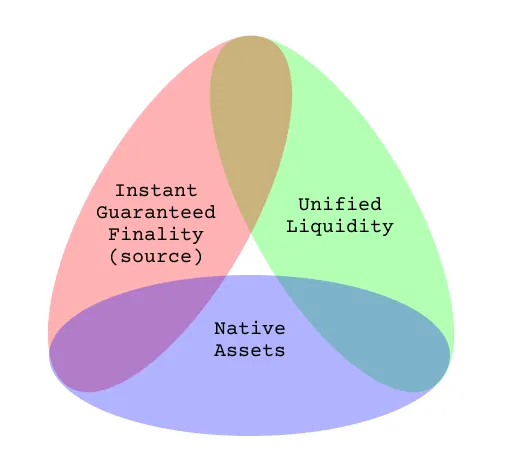
Compared to other cross-chain bridge protocols, Stargate stands out as a universal, composable solution. Its utility extends beyond simple asset transfers to various cross-chain applications. As more blockchain projects emerge, demand for cross-chain transactions will grow—and Stargate can serve as the connective bridge, enabling smoother trading and liquidity provisioning across chains.
Stargate eliminates the extra step of acquiring unwanted assets on the destination chain. Instead, users directly receive what they want, saving on slippage and swap fees. Traditional bridges require multiple wallet adjustments, customized workflows, and repeated clicks, whereas Stargate operates as a wrapper contract—users get their desired assets on the target chain with a single click, without needing gas or other actions on the destination chain. Ultimately, bridging should be abstracted from the user experience entirely—an opportunity representing a far larger market.
IV. Introduction to the LayerZero Ecosystem
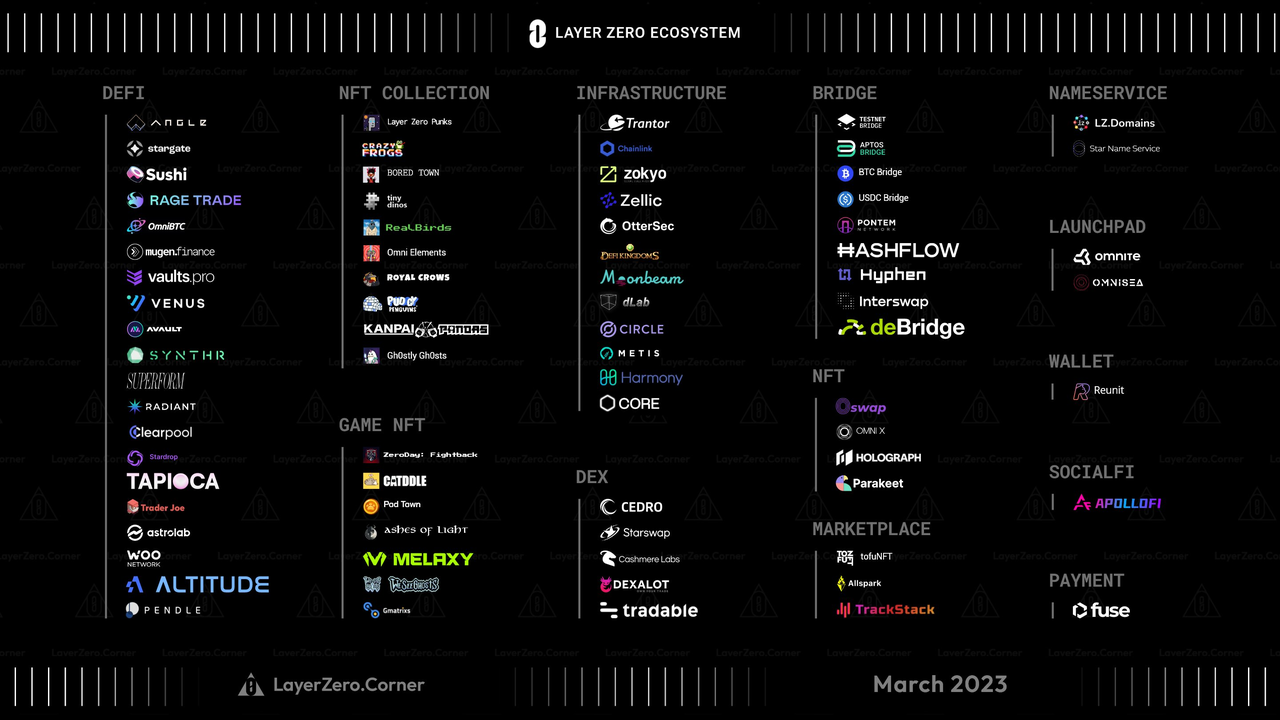
Reviewing the ranking of LayerZero ecosystem projects, the majority currently focus on DeFi infrastructure, NFTs/GameFi, and cross-chain bridge solutions.
DeFi
AMM
-
SushiXSwap — SushiXSwap is SushiSwap’s omnichain trading protocol built on LayerZero, supporting networks including Optimism, Arbitrum, Fantom, BNB Chain, Polygon, and Avalanche. Users can conduct cross-chain trades across supported networks and assets.
-
Hashflow — Decentralized exchange Hashflow announced in late April the launch of its bridgeless cross-chain swap service powered by LayerZero, using a request-for-quote (RFQ) model where professional market makers set token prices. Supports token swaps between Ethereum, Avalanche, BNB Chain, Arbitrum, and Polygon.
-
Cetus — Cetus is a pioneering DEX and liquidity protocol built on Aptos & Sui blockchains. Focused on delivering superior trading experiences and higher capital efficiency through concentrated liquidity and complementary modules. Formed a strategic partnership with LayerZero_Labs on October 22, 2022.
-
interswap — A fully composable cross-chain AMM for native assets, featuring unified liquidity built atop the LayerZero network.
-
starswap — A Move ecosystem DEX offering secure and stable assets with fast transactions and low fees.
Lending
-
Radiant Capital — Radiant Capital is a LayerZero-based omnichain lending protocol allowing users to deposit collateral on Chain A and borrow on Chain B, consolidating multi-chain liquidity. Currently, the project has launched v1 on Arbitrum, supporting only Arbitrum-based asset lending. Project documentation indicates v2 will support omnichain lending for WBTC, ETH, and USDC.
-
Cedro Finance — Cedro Finance is a cross-chain decentralized liquidity protocol enabling borrowing and lending of listed assets across multiple chains at affordable transaction costs. Lenders can deposit assets to boost platform liquidity, while borrowers can access liquidity via over-collateralization.
-
Clearpool — Clearpool is a decentralized financial ecosystem featuring a permissionless marketplace for unsecured institutional liquidity. Driven by supply-demand market forces, Clearpool’s permissionless single-borrower pools allow institutions to raise short-term capital while offering DeFi lenders risk-adjusted returns based on market-determined interest rates. Its fully compliant institutional-grade platform further meets regulatory demands for wholesale digital asset lending.
-
Venus Protocol — A high-liquidity lending protocol on BNB Chain.
-
tapioca — Tapioca DAO enables users to lend and borrow across 12+ EVM and non-EVM blockchains. Core products include Singularity, an isolated-risk lending market (based on Sushiswap’s Kashi), and Yield Box (BentoBox V2), a permissionless token vault.
Derivatives
-
Aries — Aries Markets is a Move-based decentralized exchange. Products cover lending, swapping, margin trading, and account risk management—all integrated into one platform. With a unified margin account, users can easily earn deposit yields, borrow from shared liquidity pools, trade, swap, and access other DeFi products on Aptos.
-
Rage Trade — Rage Trade is an omnichain perpetual futures market for Ethereum, supporting Ethereum, Arbitrum, Avalanche, and Fantom. Through Stargate—a LayerZero-based cross-chain bridge—Rage Trade allows ETH-USD LP positions from DEXs, money markets (e.g., Aave, Rari, Euler), and derivatives platforms (GMX, Ribbon) on supported networks to be directly deposited into Rage Trade. Of the total value locked (TVL), 80% is allocated to yield-generating services (Curve, GMX, Sushi, etc.), while 20% provides liquidity for contract trading on Rage Trade.
Aggregators
-
mugen.finance — RealYield powered by LayerZero
-
Cashmere — Cashmere Labs aims to become an MEV-resistant DEX aggregator with omnichain interoperability. The product is not yet live, but according to official descriptions, Cashmere Labs will offer two main products: stablecoin trading and an MEV-resistant cross-chain DEX aggregator. Stablecoin trading improves slippage and liquidity via single-sided liquidity and targeted incentives. The cross-chain DEX aggregator combines LayerZero’s interoperability with 1inch’s liquidity. Because arbitrageurs cannot access order information during cross-chain message passing, frontrunning and “sandwich attacks” related to MEV are prevented.
-
OmniBTC — OmniBTC is a LayerZero-based cross-chain DEX aggregator supporting Ethereum, BNB Chain, Avalanche, and Polygon. The team states future focus will shift to emerging L1s Aptos and Sui.
Stablecoins
-
Circle — Issuer of USDC
-
Angle Protocol — A decentralized stablecoin protocol that announced integration with LayerZero in August, enabling cross-chain transfers of its euro-pegged stablecoin agEUR between Ethereum, Polygon, Optimism, and Arbitrum.
Bridges
-
Stargate — Stargate is a fully composable liquidity transfer protocol. With Stargate, users and dApps can transfer native assets across chains while accessing a unified liquidity pool, with instant finality guarantees. As the first project built on LayerZero, Stargate aims to develop a fully composable native asset cross-chain bridge protocol.
-
AptosBridge — The LayerZero Aptos Bridge enables seamless asset transfers between Aptos and the broader blockchain world. Outbound transfers from Aptos require 1 million block confirmations—expected to take approximately four days.
-
Bloctoswap — Blocto is a cross-chain wallet offering a seamless experience via developer-friendly SDKs, an embedded DEX called BloctoSwap, and its non-custodial NFT marketplace BloctoBay.
-
Parakeet.dao — Parakeet.dao is a LayerZero-based omnichain bridge supporting Ethereum, Polygon, Arbitrum, Optimism, BNB Chain, Avalanche, and Fantom. The project is still in testing phase, currently supporting only NFT transfers on testnets of the above networks. Users can submit requests for NFTs they’d like to see supported.
Tools
-
Lz Domain — Lz Domain is LayerZero’s domain name service. Using LZ, users and enterprises can replace machine-generated identifiers (like wallet addresses) with human-readable, memorable names such as *LayerZero.lz*.
-
Notify — Notify allows Web3 developers to integrate communications into their apps without building infrastructure from scratch. Notify will soon launch Notifi Hub, a Web3 inbox aggregating cross-chain notifications and messages into a single location. Notifi currently supports Solana, NEAR, and Ethereum, with plans to expand to Polygon, Avalanche, Aptos, and Sui. Notifi raised $10 million in seed funding led by Hashed and Race Capital, with participation from Struck Capital, HRT Capital, Wintermute, Superscrypt, and others.
-
LayerZero.scan — LayerZero Scan enables users to explore what’s happening on-chain and across chains.
-
Reunit — An omnichain wallet.
Infrastructure
-
Chainlink — Oracle
-
zokyo — Audit firm
-
Zellic — Audit firm
-
dlab — Omnichain Interoperable Payment Protocol (OIPP). Building a decentralized NFT AMM protocol on LayerZero.
NFT
-
Omni X — Omni X is a LayerZero-based omnichain NFT platform. According to official information, Omni X connects creators and users, enabling users to mint and trade NFTs across supported chains, aggregating fragmented communities and users from multiple chains.
-
Trantor — Trantor is a LayerZero-based NFT cross-chain communication infrastructure supporting NFT transfers across chains. Currently supports only BNB Chain and Polygon testnets, allowing users to mint test NFTs and perform cross-chain operations.
-
Omnisea — Omnisea is an omnichain NFT Launchpad built on LayerZero and Axelar Network, allowing creators to issue NFTs capable of cross-chain movement via LayerZero. The project has issued its OSEA token, with stakers earning a share of platform revenue as rewards.
-
Omnite — Omnite offers a LayerZero-based omnichain NFT solution. While the product hasn’t launched yet, developers can use its SDK to build omnichain NFT projects.
-
Oswap — Oswap is a LayerZero-based omnichain NFT DEX protocol developed by dLab. Its Alpha test has concluded. The protocol resembles sudoswap but supports cross-chain trading via LayerZero.
-
Holograph — Holograph is an omnichain NFT protocol launched by CXIP Labs. The Holograph suite includes three initial products: Bridge, Core, and Mint. Bridge enables NFT transfers between EVM-compatible blockchains. Core is a multi-chain API for developers. Mint is an NFT minting tool for creators. All three products are currently in testing, supporting only Goerli, Polygon, and Avalanche testnets.
-
tofuNFT — A multi-chain NFT marketplace
-
Allspark — An NFT omnichain liquidity aggregation protocol.
-
Trackstack — A marketplace for audio NFTs.
GameFi
-
Catddle — Catddle is a Web3 pet game whose NFTs are issued via LayerZero. At the time of writing, its floor price on OpenSea was 0.035 ETH, with total trading volume reaching 11 ETH. The actual gameplay is not yet available, but official documentation describes it as a pet-raising simulation game planning to issue in-game utility token MEO and governance token CAT. MEO has no supply cap, while CAT has a fixed supply of 1 billion, with 5% allocated for airdrops.
-
Beyond — Beyond is a Web3 space exploration game where in-game NFTs (planets, etc.) support LayerZero-powered cross-chain functionality.
-
DeFi Kingdoms — DeFi Kingdoms blends the appeal of decentralized finance with the rising Play-to-Earn economy. It runs live on the Harmony ONE network.
SocialFi
- APOLLOFI — A SocialFi project built on LayerZero.
V. Capturing Opportunities in the LayerZero Ecosystem
Cross-Chain DeFi Protocols Driving Ecosystem Growth
The LayerZero ecosystem hosts a thriving array of DeFi protocols, including decentralized exchanges, lending platforms, and derivatives markets. On the AMM front, SushiXSwap, Hashflow, interswap, and starswap enable cross-chain trading, expanding
Join TechFlow official community to stay tuned
Telegram:https://t.me/TechFlowDaily
X (Twitter):https://x.com/TechFlowPost
X (Twitter) EN:https://x.com/BlockFlow_News
 Bing Ventures






