








TON and Telegram: A New Narrative Toward Mass Adoption and Investment Opportunities
TechFlow Selected TechFlow Selected
TON and Telegram: A New Narrative Toward Mass Adoption and Investment Opportunities
The growth drivers of the TON ecosystem are clear, and the ecosystem is accelerating its development, with all currently deployed projects still in very early stages.
 Navigating Web3 tides with focused insights
Author: Serein, OP Crypto
At the recent Token2049 conference in Singapore, Steve, Telegram's CIO (Chief Information Officer) and Chairman of the TON Foundation, mentioned the ambition to bring 500 million Telegram users onto the TON network within five years. Whether framed as "crypto mass adoption" or "Web 2 giants gradually transitioning into Web 3.0," this narrative is highly attractive for Web 3.0 practitioners and investors alike.
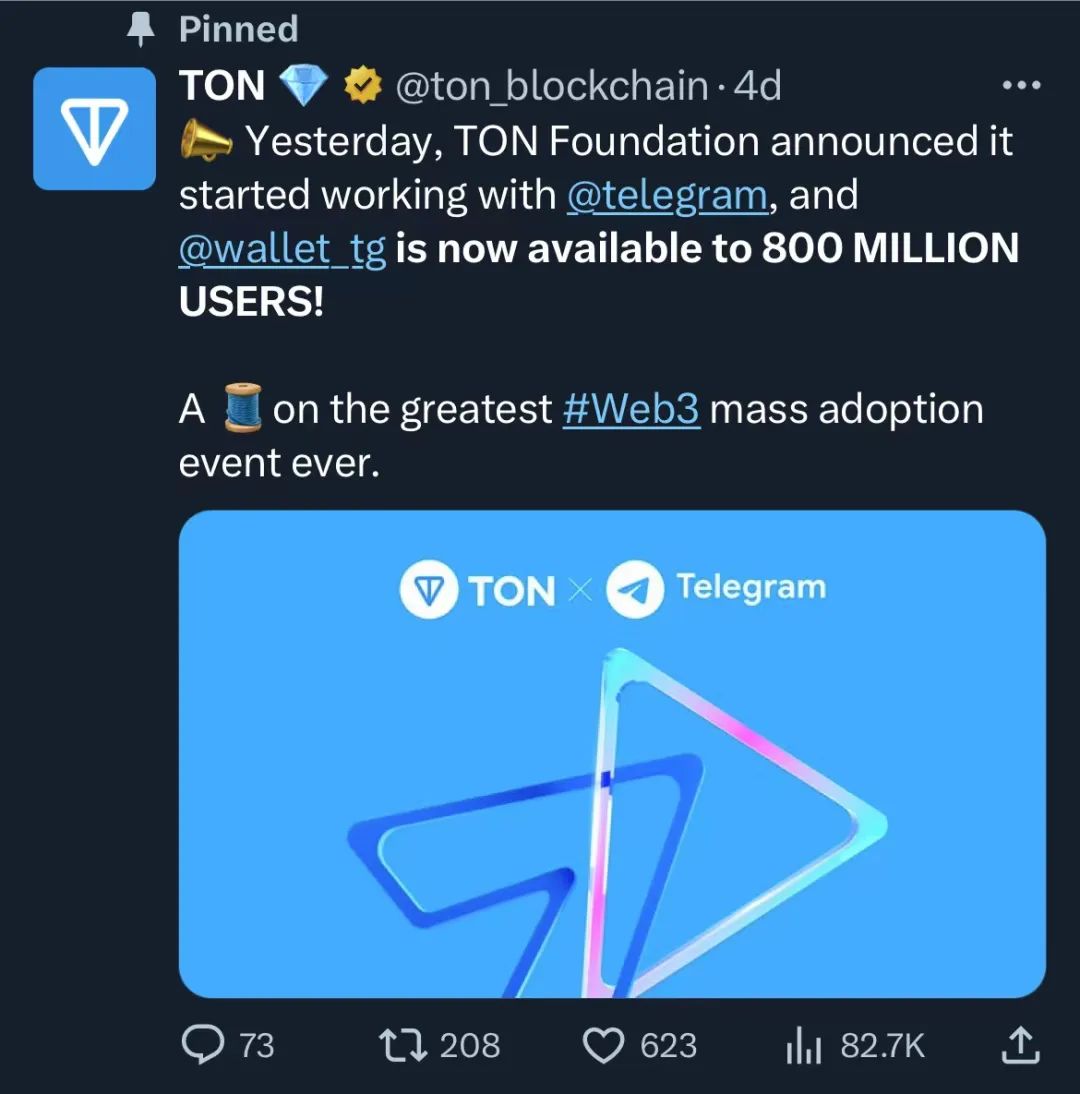
The OP Crypto team had already developed strong interest in TON prior to the conference. Combining past research with recent updates, this article explores the vast potential and investment opportunities arising from the integration of Telegram and TON.
What is Telegram?
Telegram is a cloud-based, free instant messaging app founded in 2013 by Nikolai and Pavel Durov, brothers and founders of VK (one of Russia’s leading social media platforms). Today, Telegram’s servers are distributed globally, with its operational hub and development team based in Dubai, UAE.
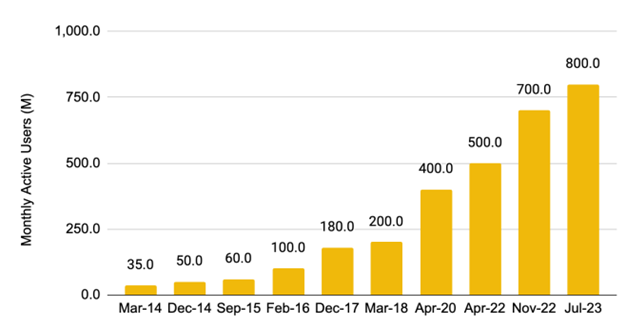
Telegram boasts a massive global user base that has grown rapidly in recent years. As of now, it reports nearly 900 million monthly active users (MAU) and over 1.3 billion registered users.
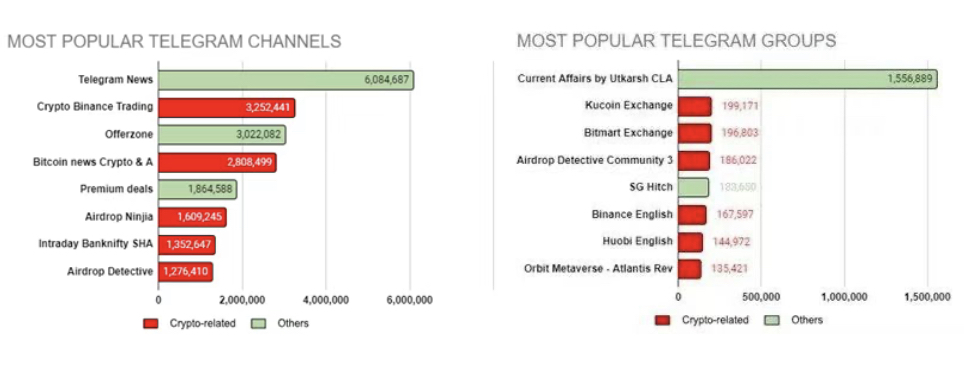
Interestingly, Telegram serves as a crucial battleground for crypto. More than half of the most subscribed channels and groups on Telegram are related to cryptocurrency content. Virtually every Web 3.0/Crypto project maintains a Telegram community to facilitate communication, share updates, and promote their initiatives.
Another interesting aspect is that many cross-border e-commerce sellers use public platforms (like TikTok) to drive traffic to Telegram for transactions—making Telegram not just a messaging platform but also a marketplace for consumer commerce.
What is TON?
TON was initially launched by Telegram in 2018 but faced allegations from the U.S. SEC for illegal fundraising. In May 2020, founder Pavel Durov announced Telegram would cease involvement in blockchain development. However, after Telegram stepped back, the community took over the project, renaming it from “Telegram Open Network” to “The Open Network,” and launched the TON token.
TON is more than just a blockchain—it’s a comprehensive ecosystem including a P2P network (currently enabling fiat-to-crypto settlements), and various service-oriented tech stacks such as TON Proxy (for IP and data privacy) and TON Storage (a decentralized storage solution).

The core mission of TON’s technology stack is to solve the usability challenges that social product users—including those on Telegram—face when interacting with blockchain or decentralized services.
TON Blockchain is a Proof-of-Stake (PoS) chain powered by the TVM (Telegram Virtual Machine) for smart contract execution. Theoretically capable of supporting millions of on-chain transactions, with enough validators, it can scale up to 2^92 shards. However, due to currently limited transaction volume, there hasn’t yet been an opportunity to test its stability and security at peak TPS. Currently, TPS remains below 60,000.
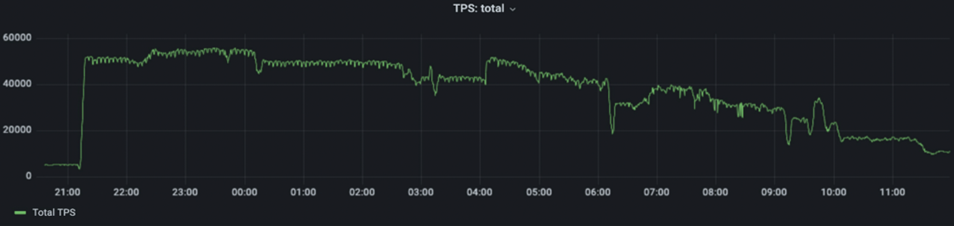
The key to achieving such high TPS lies in TON Blockchain’s support for parallel transaction processing and asynchronous smart contract execution. Its architecture consists of three layers: Masterchain, Workchains, and Shardchains—supporting up to 2^32 Workchains, each capable of 2^60 sharding levels (Shardchains).
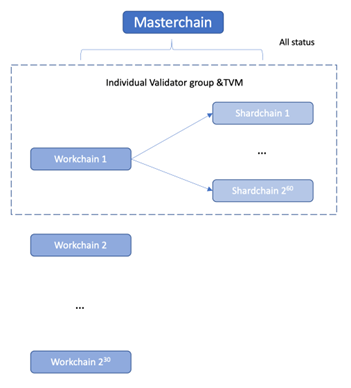
Each Shardchain can be seen as a ledger for one or more accounts, built and validated by a group of validators. During the next time slot of a Workchain, all Shardchain validators under that Workchain participate again in PoS consensus to earn block rewards. All state changes across Workchains and Shardchains are ultimately recorded on the Masterchain. Logically, there are five key points:
- Both Shardchains and Workchains enable parallel computation
- TVM supports asynchronous computation
- Supports instantaneous cross-shard communication
- Ledger data is replicated multiple times, requiring higher storage capacity
- Two rounds of PoS are required to ensure decentralization of both Shardchains and Workchains
The first three points form the theoretical foundation for TON’s high TPS performance.
Interesting Connection between TG and TF
Currently, TON is primarily driven by the TON Foundation, which has a team of over 40 members, more than half from regions like Russia and Ukraine. Most employees have prior experience working at VK or Telegram.
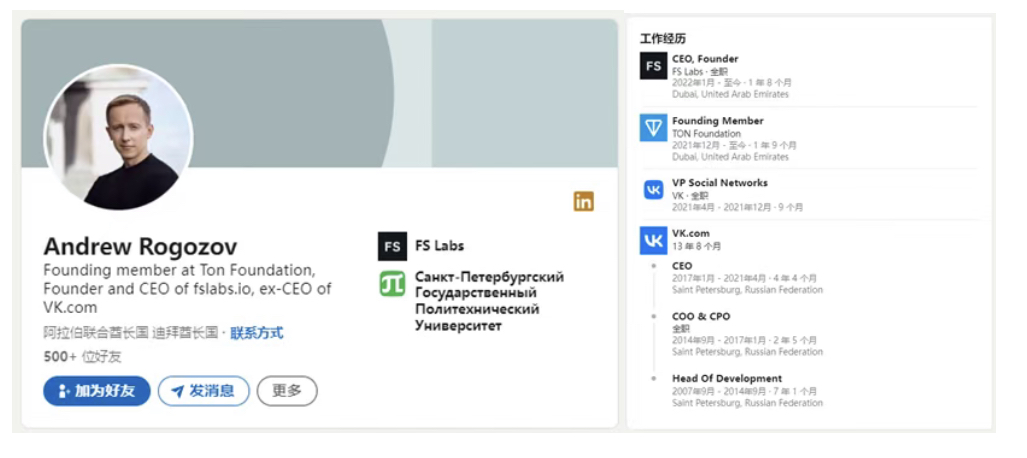
One of the core founding members of the TON Foundation, Andrew Rogozov, is the former CEO of VK.com.
TON Ecosystem Landscape
1. Validator
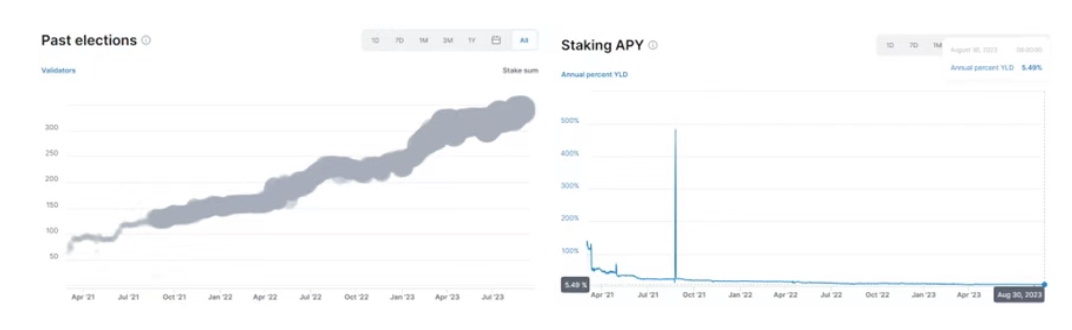
As a PoS-based blockchain, the scale of validator nodes ensures TON’s decentralized, stable, and secure operation. TON currently has 342 validator nodes, with 490 million TON staked—representing 9.6% of total supply—and offering a steady APY around 5.5%.
Requirements to become a validator node include:
- Staking at least 300k TON tokens
- Meeting hardware requirements
Regarding slashing mechanisms, TON continues refining its system. Validators earn block rewards and transaction fees (gas), but improper behavior leads to partial or full stake slashing, with equivalent TON tokens burned.
2. Dev Community
As of July 2023, the global full-time developer count stands at 6,793, with 21,338 monthly active developers. On TON, there are 39 full-time developers and 174 monthly active developers.

From a technical development perspective, the TON Foundation is actively expanding and supporting the developer community, continuously improving documentation to help developers adapt to new languages and deploy projects in parallel computing environments (which may increase development and management complexity). Following the conference, attention has significantly increased, and several new projects have begun launching on TON.
3. TON’s Application
Telegram’s Web3 ecosystem is expanding into Wallets, Gaming, Social, NFTs, DeFi, and beyond. While the TON ecosystem is accelerating, it currently focuses mainly on wallets and DeFi applications:
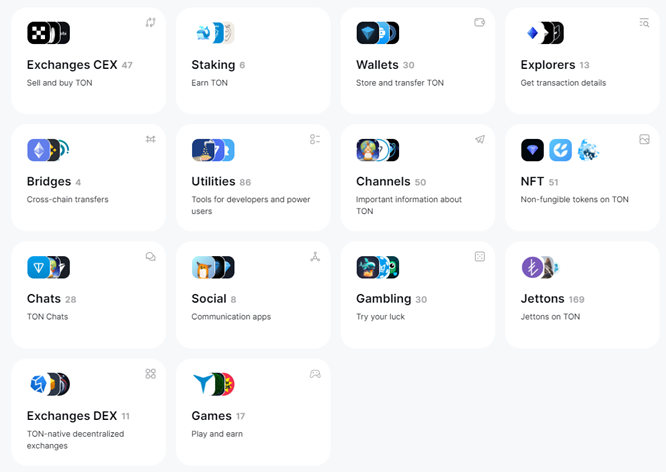
a. Wallet
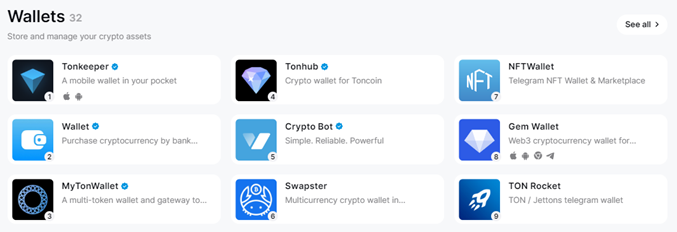
There are numerous consumer-facing wallet projects today, most integrating with TONSpace. There is also potential for major wallets like MetaMask to enter the space in the future.
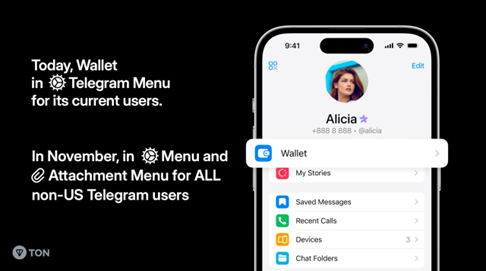
Telegram Wallet (@Wallet)
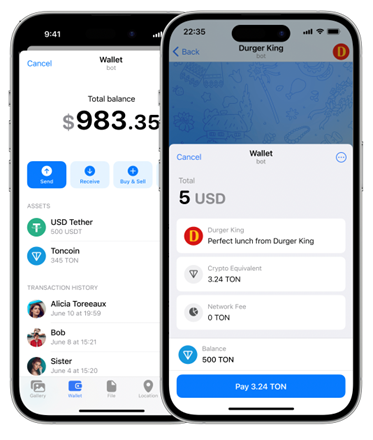
Telegram Wallet is a native, centrally custodied wallet embedded within Telegram. Users can currently swap TON, BTC, and USDT. Through the attachment menu in chat, users can send and receive these cryptocurrencies directly to contacts.
@Wallet supports depositing fiat via bank cards or P2P markets. Users can select their preferred currency and also transfer cryptocurrencies from external wallets. By June this year, Telegram Wallet had surpassed 2.5 million registered users, with numbers growing rapidly.
TON Space
TONSpace is a non-custodial wallet integrated within @Wallet. It allows users to import existing TON blockchain wallets using seed phrases or create new ones. Private keys can also be secured via Telegram account or email. Currently, TONSpace supports token transfers and NFT operations.
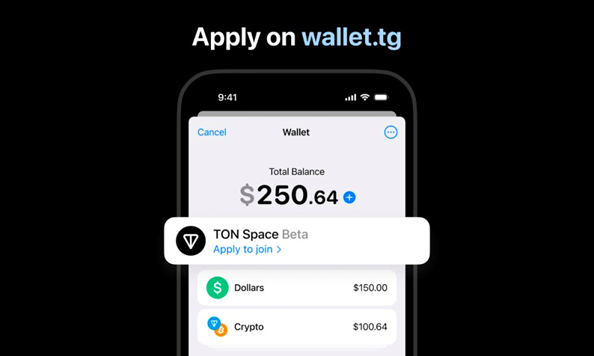
In the future, users will be able to directly access TON’s on-chain infrastructure and applications through TONSpace, such as interacting with DeFi protocols. The beta version was unveiled at Token2049 and the mainnet launch is scheduled for November this year.
b. DeFi
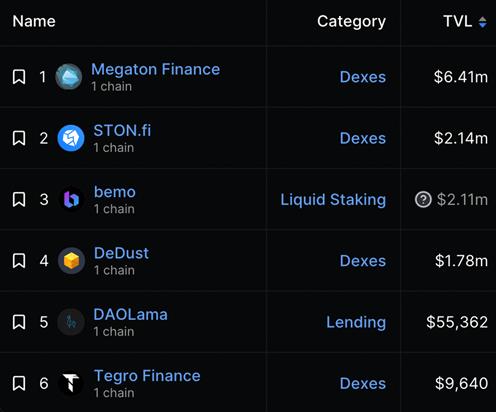
The current DeFi ecosystem on TON is still nascent, consisting only of spot DEXs and liquid staking solutions. However, development is accelerating—from developer tools and user adoption to bridges and token deployments.
Megaton Finance
Megaton Finance is an AMM-based spot DEX developed over six months by OZYS, a South Korean blockchain company. Its total value locked (TVL) currently stands at $7.13 million.
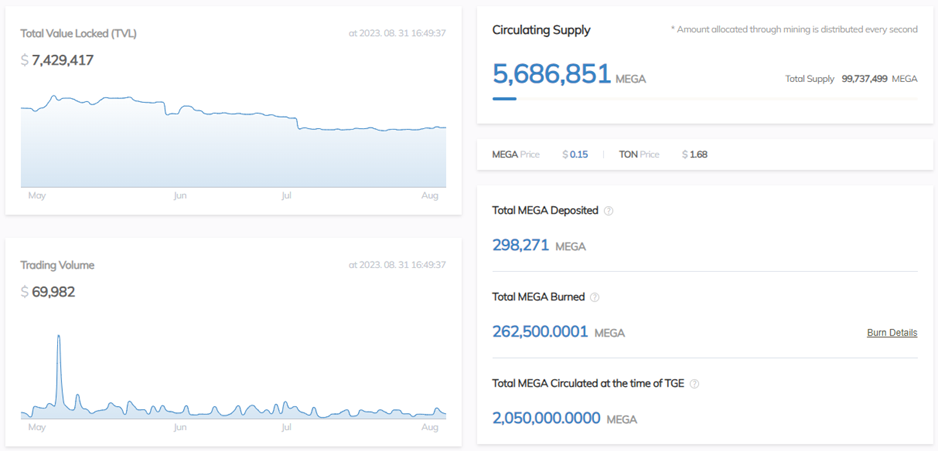
The MEGA token has a total supply of 100 million, with 5.14 million in circulation and a market cap of approximately $710,000. It raised $1.5 million in seed funding in March, led by TONcoin.Fund, with participation from Orbs and MEXC Ventures.
Bemo
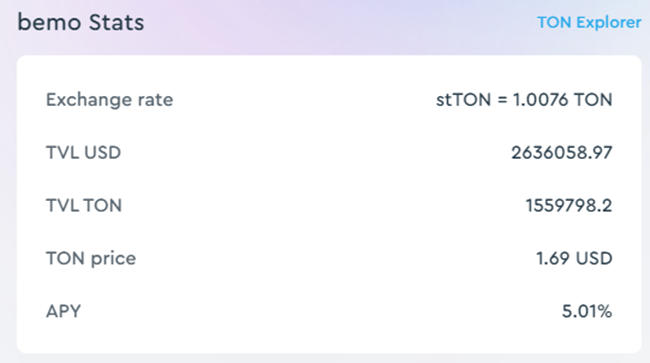
Bemo is a liquid staking protocol on TON, similar to Lido, with a current TVL of around $2.6 million and an APY of approximately 5%.
4. TON Token
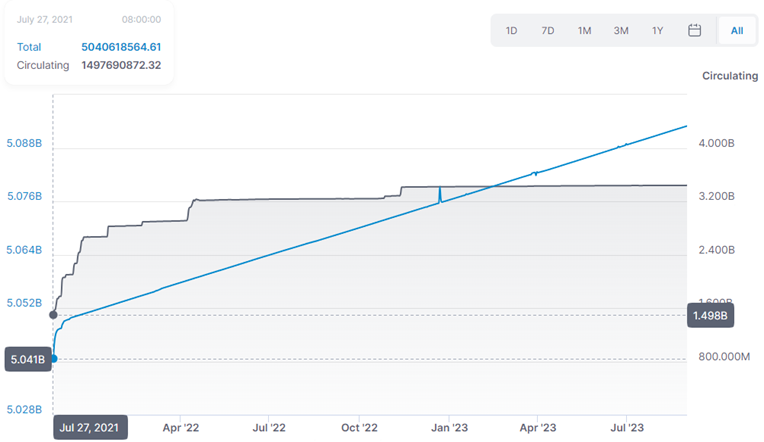
TON Token is the native cryptocurrency of the TON Blockchain. Current supply exceeds 5 billion tokens, mostly mined during the early PoW phase of TON Blockchain, which concluded entirely by June 2022. Additionally, TON Token has no hard cap and undergoes annual inflationary issuance of about 0.6% (approximately 30 million tokens per year).
The utility of TON Token is uniquely differentiated. Beyond standard investment attributes and gas payment functions—similar to how BTC serves as an alternative large-scale payment method—TON Token benefits greatly from Telegram’s social context, positioning it as a universal payment tool. Its broader use cases span diverse social transfers, deposits/withdrawals, ad payments, application payments (including bots), and even real-world goods purchases—offering users an experience surpassing even WeChat Pay. Telegram is actively developing more user-friendly secondary payment methods.
Currently, average gas cost per transaction on TON ranges between $0.1 and $0.5, significantly lower than Tron’s $1–$2 and Ethereum’s ~$7.
TON’s Comparison
The integration between TON and Telegram dramatically raises the ceiling for the entire ecosystem. We’ve identified three key comparative dimensions: social platform comparison, blockchain development comparison, and product format comparison within the Telegram ecosystem:
1. Social Platform Comparison
Globally, the dominant form of personal social networking today is instant messaging (IM), exemplified by WeChat and WhatsApp. These platforms benefit from strong moats rooted in scale and network effects. With the rise of mini-programs, WeChat alone processed trillions of dollars in transactions in 2022 and now boasts over 1.1 billion MAUs. The increasing migration of economic value into in-app programs demonstrates clear user preference for integrated product models.
Built on blockchain and decentralized architecture, Telegram can leverage Internal-Dapps to foster real and virtual economies across multiple countries and regions, significantly reducing friction in cross-border commerce. If we view TON as Telegram’s commercialization strategy, the narrative becomes very clear.
Alternatively, comparing TApps against other Web3 social products reveals another advantage: a more mature user base and broader token utility make the environment for social applications (including social games) on TON far more favorable than on other chains. Moreover, since Telegram does not analyze user data, this could attract many developers and entrepreneurs.
2. Blockchain Comparison
Architecturally, TON differs from Ethereum primarily in shard count and cross-shard communication. Combined with shorter block times, parallel computation, and asynchronous processing, TON demands stricter technical standards and higher security considerations for project deployment.
However, the upside is much higher theoretical TPS—around 100,000 times that of Ethereum. Compared to Solana, both share support for asynchronous computation and parallel processing, but TON is notably more decentralized. Furthermore, Solana lacks sharding design, meaning its maximum theoretical TPS (~50,000) falls short of TON’s current performance.
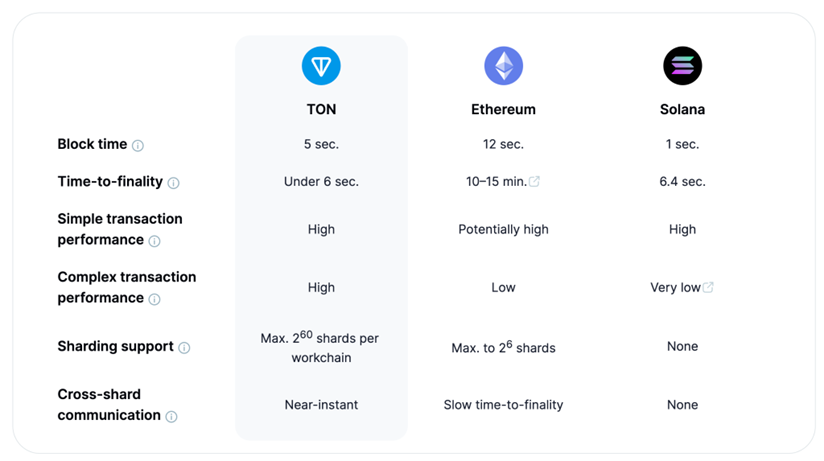
When considering growth potential, TON presents clearer pathways. As one of the world’s leading social platforms—with additional traffic from VK.com—Telegram hosts the largest crypto-native social audience. Most users already possess some understanding of crypto and Web3.0, drastically lowering education costs. This implies relatively lower market risk for TON’s user acquisition.
Empowered by a massive social network, TON Token gains enhanced payment utility, signifying a much higher ceiling for TON.
3. Telegram Bots vs TON App
Telegram Bots represent a novel way to interact with blockchain, implemented by integrating functionalities into Telegram via bot modules. Users execute actions by sending commands to bots, primarily for trading purposes today. Here, “bot projects” refer broadly to those connected to non-TON chains like Ethereum.
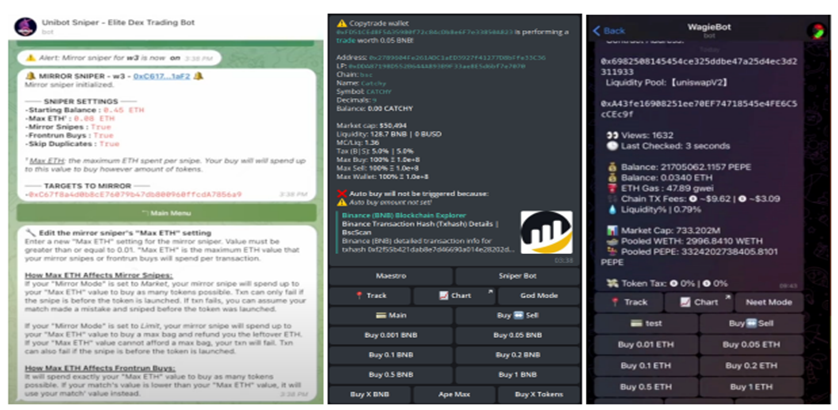
In summary, key differences between current Bot projects and TON Apps:
- Bots suffer from slow response times, limited interaction modes, and poor parallel handling; TON Apps better resolve these issues. Bots struggle to facilitate seamless payments and on/off-ramping, whereas TON ecosystem apps integrate seamlessly with underlying infrastructure
- Bots often impose additional fees on DeFi interactions, while TON DeFi apps charge only a single, lower fee layer
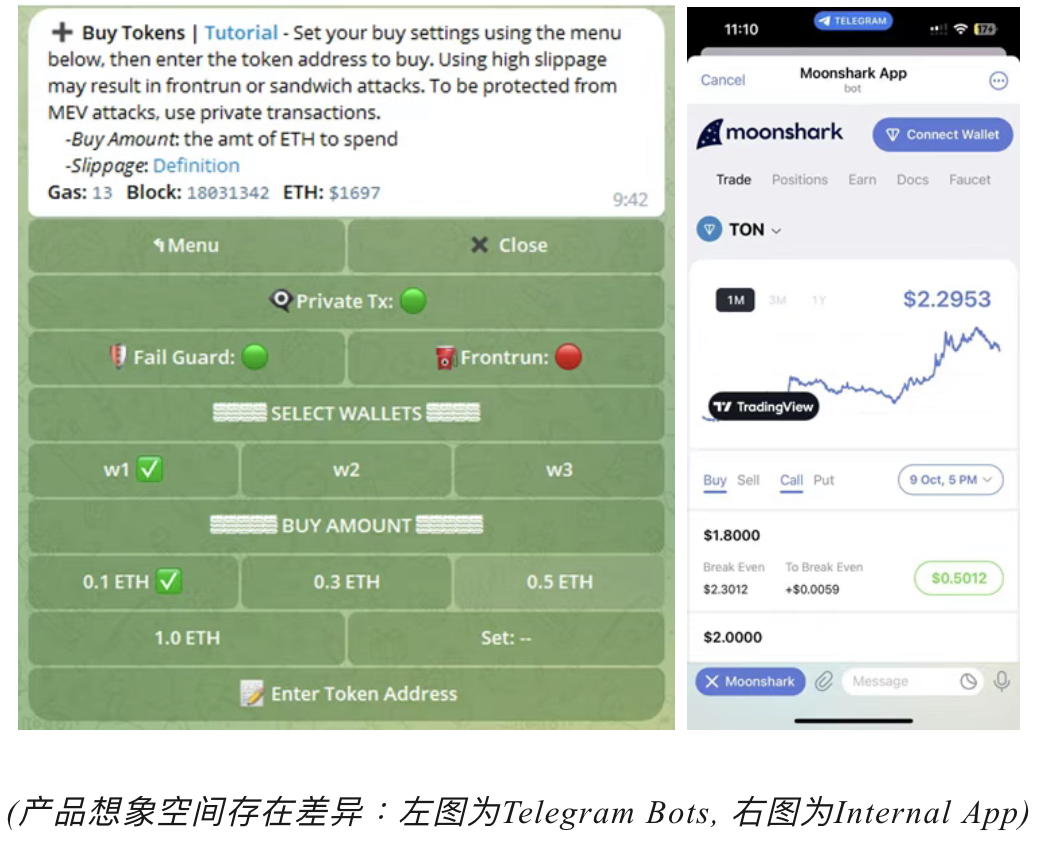
As previously summarized, both Telegram Bots and TON-based projects engage users directly. However, Bots offer a monotonous proxy-like interface, while TON projects function as highly interactive, composable apps. Projects listed in the APP Center can be interconnected via @Wallet (aggregating multiple TON wallets and fiat-to-crypto gateways), creating a vastly deeper integration compared to standalone Bot projects.
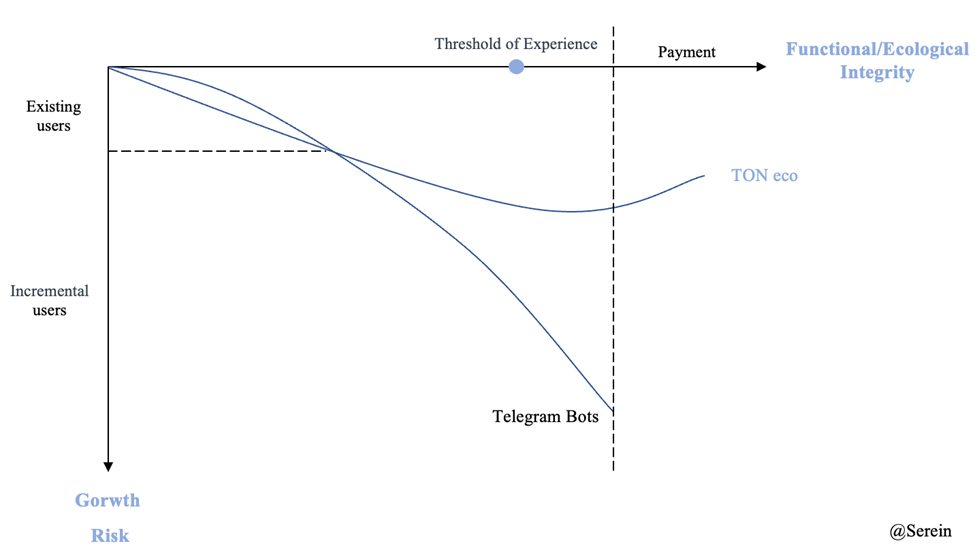
The success of Bot projects actually opens up a larger narrative for TON: while expanding on Telegram’s traffic, it can also convert existing crypto users. Going forward, it remains uncertain whether non-TON chain Bots face blocking risks, but the TON Foundation has strong incentives to welcome promising Bot projects and encourage migration to TON.
Conclusion
Facing risks related to technical architecture, economic model, and team dynamics, TON is actively responding: investing heavily in community developers to strengthen technical reliability, distributing funds through community grants to reduce centralization, and collaborating with institutions like DWF Labs to redesign its economic model.
Backed by Telegram, TON’s development enables us to envision a future blueprint: a low-cost, high-parallelism on-chain environment where users enjoy intuitive “partially or fully decentralized” applications, clear on-chain identities and social graphs, and seamless movement between the crypto and real worlds—a complete digital life journey. While we cannot precisely predict whether the future equilibrium will still tilt toward Web2, we can imagine users effortlessly leveraging trustless or trusted tools to meet their needs. Web3 may simply be one choice among many, but this evolving balance is exactly what we seek.
Overall, TON’s growth vectors are clear, its ecosystem is accelerating, and deployed projects remain in early stages—creating abundant investment opportunities with high upside potential ideal for venture capital. Additionally, early entry into this emerging narrative offers institutional investors potential influence dividends.
However, unlike other public blockchains, TON’s technological advancement is currently led primarily by the TON Foundation and early developer contributors. Opportunities for third-party infrastructure development remain highly uncertain, making top-down prescriptive investments in infrastructure difficult. A more suitable approach for institutions is to build extensive connections and closely monitor TON’s internal developments while identifying existing pain points.
Regarding DeFi on TON, the migration of leading projects is likely. Given their maturity and greater potential for ecosystem support, significant investment opportunities here may be limited.
Taking all factors into account, based on TON’s current trajectory, I am bullish on narratives centered around “accelerating TON development,” “Internal-Apps as the optimal product form,” and “creating new value flows aligned with Telegram’s new social paradigm.” Below are some reasonable, lower-risk investment and entrepreneurial directions:
- Accelerate TON development
- Dev Tools / Community
- Social Payment and parallel payment infrastructure
- Internal-App as superior product format
- Real-Yield Aggregator
- New value creation and circulation
- Social Plus / Graph
- Game and on-chain infra
- Traffic distribution platform
Finally, special thanks to Vivi, Howard, John from the TON Foundation, Jerry from TONup, and colleague Michael for their invaluable support!
Join TechFlow official community to stay tuned
Telegram:https://t.me/TechFlowDaily
X (Twitter):https://x.com/TechFlowPost
X (Twitter) EN:https://x.com/BlockFlow_News
 OP Crypto






