
a16z: The Science of Governing "Machiavellian DAOs"
TechFlow Selected TechFlow Selected
a16z: The Science of Governing "Machiavellian DAOs"
Web3 should overcome Web2 through decentralization; by incentivizing competition, empowering rivals, and leveraging non-token voting, DAOs can help accelerate this cycle.
 Navigating Web3 tides with focused insights
Author: Miles Jennings, General Counsel at a16z crypto
Translation: Babywhale, Foresight News
Web3 should triumph over Web2 because Web3 enables decentralization, which reduces censorship and promotes freedom. Freedom makes opposition to power possible, and such opposition drives greater progress. But first, we need to solve the problem of decentralized governance.
Since decentralized governance is still in its early stages, many Web3 protocols and DAOs are still working through solutions to the challenges that arise in decentralized governance. As someone closely tracking decentralized governance practices across Web3—including how they impact decentralization and how they are incorporated into various decentralization models—I believe applying Machiavellian principles to Web3’s decentralized governance can address current shortcomings. This is because Machiavelli's philosophy was built on a pragmatic understanding of social power struggles at the time—struggles similar to those experienced by protocols and their DAOs, which often have unclear, shifting, or inefficient social hierarchies.
In another article, I outlined four Machiavellian principles as guidelines for designing stronger, more effective decentralized governance—a “Machiavellian” DAO: embrace governance minimalism; establish a balanced leadership class perpetually challenged by opposition; create pathways for continuous turnover within the leadership; and strengthen accountability among leaders. In this piece, I will share the factors, strategies, and tactics DAOs should consider when implementing these guiding principles to build a “Machiavellian DAO.”
The strategies and tactics I propose are not suitable for all DAOs, as they introduce inefficiencies and friction into decentralized governance, making them potentially unsuitable for highly dynamic, rapidly evolving systems or systems with civic characteristics. However, for protocols in development that prioritize economic growth while maintaining credible neutrality, such as the hypothetical Web3 marketplace protocol “Blockzaar” used as an example here, the benefits of added friction may far outweigh the costs.
Two Steps to Implement Before Designing a DAO
Before sharing design principles, it’s essential to identify who the stakeholders are within the ecosystem. Once these distinct stakeholders are identified, the DAO can determine their intrinsic motivations—an essential prerequisite for balancing their power.
After completing these two preliminary steps, builders can implement the four Machiavellian design principles discussed below.
Step One: Identify Protocol Stakeholders
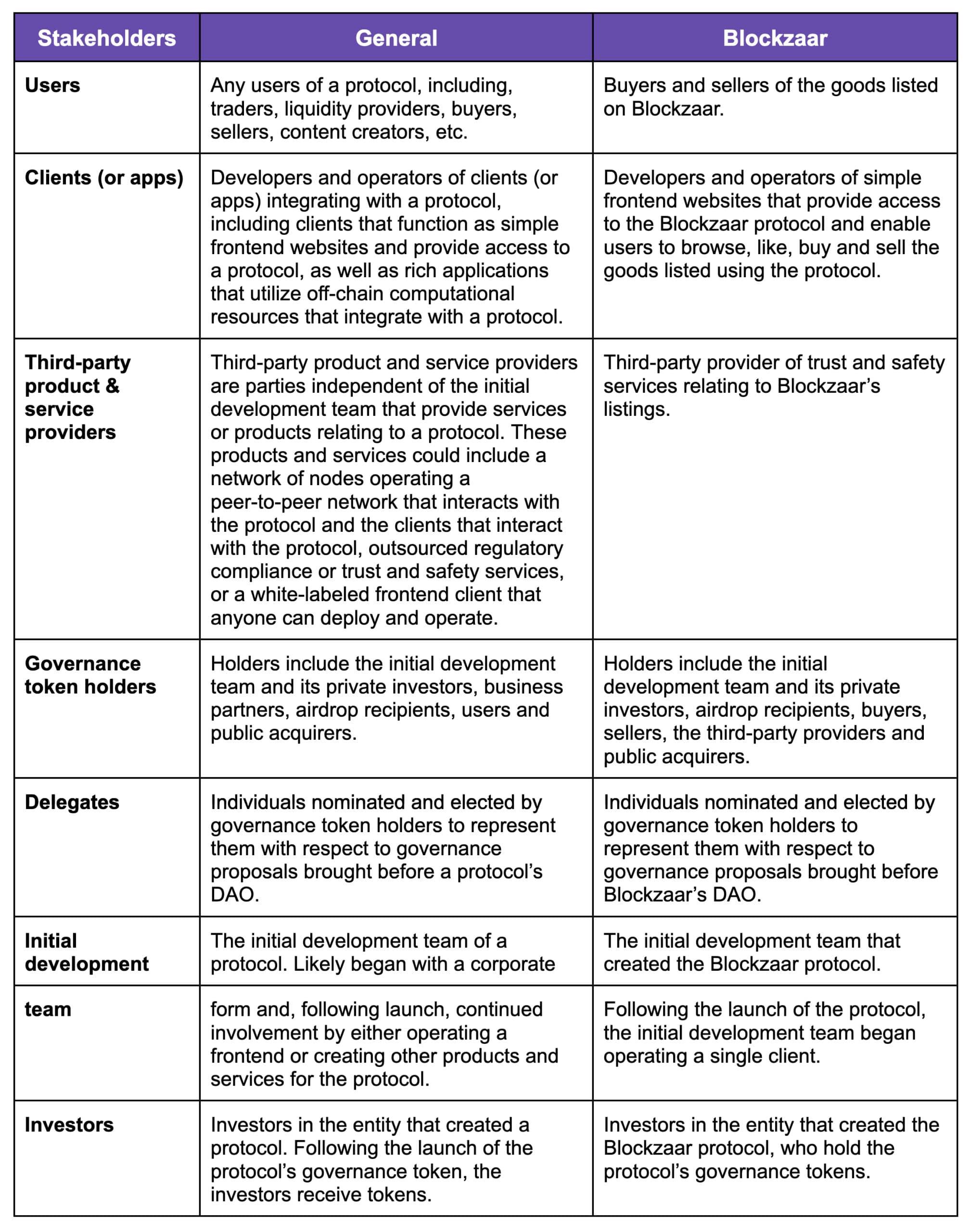
Stakeholders in a Web3 protocol include many different participants: users, applications (or clients), third-party product or service providers, governance token holders, representatives, initial development teams, and investors:
Step Two: Understand the Incentive Structure
The more active stakeholders—those economically incentivized to see the protocol grow and thrive—the greater the pool of parties available to effectively manage the protocol. This is why Web3 systems that encourage independent clients/applications (client layer) to be built and operated atop shared smart contract/blockchain infrastructure (protocol layer), and that encourage independent third parties to create off-chain products and services for stakeholders within the ecosystem (third-party layer), are best suited to leverage Machiavellian structures. (See the open decentralization model discussed there.)
Below is an ecosystem model using both incentive structures:
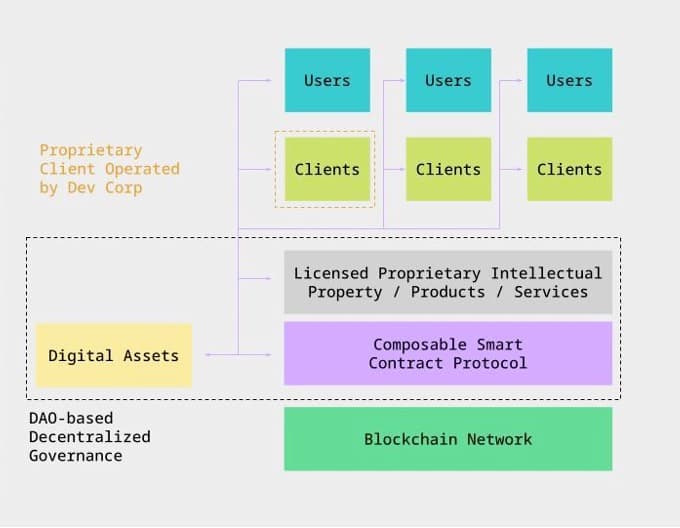
The goal of these incentive schemes is to make it profitable for independent third parties to operate clients as standalone businesses atop the protocol, while also creating tools and other shared intellectual property and services for use by protocol clients and users. These elements help foster decentralized economic prosperity within the protocol and provide fertile ground for designing more effective decentralized governance by giving independent participants a vested interest in the success of the decentralized economy.
When designing incentives, the DAO must balance the interests of the protocol/DAO (including token holders) against those of other stakeholders in the system (users, client operators, and third-party product and service providers). Token holders may resist commoditization at the protocol layer (where all value accrues to users, clients, and third-party providers), as this would deprive them of economic returns. Such commoditization also contradicts the protocol’s goal of accumulating network effects.
Meanwhile, commoditization at the client layer—where all value accrues to the protocol (also known as "fat protocols")—is unlikely to produce a rich client ecosystem, as builders cannot profit from developing clients. Both extremes jeopardize the decentralized economy of the entire system. Therefore, many ecosystems should adopt a more balanced approach. To illustrate, below is a very simple incentive scheme using “Blockzaar,” a hypothetical Web3 marketplace business:
-
The protocol is designed to incentivize buyers to purchase products; sellers to sell products; client operators to maintain such clients; and third-party service providers to develop and offer products and services to the ecosystem;
-
The benefit generated by the protocol is a 2.5% commission on all buy-sell transactions, distributed to stakeholders either via revenue sharing or governance token allocation;
-
Buyers and sellers receive benefits only when participating in transactions. Client operators receive benefits only when transactions occur through their clients. Third-party product and service providers receive benefits only when transactions are completed through clients using their products or services (in this case, when clients use the trusted and secure services of the third-party provider).
The benefits represented by commissions earned by Blockzaar can be distributed among stakeholders as follows:
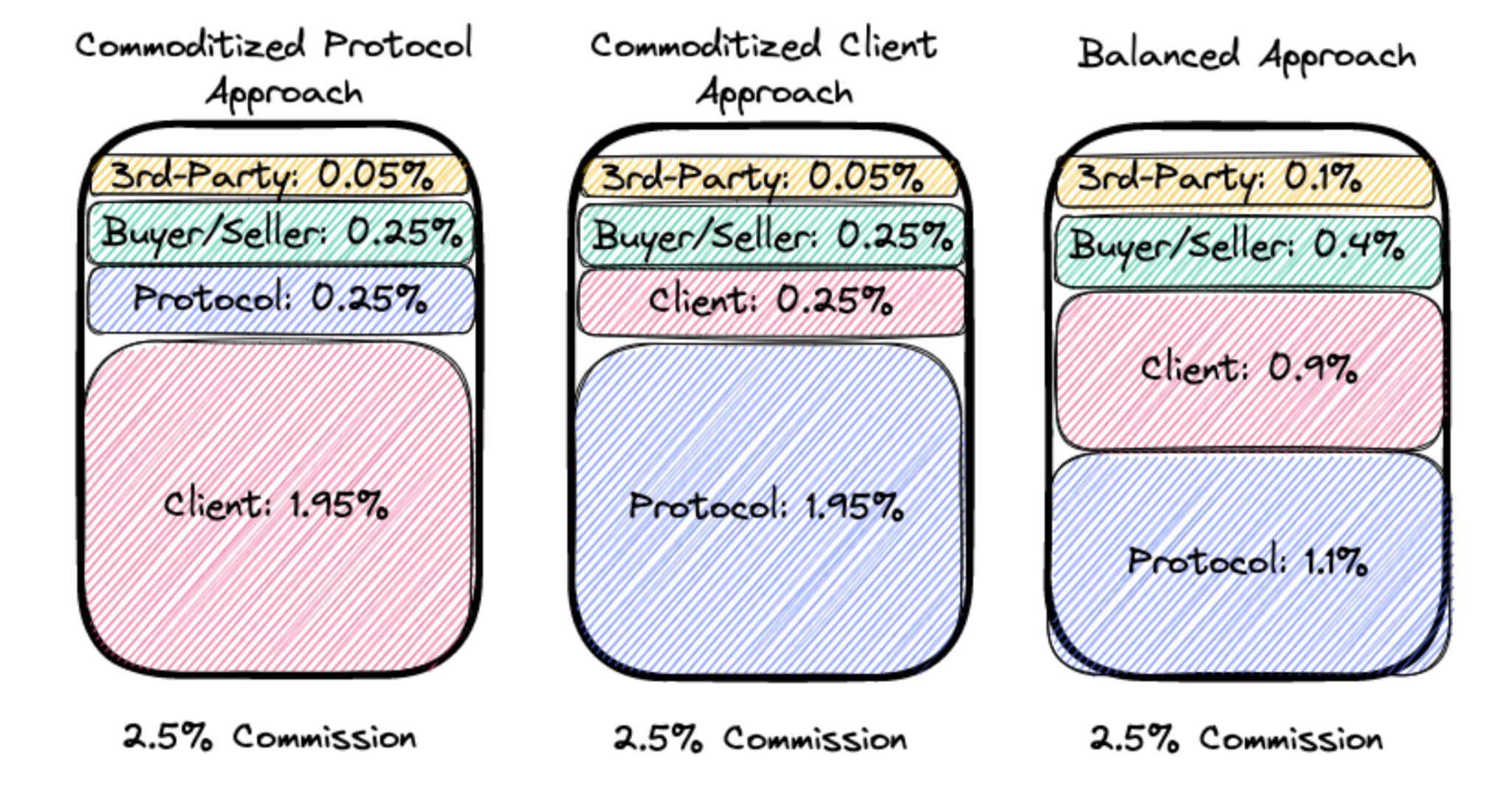
As shown above, of the 2.5% commission, 1.1% goes to the protocol, 0.9% to the client initiating the transaction, 0.4% to the buyer or seller, and 0.1% to the third-party service provider. Thus, both token holders (via protocol-generated benefits) and other stakeholders are rewarded upon execution of a transaction.
Why reward stakeholders? There are two additional considerations:
First, a balanced incentive structure may not only be feasible but necessary for certain systems. Regulatory actions in the U.S. have made it clear that systems facilitating regulated activities must find compliant pathways. In most cases, compliance cannot be embedded directly into the protocol itself and must instead be implemented at the interaction points between users and the protocol—i.e., at the client layer. Therefore, operators of protocol clients facilitating regulated activities must generate revenue from client operations to cover compliance costs. Avoiding compliance is undesirable: not only does it put client operators at risk, but collecting funds from illegal activities also exposes the protocol’s DAO to legal liability.
Thus, in cases where the protocol facilitates regulated activities, the "fat protocol" theory fails, and a balanced approach becomes essential.
Second, any decentralized model that strongly incentivizes the client layer must achieve a balance of power among clients. If a single client captures too many users, its dominance threatens the system’s decentralization. Therefore, the protocol must be designed to resist client dominance. To this end, the DAO could impose controls on clients exceeding a pre-determined dominance threshold (e.g., 50% of user transaction volume). To prevent manipulation of such mechanisms to censor certain clients, the mechanism should be as autonomous as possible and include upper and lower bounds for the dominance threshold. For example, for Blockzaar, this mechanism would trigger only if a client exceeds 50% of transaction volume, reducing its commission allocation from 1.4% to 1.0%, with the 0.4% difference going to the protocol.
Four Principles for Designing a Machiavellian DAO
Now that we understand the interactions among protocol stakeholders and the incentive structure of the protocol, the protocol’s DAO can be designed according to the four principles derived from Machiavellian thought.
Principle One: Governance Minimalism
Machiavellians observe that organizations tend toward autocratic leadership, which eventually discriminates to preserve its privilege and power. This suggests that DAOs should prioritize governance minimalism to protect credible neutrality as much as possible. In other words, since every human-driven decision affecting the protocol risks discriminating against stakeholders and undermining the ecosystem’s credible neutrality, such subjective decisions should be minimized.
The general consensus around governance minimalism is that protocol governance should be reduced to three categories of decisions that must be executed:
-
Complex parameter settings, such as collateral ratios in DeFi lending protocols;
-
Funds management, such as fund diversification, grant programs, including funding for public goods;
-
Protocol maintenance and upgrades, including oracle replacements, deployment of upgraded smart contracts, etc.
The number and scope of decisions within any of these categories for a specific DAO will largely depend on the type of protocol being governed.
To be sure, as Web3 protocols grow more complex, the number and scope of decisions will likewise increase. However, this does not necessarily mean that decentralized governance at the protocol layer must become equally complex. Instead, DAOs can leverage incentive-based decentralization models to counter this trend and further advance governance minimalism.
In particular, DAOs can protect their credible neutrality by “pushing” many governance decisions down to the client layer and/or third-party layer. For instance, decisions affecting only client-user relationships can be determined by individual client operators. While these operators could use decentralized governance to manage their clients, the inefficiency of decentralized governance may render this impractical.
Fortunately, decentralized governance at the client layer is likely unnecessary, as users do not directly participate in client-layer governance. Instead, they influence the client layer by accepting a client operator’s decisions and continuing to use the client—or by switching to a different one. Similarly, third-party providers can offer products and services with varying features and prices, allowing clients and users to choose based on their preferences.
Thus, a robust client and third-party layer can reduce the need for decentralized management while increasing user choice.
This resembles the “fork-friendly” environment advocated by Ethereum founder Vitalik Buterin and others—a remedy for decentralized governance problems, but extended beyond the protocol layer. Essentially, each client is a fork of other available clients; each third-party product or service is a fork of others. This dynamic fosters competition, allows rapid experimentation, provides users with more diverse choices, and maintains credible neutrality at the protocol layer.
For example, in a Web3 social network, if a client operator wants to remove all hate speech from their client, users can accept this moderation by continuing to use the client—or avoid it by switching to a client without such measures. But such moderation does not apply at the protocol layer, which remains neutral on speech. This is preferable to today’s Web2 content moderation, where users often don’t know what speech is restricted, by whom, or why. The problems of Web2 social media and arbitrary, subjective decisions by a few point strongly toward a better solution: Web3 protocols with minimal governance.
Forking at the client and third-party layers also avoids several key drawbacks that hinder forking at the protocol layer, such as liquidity fragmentation when forking DeFi protocols, or audience/user base fragmentation in Web3 social protocols. Forking at the protocol layer ultimately consumes the network effects generated by the protocol, making it unattractive to protocol developers and early adopters. For Blockzaar, governance minimalism and related concepts I’ve shared can be implemented by the DAO as follows:
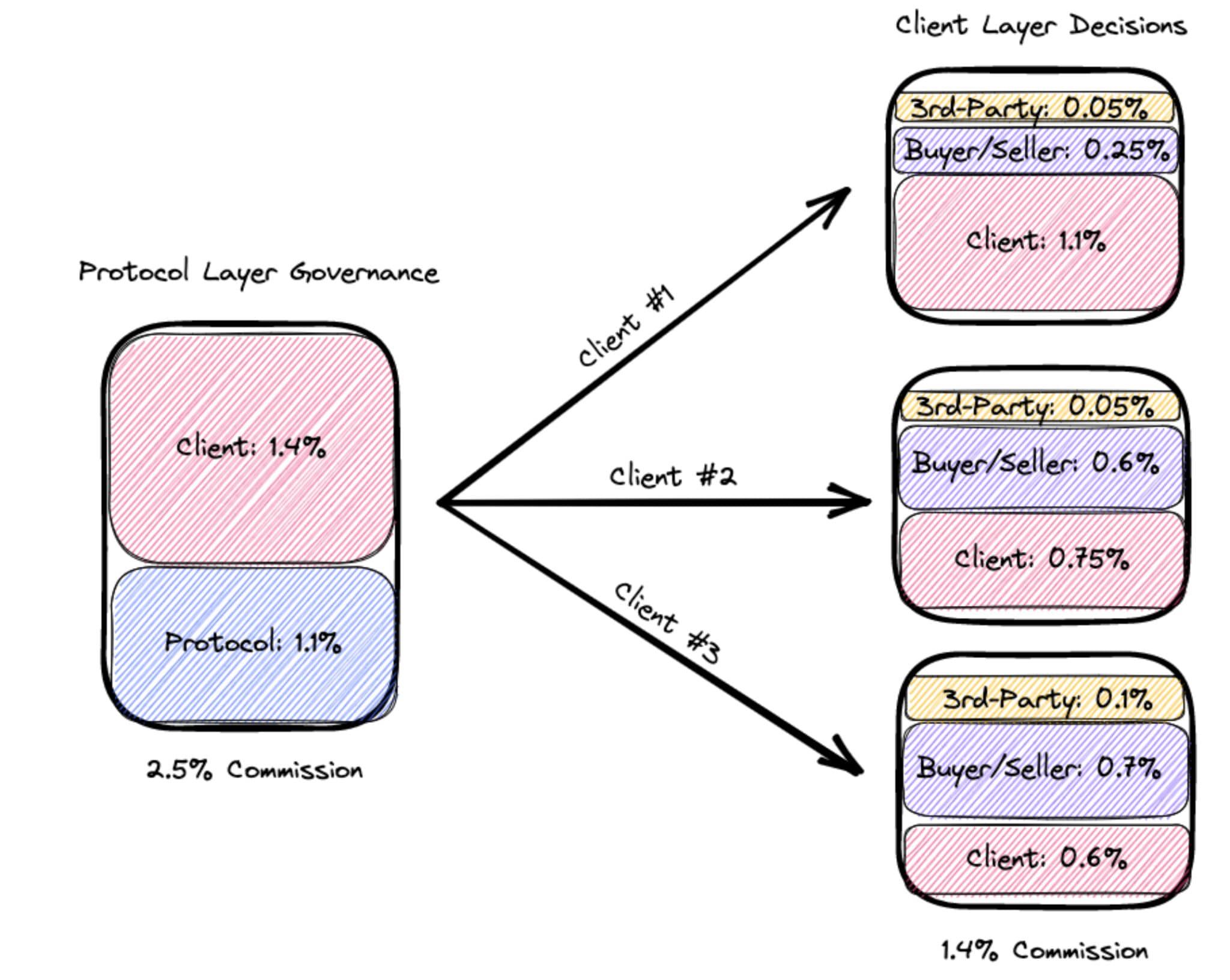
Complex parameter settings. For the simplest version of Blockzaar, the only parameters the DAO might change could be the commission rate applied to transactions and its distribution between the protocol and client layers. As shown below, the commission split among clients, users, and third-party providers can be “pushed” to the client layer, with each client deciding how to distribute its share of the protocol’s commission to its users and third-party providers:
Funds management. Blockzaar’s simplest governance design might still authorize the DAO to engage in funds management activities. This would include creating grant programs to fund public good development within the marketplace ecosystem and supporting other third-party products and services for clients and users.
Protocol maintenance and upgrades. Blockzaar’s simplest governance design might still empower the DAO to maintain and upgrade the protocol. This would help keep pace with competition, especially given the rapid pace of technological iteration in Web3.
Overall, if Blockzaar achieves governance minimalism, it can drastically limit the number of decisions requiring decentralized governance processes, significantly reducing the protocol’s governance burden. Nevertheless, the protocol can still achieve a degree of flexibility and experimentation by nurturing a strong ecosystem of incentivized clients and third-party products and services.
Principle Two: Balanced Leadership Class
Given the above, and the fact that Web3 protocols are becoming increasingly complex, even the most extreme governance minimalism is unlikely to eliminate the need for all human judgment. Therefore, DAOs must take additional steps to ensure that the decisions they must make are made effectively. For example, taking Blockzaar as a case, if a new version of the protocol is released, the DAO will need to decide whether to adopt it.
Given that most political systems tend toward autocratic leadership (as observed by Machiavellians), DAOs should seek to establish a leadership “class” within the ecosystem to more efficiently handle remaining governance matters. But the key is to design checks on any leadership class so that any emerging leader is always vulnerable to open opposition.
While DAOs might attempt non-token-based voting designs (such as proof-of-personhood) to overcome autocracy, Machiavellian principles drawn from observing contentious politics suggest such designs are unlikely to succeed long-term. Even if proof-of-personhood eliminates differential rights based solely on token ownership, token holders in such DAOs would likely reorganize into new groups based on new property rights and new class divisions. Thus, while proof-of-personhood may reduce a DAO’s vulnerability to attacks, it cannot eliminate autocracy.
A better alternative is establishing a system of checks and balances. Fortunately, incentive-driven decentralization offers fertile ground for exploring other tools to balance leadership power. Below, I’ll share a potential DAO design featuring a bicameral governance body—different from the U.S. Congress’s House and Senate.
Stakeholder Council
If a protocol successfully incentivizes a strong ecosystem of clients and third-party providers operating independently, it stands to reason that these actors have a legitimate stake in the protocol’s governance. Their livelihoods may depend on the protocol’s survival. Moreover, the protocol’s most active users may also have a vested interest in governance, especially if their usage ties into their own businesses.
Given their stakes, these stakeholders may be best suited to participate in the protocol’s decentralized governance. However, under current token-based voting models, these stakeholders are unlikely to hold sufficient voting power, greatly limiting the potential for genuine stakeholder capitalism within these ecosystems.
This challenge can be overcome by providing stakeholders with their own Stakeholder Council using non-token voting. Specifically, non-transferable NFTs (also known as soulbound NFTs) could be granted to certain individuals within each constituency, giving holders the right to propose and vote on issues facing the DAO.
When designing any such leadership class, the DAO should:
Distribute leadership power broadly so that no individual or affiliated group can be said to control the DAO. First, under U.S. securities laws, establishing a leadership class may carry negative implications. Power should be granted to a body composed of multiple members elected by the DAO from each constituency.
Evaluate stakeholders’ interests to identify areas of conflict and alignment. While difficult, assessing these interests is more straightforward than evaluating anonymous token holders’, as we can start from on-chain incentive mechanisms. For Blockzaar, for example, the incentive structure aligns the interests of users, client operators, and third-party providers with the protocol through commission distribution. As noted earlier, this is a complex parameter setting determined by the DAO.
At the same time, when it comes to funds management and/or protocol maintenance and upgrades, these stakeholders’ interests may diverge. For example, users may want DAO funds spent on user-benefiting products and services rather than those benefiting client operators; third-party providers may oppose such spending due to fears of increased competition.
Balance voting power of stakeholder representatives based on stakeholder interests. This can be achieved through weighted voting, where top-performing representatives in each constituency receive more votes, encouraging competition and tension among stakeholders. Additionally, voting can occur via a single council or separate constituency votes, as illustrated below:
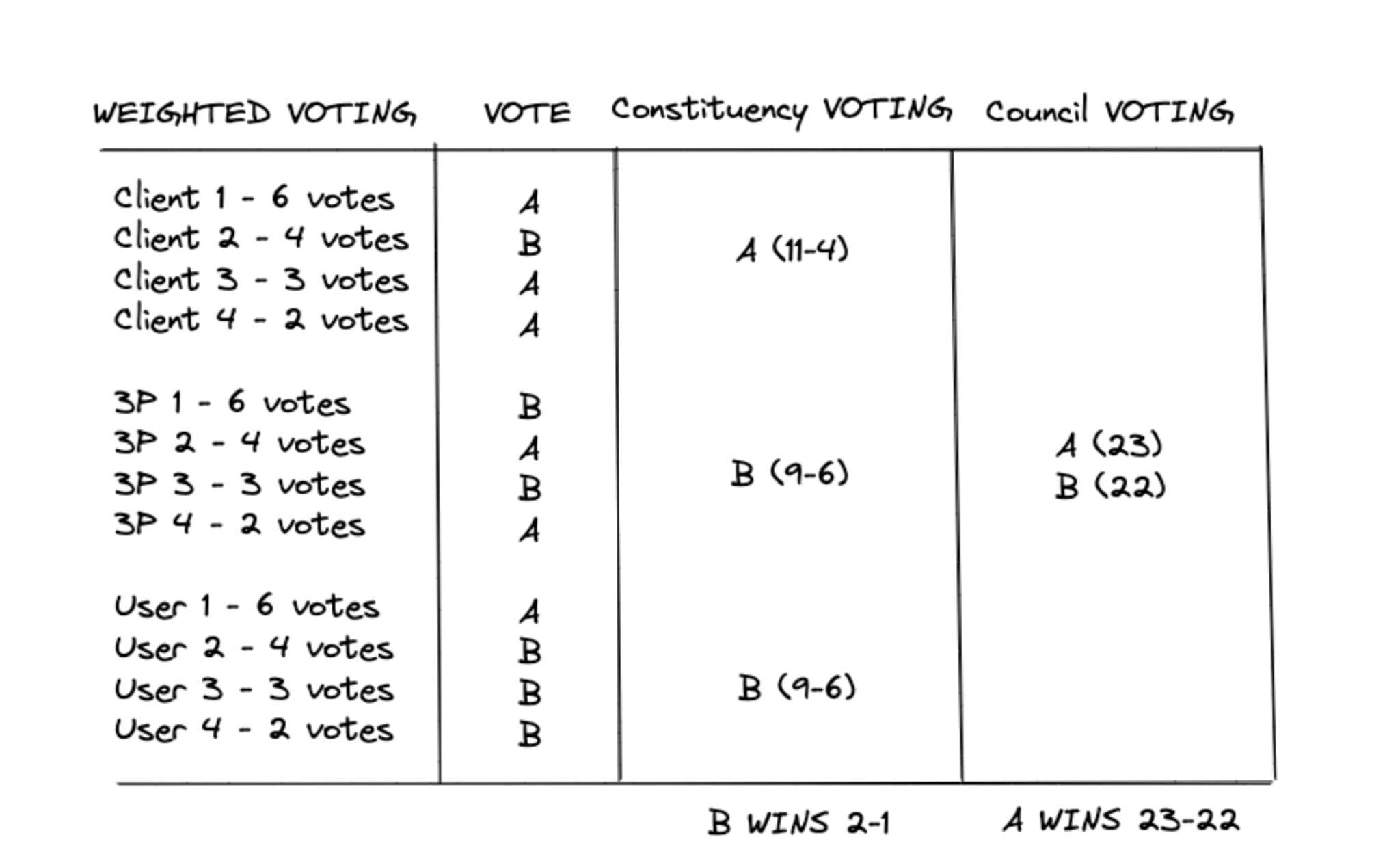
Any Stakeholder Council faces the risk of “hostile takeover” if the same or affiliated parties control multiple clients and/or third-party providers. However, this risk can be partially mitigated by requiring all such parties to have distinct U.S. taxpayer identification numbers or by using some form of individual identity verification protocol.
Representatives Council
The Stakeholder Council’s power should be checked by token holders, who have inherent stakes in protocol governance that may conflict with those represented by the Stakeholder Council.
The DAO can mitigate common problems of direct democracy (such as low participation, uninformed voters, etc.) by implementing representative democracy, most likely through delegation. Representatives should, among other things, be independent of any leadership members and appropriately compensated for their role in system management.
The Stakeholder Council and Representatives Council jointly have the authority to approve proposals submitted to the DAO. One or both councils may serve as the initial governance layer responsible for creating new proposals, while the other holds passive power (a proposal approved by one council passes unless vetoed by the other) or active power (a proposal approved by one council only passes if also approved by the other).
While this setup resembles Optimism’s bicameral structure, a key difference is that Blockzaar DAO’s Stakeholder Council (similar to Optimism’s Citizen’s House) would systematically consist of the most productive stakeholders in the system. Compared to well-intentioned but poorly incentivized participants, these stakeholders are more likely to become vested advocates for such systems. Since stakeholders’ livelihoods ultimately depend on the protocol, they are more likely than those acting purely out of civic duty to take governance seriously. This arrangement helps the DAO function more like an industry consortium than a homeowners’ association.
Elsewhere, including in constitutional and international law systems, similar concepts relying on self-interested parties rather than disinterested or noble social designers have been explored—with self-interest prevailing.
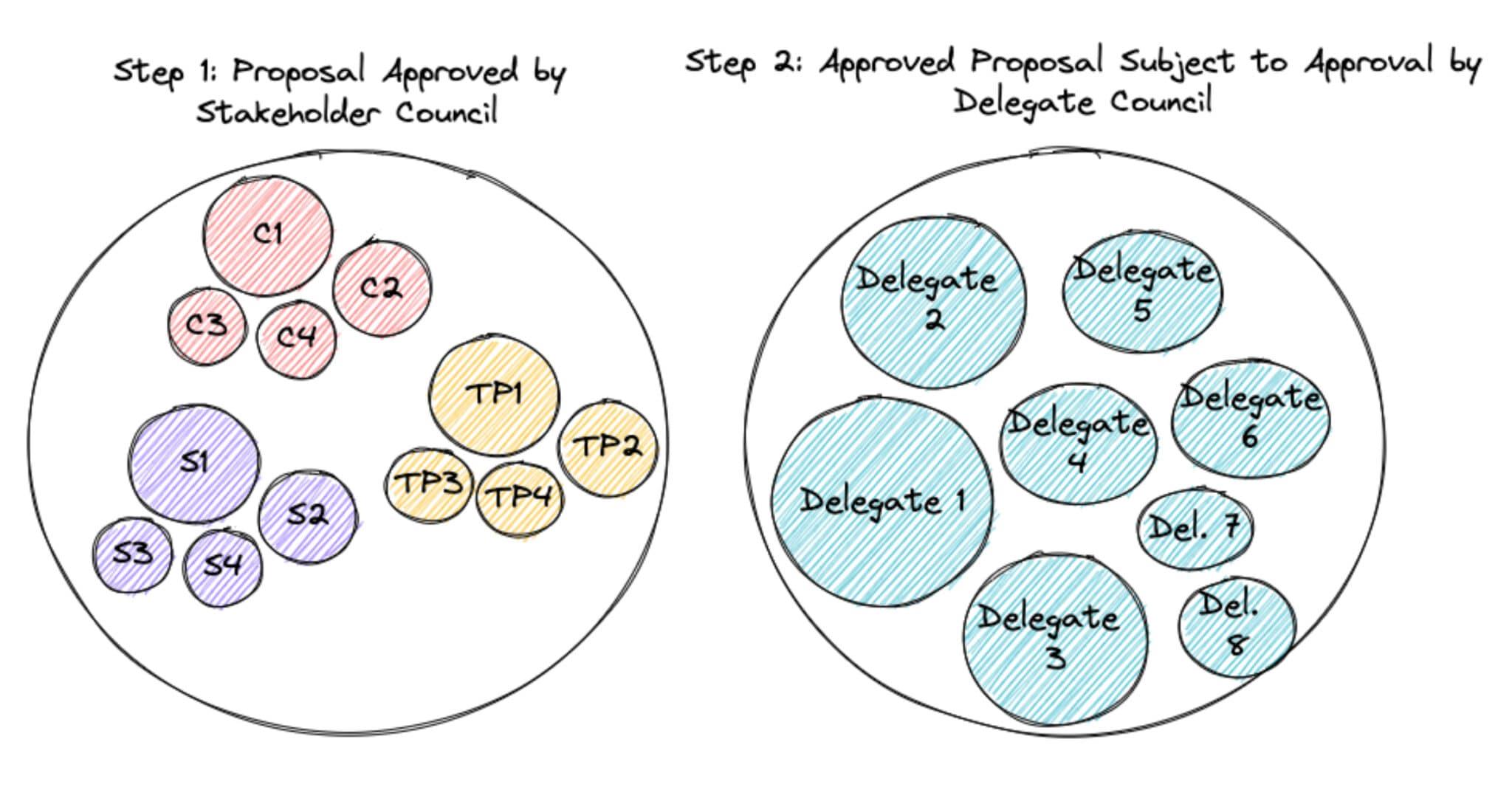
For Blockzaar, the DAO’s leadership and governance structure could be set up as follows:
-
The Stakeholder Council consists of: the top four client operators (by transaction volume); the top four third-party providers of products and services (by transaction volume of clients using these products/services); and the top four sellers (by transaction volume).
-
Voting power in the leadership is weighted by constituency and divided into three separate series (as shown above). The leadership votes as a single council.
-
The Representatives Council consists of 8 representatives elected and approved by token holders, with voting power proportionally allocated based on token holdings.
-
Governance changes do not default to passing in the DAO; any proposal approved by the Stakeholder Council takes effect only if also approved by the Representatives Council.
An example of Blockzaar’s governance system is shown below:
Principle Three: Continuous Turnover in Leadership
Machiavellians argue that institutions must not only sustain constant opposition but also allow new leaders to forcibly enter the leadership class—to create turbulence and avoid stagnant power balances. According to Machiavellians, such change must be forced, as the leadership will always resist to preserve its status and privileges.
Broad community participation is already a hallmark of Web3 ethos and frequently extends to DAO leadership, with community members often becoming formal contributors to the DAO. However, in token-based voting systems, community members’ ability to gain real power is often limited by financial barriers.
Nevertheless, DAOs wishing to embrace Machiavellian principles—that leadership must undergo continual turbulence—can introduce churn into leadership through several methods, including:
Imposing term limits on stakeholders in the Stakeholder Council. For example, performance criteria for promotion to the Stakeholder Council could be periodically reassessed, allowing the council to renew its membership with the top performers from the previous period.
Allowing token holders to recall representatives at will, or otherwise ending representative terms regularly, requiring re-delegation.
Empowering token holders to directly elect some members of the Stakeholder Council (client operators, third-party providers, and users), establishing that prior performance alone is not the sole path to council membership.
Principle Four: Strengthen Leadership Accountability
If large groups are inherently unable to hold their leaders accountable (as Machiavellians predict), then DAOs should seek ways to strengthen accountability across their entire ecosystem.
By implementing the first three principles above, a Machiavellian DAO can achieve stronger accountability than current DAOs, particularly:
-
With fewer leadership participants (compared to the broader token holder base), each member can more effectively hold others accountable for their voting history. This is especially likely between members of the Stakeholder Council and Representatives Council, given their inherent tensions.
-
If the client ecosystem becomes too dominant, users can simply stop using certain clients and switch to others, making client operators (including those elevated to leadership) more accountable to user demands. Similarly, a strong third-party provider layer allows users and client operators to hold providers accountable by switching to alternative products and services.
-
Regular representative recalls and term expirations give stakeholder class members opportunities to lobby token holders, thereby holding representatives accountable for past votes.
DAOs can further enhance accountability in their Stakeholder and Representatives Councils by requiring client operators, third-party providers, and users to “lock” a certain amount of governance tokens. These could be locked in a smart contract before joining the Stakeholder Council and released only after a fixed period. However, given that Stakeholder Council members may distrust their peers enough not to risk their own assets, such mechanisms may be hard to implement. Therefore, if any locking mechanism is introduced, it may also need to allow stakeholders to “rage quit,” similar to the mechanism implemented by Moloch DAO.
If properly implemented, a locking mechanism would help better align incentives between the Stakeholder Council and the broader token holder base.
Conclusion
A common critique of the ruling elite in the U.S. corporate system is that shareholders, directors, and executives often wield unchecked power. Hence, we see CEO pay vastly exceeding employee wages, or boards implementing stock buyback programs instead of reinvesting resources into the organization’s long-term health—alongside numerous other issues.
While this centralized power sometimes enables faster action, their errors and misjudgments have led to countless failures, with no recourse for other stakeholders within these organizations. Blockchain, smart contracts, and digital assets enable fundamentally different designs for Web3 systems. By prioritizing governance minimalism, DAOs can preserve credible neutrality, enabling the emergence of vibrant ecosystems of client operators, third-party providers, and users.
Giving these stakeholders meaningful roles in governance gives DAOs a real chance to achieve “stakeholder capitalism”—something traditional equity/corporate forms seem unable to deliver. Therefore, we should push Web3 systems to adopt incentive structures that promote actions improving their systems—making them more productive and better serving all stakeholders—rather than structures optimizing value solely for a few owners.
Again: Web3 should triumph over Web2 through decentralization, because decentralization reduces censorship, promotes freedom, and freedom enables opposition to power, driving greater progress. By incentivizing competition, empowering opposition, and leveraging non-token voting, DAOs can help accelerate this cycle.
But only if we embrace and adapt to such systems.
Join TechFlow official community to stay tuned
Telegram:https://t.me/TechFlowDaily
X (Twitter):https://x.com/TechFlowPost
X (Twitter) EN:https://x.com/BlockFlow_News
 a16z
a16z