Starknet Engine Reshapes Lootverse, Ushering in a New Era of On-Chain Gaming
TechFlow Selected TechFlow Selected
Starknet Engine Reshapes Lootverse, Ushering in a New Era of On-Chain Gaming
This article comprehensively outlines the complete development journey of the Loot ecosystem, from its rise and decline to its eventual revival, with detailed and thorough information.
 Navigating Web3 tides with focused insights
Authors:
@TianranZhang, @fangtingeth, @_eat_apple_, @0xBrawler
A Song of Ice and Fire on the Blockchain
"What is dead may never die, but rises again harder and stronger!"
— A Song of Ice and Fire
In just two years since its inception, Loot has played out a blockchain-native version of "A Song of Ice and Fire." During its initial frenzy, nearly 300 derivative projects formed the Lootverse. After the hype cooled, the community tide receded, leaving behind a core group of truly passionate creators who preserved the flame of the story at minimal cost and endured deep bear markets marked by crises like Luna and FTX. Time has proven that a good story never dies: in the early spring of onchain gaming, dojo reignited Loot's spark, breathing new life into Lootverse derivatives and driving a significant rebound in both quantity and quality of creations.
The long winter is over. On the eve of Lootverse’s revival, we revisit this “Eternal Story.” This article covers three aspects: the origin of Lootverse; the evolution of Lootverse IP and its ecosystem; and why Lootverse represents the best existing narrative onchain.
The Origin of Lootverse
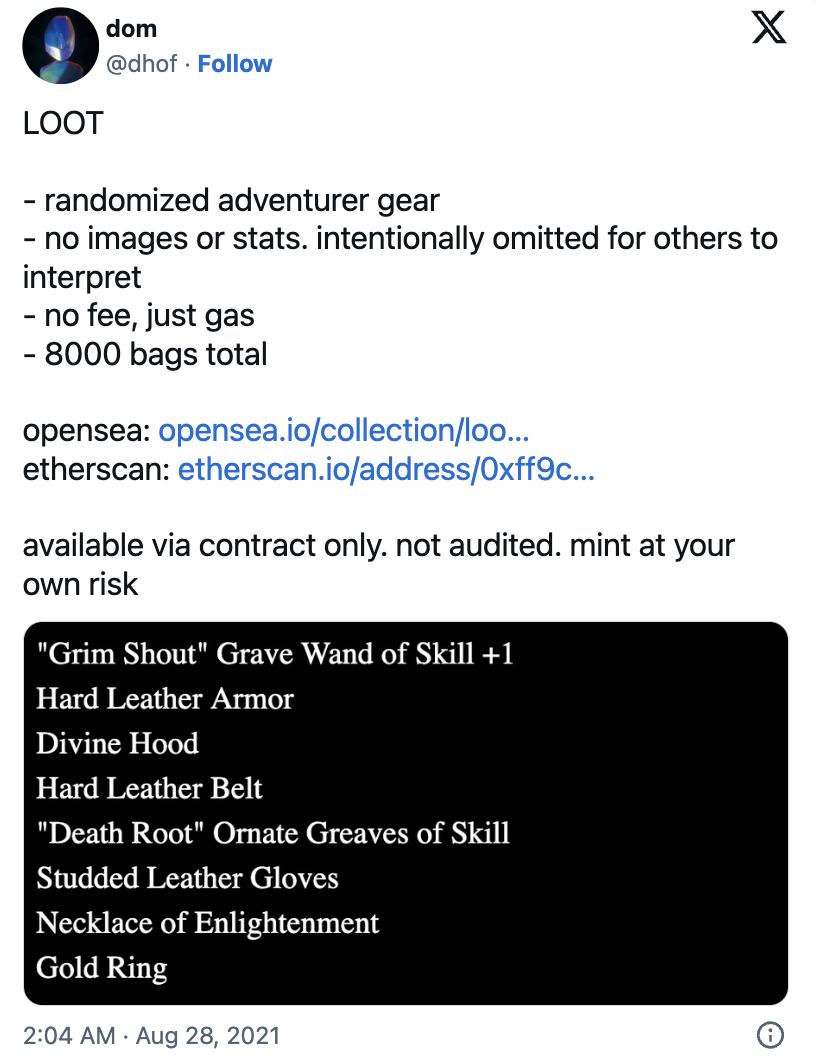
Two years ago today, August 28, 2021, Lootverse was born. Within ten days, Loot’s price surged dramatically to a peak of 20 ETH. Behind this price surge was widespread enthusiasm for Lootverse’s value proposition—bottom-up creation, no centralized team, replacing rich-media NFTs with "txt NFTs"—which represented a maximalist innovation within the standards of “crypto native.” A few lines of white text on a black background served as a “prompt” for an entire world system, enabling everyone to envision their own version of a “composable world,” and not just imagine it: Lootverse was architecturally open, allowing anyone to meaningfully participate in the collaborative construction of this world.
Early History: The Surge of Derivative Projects
A completely open fictional universe combined with a freely tradable market led to an explosion of derivative projects. Within three months, nearly 300 derivative projects emerged in Lootverse. While most were speculative, many original works also appeared.
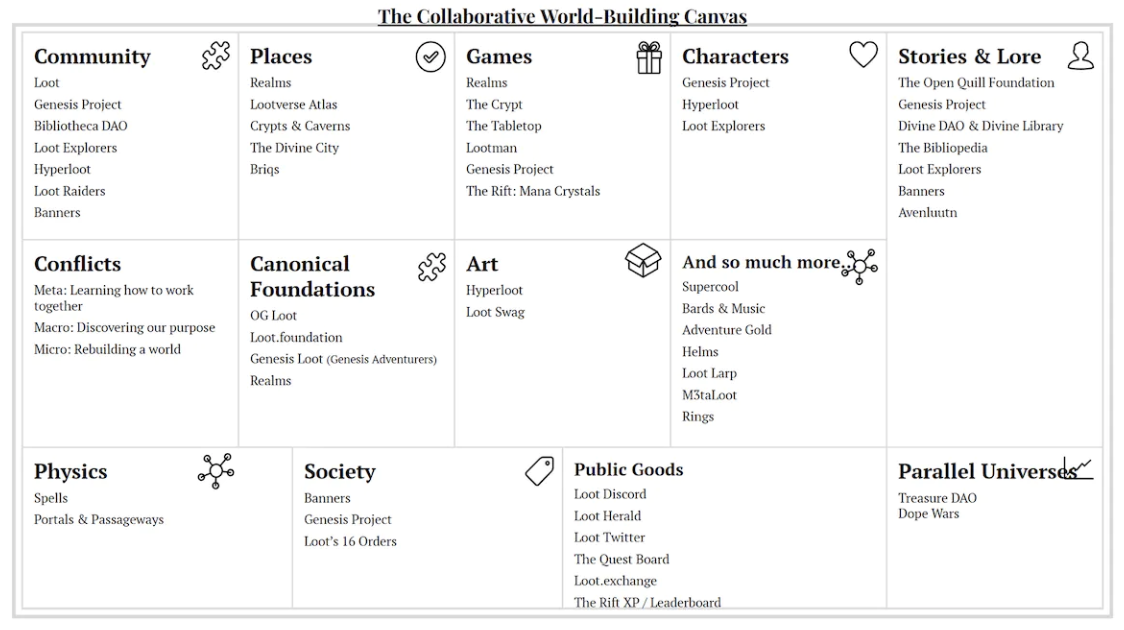
One significant derivative project was the Genesis Project, initiated by Timshel (also founder of Loot.foundation). It reorganized native Loot bags and, based on Loot suffixes, allowed holders to extract Genesis Mana and awaken Genesis Adventurers. This collect-and-evolve identity game cleverly engaged the community, requiring collaboration and communication among members while driving deeper familiarity with Loot’s meta-timeline—the timeline梳理 by DivineDAO was completed during this period. In this newly developed narrative arc, there are 2,540 Genesis Adventurers NFTs, with naming rights opened to the public.
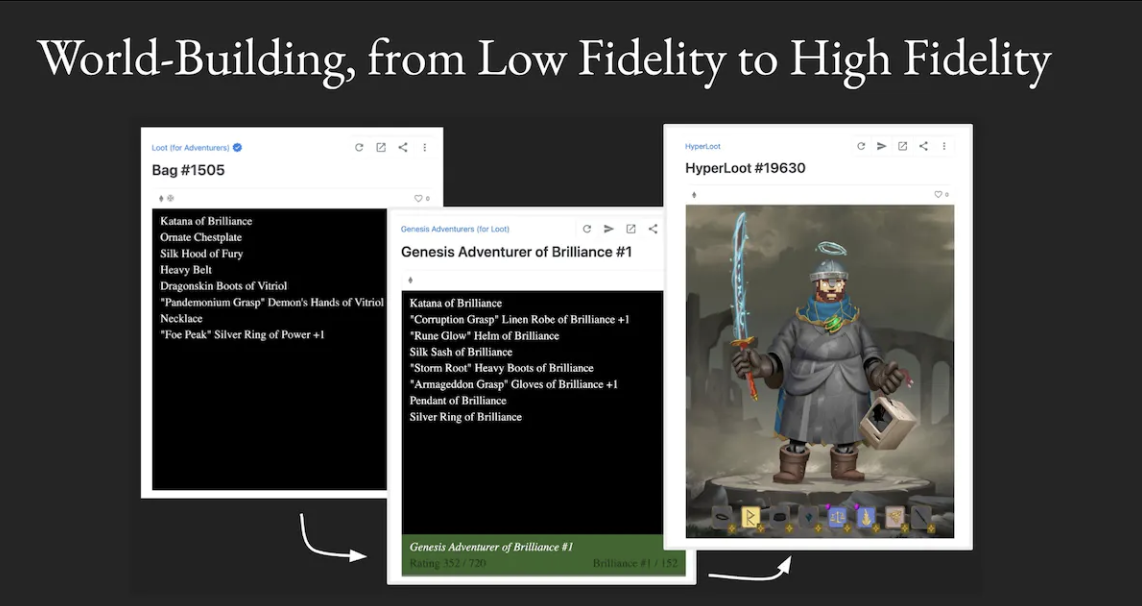
Genesis Adventurer and Hyperloot gameplay screenshot
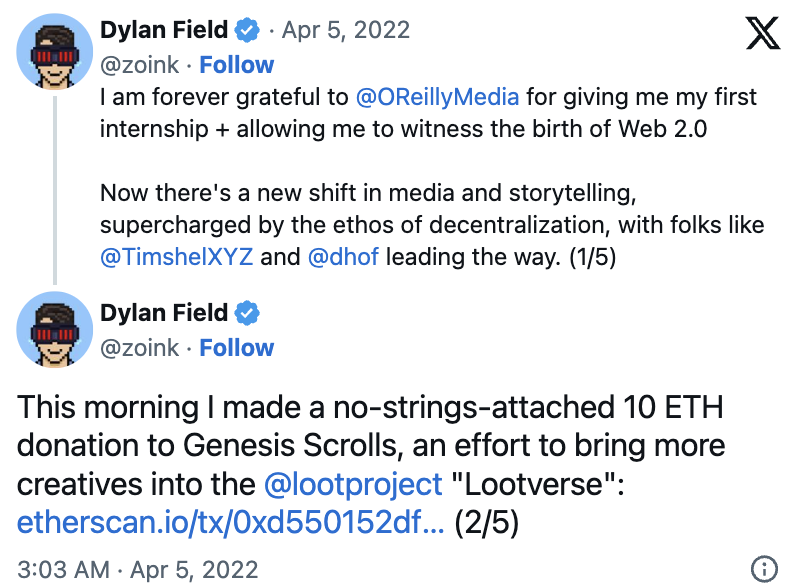
Opening up naming gave GA potential as a “universal IP,” allowing characters to be named Ned Stark or Jon Snow, creating authentic archetypes within Lootverse. Later, the Genesis Scrolls writing competition attracted considerable attention, aiming to piece together a Lootverse equivalent of *A Song of Ice and Fire*. Dylan Field, co-founder of Figma, was one of the earliest donors to the Genesis Scrolls project.
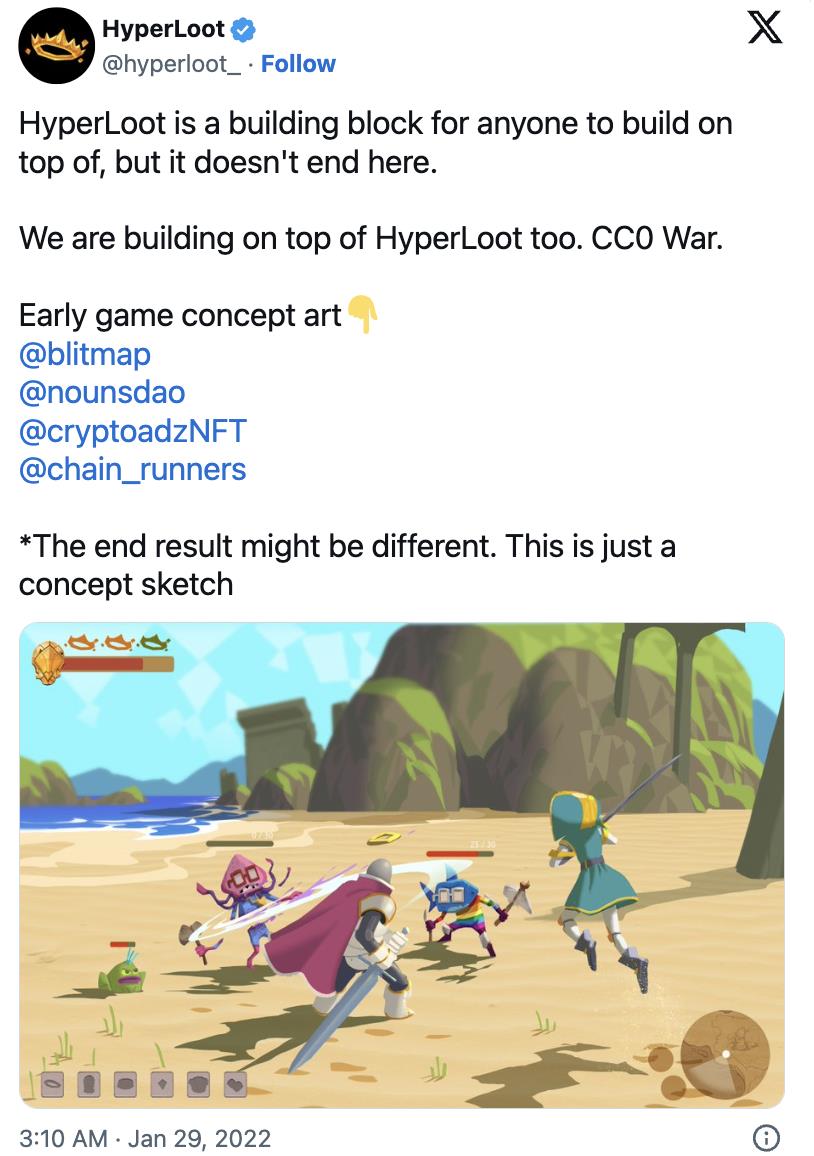
Hyperloot is another Loot derivative that visually interprets Loot through an artistic lens, contributed by an outstanding Thai team. It boasts a strong roadmap and product quality, connects with other Loot ecosystem projects (such as mloot, Genesis Project), and integrates with CC0 projects like Nouns, Chain Runner, and Blitmap. With the release of its 3D NFTs and its own spin-off games in 2023, Hyperloot remains worth watching. Even Paradigm and Coinbase co-founder Fred Ehrsam went so far as to create content highlighting Hyperloot team’s efforts in the CC0 wars, likening it to “Marvel Heroes vs Capcom.”
Crypts & Caverns is another key onchain infrastructure in Lootverse, created by threepwave in November 2021, offering composable dungeon maps. As a universal map system, Crypts & Caverns is usable not only within Lootverse but will be transferred to CheDAO for management in 2023. For details about CheDAO’s stewardship, see “Crypts and Caverns: A Sleeping Giant Awakened by CheDAO”.
The Crypt is a dungeon-crawling game built on Loot, where players retrieve imprisoned NFT relics. Participation requires holding Loot, mLoot, or GA, and the game currently features three open chapters. It was the first fully playable onchain Loot game. After securing $4 million in funding, the Playmint team began building their own onchain games.
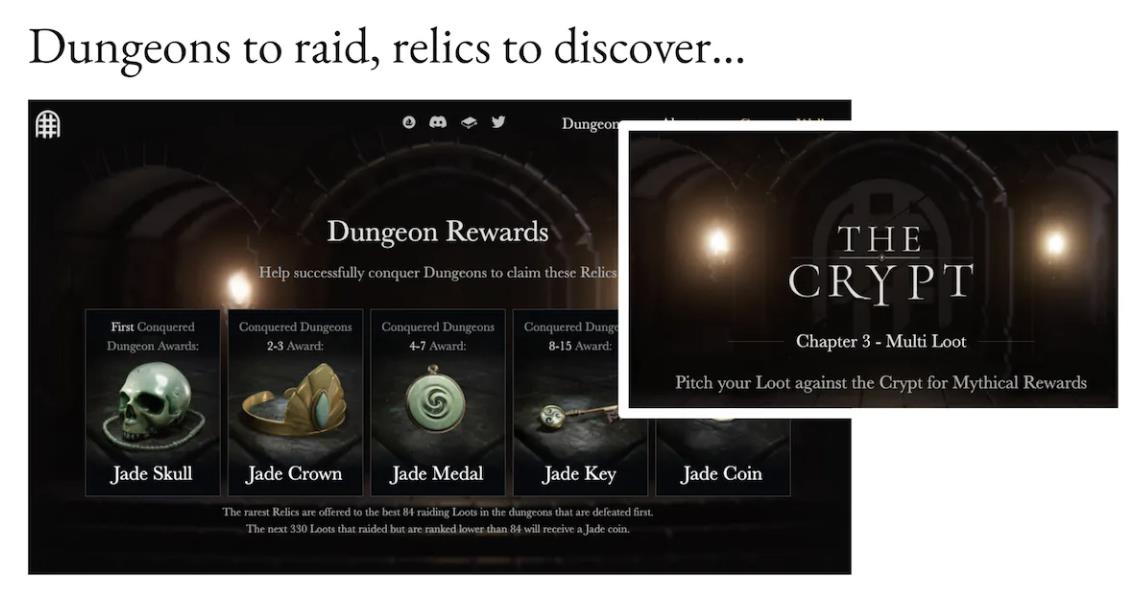
Exploration rewards in The Crypt
Loot Realms is a series of 8,000 procedurally generated NFTs developed by BibliothecaDAO. Realms has remained one of the core organizations in the Loot ecosystem, maintaining consistent productivity and later launching its governance token $LORD through Realm NFT staking. Unlike others, it chose Starknet as its gaming destination. The first game they decided to build is Eternum, a strategy-based S.L.G. game. More on this later, as Realms has proven to be the sole pillar of today’s Lootverse.
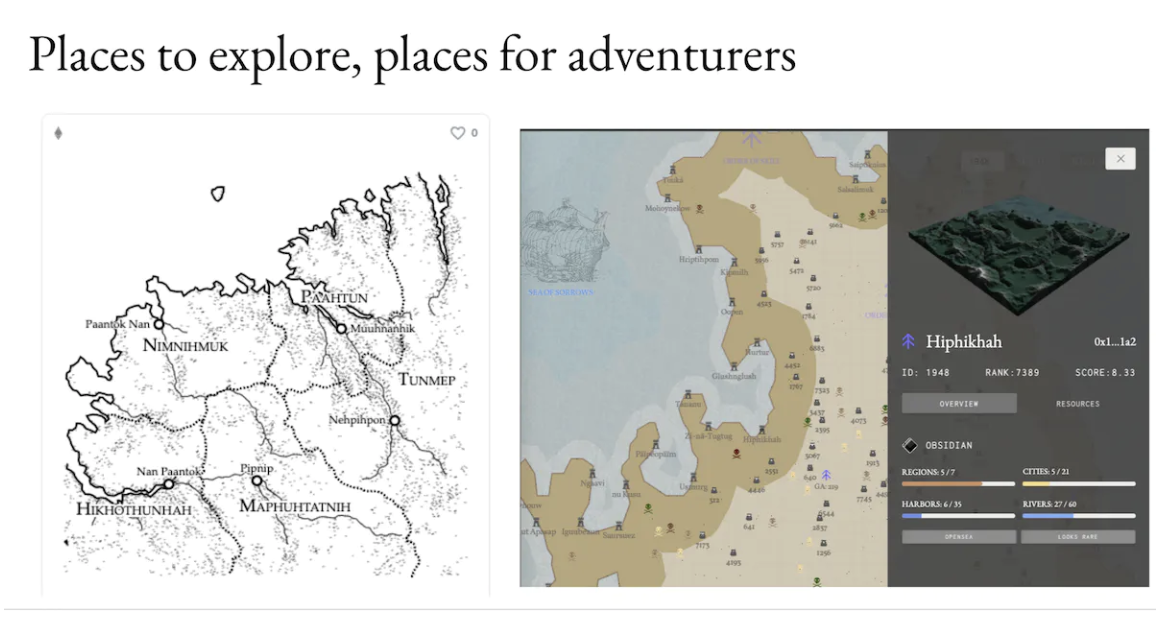
Realm NFT and early Realm: Eternum gameplay
Dope Wars is a fully onchain Loot-style game launched on StarkNet in August 2021 by perama and flourished with contributions from the Cartridge team. Inspired by “Drug War” and “GTA,” it blends street culture into a GTA-style universe. Its first playable mode, “Roll Your Own,” adapted “Drug War” to StarkNet’s L2 layer. As a major Loot derivative, Dope Wars and Loot Realms launched on Ethereum mainnet on August 31, 2021, distributing 125,000 $PAPER tokens to NFT holders on September 4. The Cartridge team is now developing Dojo, the StarkNet onchain game engine, which will be discussed further below.
2022 Grant Programs Driving the Community Ecosystem
By the end of 2022, Lootverse’s community ecosystem continued to thrive thanks to contributions from core creators, hosting over 30 community meetings. Timshel’s milestone Loot Deck released in April 2022 continued to resonate within the community, serving de facto as Lootverse’s “North Star.”
Initial hype had faded. In the first three months, an estimated 300 Lootverse derivative projects were created, most vanishing quickly. However, around 10% of genuine projects survived, and new ones continued emerging throughout 2022. By mid-2022, approximately 30 projects existed, most self-funded or grant-supported.
From eight lines of black-and-white text to an interconnected network of projects, these initiatives together form an infinitely expandable yet cohesive sci-fi fantasy universe, collectively pushing Lootverse forward.
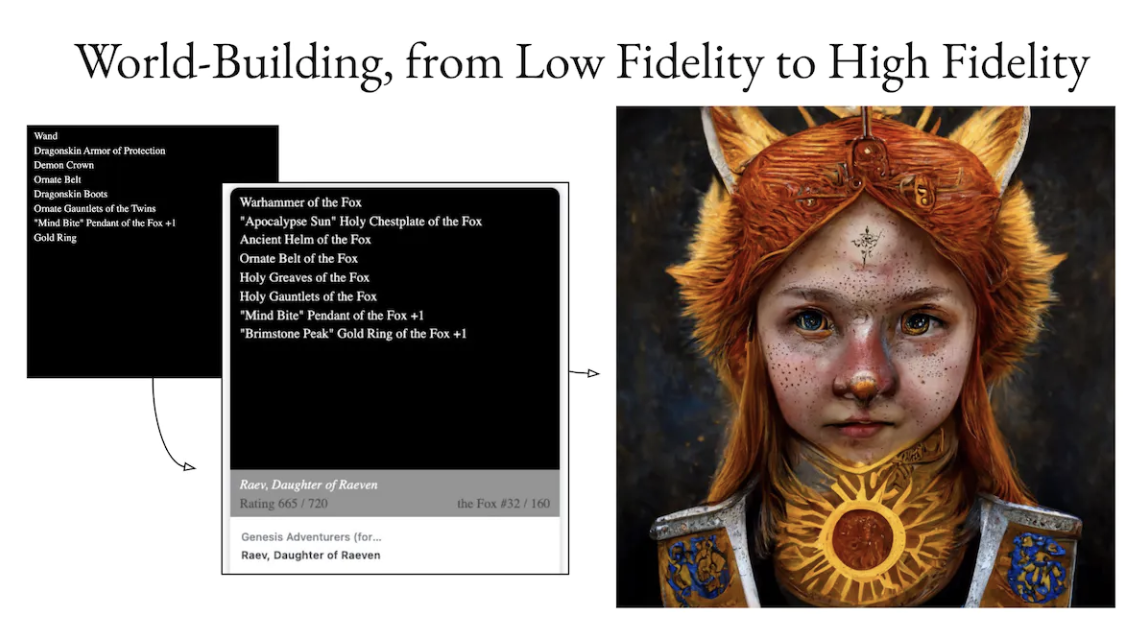
On the right: artwork specifically created for GAs
Gitcoin has been a consistent partner nurturing Lootverse through regular funding opportunities. In grant rounds 14 and 15 in June and September 2022, Gitcoin provided over $200,000 in total funding to the Loot ecosystem. Round 14 included support for projects such as “Monsters of Realms,” “The Violette of Vitriol,” “Genesis Scrolls” (focused on crafting stories, character backgrounds, and creative content from the Genesis era—the first Genesis Scrolls round took place in June 2022), and “The Genesis Scrolls Painted” (projects evoking strong feelings of “Game of Thrones” or “Lord of the Rings”). In September 2022, Gitcoin’s Round 15 awarded $75,000 to 21 projects expanding the Loot ecosystem. With 1,162 donors collectively contributing $92,000, total funding exceeded $84,000, providing timely support during a broader downturn in NFT interest.
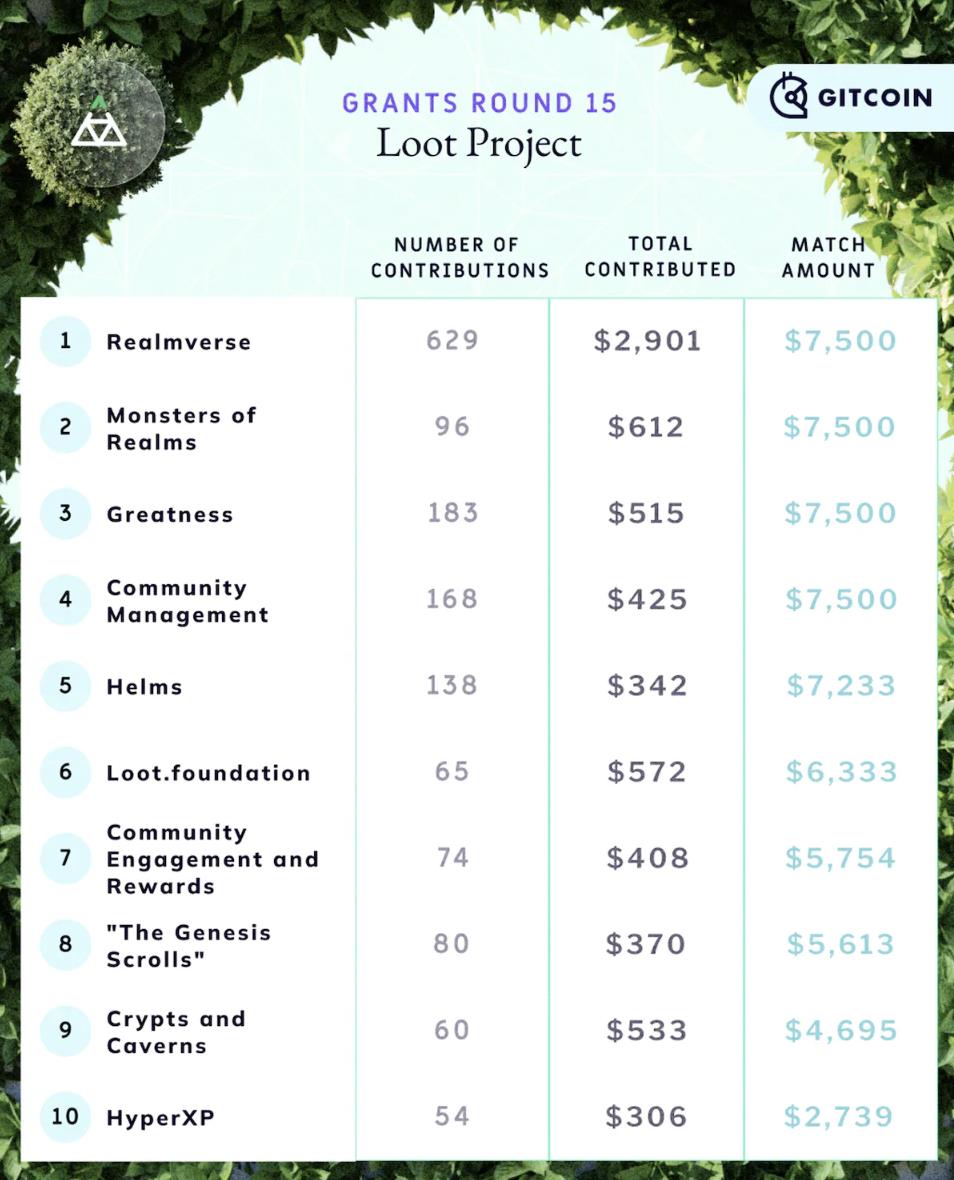
Lootverse ecosystem projects in Gitcoin Round 15
Mask Network also increased its support for Lootverse, backing five key projects. In their first grant batch in November 2022, recipients like Genesis Scrolls and The Rift each received $10,000 to advance narrative and gaming infrastructure. In the second batch in June 2023, Dojo received $20,000 to further develop its StarkNet game engine, Guildly received $10,000 for NFT guild functionality, and Banners received $10,000 to move its text RPG onchain.
The strategic grants from Gitcoin and Mask at critical moments collectively demonstrate their commitment to sustaining Lootverse as a community-driven ecosystem. These funds helped projects weather market volatility during the crypto winter and continue building.
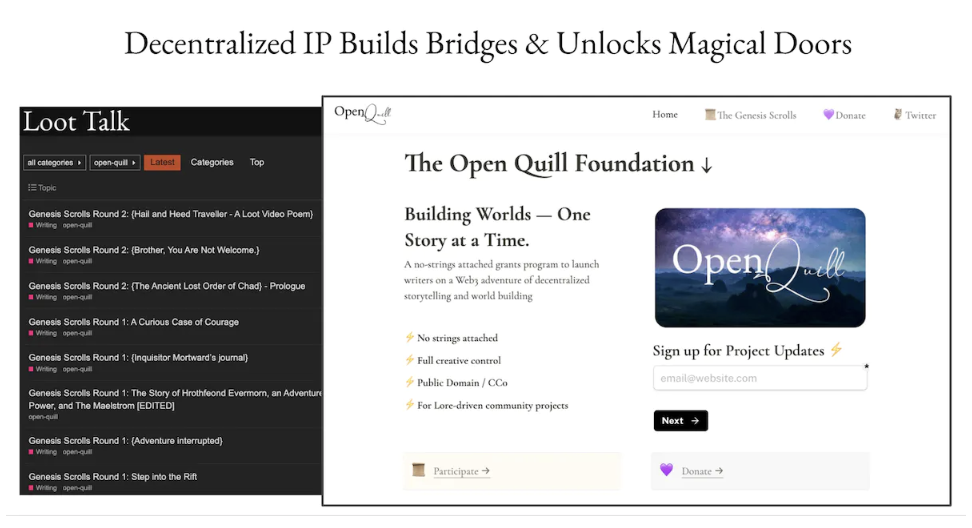
One particularly notable grant was awarded to the Genesis Scrolls project, aimed at attracting writers to bring Lootverse into real-world literature. In under six months, nearly 100 submissions totaling about 100,000 words were collected. A professional editor was then brought in to compile these works into a complete Loot book, expected to be published soon.
You can also read this article to learn what happened one year after Loot’s launch.
Loot, One Year Later: The NFT Hype Is Dead—But 'Lootverse' Hope Lives On - Decrypt
Realms – The Culmination of Gaming
If Timshel’s Genesis Adventurer and Genesis Scroll are projects that bind Lootverse together at the legendary level, Loaf’s Realms unites Lootverse through products—especially a suite of games.
Before any game release, on February 21, 2022, Realm unveiled the first version of Realm Atlas (the world map), previewing upcoming content—an astonishing showcase.
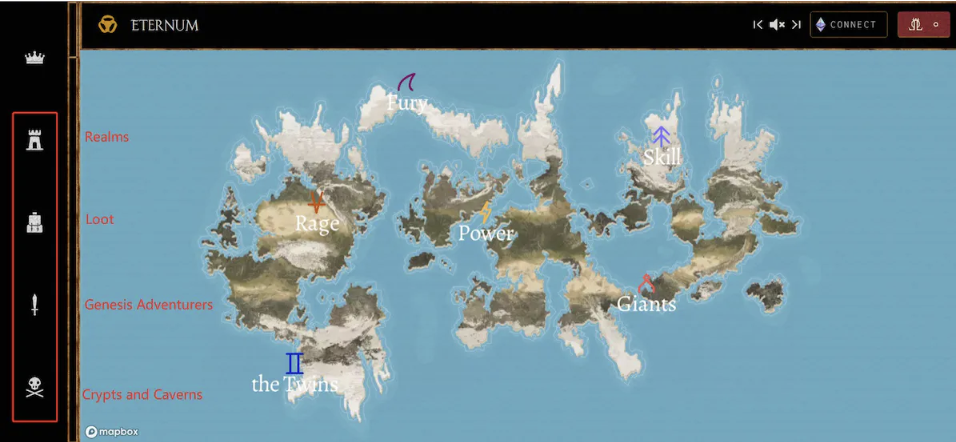
The Realm Atlas
This image shows the Atlas (world map) with 16 factions (nations) such as FOX, Power, and Giants, all generated from Loot data. It resembles the intricate political landscape of “Game of Thrones.” NFT projects like Realms, Loot, Genesis Adventurers, and Crypts & Caverns correspond to these nations within the Atlas.
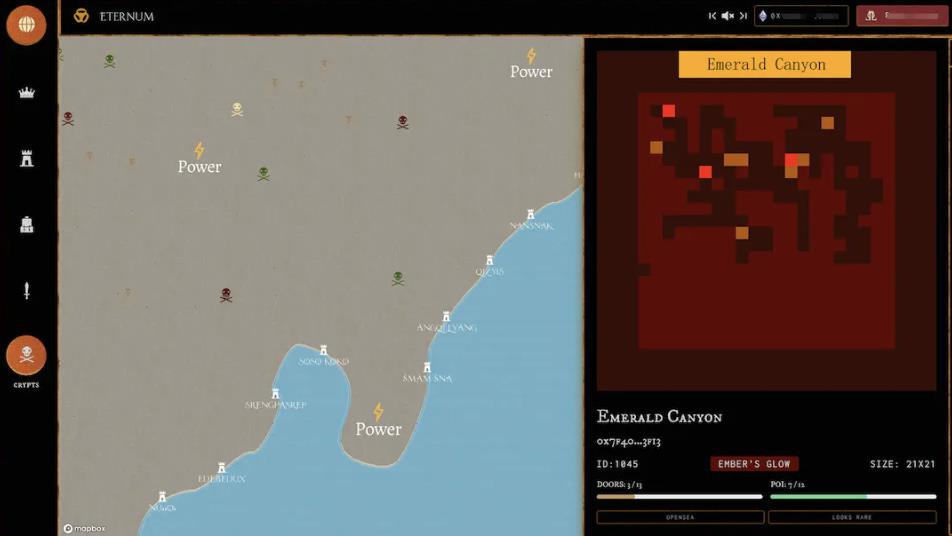
C&C in the Atlas, each skull representing a C&C plot
Later, the Atlas evolved several times, adding features like viewing your top four NFT packs and flying to your territory. It also provided much-needed engagement during the long wait for the main game, Realm: Eternum.
The pre-alpha version of Realm: Eternum was released in January 2023, offering a holistic experience where players could trade resources, raise armies, build castles, and wage war. While still rough around the edges, the core gameplay was already present.
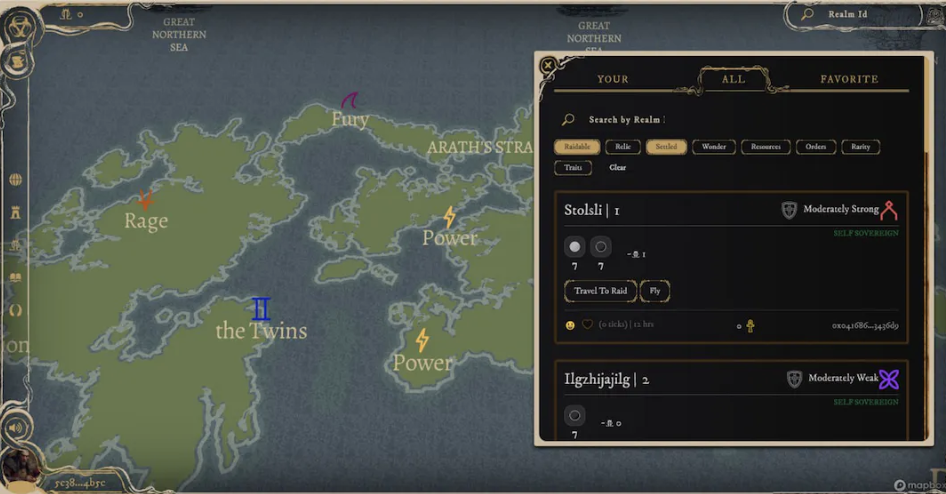
First version of Realm Eternum
Just days after the pre-alpha launch, the Realms team launched a $625,000 funding round for the community. $4,000,000 was committed within 24 hours—an astonishing oversubscription rate of 6.32x (5.32x returned), reflecting strong community confidence in Realms’ growth.
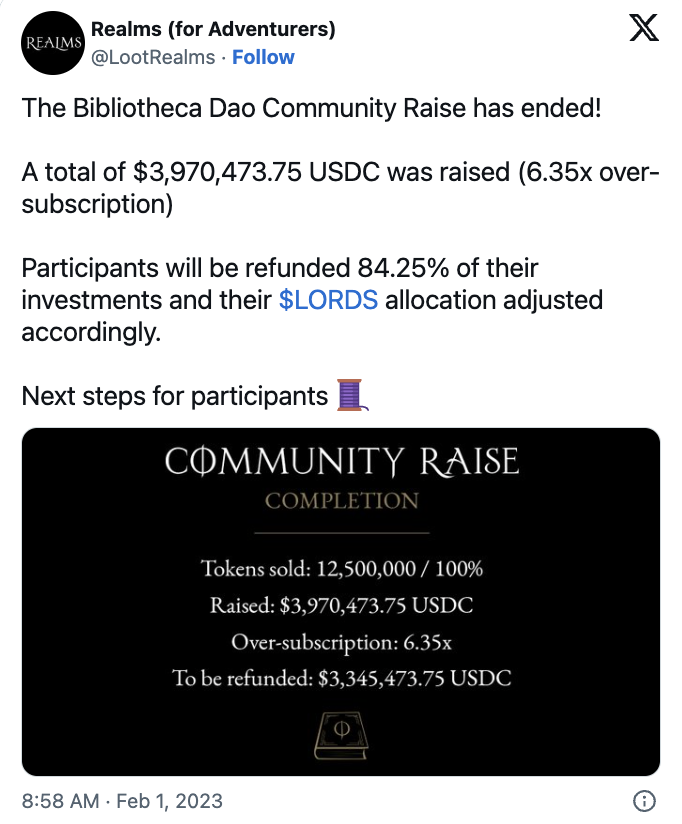
However, impacted by a series of market crashes and other factors, surviving the deep crypto bear market became difficult for most community projects. By spring 2023, only about 5 of the roughly 30 Lootverse projects remained active. Yet, spring was approaching.
Entering the DOJO Era – An Onchain Game Engine Built with Cairo
Building games directly on blockchains is a massive challenge, as pioneers like Dark Forest and Realm Eternum discovered. Testing of the first version of Realms: Eternum clearly revealed two things. First, a dedicated game framework or engine is needed to facilitate development. Second, a simpler game is required—one that enriches the Realm world and reaches market faster. The first need confirmed Dojo’s significance, while the second drove us toward Loot Survivor.
Thanks to the Lattice team creating MUD since early 2022, eventually solving this problem and later introducing the concept of autonomous worlds—achieving great success. Dojo initially started as a Telegram group comprising members from Realm, Cartridge, and briq teams. It began as a MUD v1 fork on StarkNet in November 2022. With growing development resources, Dojo has far surpassed its original vision.
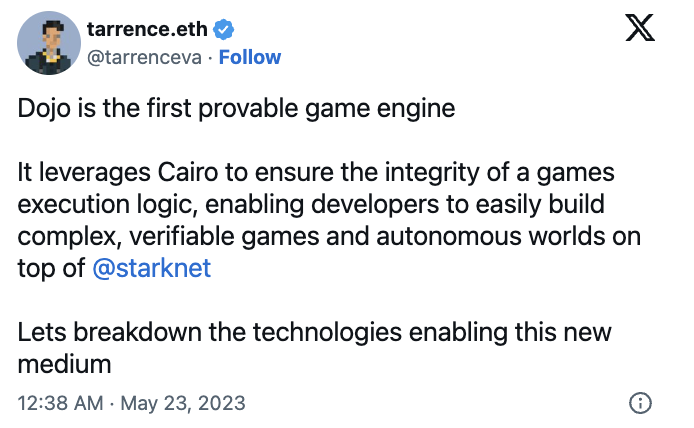
Dojo is a public game engine built by Starknet developers. It is the only verifiable game engine on the market, and this verifiability has greatly inspired its architectural and tooling design.
Dojo provides developers with an entity-component-system (ECS) architecture and integrated tools tailored specifically for Starknet and Cairo. This open-source engine lowers the barrier to creating high-quality onchain games with true ownership and asset interoperability. By fostering a strong developer community, Dojo aims to drive innovation beyond what MUD achieved on EVM.
Loot Survivor is a text-based adventure game created by Bibliotheca DAO on Starknet. It leverages Loot’s procedural generation elements, letting players adventure through dangerous realms filled with monsters, traps, and bosses. The goal is to climb the leaderboard before your character dies.
The game cleverly implements a Play2Die economic model, where characters carry and drop tokens upon death, rewarding early adopters and incentivizing participation. Over 500 onchain characters have been created.
Loot Survivor demonstrates creative onchain game design and community engagement. Built with Cairo on StarkNet, it maintains full onchain status while keeping gas costs low. Although current interaction speeds are slow, Ethereum improvements like EIP-4844 will enhance StarkNet performance and reduce onchain gaming costs.
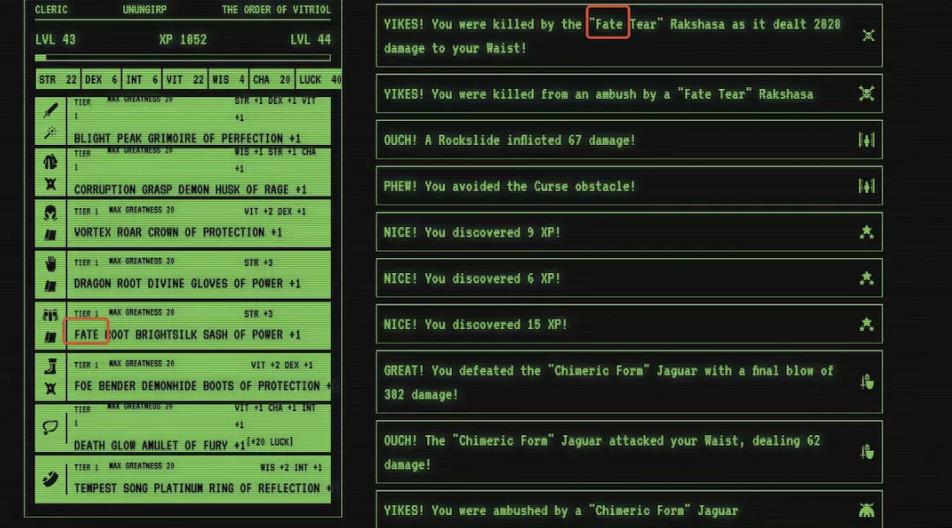
Level 20 loot items in Loot Survivor
Notably, Loot Survivor’s item and numerical designs align perfectly with the original Loot and GA setups, as the game was primarily designed by Loothero. This thoughtful continuity brings nostalgia to hardcore Loot fans, connecting them back to the early days of Loot mania. Sacred robes, katanas, +1 attributes, 16 factions—all are faithfully recreated.
The Rise of Dojo and Loot Survivor: Realms Members and Starknet Onchain Game Teams Accelerate Full Speed
The onchain gaming summit held in Portugal on May 25–26 became a milestone for the Loot and Dojo ecosystems. Among the 50 participants, 6 were from Realm, 4 from Cartridge, and 2 from briq—accounting for a quarter of attendees. Three days before the summit, Tarrence’s announcement about Dojo gained widespread attention and recognition across the Starknet and Ethereum communities. Polynya stated that infrastructure built for onchain gaming would unlock a new paradigm and lead broader application-layer innovation. Dojo’s demo on the first day of the summit was successful and received strong community support. On the second day, during designated game testing, Loot Survivor made its debut from internal alpha—the only playable game at the time. Despite Starknet’s poor performance requiring 3-minute actions, the leaderboard system motivated eager players to climb ranks, with bounties rapidly updating as records were broken, eventually reaching 0.1 ETH. The mechanism proved highly effective.
As Dojo matures as technical infrastructure, more games are beginning to emerge on it. (The first version of Loot Survivor was built directly on StarkNet, not on Dojo.) Two hackathons held in June and July welcomed Pixellaw as a wonderful addition to the Dojo family. It began as a brainstorming session at the Paris Komorebi Hacker House.
Both Dojo and Loot Survivor have become pivotal initiatives in the Loot ecosystem. They highlight StarkNet’s potential in delivering onchain gaming experiences.
Early games like Influence, Dope Wars, and Realms showcased Dojo’s potential. As the first game engine designed from scratch for StarkNet, Dojo lays the foundation for the next generation of crypto games. Its open and extensible nature ensures the engine can continuously evolve as StarkNet matures. Dojo represents a critical milestone toward fulfilling the promise of blockchain gaming.
The Rebirth of Crypts and Caverns
Crypts and Caverns (C&C), a pioneering procedurally generated map NFT project, has recently been acquired by CheDAO, marking an exciting new era for C&C. C&C demonstrates adaptable procedural mapping capabilities with immense potential. However, progress stalled recently. With CheDAO taking over C&C, renewed momentum and scalability are expected.
CheDAO plans to optimize C&C into a flexible mapping module for developers. Through partnerships, the goal is to establish C&C as the standard random map solution for onchain games, enabling widespread adoption by games needing procedural environments.
C&C is poised to fully realize its vast potential by integrating with various games like Lootverse, demonstrating its versatility, and continuing to prioritize community involvement. The integration across gaming universes will showcase the adaptability of C&C’s procedural mapping capabilities.
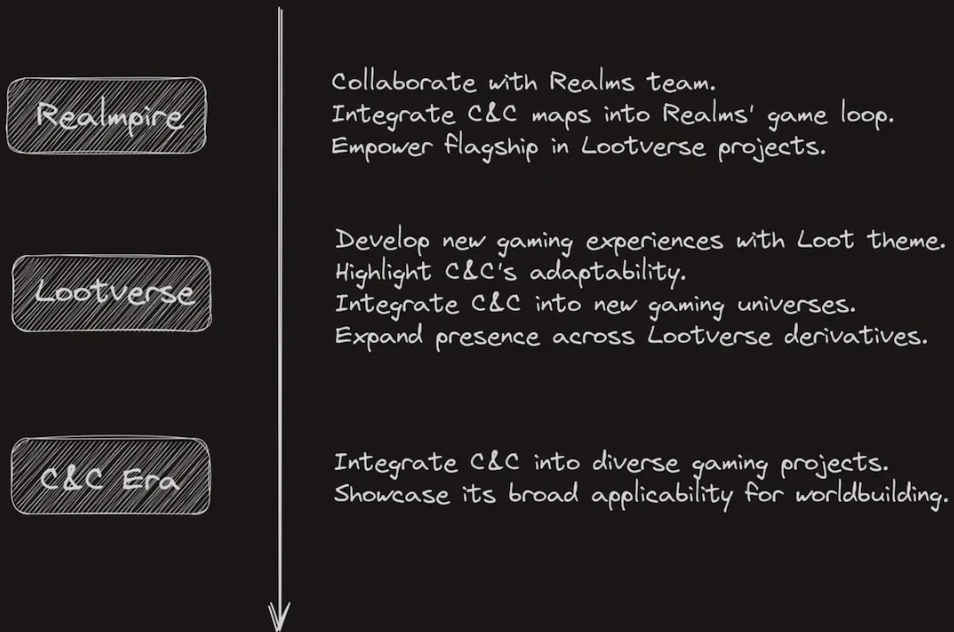
New roadmap for Crypts & Caverns
Frontinus House: A Grant Distribution Platform
Realms Autonomous World (RAW) aims to truly live up to its name: autonomy. Yet, such autonomy depends on infrastructure—often called public goods. This understanding gave birth to Frontinus House, a mechanism for deploying capital and funding projects within RAW and the broader Loot ecosystem.
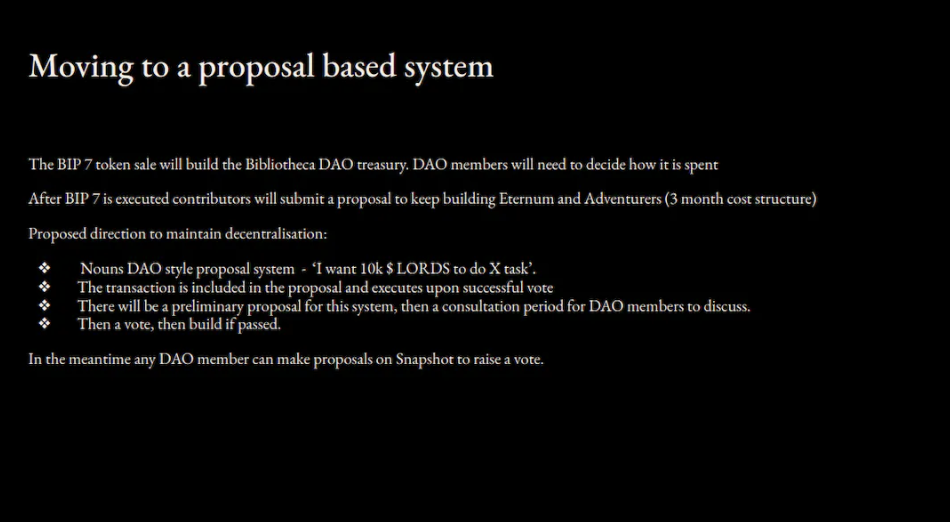
Frontinus House officially launched following BIP7 proposal
Frontinus House will launch during a fundraising phase, where builders will present innovative and compelling project ideas aligned with Loot Realms’ vision, mission, and goals.
Frontinus House’s ultimate goal is to cultivate a culture of transparency, accountability, and collaboration in the use of public capital. It also aims to support the development of excellent public infrastructure tailored to community needs. Through this, RAW seeks to fulfill its vision of autonomy, promote transparency and cooperation within the Loot ecosystem, and provide essential support for community-driven projects and infrastructure development.
Expanding the Realmpire: Overview of Realm Grant Projects
With Frontinus House ready, the first Realm grant applications began. Recently, 24 thoughtful proposals submitted to the Loot Realm Genesis Grant indicate revived interest and participation in the Lootverse ecosystem, signaling recovery from a year of stagnation. During Loot’s passionate early days, nearly 300 derivative projects emerged, primarily focused on cultural and creative endeavors, collectively forming Lootverse. By mid-2022, only about 30 projects centered on culture and creativity survived the initial fervor.
Another year passed, and only five of those 30 remained active, reflecting declining momentum. However, a major shift occurred with the introduction of the Dojo game engine on Starknet. By lowering barriers for developers, Dojo opened the door for a new wave of projects, especially in gaming and interactive experiences. This transformation sparked fresh vitality—24 new proposals have now passed through Realm Grant. This new wave is predominantly game-related, driving a resurgence in Lootverse activity and bringing the number of currently active projects back to around 30. From 300 creative projects to 30 cultural survivors, down to just 5 active initiatives, now returning to a diverse set of 30 projects—this journey vividly illustrates the dynamic evolution of the Lootverse ecosystem.
The renewed energy and shift toward game-related projects closely correlates with the rise of the Dojo game engine on Starknet. By offering game developers a powerful and user-friendly platform, Dojo has ignited creative landscapes within Lootverse. Combined with Lootverse’s organic momentum, this signals a welcome spring after the crypto winter.
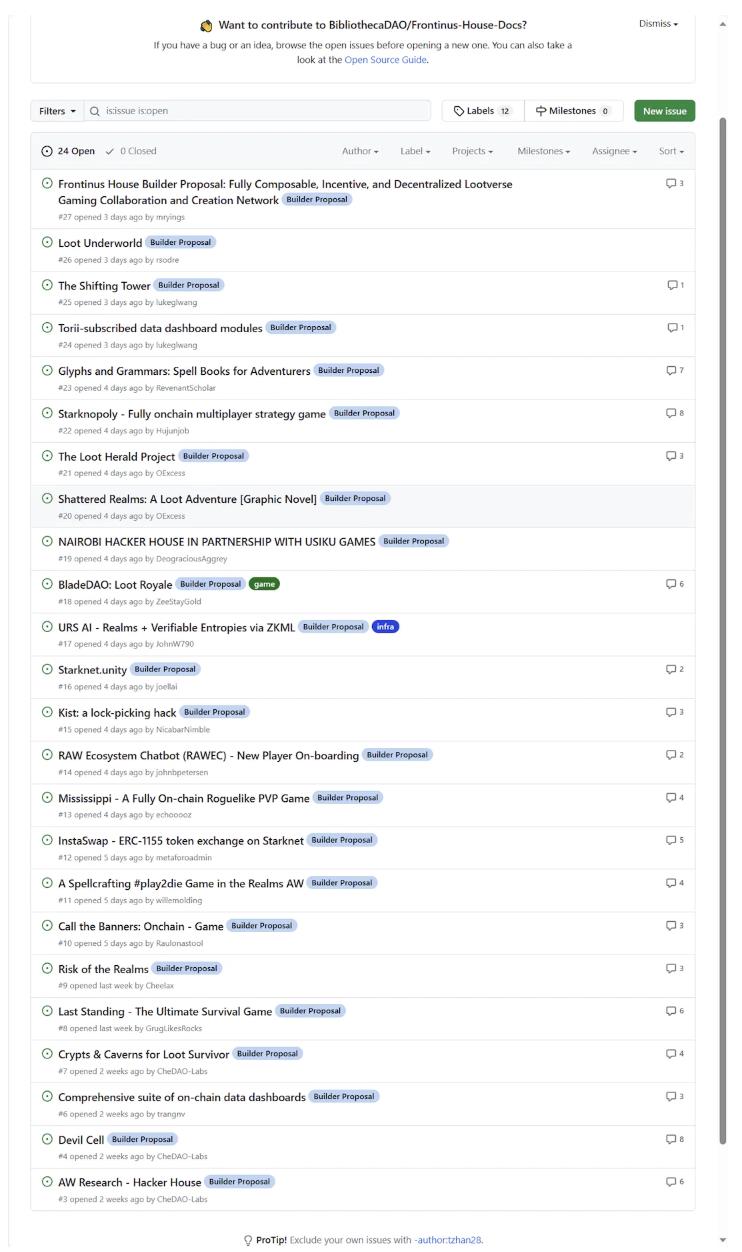
24 projects in Realm Grant Applications
Over the past year, Lootverse’s resilience amid ups and downs highlights its deeply rooted essence. With this renewed vitality and strengthened foundation, Lootverse is poised to enter the next phase of decentralized world-building, showcasing the vibrancy of a collaborative ecosystem built on open infrastructure (Loot).
Recent news confirms formal approval of BIP-14. The number of eligible grants has increased from 5 to 10, indicating substantial confidence from the Realms community in promoting the ecosystem.
BIP-14: Increase Frontinus House Proposal 1 Grants to 10
Why We Are Bullish on Lootverse and the Dojo Game Engine
Lootverse fosters a vibrant ecosystem through composability and interoperability among its core NFT primitives. Projects like Realms, Loot, Genesis Adventurers, and Crypts & Caverns establish reusable building blocks, enabling seamless collaborative world-building. This modular approach lowers barriers for developers and creators to participate. By sharing infrastructure covering maps, items, characters, and more, Lootverse empowers unlimited imagination.
At the narrative level, Lootverse showcases the potential of decentralized storytelling. Designed to inspire creative narratives, the community collectively builds a complex world through shared authorship. This decentralized model resists consolidation under a single vision, instead cultivating diverse perspectives. Lootverse demonstrates how blockchains can enable permanent, open-ended stories shaped by collaborative participation.
Complementing its rich world-building assets, Dojo serves as a powerful technical foundation—a game engine purpose-built for blockchain capabilities. Dojo’s architecture leverages recursive proofs, incremental verification, and compressed state storage, opening new frontiers in onchain gaming. Combined with Cairo’s advantages in performance, generality, and Rust-like syntax, Dojo creates a development environment capable of unlocking gameplay complexity far beyond current limits.
With strong foundational components across narrative, economic, and technical dimensions, Lootverse and Dojo possess immense potential. As interoperable building blocks accumulate and tools mature, their momentum becomes unstoppable. We are witnessing the birth of a new creative paradigm that will reshape how collaborative digital worlds are built. When imagination and innovation converge, the possibilities are infinite.
Lootverse and Dojo have laid the groundwork for next-generation, community-driven gaming universes. As spectacular developments unfold, it’s clear this is only the beginning.
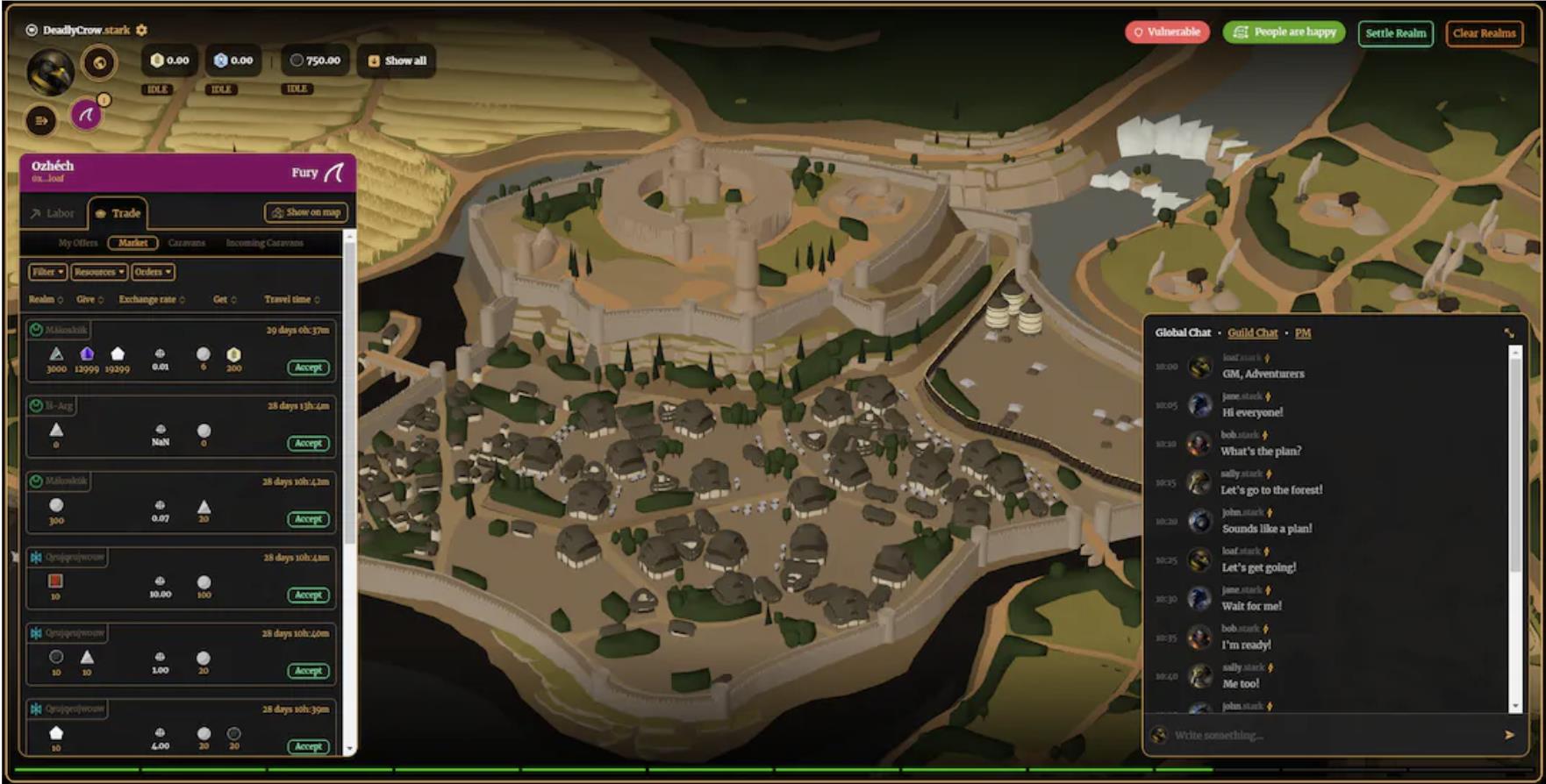
Realm Eternum rebuilt using the Dojo engine
The Role of Asian Developers and Why We Are Bullish on the Asian Community
Lootverse offers themes reminiscent of popular Asian gaming genres, such as sandbox fantasies based on the Three Kingdoms. In China, Three Kingdoms-themed games occupy nearly 10% of the gaming market, spanning genres from RPGs to MOBAs. “Honor of Kings,” the world’s highest-grossing game, even features over 20% of its characters from the Three Kingdoms era.
The cultural resonance of Three Kingdoms across Asia mirrors Lootverse’s global appeal. As Lootverse expands, Asian developers—especially Chinese ones—can replicate the proven formulas of Three Kingdoms games. Leveraging strong productivity and successful templates, Asian teams are well-positioned to launch related Lootverse games, potentially capturing over 10% of the onchain gaming market share and achieving popularity comparable to hits like “Honor of Kings.”
Their familiarity with widely appealing story-driven game universes will be invaluable. As the thriving Asian ecosystem emerges, global creators will be drawn into Lootverse. Their collaborative contributions in technology, content, and operations will complement each other, restoring Lootverse’s original decentralized spirit.
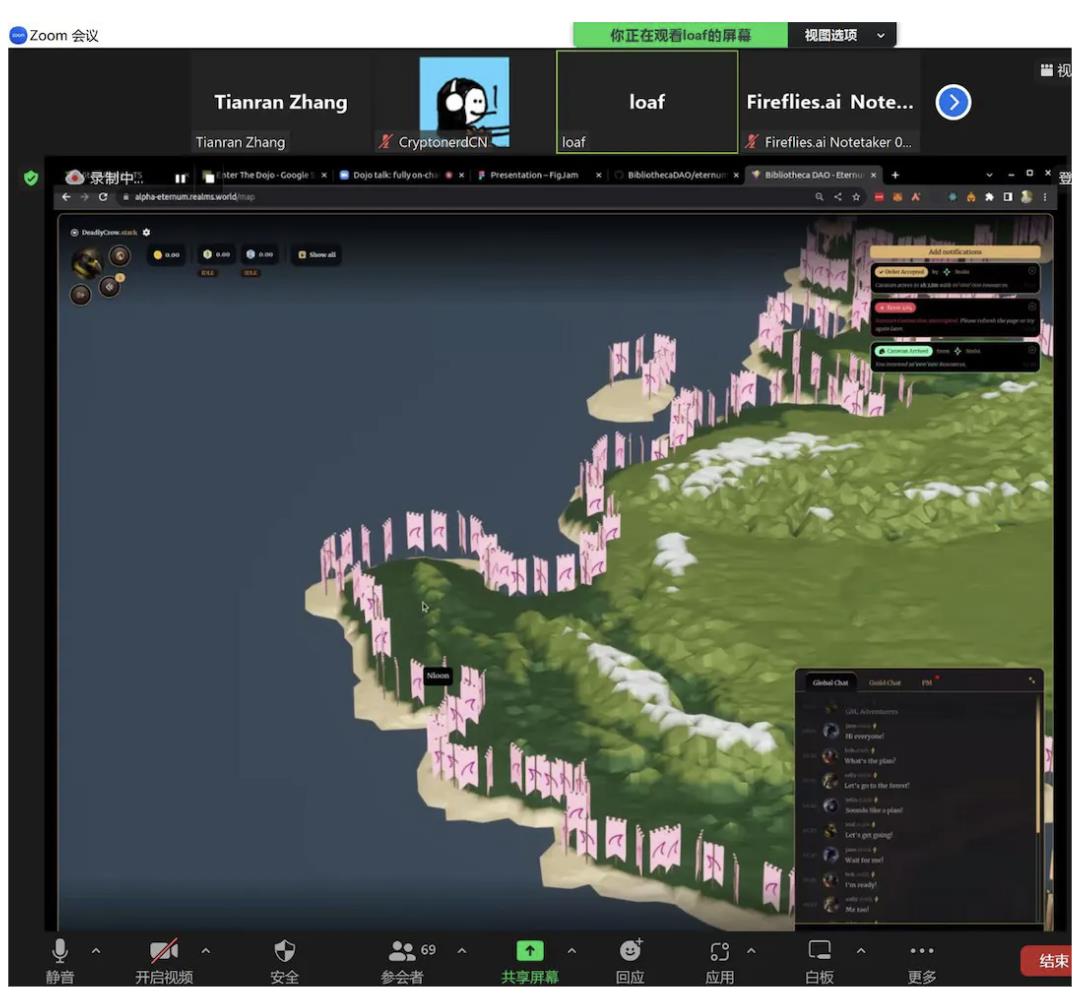
Screenshot of Loaf’s presentation at the Starknet Astro Workshop in Chengdu. Attendance once reached 100 people.
With its narrative resonance and composable building blocks, Lootverse may become the next breakthrough gaming paradigm driven by the Asian developer community. Their expertise plays a crucial role in guiding Lootverse toward true decentralization and diversity. By connecting global creators, Asian teams bring us closer to collaborative storytelling at metaverse scale.
Join TechFlow official community to stay tuned
Telegram:https://t.me/TechFlowDaily
X (Twitter):https://x.com/TechFlowPost
X (Twitter) EN:https://x.com/BlockFlow_News
 @AW_Research