A Comprehensive Overview of the On-Chain Data Tools Sector (Part 1)
TechFlow Selected TechFlow Selected
A Comprehensive Overview of the On-Chain Data Tools Sector (Part 1)
This article analyzes and summarizes on-chain data tools from three aspects: product types, business models, and future development directions.
 Navigating Web3 tides with focused insights
Author: Wendy, IOSG Ventures
TL,DR:
-
The unique characteristics of on-chain data make on-chain analytics tools a strong market demand. This article categorizes existing products by focus into data-driven or transaction-driven types;
-
Dashboard products face intense competition and require differentiation; automated trading tools are gaining popularity but carry significant risks. While these two categories have overlapping needs and functionalities, they serve distinct purposes and won't fully replace each other;
-
Monetization of data products is a topic worth detailed discussion. This article briefly outlines the pros and cons of monetization with and without tokens, with deeper analysis reserved for the next piece;
-
Potential future directions for on-chain tools include developing socialfi and communities, personalized recommendations based on user profiles, and integration with AI.
Introduction
Whether in web2 or web3, data remains a resource akin to oil in the information age—an area of immense value and fierce competition. On-chain alpha refers to valuable, underexploited information on blockchains that can yield profits. By analyzing on-chain data, one can leverage time lags in market efficiency to gain excess returns. The decentralized nature of blockchain makes on-chain data a public treasure trove. However, as multi-chain ecosystems mature and sectors like NFTs, GameFi, and SocialFi diversify, while the volume of on-chain alpha increases, so does the difficulty of capturing it. Most non-technical users lack the capability to extract insights independently, creating high demand for accessible on-chain analysis tools.
On-chain data possesses several unique traits that render data tooling indispensable:
-
Transparency: All on-chain data is publicly verifiable. For both projects and investors, this presents both opportunities and challenges—driving mutual growth. Projects must differentiate themselves, while investors need to continuously improve their analytical skills.
-
High timeliness: Data updates 24/7 with near-instantaneous recording of on-chain activity. Opportunities often arise and vanish quickly, far faster than traditional financial disclosures.
-
Multi-dimensional and heterogeneous: On-chain data includes not only transactions but also approvals, staking, cross-chain flows, and more.
-
High technical barrier: Most users lack understanding of concepts like gas fees and MEV. Even when information is available, translating it into actionable strategies remains challenging. Thus, automation tools empower ordinary users with "scientist"-level capabilities on-chain.
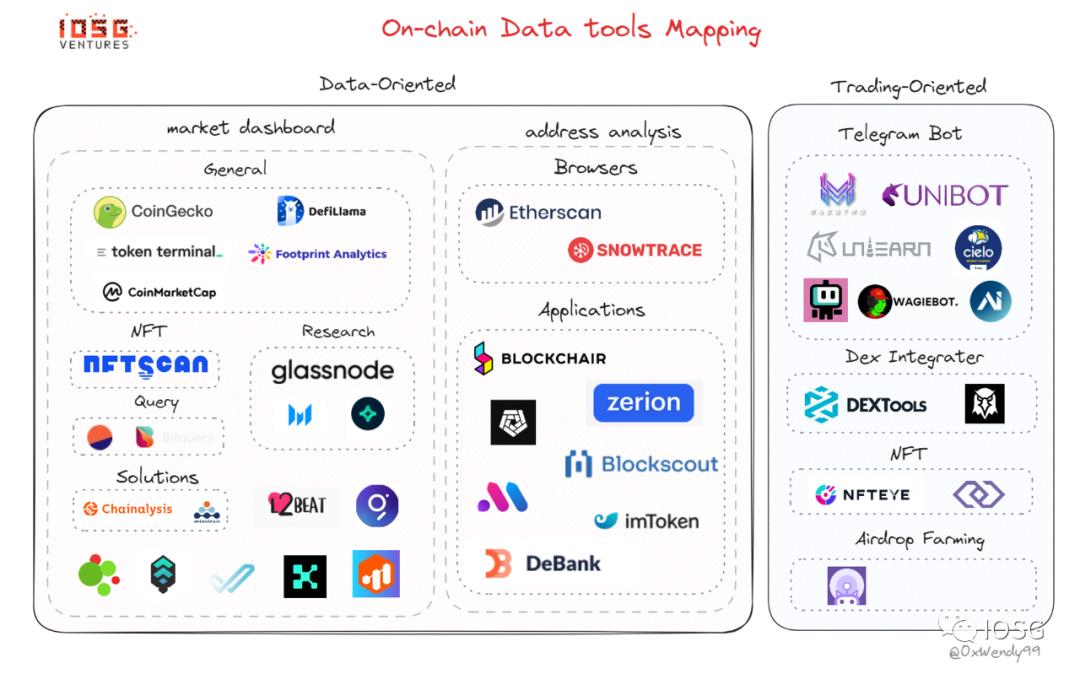
This article broadly divides on-chain analytics tools into two categories—data-oriented and transaction-oriented—based on whether the end output targets data insight or direct trading actions. In practice, many tools combine both aspects.
Data-Oriented Tools
Marketwide Data Dashboards
Similar to Bloomberg in traditional finance, these tools offer users an overarching view of the market, focusing on chain-level, protocol-level, and token-level metrics. In early blockchain days, key indicators were simple: token price, holder count, holding duration, and transaction history. With the rise of DeFi, NFTs, and GameFi, new dimensions emerged—TVL, market cap, 24h volume, token distribution, unlock schedules, NFT rarity rankings, floor price distributions, etc. Platforms like Token Terminal even provide revenue, fee, and estimated P/S and P/E ratios. Since these are less relevant for short-term trading, data latency is higher, whereas platforms like Nansen offer minute-level freshness.
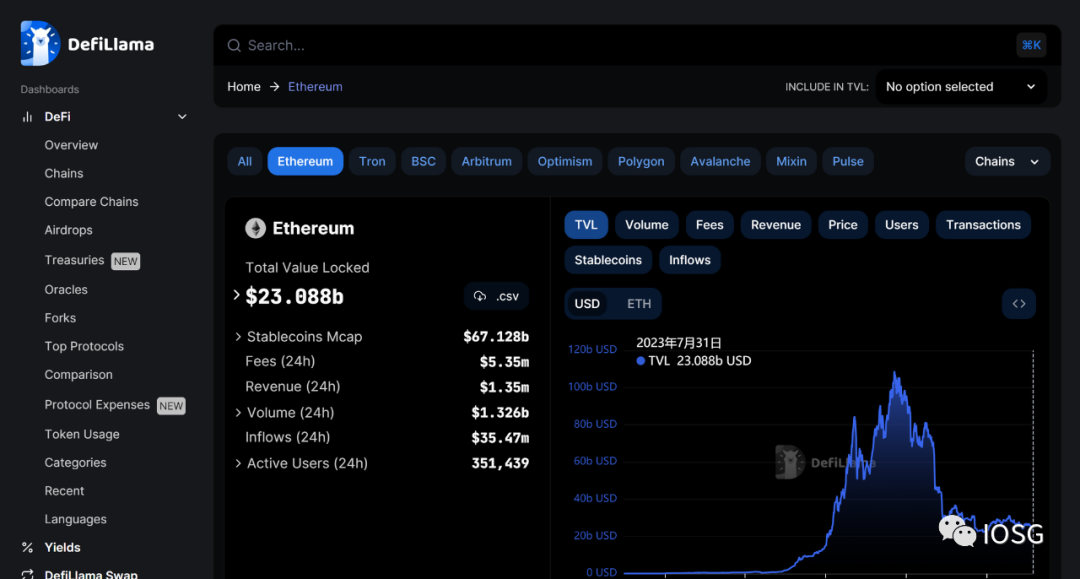
DeFiLlama User Interface
Competition among dashboard products is fierce, prompting teams to pursue differentiation:
-
Research Output: Nansen and Messari regularly publish research reports. Many data teams employ analysts to interpret metrics, with reports becoming core product offerings.
-
Vertical Focus: NFTSCAN specializes in multi-chain NFT data; L2Beat aggregates and visualizes Layer2-specific metrics.
-
SQL Query Tools: Dune Analytics and Bitquery allow custom SQL queries, enabling personalization at the cost of higher technical barriers.
-
Enterprise Solutions: Chainalysis and Amberdata primarily serve B2B clients such as exchanges and traditional financial institutions with comprehensive blockchain data solutions.
Other notable examples include visualization-focused Crypto Bubbles and AI-integrated tools like DexCheck and KaitoAI. Overall, market dashboards are the most common and frequently used type of on-chain analytics tool. Though functionality varies slightly across platforms, competition remains intense.
For prior analysis on Nansen and similar projects, see IOSG’s earlier article: link.
Address-Level Analysis
Beyond macro-level support, another major analytical angle is address-based. Key types include:
-
Blockchain explorers like Etherscan serve as foundational tools, allowing inspection of individual addresses’ interactions and gas usage.
-
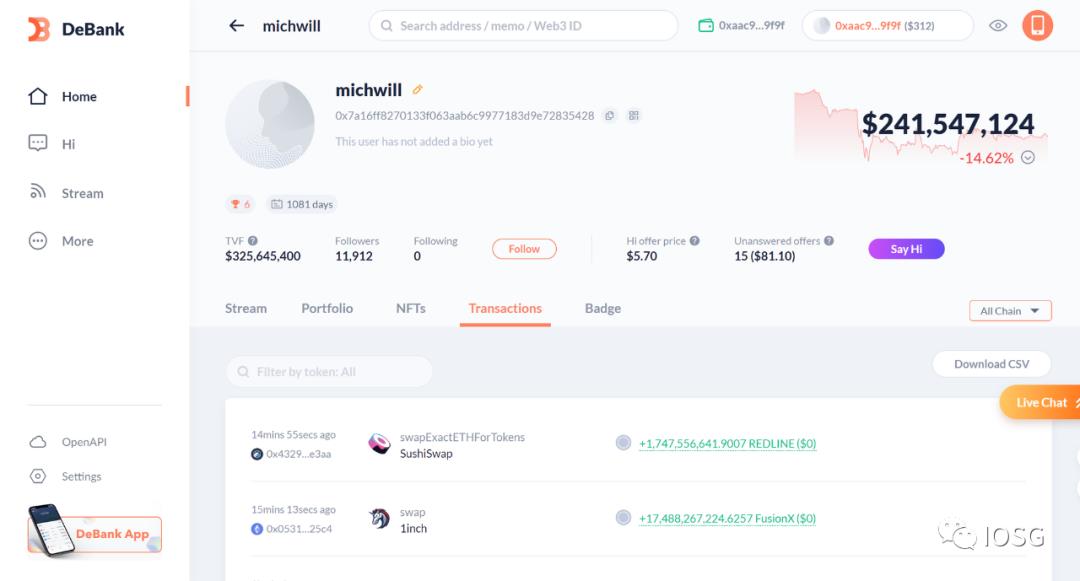
Platforms like Debank display portfolio holdings, PnL, and transaction histories. Bubblemaps visualizes connections between addresses, helping users trace fund flows. Nansen is renowned for this kind of analysis. “Smart money” tracking enables users to observe or mirror successful traders’ moves to boost profitability.
Transaction-Oriented Tools
Recently, Telegram bots like Unibot and Maestro have surged in popularity, with their token prices and TVL increasing nearly tenfold over recent weeks—standing out even during a bear market. Telegram, with 700 million monthly active users, offers rich APIs that enable developers to easily integrate mini-apps. Compared to data terminals, transaction-oriented tools automate user operations entirely, greatly simplifying the path from analysis to execution—but at the cost of increased security risks and capital expenses (including transaction and service fees).
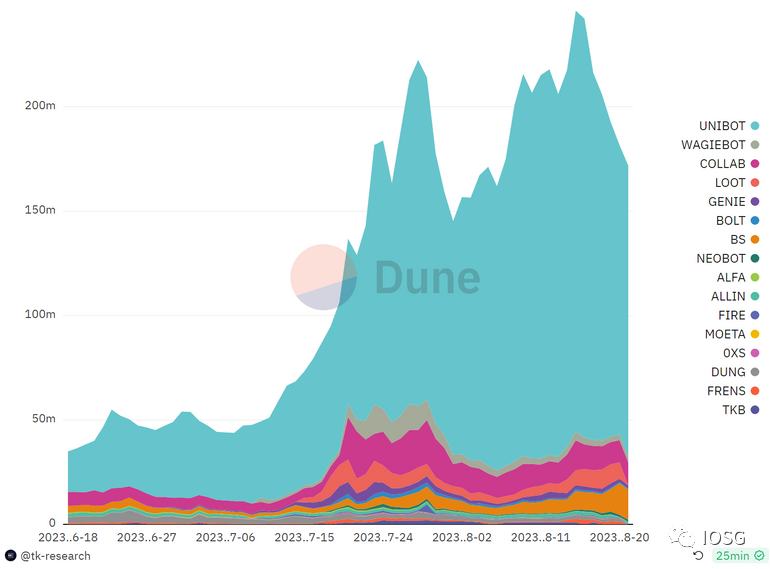
TVL Changes Across Multiple Telegram Projects
These automated trading tools use real-time on-chain data to execute trades via proxy wallets or push intelligence alerts to email, Discord, or Telegram. Another subset focuses on farming—randomly interacting with protocols to maximize chances of receiving airdrops or engaging in algorithmic arbitrage. Common features of tools like Unibot and Maestro include:
-
Limit Orders: Similar to centralized exchanges, enabling buy/sell orders at specified prices and quantities.
-
Copilot/Trade Copying: Mirroring transactions from selected addresses—often used to emulate high-performing “smart money.” This offers passive investors and beginners a low-effort way to profit from crypto markets.
-
Alerts: Notifications for specific on-chain activities, such as large transfers or newly deployed token contracts.
-
Simulation: Simulating trade outcomes before execution—e.g., assessing potential failure or loss due to gas or slippage settings.
-
Private Transactions: Avoiding frontrunning and sandwich attacks to reduce losses.
-
Farming: Random interactions with new projects to mimic user behavior and increase airdrop eligibility.
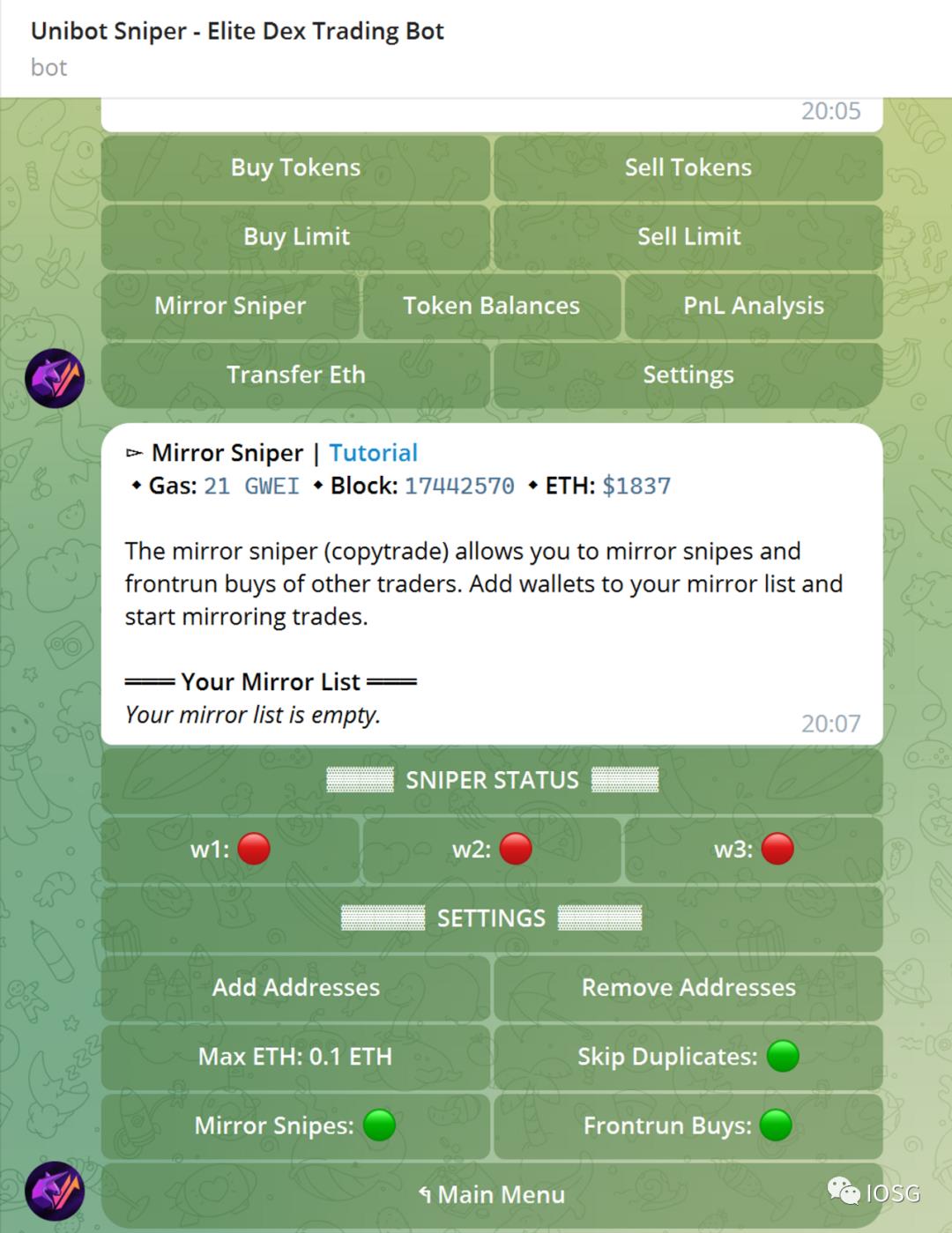
Unibot Sniper Feature List
Automated trading tools have seen explosive user growth recently, with daily Telegram bot users approaching 6,000. Most come from established players like Maestro and rising stars like Unibot, which together dominate over 80% of DEX-related Telegram bot users.
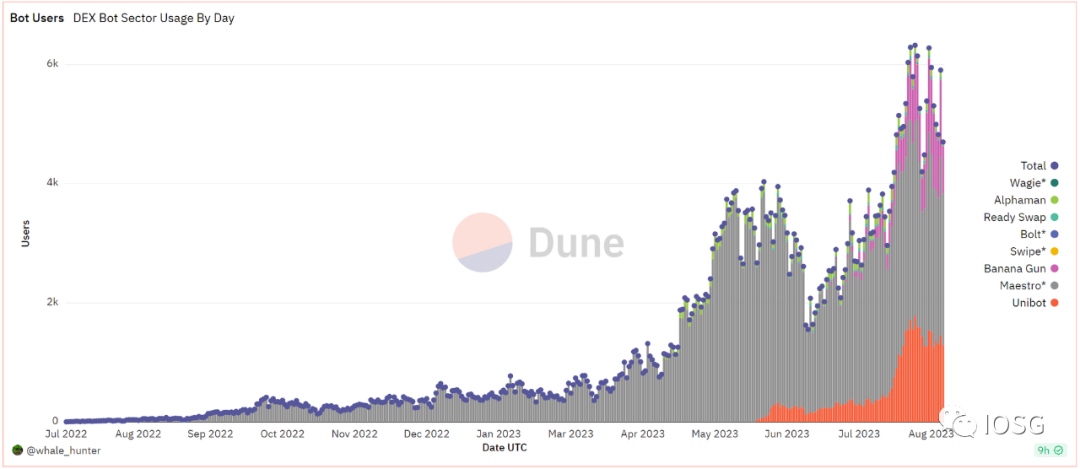
Telegram On-Chain Bot User Count
However, beyond the hype driven by token price surges and media attention, the actual underlying demand warrants scrutiny. The two main functions of Telegram bots—alerts and copy trading—are not novel; they're already well-served by centralized exchanges and mature platforms (see below). Telegram bots clearly lag in competitiveness here. Given the relatively small base of degen traders and the availability of safer, more feature-rich alternatives, we believe seasoned users represent a minority among Telegram bot adopters—most likely using only alert features. On a more optimistic note, Telegram's massive, crypto-friendly user base combined with simple, intuitive bots could serve as a gateway for onboarding Web3 newcomers.
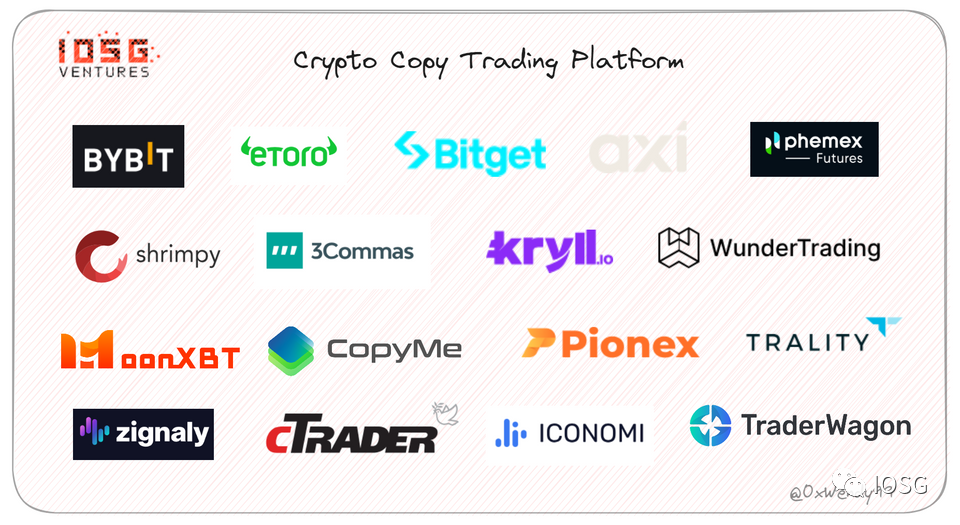
Copy Trading Platforms
Another closely related category includes decentralized exchange interfaces like DexScreener and DexTools. These tools monitor real-time price movements of token pairs and typically integrate DEX swaps with basic contract safety checks (e.g., honeypot detection, tax verification). Recently, Unibot launched its trading terminal Unibot X, integrating with GeckoTerminal. Users can log in via their Telegram-generated wallet, accessing limit orders, live K-charts, trade history, and smart money tracking. Going forward, tighter integration between DEXs and bots is likely, enhancing the overall decentralized trading experience.
While automated trading tools significantly enhance retail capabilities, they carry substantial centralization risks. Most bots generate wallets on behalf of users, exposing private keys directly to project teams. As the crypto adage goes, “Not your keys, not your money.” To use these tools, users must deposit funds into addresses controlled by third parties—placing them at a structural disadvantage in risk terms.
Value Proposition of Data Tooling
Pros and Cons of Data Tool Business Models
Compared to newer, speculative niches in Web3, data tools may lack flashy narratives or sky-high valuations, but their demand is grounded and real. Their business models are mature—similar to web2 data companies—and have been repeatedly validated. Some tooling projects generate stable cash flow even without issuing a token.
For projects not raising funds or collecting fees via tokens, revenue streams include:
-
C2C Subscription Fees: Analogous to SaaS models—basic features free, premium features paid, or usage caps (e.g., tracking up to 10 addresses). Payment models are typically either one-time purchase (lifetime access) or recurring (monthly/quarterly/annual subscriptions);
-
B2B Services: Selling API packages or building custom data systems for developers and enterprises—a proven monetization path. For example, The Graph provides APIs to major DeFi and GameFi projects, and DeBank offers similar services;
-
Advertising Revenue: Once user scale is achieved, traffic can be monetized through ads.
Given the nature of on-chain data and current product landscape, the data tooling sector presents clear opportunities—but also intense competition. Early-stage investment in infrastructure is required, yet open data access means no sustainable moat on data sourcing alone. For instance, new entrant Arkham has already made several Nansen-like features free, inevitably pressuring paid tools. However, given the complexity and diversity of data needs, both all-in-one platforms and niche specialists can still emerge as leaders in their domains. Success requires rapid iteration, deeper insights from vast datasets, richer functionality, and tangible improvements in users' ability to generate returns—key to escaping commoditization and building defensible advantages.
Tokenomics of Data Tooling Products
There’s ongoing debate about whether tooling products should issue tokens. Critics argue utility is limited and post-launch price sustainability is questionable. Here, we examine Arkham and Unibot—representing data-side and transaction-side tools respectively—to analyze their token design:
Arkham recently launched its token to considerable fanfare. It’s a comprehensive analytics platform offering dashboards, address analysis, price alerts, and intelligence bounties. ARKM is the native token of the Arkham Intel Exchange ecosystem, with a total supply of 1 billion: 50% treasury, 20% investors, 20% team, 5% market making, 5% rewards.
ARKM holders have governance rights over strategic decisions. Additionally, users can earn ARKM by submitting intelligence, staking tokens, building ecosystem projects, or referring new users.
-
The bounty system introduces novel use cases: bounties and payouts incur 2.5% and 5% fees respectively, payable in ARKM with a 20% discount. Locking ARKM grants up to 50% off (with 30+ day lockup). Users can auction leads or submit them directly to the platform. Auctions have a 15-day lock; winners withdraw after, but bidders can exit early with a 10% penalty. Submissions are rewarded in ARKM based on quality. After 90 days, exclusive intel becomes public—encouraging continuous platform enrichment.
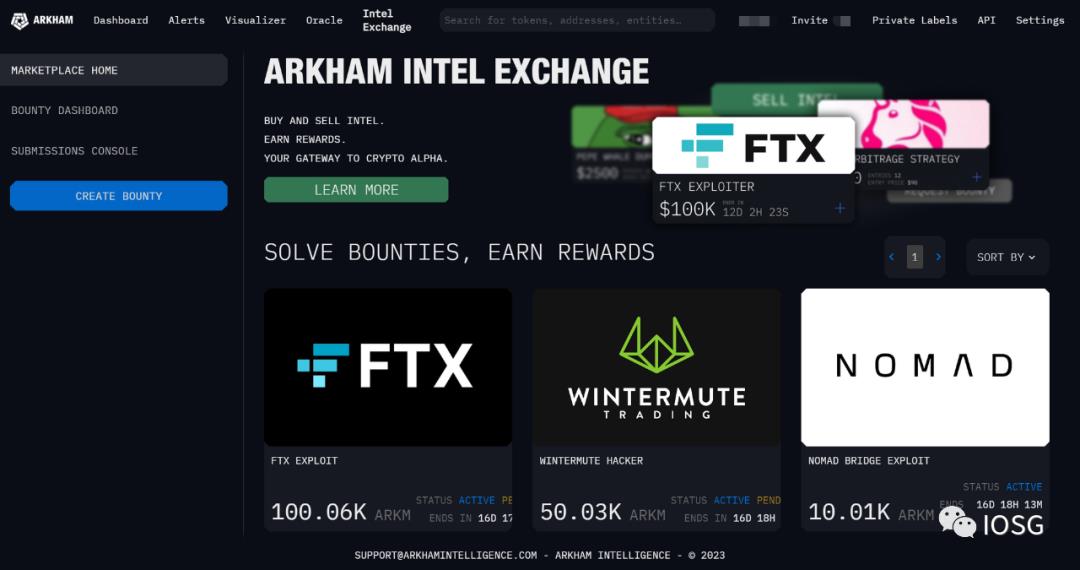
Most of Arkham’s data features are free—their economic model centers on the intelligence marketplace, which is also its most controversial aspect. While anonymity is a celebrated trait in crypto, Arkham actively links anonymous on-chain addresses to real-world entities.
In contrast, Unibot’s token model is simpler and more traditional. Unibot is a Telegram-based automated trading bot currently on Ethereum, with a FDV of $176M. It supports token swaps, limit orders, copy trading, private transactions, and liquidity provision—all operable via Telegram chat without coding. Wallets can be generated by Unibot or imported (higher risk).
As a leader in automated trading, Unibot has earned over 4,000 ETH in revenue, primarily from service fees and token swap taxes. Its token enables profit-sharing: holding at least 10 $UNIBOT qualifies users for 40% of platform trading fees and 1% of UNIBOT token swap taxes. Rewards are recalculated every 2 hours and claimable every 24 hours. Transfers exceeding 200 tokens within 2 hours forfeit earnings. Rapid price appreciation fueled FOMO and user growth, lifting the entire automated trading segment.
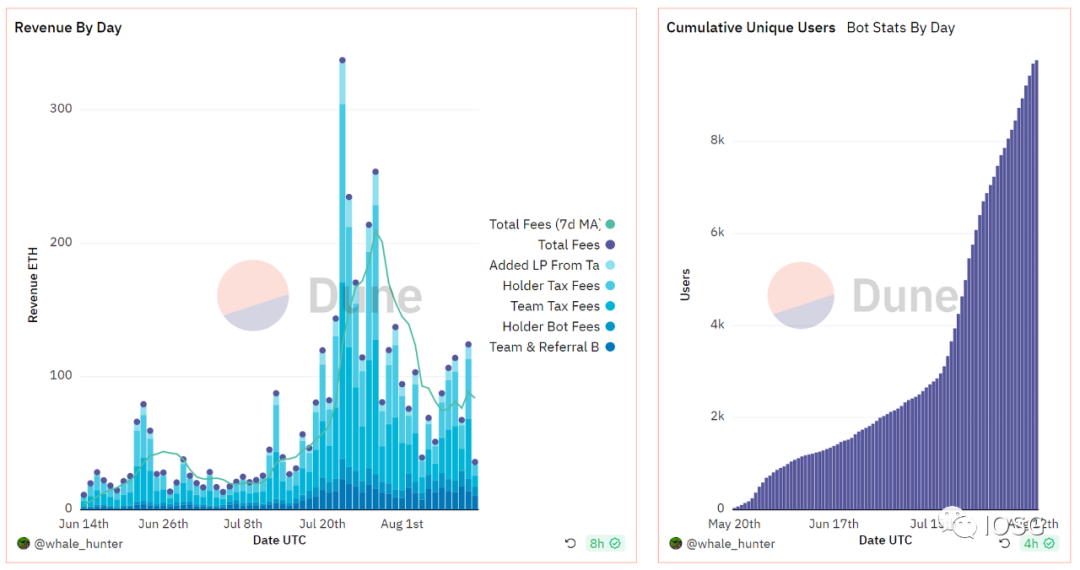
Arkham’s main risk lies in over-relying on its innovative bounty model, while Unibot’s token faces sustainability concerns. Analysis shows 80% of Unibot’s revenue comes from token swap taxes—highly dependent on market热度 and new inflows. Should sentiment cool and volume drop, a downward price-volume spiral (a “double whammy”) becomes likely.
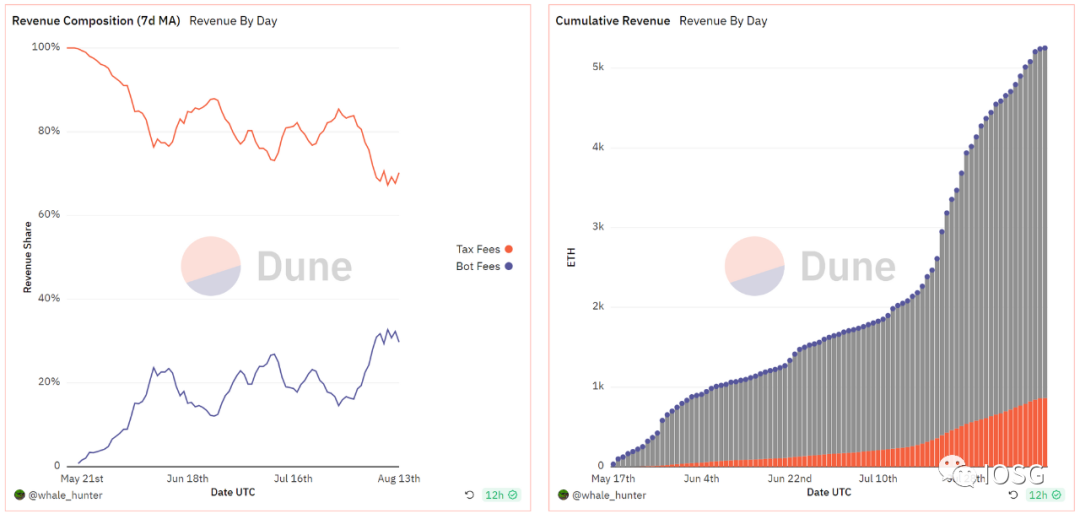
Thus, debates around token models in tooling aren’t unfounded. Enriching ecosystems and expanding token utility should be central to economic design. Balancing short-term incentives with long-term sustainability is crucial—while quick wealth generation drives adoption, lasting success demands more durable foundations.
Possible Future Directions
SocialFi Integration
Social dynamics require critical mass participation. SocialFi has struggled with user acquisition and retention. Even Meta’s Threads, despite tight Instagram integration, saw DAUs drop 20% in its second week, with average session time falling from 20 minutes to under 5. Meanwhile, Web3’s primary social and UGC platforms remain Twitter and Discord—legacy web2 apps lacking native Web3 social layers. Data platforms bring shared interests and dense information, making them fertile ground for SocialFi. Compare Snowball and Futu—difficulty in building data-driven social networks.
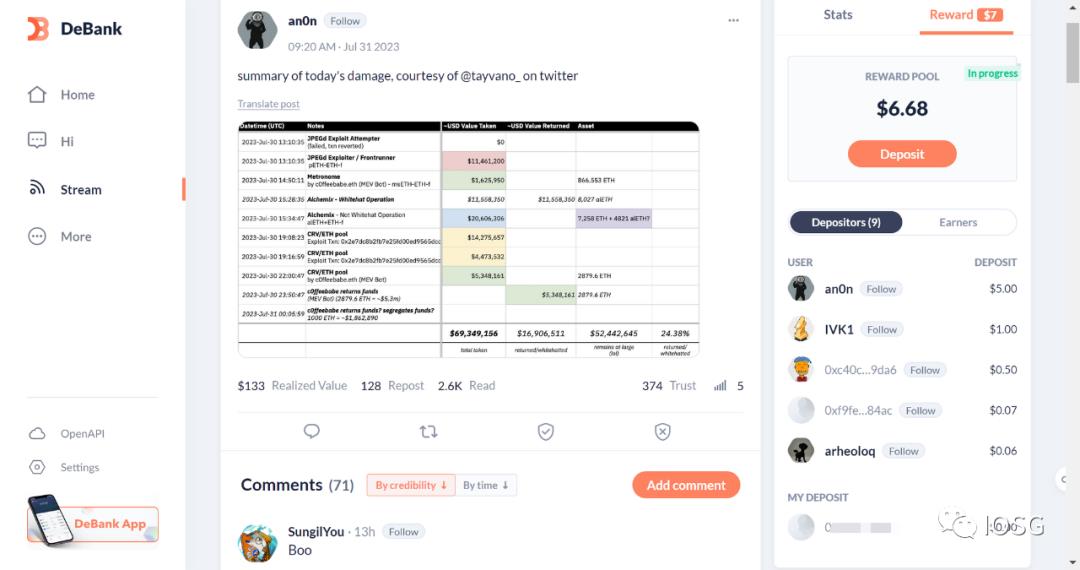
Debank’s Stream function exemplifies a move toward SocialFi. Using wallet addresses as identities adds verifiability; KOL opinions gain credibility, pushing transparency. Users can tip valuable content—a promising form of creator economy.
We know social interaction fundamentally depends on broad user participation. SocialFi continues to grapple with user onboarding and retention. Even Meta’s Threads, despite being tightly integrated with Instagram, suffers from poor stickiness—its daily active users dropped 20% in the second week post-launch, and average usage time fell from an initial 20 minutes to under 5. Currently, Web3’s main social and user-generated content platforms are still web2 applications like Twitter and Discord, lacking native Web3 social media. Data platform users share common interests and engage with high-density information, showing potential as a foundation for SocialFi. The challenge of building data-driven social experiences, as seen with Xueqiu and Futu, remains significant.
Personalized Recommendations
The transparency of on-chain data makes behavioral and preference analysis natural. Currently, Web3’s recommendation algorithms and engines are in their infancy. But as multi-chain ecosystems expand, user profile dimensions will grow accordingly.
Contrast with top-tier web2 products: recommendation algorithms are mature. Taobao, Douyin, Meituan, and Bilibili all deliver personalized content. Yet today, neither data tools like Dune nor marketplaces like OpenSea offer such personalization. As data grows, accuracy improves in a positive feedback loop. Blockchain’s unified data structure could surpass web2 in precision. With data sovereignty, users could choose and fine-tune their own models. Just as web2 recommends across food, travel, and housing, Web3 can apply modular recommendation engines to social, trading, and gaming contexts.
Integration with AI
The transparency of on-chain data makes behavioral and preference analysis natural. Currently, Web3’s recommendation algorithms and engines are in their infancy. But as multi-chain ecosystems expand, user profile dimensions will grow accordingly.
Contrast with top-tier web2 products: recommendation algorithms are mature. Taobao, Douyin, Meituan, and Bilibili all deliver personalized content. Yet today, neither data tools like Dune nor marketplaces like OpenSea offer such personalization. As data grows, accuracy improves in a positive feedback loop. Blockchain’s unified data structure could surpass web2 in precision. With data sovereignty, users could choose and fine-tune their own models. Just as web2 recommends across food, travel, and housing, Web3 can apply modular recommendation engines to social, trading, and gaming contexts.
Conclusion
This article analyzes on-chain data tools across product types, business models, and future directions, aiming to inspire practitioners, institutions, and individual investors. Though Web3 remains in early exploration, the data sector has already produced several billion-dollar unicorns. From DeFi Summer to NFT Summer, and potentially Layer2 or GameFi Summers ahead, every application layer relies on on-chain analytics. Each address and transaction forms the stars of a decentralized universe, and this high-potential sector will remain one of its most critical anchors. As natives of this data-born industry, we remain excited by the magic of on-chain alpha.
Due to length constraints, our next piece will dive deeper into commercialization practices for data products.
Join TechFlow official community to stay tuned
Telegram:https://t.me/TechFlowDaily
X (Twitter):https://x.com/TechFlowPost
X (Twitter) EN:https://x.com/BlockFlow_News
 IOSG Ventures