









Deep Dive into CyberConnect: How Far Is Web3 Social from True Adoption?
TechFlow Selected TechFlow Selected
Deep Dive into CyberConnect: How Far Is Web3 Social from True Adoption?
CyberConnect is where Web3's current state unfolds—where better technology, value, and experiences are showcased.
 Navigating Web3 tides with focused insights
Written by: Jay : : FP
Translated by: TechFlow
Key Takeaways
-
Identity is a key enabler of interactions between entities. However, the current Web3 tech stack lacks a holistic identity that can interact across various applications and types of engagement.
-
CyberConnect is creating a social graph defining holistic identity through account abstraction, building a Web2-like user experience and a participant-centric creative economy.
-
As one of the most technologically sensitive companies in the Web3 space, CyberConnect has integrated with the largest number of ERC4337-based smart contract wallets to validate use cases for account abstraction and integrate with existing technologies such as DID, VC, and ZKP—offering significant potential for further innovation.
-
Furthermore, CyberConnect is considered one of the closest protocols to Web3 adoption, with a broad ecosystem and the largest user base capable of transforming technology into new experiences and sharing them widely.
Account Abstraction for Web3 Adoption
The Rise of Web3
Advancements in IT technology and increased time spent in digital spaces have led to diverse digital interactions. In particular, social media platforms initially used only for networking have gradually permeated lifestyles and are now powerful channels for marketing, information discovery, and more. As a result, top social platforms have grown massive, giving rise to new types of participants and markets such as “content creators,” “influencers,” and the “creator economy.” Within this market, self-expression has become crucial for increasing personal value and social influence, and individual content is no longer just disposable for one-time interactions.
However, as the creator economy grows, concerns about its sustainability grow alongside it. Centralized media platforms maximize ad revenue using user data and take a large share of creators’ income. Despite this discouraging incentive structure, creators are forced to continue collaborating with dominant platforms due to lack of alternatives. Media platforms increasingly focus on one-way brand broadcasting, leading to biased content dissemination and declining user interaction quality.
To restore smooth interaction between social media and the creator economy, a new way for participants to engage—and a sustainable market structure—is needed. Currently, Web3 is seen as a promising alternative: using blockchain technology, users gain full control over their data and content, deciding how to share without relying on any centralized platform. Since creative works’ distribution paths can be transparently tracked, creators can design fair revenue models for themselves. Additionally, creators can embed attributes into their works or issue their own tokens to redefine interactions or align incentives with their communities. In short, while the existing creator economy is driven by a centralized, inefficient market, Web3’s version could evolve into a symmetric market centered around actual participants—creators and consumers alike.
Lack of Identity Middleware in Web3
Yet, widespread adoption of Web3 still seems far off. Key reasons include inconvenience and lack of interoperability. Recalling the early internet, we could mostly only receive information from providers rather than interact broadly. But once identity models emerged that characterized individuals, enabling mutual trust, the internet experienced a wave of innovation embracing wider interaction.
Likewise, identity becomes a critical driver of interaction by enabling better mutual recognition. Therefore, to enable broad interaction in Web3, a holistic identity defined according to Web3’s syntax must exist—yet currently, no clear mechanism achieves this.
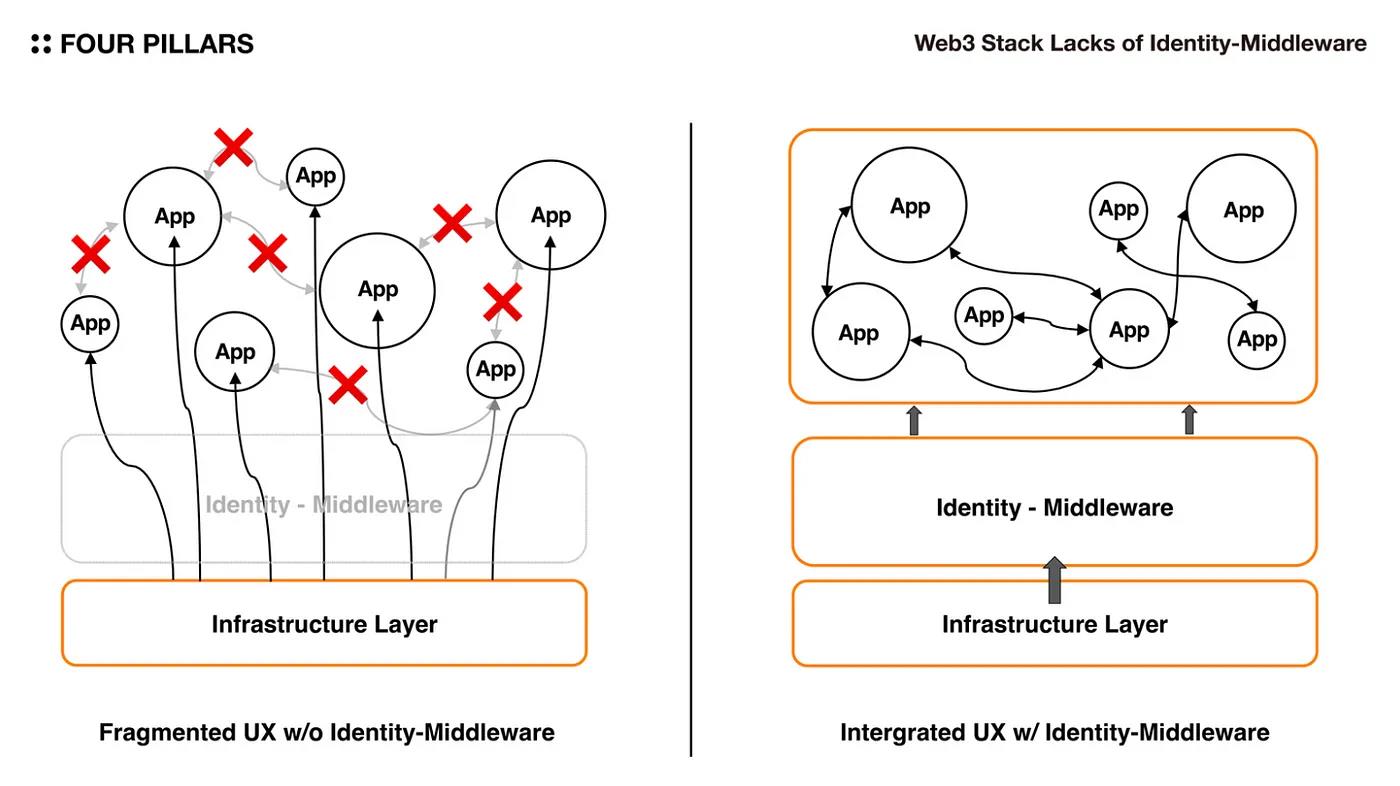
The burden of inconvenience and risk caused by the absence of such holistic identity falls entirely on end users. Beyond being unable to interact across different Web3 services, they must undergo complex processes required by each service, all of which require secure management at their core.
We often refer to this as a “user experience problem,” a major bottleneck preventing mainstream Web3 adoption despite significant attention. Thus, if we assume an identity middleware could emerge—one that defines holistic identity and resolves these issues—it should possess the following characteristics:
-
It should support persistent identity and guarantee interaction across different application types.
-
It should adopt a scalable and flexible storage structure to support various data needed to define identity.
-
Data within the identity should be controlled voluntarily and flexibly.
Account Abstraction Unlocks Identity Middleware
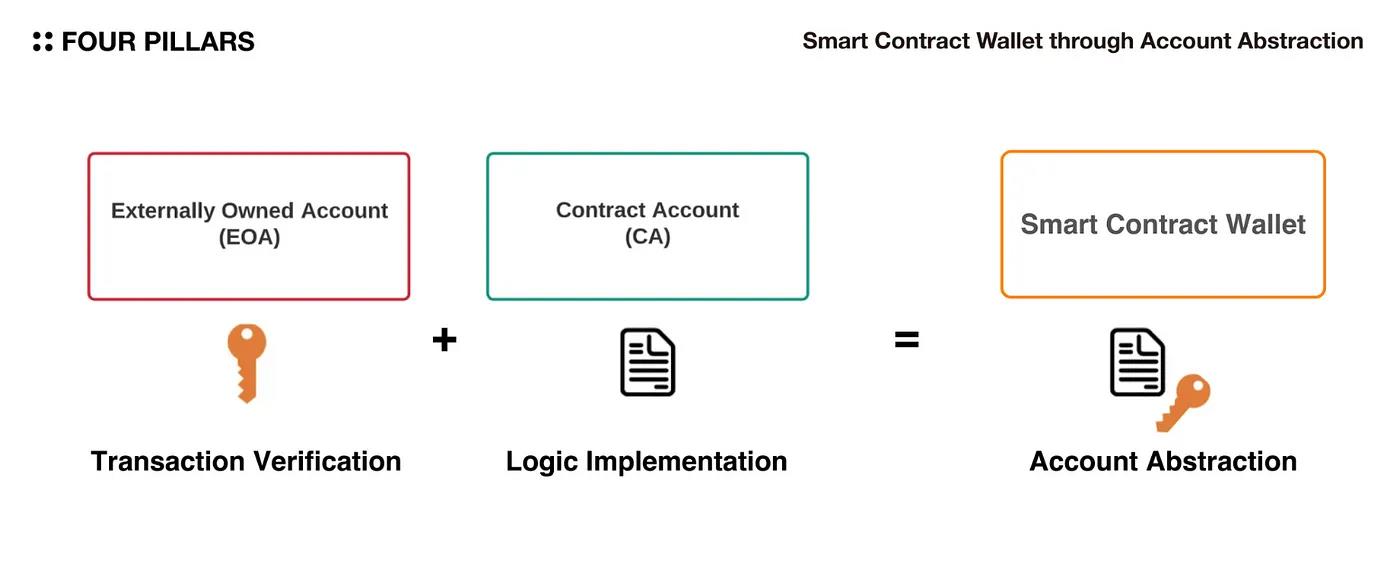
“Account abstraction” is a concept actively discussed today that satisfies most of the above requirements and greatly aids in building identity middleware within the Web3 tech stack. The core idea is converting existing wallets into “smart contract wallets” by enabling contract accounts to send transactions and signatures. In other words, existing accounts, originally limited to initiating and sending transactions, can now embed various functions, making them as easy to manage as any Web2 identity account.
These functions include not only advanced transaction logic but also methods of account control via key management services and defining associated data. This means security logic and data required for identity can be integrated directly into the underlying account—or more simply, account abstraction allows us to inject the concept of identity into existing accounts.
Specifically, smart contract wallets can support various features to ensure diverse and flexible user experiences:
Custom signature schemes: Currently, EOAs only use the ECDSA algorithm. With account abstraction, however, other schemes like Schnorr, BLS, or quantum-resistant alternatives become possible.
Flexible gas payment: By delegating gas fees to others (or apps) or allowing users to pay with various tokens, flexibility between users and services increases.
Batch transactions: Implementing logic to process multiple transactions at once reduces execution costs.
Signature abstraction: Custom validation logic under specific conditions enables features like whitelist/blacklist controls for transaction targets, time-bound signatures, or multi-signature requirements for high-value transactions.
Authentication and private key management: Users can freely add, remove, or change permissions across multiple accounts and improve transaction experiences using multi-factor authentication (MFA) and session keys.
ERC4337 and the Brief History of Account Abstraction
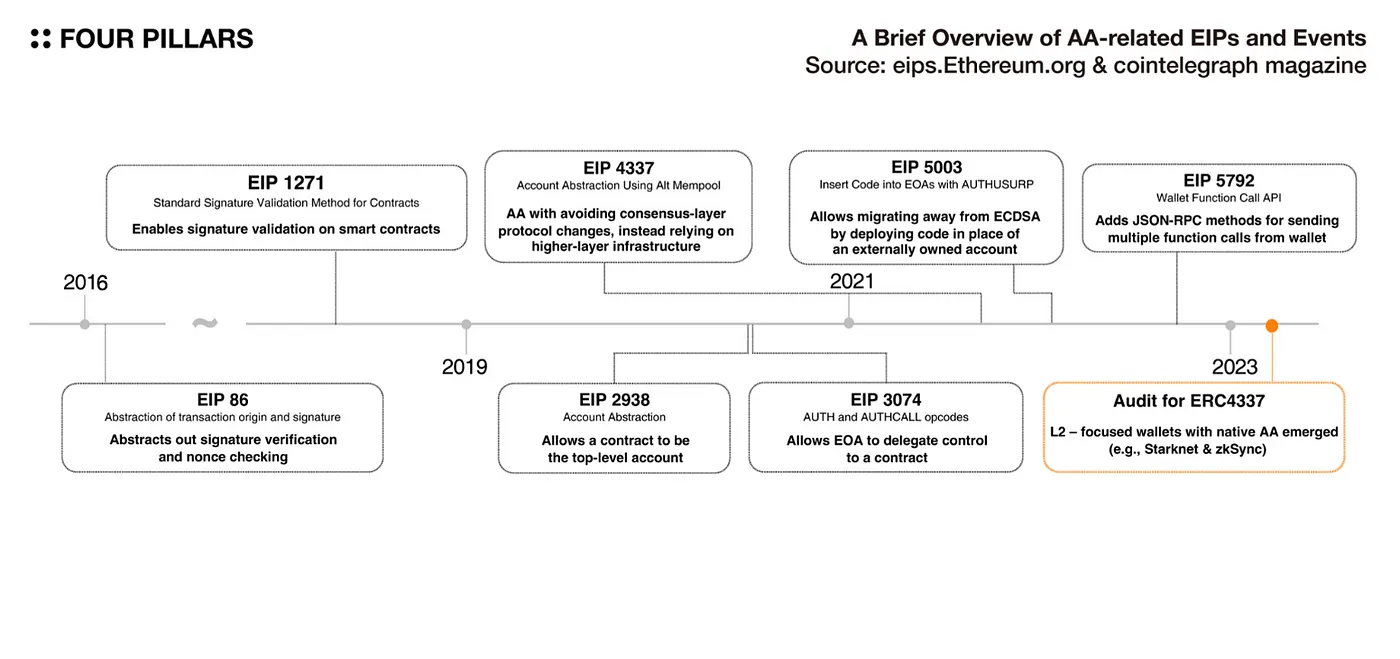
In fact, the concept of account abstraction has existed for some time. Ethereum’s 2016 proposal “Abstraction of Transaction Origin and Signature (EIP-86)” marked its first step. Since then, several proposals further developed the idea, coining the term “account abstraction.” Among various candidates, the relatively recent ERC4337 proposal stands out as the most advanced and popular because it achieves account abstraction without modifying the consensus layer. Before Vitalik highlighted its importance, account abstraction and ERC4337 gained momentum, prompting many projects to adopt ERC4337.
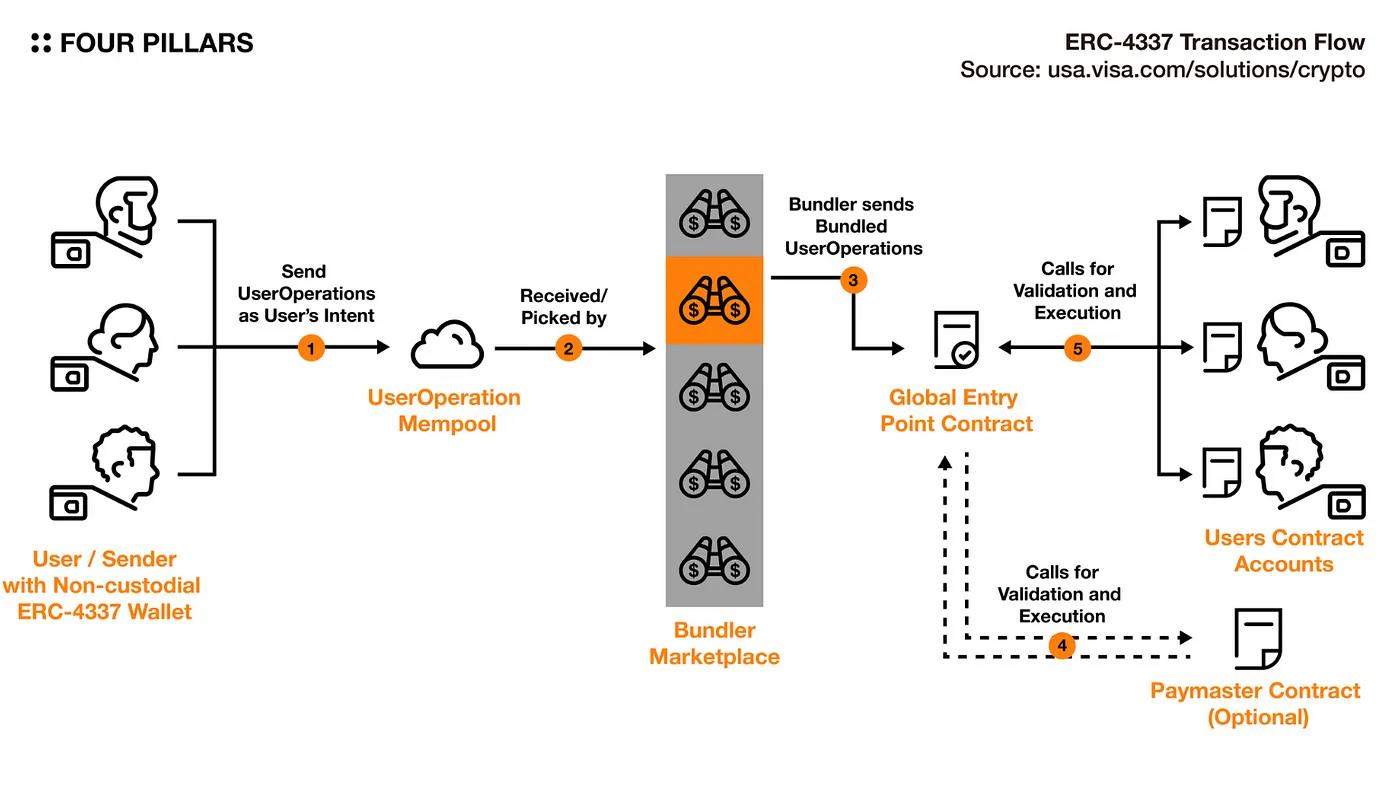
Below is the simplified process of a smart contract wallet using ERC4337:
-
Users submit a smart contract called UserOperation via a smart contract wallet into the UserOperation Mempool. Here, UserOperations can contain various logic beyond simple token transfers, and the UserOperation Mempool is a separate mempool distinct from the network’s standard transaction pool.
-
Bundlers pick the highest-paying UserOperations and package them into a Bundle Transaction.
-
The bundler calls a smart contract named EntryPoint with this Bundle Transaction, simulating validation of each UserOperation’s signature and gas payment capability, then submits the bundle along with fees to EntryPoint.
-
(Optional) Users may choose to use a feature called Paymaster, allowing another entity to pay gas on their behalf or pay with other currencies (e.g., ERC20 tokens).
-
EntryPoint validates and executes each UserOperation on the network. Unlike the bundler, which only simulates, EntryPoint performs actual validation. Upon successful execution, the bundler receives pre-determined fees from the UserOperation originator and any leftover gas fees.
In summary, account abstraction brings the principle of running smart contracts on the network down to the application layer by configuring specific logic per account (Steps 1–4), and uses a contract called EntryPoint to verify and execute all such logic (Step 5).
ERC4337’s flexibility allows smart contract wallets to integrate with multiple existing technologies beyond the above features—for example, strengthening identity or data privacy using decentralized identifiers (DID), verifiable credentials (VC), and zero-knowledge proofs (ZKP). Since OpenZeppelin’s code audit, ERC4337 has attracted wide attention, with many projects rapidly adopting or experimenting with it.
CyberConnect: Web3 Social Middleware with AA
CyberConnect was among the first to adopt ERC4337 and is exploring integration with other technologies like ZKP. By fully implementing ERC4337 and applying it flexibly across broader user groups and ecosystems, CyberConnect maximizes the use cases of smart contract wallets.
Introduction to CyberConnect
CyberConnect is a Web3 social middleware project upon which various social applications can be built. Currently, CyberConnect is preparing for its V3 update, including ERC4337 implementation. With this update, CyberConnect envisions creating a social network where users can create chain-agnostic accounts, centralizing identity within a Web2-like user experience and a participant-driven creative economy. Creators and consumers can move seamlessly across platforms with unified identities, enabling content-based community economies with optimal UX, while developers leverage all this data to build a richer ecosystem.
Three Pillars of CyberConnect
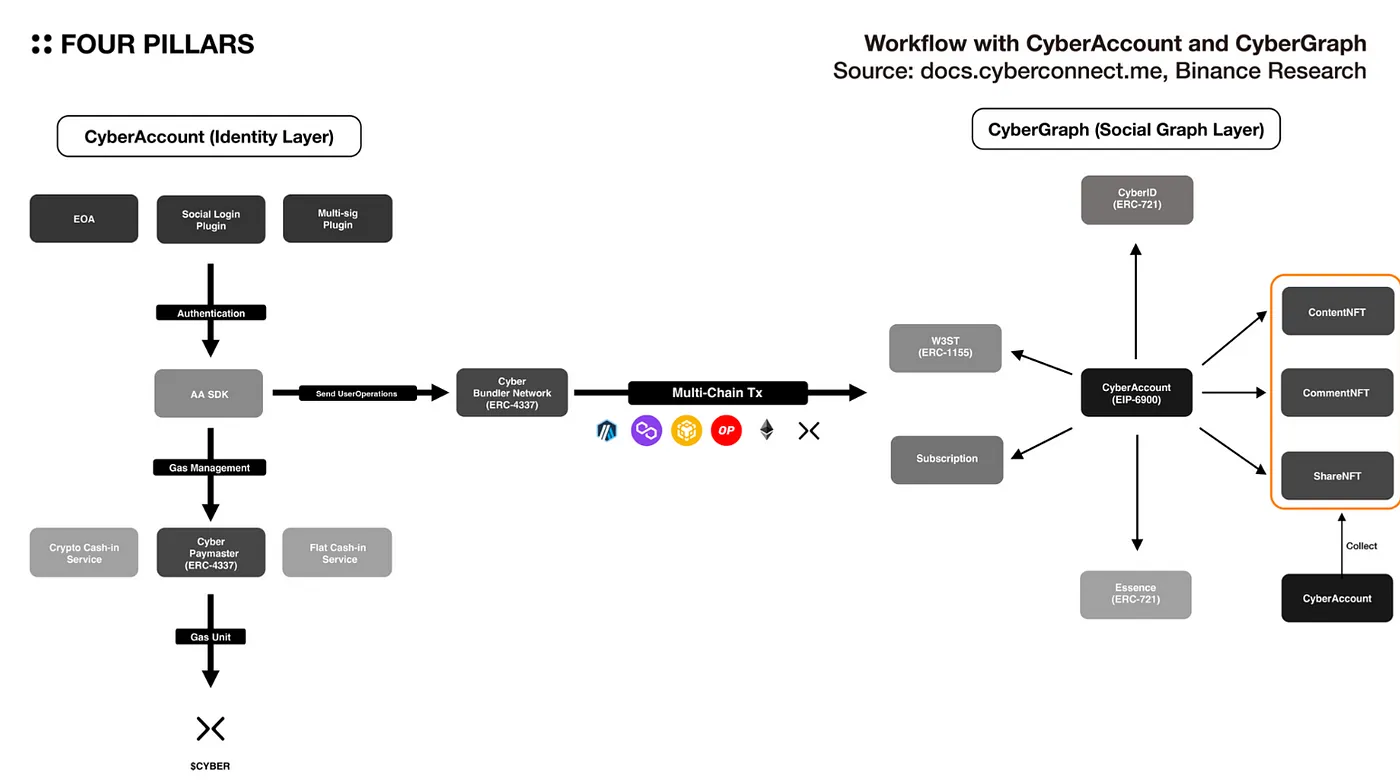
CyberConnect rests on three core components: 1) Identity—the center of all interactions; 2) Social Graph—representing connections between entities; 3) Network—supporting data solutions and seamless communication.
CyberAccount
CyberAccount is the core identity for creators and consumers in the CyberConnect ecosystem. Its compatibility with ERC4337 and ERC6900 enables enhanced user experiences during app interactions, leveraging account abstraction features like Paymaster, social recovery, permission management, and relayed transactions. CyberAccount aggregates data from both Web3 and Web2 social platforms like Twitter and Discord, giving users full control over their social data. A special “Organization Account” is available for teams, organizations, and brands, offering advanced account management such as multisig and customizable access control rules.
CyberAccount can own independent identifiers called “CyberID.” Since CyberAccount can store vast information, only essential details need display during each interaction. CyberID, denoted by “.cyber,” is dedicated to app interactions and includes basic identity info like username, avatar, and metadata. However, CyberID requires periodic renewal. If renewal is missed, the identifier goes up for public auction.
CyberGraph
CyberGraph is a social graph that receives CyberAccount metadata and activities, records them in storage, and surfaces necessary data. Beyond identity, data flowing through CyberGraph includes (ERC721-based) collectibles, subscriptions, content, W3ST (Web3-Status Token, an ERC1155-based SBT defining user status in specific communities), and other off-chain managed information.
On traditional Web2 platforms, social context struggles to cross worlds without tying to a centralized entity, forcing participants to either stay locked in or restart from scratch elsewhere. With CyberGraph, participants can continue interacting with data accumulated via CyberAccount across various worlds with minimal switching cost, while developers expand the ecosystem via data APIs and toolkits.
CyberNetwork
CyberConnect aims to cover data from both Web2 and Web3 (on-chain and off-chain) and operate efficiently and seamlessly. CyberNetwork is a gas-efficient, scalable L2 network designed to smoothly retrieve such data. It will be further integrated into CyberConnect in the coming months.
Comparison with Other Protocols
CyberConnect is often compared in the industry to Lens Protocol, Farcaster, and DeSo. While they all aim to solve problems of existing social platforms and build user-owned profiles and social graphs, their approaches and protocol designs differ slightly.
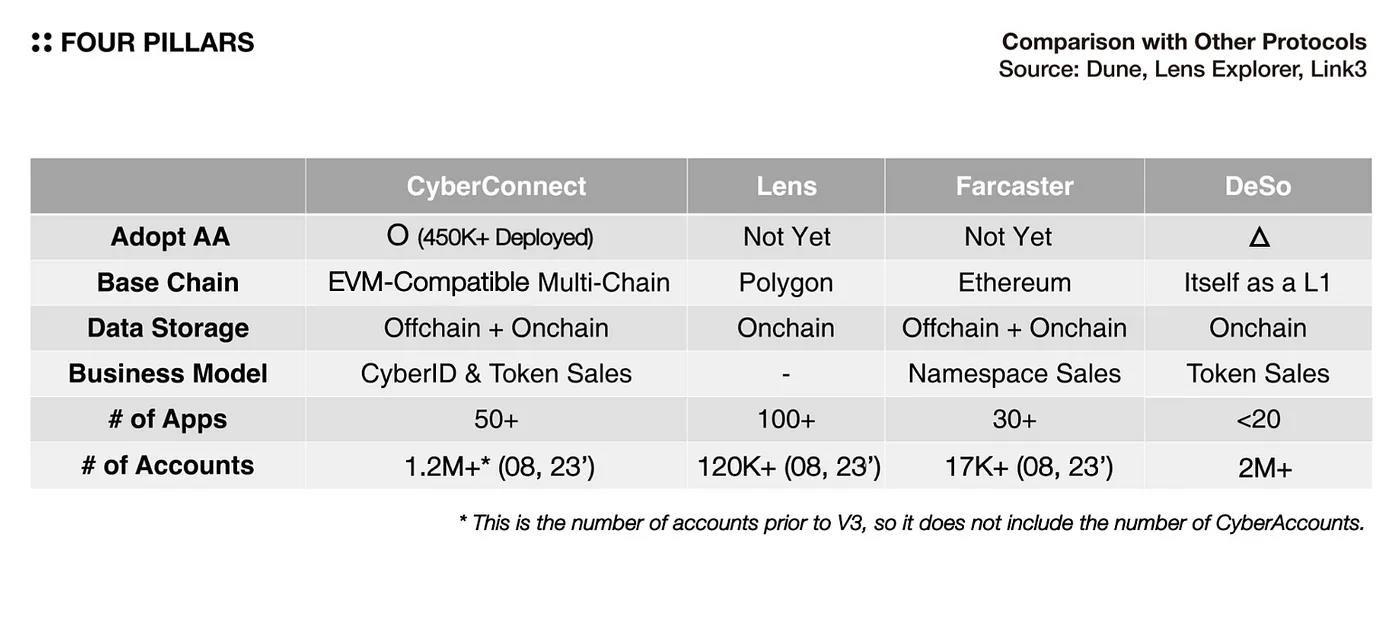
All four protocols emphasize scalable and flexible interactions via identity-based accounts. Currently, only CyberConnect fully implements account abstraction through ERC4337. CyberConnect was among the earliest adopters after the account abstraction discussion began and hosts the largest number of ERC4337-based smart contract wallets in the industry, enabling cross-chain, chain-agnostic use cases. In contrast, DeSo does not directly adopt account abstraction standards but introduces some functionality via “derived private keys” to authorize other entities to sign transactions. The remaining protocols use NFTs to define identity accounts but haven’t fully implemented account abstraction.
Another major difference lies in the “base chain.” Relying on a specific chain offers quick access to its user base but comes with drawbacks like inflexible infrastructure and limited interoperability. While Lens and Farcaster depend on single chains, CyberConnect supports multiple EVM-compatible chains such as Polygon, Linea, Arbitrum, and Base—with Optimism, opBNB, and others soon to follow. Recognizing limitations of general-purpose chains for Web3 social graphs, DeSo built its own specialized Layer 1.
“Data storage” is another key differentiator. CyberConnect and Farcaster adopt hybrid models combining on-chain (including decentralized storage) and off-chain solutions—CyberConnect stores identity and core interaction data on-chain, while other data resides off-chain. Farcaster minimizes on-chain data, relying heavily on off-chain systems. Other protocols default to storing all data on-chain, though Lens stores some non-identity data on decentralized solutions like Arweave or IPFS instead of the base chain. These strategic differences reflect trade-offs each protocol makes between user value and convenience.
CyberConnect and DeSo impose low barriers to account creation, whereas Farcaster and Lens restrict account (or profile) creation by default to invites or special events. Consequently, account registration numbers vary greatly between protocols. Interestingly, this affects community nature—CyberConnect’s community focuses on sharing event info, introductions, and app interactions; Lens leans toward artists and creators; Farcaster emphasizes productive discussions. DeSo shows no clear trend.
While key differences exist, user experience varies per individual, so trying each app to find the best fit is ideal.
Another crucial consideration is the project’s macro direction—what it’s actively building toward. Web3 infrastructure remains nascent, so comparing protocols at this stage may be premature. Rather than analyzing tech stacks, stats, or business models temporarily, what matters more long-term is judging how quickly and flexibly each protocol adopts emerging technologies.
From this perspective, CyberConnect may be the most agile, rapidly adopting cutting-edge tech, cultivating a diverse ecosystem, spreading relevant experiences to as many users as possible, and reinforcing its core values (i.e., holistic identity) based on feedback.
Ecosystem, Tokenomics, etc.
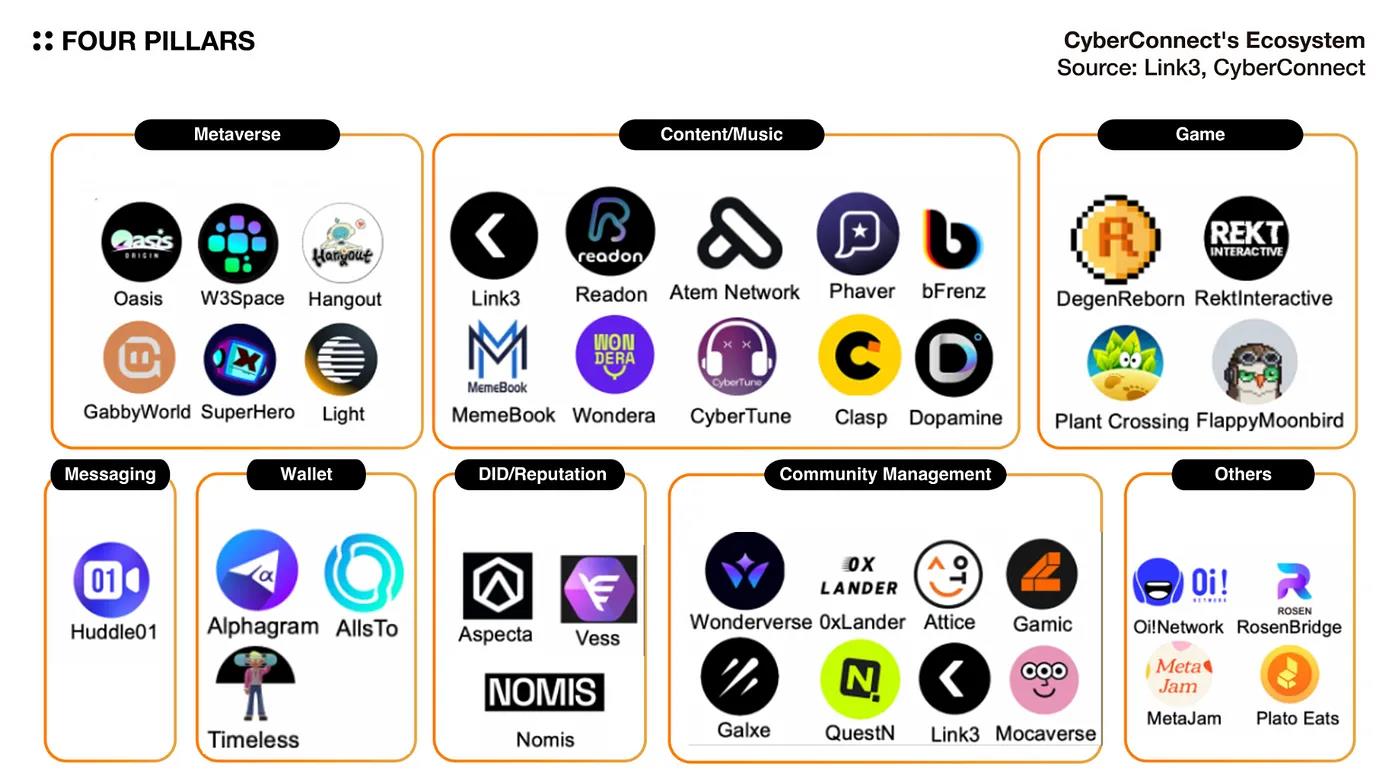
The combination of diverse interactions and synergies from a broader ecosystem can amplify identity impact and drive wider adoption.
Since launch, CyberConnect has completed two funding rounds totaling $25 million and now boasts a robust ecosystem where smart contract wallet use cases via account abstraction are fully realized—over 1.4 million accounts onboarded, 1.8 million content items, 11 million collects, maintaining between 60,000+ weekly active users and 400,000+ monthly active users (with fluctuations). Notably, as previously mentioned, CyberAccount achieved over 450,000 accounts within about three weeks of launch, demonstrating dominance in the ERC4337-based smart contract wallet space.
Within the CyberConnect ecosystem, these users interact with diverse applications including social platforms, membership systems, entertainment, NFT marketplaces/issuance platforms, and more. Over 50 applications in the CyberConnect ecosystem interact with CyberAccount in various ways, fully utilizing account abstraction features.
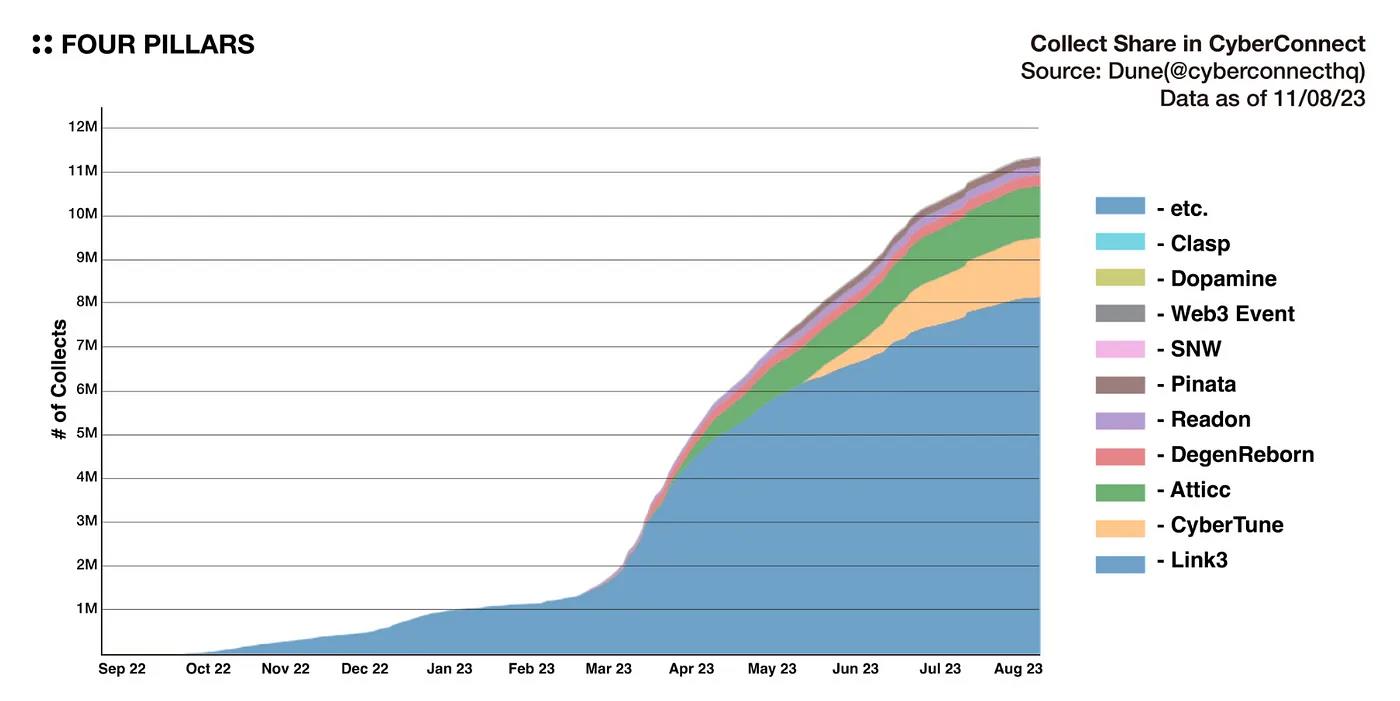
The diversity of interactions within the CyberConnect ecosystem is also visible in the chart above. Until early 2023, interaction rates were dominated by Link3—the first-party community app by the CyberConnect team allowing users to easily create/manage profiles and participate in community learning. Since March, however, new apps like CyberTune (a music NFT platform) and Atticc (a community-based NFT platform) have emerged and grown on CyberConnect alongside Link3.
By participating in cyberTrek reward programs or Link3 FanClub activities, CyberAccount users can further explore the CyberConnect ecosystem and engage differently across multiple apps.
CYBER Tokenomics and CyberConnect Milestones
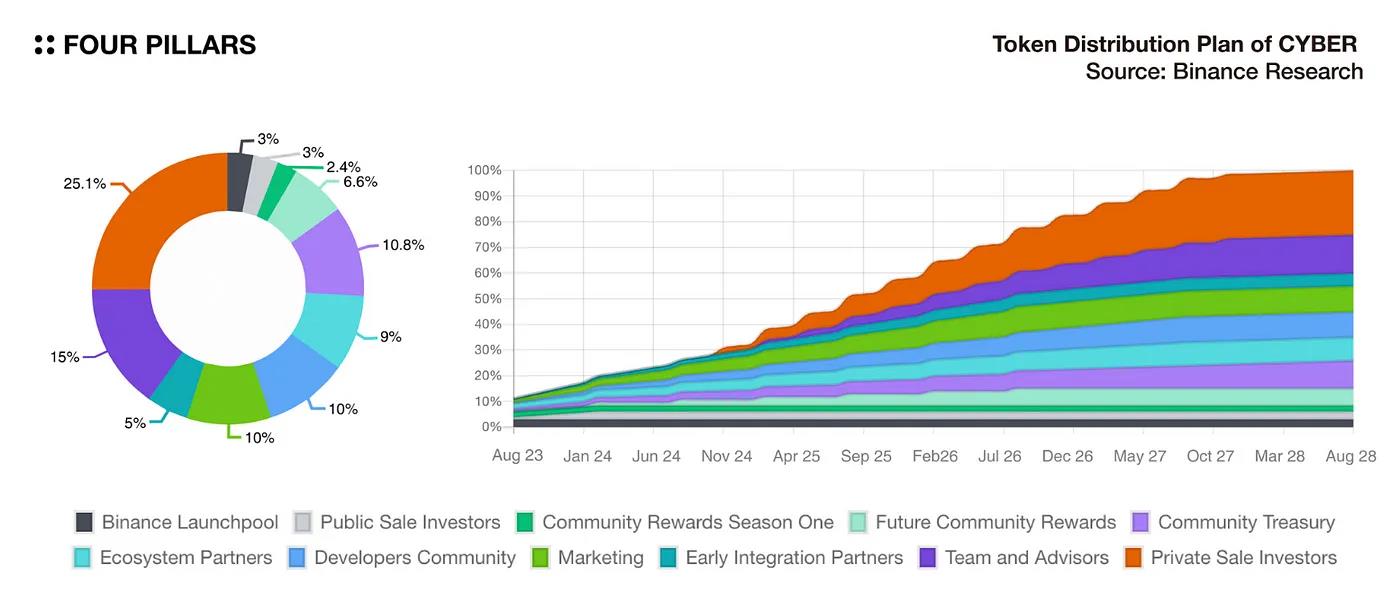
CyberConnect’s native token CYBER serves not only as the essential currency for cross-chain interactions within the ecosystem but also as the primary voting power for ecosystem prosperity.
Governance—CYBER holders have voting rights to improve the CyberConnect protocol and can delegate voting power to other entities. Governance scope includes:
-
Changes to payment methods and fee structures
-
Adoption of new base chains
-
Allocation of funds for ecosystem development, such as grants and community contribution programs
-
Organizing online/offline events to revitalize the ecosystem
CyberAccount Gas Token—CYBER is used as the gas payment method for all transaction types across CyberConnect’s multi-chain ecosystem.
CyberConnect’s most important Q3 update will be the launch of CyberDAO, a DAO discussing improvements to multi-chain interaction. Additionally, cyberTrek will continue in partnership with six chains (Ethereum, BNB, Optimism, Arbitrum, Polygon, and Base) to educate users on CyberAccount use cases.
Q4 will see the release of Login-SDK and CyberWallet app, followed by CyberNetwork and developer grant programs next year.
Potential Opportunities with DID, VC, and ZK Proofs
Several so-called “game changers” exist in Web3—DID (Decentralized Identifiers) and VC (Verifiable Credentials), along with ZKP (Zero-Knowledge Proofs), are among them. DID and VC are technologies/specifications enabling SSI (Self-Sovereign Identity), where users control their identity information and ensure privacy. ZKP is a cryptographic technique proving information validity without revealing its details.
They’re especially notable in Web3 because their tech aligns well with blockchains and enhances identity autonomy—here, enhanced autonomy means people gain greater control over their identity, enabling richer self-expression, reducing information imbalance between users by minimizing reliance on third-party data, and enabling trust-based new forms of interaction.
Using DID and VC
Currently, environments for on-chain and off-chain interactions are separate. However, connecting DID and VC to CyberAccount could unlock entirely new user experiences, covering a person’s entire digital and real-world activity.
For example, if a government (or high-trust entity) in the real world owns a smart contract wallet like CyberAccount and issues citizenship (or equivalent identity representation) as a VC on-chain, individuals could conduct compound interactions on-chain mirroring real-world identity. Since the introduction of personal identity and federated identity models in early internet days, we’ve observed explosive growth in network interactions. Conversely, if on-chain activities are stored as VCs in a DID, individuals could build more dimensional identity representations, enabling purpose-specific real-world activities. Ultimately, such cases could generate strong synergy between the real world and Web3, enhancing reliability in both domains.
Using ZK Proofs
Despite identity tools like CyberAccount claiming data control and curated disclosure, all on-chain data is public—posing risks of exposure to unintended parties or tracking of on-chain activity sequences. Moreover, in CyberGraph, personal identity includes not just static data but contextual or dynamic elements like claims and interactions. By embedding ZKP into its infrastructure, CyberConnect could offer users fully contextualized experiences, tailoring social environments to specific app usage. Such experiences are impossible on existing social platforms due to privacy constraints.
Alternatively, CyberAccount could drive ZKP adoption. Verifying ECDSA signatures from EOAs using ZKP-friendly schemes is costly. If smart contract wallets adopt ZKP-friendly signature schemes via account abstraction, these limitations can be overcome, unlocking broader network-wide benefits of ZKP.
In summary, smart contract accounts not only strengthen holistic identity but also offer excellent external scalability due to synergies with diverse existing technologies. In this regard, CyberConnect stands as the best candidate for broad Web3 adoption—not only rapidly mastering and integrating cutting-edge technologies that enhance Web3’s core values but also transforming and sharing these synergies into new experiences across its vast user base and ecosystem.
Beyond Technology: Toward New Experiences
As digital technologies advance, interactions between individuals online will grow more complex, and the importance of the creator economy may increase. Thus, blockchain-based Web3 is gaining attention as a sustainable alternative for future creative economies. Especially, the concept of account-abstraction-based smart contract wallets can eliminate many complexities and limitations of current blockchain accounts, helping define Web3 identity, and their synergy with other technologies enhances Web3’s innovativeness.
Yet, even with these innovations, true value cannot be realized unless embraced by the public. If technology adoption is defined as the moment new experiences spread among people, then Web3 has spent much time defining new experiences but relatively little discussing how to spread them.
We’ve seen how different interactions on social platforms like Facebook (Meta) evolved into new experiences accepted by millions. AI was long seen as promising, but only with GPT models and experiential dissemination did it achieve rapid adoption. Hence, attributing the gap between Web3 adoption and innovation solely to technical accessibility or UX issues is unconvincing—improving these aspects alone isn’t the only path to broad Web3 adoption.
In this sense, CyberConnect is the closest protocol to achieving broad Web3 adoption—in other words, CyberConnect represents Web3 today, where better technology, values, and experiences are showcased.
Join TechFlow official community to stay tuned
Telegram:https://t.me/TechFlowDaily
X (Twitter):https://x.com/TechFlowPost
X (Twitter) EN:https://x.com/BlockFlow_News
 Four Pillars






