Bob the Solver: Achieving a Streamlined Transaction Process through "Intent Transactions"
TechFlow Selected TechFlow Selected
Bob the Solver: Achieving a Streamlined Transaction Process through "Intent Transactions"
Essentially, "intent" represents the desired outcome, while "transaction" outlines the precise steps required to execute the transaction.
 Navigating Web3 tides with focused insights
Author: AArow, Founder of Go2Mars Capital
Recently, the concept of "intents" proposed by Paradigm has gained significant traction. Projects in this space have also attracted strong backing and funding, making the sector increasingly appealing to investors. So, what exactly are intents—“What Are Intents?” Today, we’ll discuss “intents” and “intent-based transactions,” as well as Bob the Solver, an infrastructure built on intent-driven transaction models.
How to Buy a Braised Pork Knuckle Rice via “Intent-Based Transactions”
Imagine you want to order a braised pork knuckle rice meal on Meituan. You’d need to—open the app, locate the restaurant, check for coupons, apply discounts, pay 20 yuan, and then wait for your meal to be delivered. This is a typical “command-style” transaction where every step of execution is explicitly defined by the user. In contrast, an “intent” refers to the desired outcome of an operation. For example, when ordering the meal, your “intent” would simply be: “I want to buy a braised pork knuckle rice meal and am willing to spend 20 yuan.” A third-party service then takes over, helping you open Meituan, find the vendor, apply available discounts, and complete the purchase on your behalf.
In this scenario, the former approach represents a “command-based transaction,” where users must manually specify every parameter of the transaction. The latter represents an “intent-based transaction,” where users only need to express their desired outcome—the rest is handled automatically. Of course, achieving this convenience requires delegating the execution tasks to trusted third parties.
At its core, an “intent” represents the desired result, while a “transaction” outlines the precise steps required to execute it.
Differences Between Intents and Traditional Transaction Flows
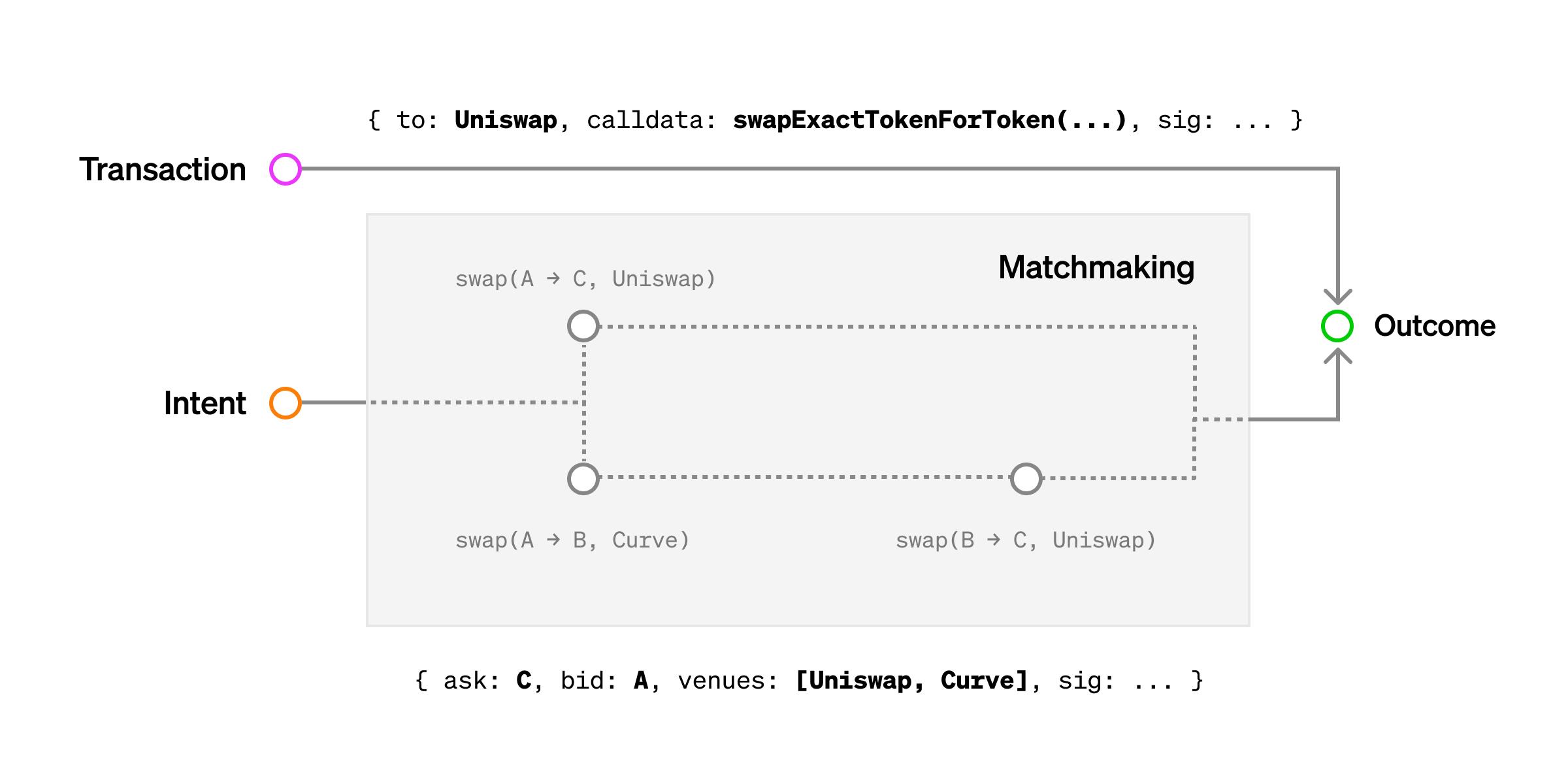
The current standard way users interact with Ethereum involves manually creating and signing transactions, then sending specially formatted messages to the Ethereum Virtual Machine (EVM) to trigger state transitions. However, crafting transactions is inherently complex—inefficient and forcing users to make decisions without full information or optimal execution strategies.
Intents aim to reduce this burden. An intent consists of signed declarative constraints that allow users to outsource transaction creation to third parties—without fully relinquishing control. Essentially, it’s about securely delegating complicated operations to external solvers.
In a traditional transaction flow, your transaction signature allows validators to follow one specific computational path toward a defined state, incentivized by fees.
With intent-based transactions, however, no fixed computational path is specified. Instead, any path that satisfies the user-defined constraints can be used. By signing and sharing their intent, users effectively grant recipients permission to choose the best computational route on their behalf.
Project Example: Bob the Solver
Now let’s look at a real-world example (note: not an endorsement, purely for analysis).
Bob the Solver is an intent-based transaction infrastructure designed to improve wallet and dApp user experiences. Let’s explore how it works.
Bob the Solver aims to simplify the transaction process by integrating into wallets and decentralized applications (dApps).
It emerged from a paradigm shift in the evolving field of account abstraction (we’ll dive deeper into account abstraction later), which delegates transaction creation to third parties. The focus shifts from specifying exact actions to fulfilling the user's intent.
Essentially, it outsources transaction creation and execution, transforming how users interact with blockchain transactions—making the experience more intuitive and user-friendly.
Bob the Solver operates through two interconnected components:
1. A “Solver” responsible for creating transactions (txs);
2. An “Account Abstraction (AA)” wallet responsible for executing those transactions;
The Solver
Solver: Equipped with machine learning (ML) models, the solver classifies user intents.
After classifying the intent, an optimizer scans potential transaction routes to identify the most efficient path toward the desired outcome.
Once the optimal path is determined, the solver constructs the necessary transaction on behalf of the user and forwards it to the AA wallet.
Account Abstraction (AA) Wallet
The AA wallet acts as the executor within the system. It includes two key components: a bundler and a paymaster.
The bundler collects and organizes transactions sent by the solver.
Meanwhile, the paymaster manages gas fees associated with these transactions—paying them when needed to ensure smooth and uninterrupted execution.
By leveraging ML models to interpret user intents, the solver eliminates much of the complexity involved in transaction construction, while the AA wallet ensures reliable execution.
Together, these components streamline the transaction process. For instance, if you say, “I want to buy a Bored Ape Yacht Club (BAYC) NFT at floor price,” Bob the Solver can deliver a seamless and efficient transaction experience.
You no longer need to manually search across platforms or compare options. Simply express your intent—the rest is handled automatically by the intent-based transaction system.
Note: Most views in this article are based on my reading of Quintus Kilbourn and Georgios Konstantopoulos’ piece from Paradigm titled “Intent-Based Architectures and Their Risks.” Additional insights come from current trending projects and personal understanding. For a more comprehensive view, refer to the original article by the Paradigm authors.
Join TechFlow official community to stay tuned
Telegram:https://t.me/TechFlowDaily
X (Twitter):https://x.com/TechFlowPost
X (Twitter) EN:https://x.com/BlockFlow_News
 Go2Mars Capital