The Future of Web3 Social (II): Biometrics and Social Endorsement Solve the Identity Problem
TechFlow Selected TechFlow Selected
The Future of Web3 Social (II): Biometrics and Social Endorsement Solve the Identity Problem
From data privacy to the intrusiveness of the process, and to the effectiveness of verifying human identity, this process involves many trade-offs and is one of the well-known "hard problems in cryptocurrency."
 Navigating Web3 tides with focused insights
Author: PAUL VERADITTAKIT, Partner at Pantera
Translation: TechFlow
This is the second article in a series on decentralized social networks written by Pantera partner PAUL.
The series explores how current technologies and trends can solve a range of problems facing decentralized social networks, offering detailed explanations and analysis for each issue.
Previous article in the series: The Future of Web3 Social (Part 1): Building a Social Graph to Solve User Acquisition - TechFlow
In 2017, a group of researchers from the MIT Media Lab claimed in Wired magazine that decentralized social networks would “never succeed.” In their article, they outlined three insurmountable challenges:
(1) The problem of attracting (and retaining) users from scratch
(2) The problem of handling personal user data
(3) The problem of user-targeted advertising
They argued that in all three cases, incumbent tech giants like Facebook, Twitter, and Google, due to their massive economies of scale, left no room for meaningful competition.
Fast forward to today, what was once deemed "impossible" now seems within reach. We appear to be on the cusp of a transformation in the concept of social networking. In this three-part series (this being the second), we explore how new ideas in decentralized social (DeSo) are tackling these "old" problems, specifically:
(1) Using an open social layer to solve cold-start problems
(2) Using proof-of-personhood and cryptography to solve user identity issues
(3) Leveraging token economics and incentive mechanisms to solve monetization
In this article, the author focuses on solving problem (2).
The User Identity Problem in Social Media
Modern social media faces a bot problem. While platforms have a responsibility to uphold free speech, complications arise when the "users" participating aren't real people but bots.
Bots have demonstrably influenced public discourse—from alleged interference in U.S. presidential elections to shaping public perception around COVID-19. Especially under conditions emphasizing anonymity, security, and privacy, any decentralized social media platform inherits the "bot problem": in an age of advanced AI, how do you convince people that accounts on your platform are real humans, not bots?
A naive solution would be traditional KYC protocols, but this immediately raises privacy concerns—the other side of the dilemma. Why should users trust any social media platform with sensitive data (from government IDs to private messages and financial transactions) capable of reconstructing one’s entire personal, social, and professional life?
Thus, the "user identity" problem is fundamentally a tension between verifying that a user is “truly human” and providing strong privacy guarantees over personal data. In this article, we’ll examine two distinct approaches to solving this: biometric methods (using zero-knowledge proofs) and social attestation methods.
Worldcoin and Biometric Authentication
In the space of "proof-of-personhood," Worldcoin is one of the most well-known and controversial projects. Backed by none other than OpenAI CEO Sam Altman, Worldcoin’s solution to the personhood problem is straightforward: use retinal scans to create a biometric proof that you are human (since robots don’t have retinas), and receive a verification token. On privacy, Worldcoin claims to use zero-knowledge proofs to securely store collected biometric data.

Worldcoin argues that as AI plays an increasing role in society, it becomes essential to distinguish humans from bots in a privacy-preserving and decentralized manner. By using the Worldcoin orb’s retinal scan, individuals can obtain a “digital passport”—a World ID—that may qualify them for cryptocurrency-based universal basic income mechanisms and participation in new forms of global democratic governance. Essentially, this World ID aims to become the foundational primitive for future digital social networks.
In its documentation, Worldcoin emphasizes its privacy-first approach. For example, it states that images collected by the orb are deleted, only storing a hash of the user's iris, and runs zero-knowledge proofs (zk-SNARKs) to share proof-of-personhood information without revealing any personal data. Although during the current rollout phase these hashes are stored in a centralized database, the team plans to eventually store iris hash data on-chain once the hashing algorithm matures.
Despite these privacy assurances, significant controversies remain around actual privacy, security, and fairness. For instance, there have been reports of stolen credentials from Worldcoin operators and World IDs being sold on digital black markets, allowing users to claim Worldcoin tokens without undergoing iris scanning. There are also broader ethical concerns: in April 2022, MIT Technology Review published a scathing article accusing the project of deception, manipulation, and exploitation of nearly half a million users—mostly in developing countries—going so far as to label it “crypto-colonialism.” Indeed, as of August 2, 2023, Kenya—one of Worldcoin’s largest data collection hubs—banned the scanning operations over security, privacy, and financial concerns.
Beyond project-specific controversies, there are wider concerns about Worldcoin’s reliance on proprietary hardware for biometric authentication. Since the orb is essentially a hardware device, even if Worldcoin’s software were flawless, there’s no guarantee against hardware backdoors that could allow Worldcoin (or third-party manufacturers) to secretly collect actual biometric data or inject fake profiles into the system. To skeptics, all of Worldcoin’s privacy assurances—zero-knowledge proofs, iris hashing, blockchain decentralization—appear to be mere window dressing.
Proof-of-Personhood and Social Attestation
An alternative approach to solving proof-of-personhood is through social attestation. Simply put, if verified humans Alice, Bob, Charlie, and David all “vouch” for Emily as a verified human, then Emily is likely also human. The core challenge here becomes one of game-theoretic design: how do we structure incentives to maximize accurate human verification?
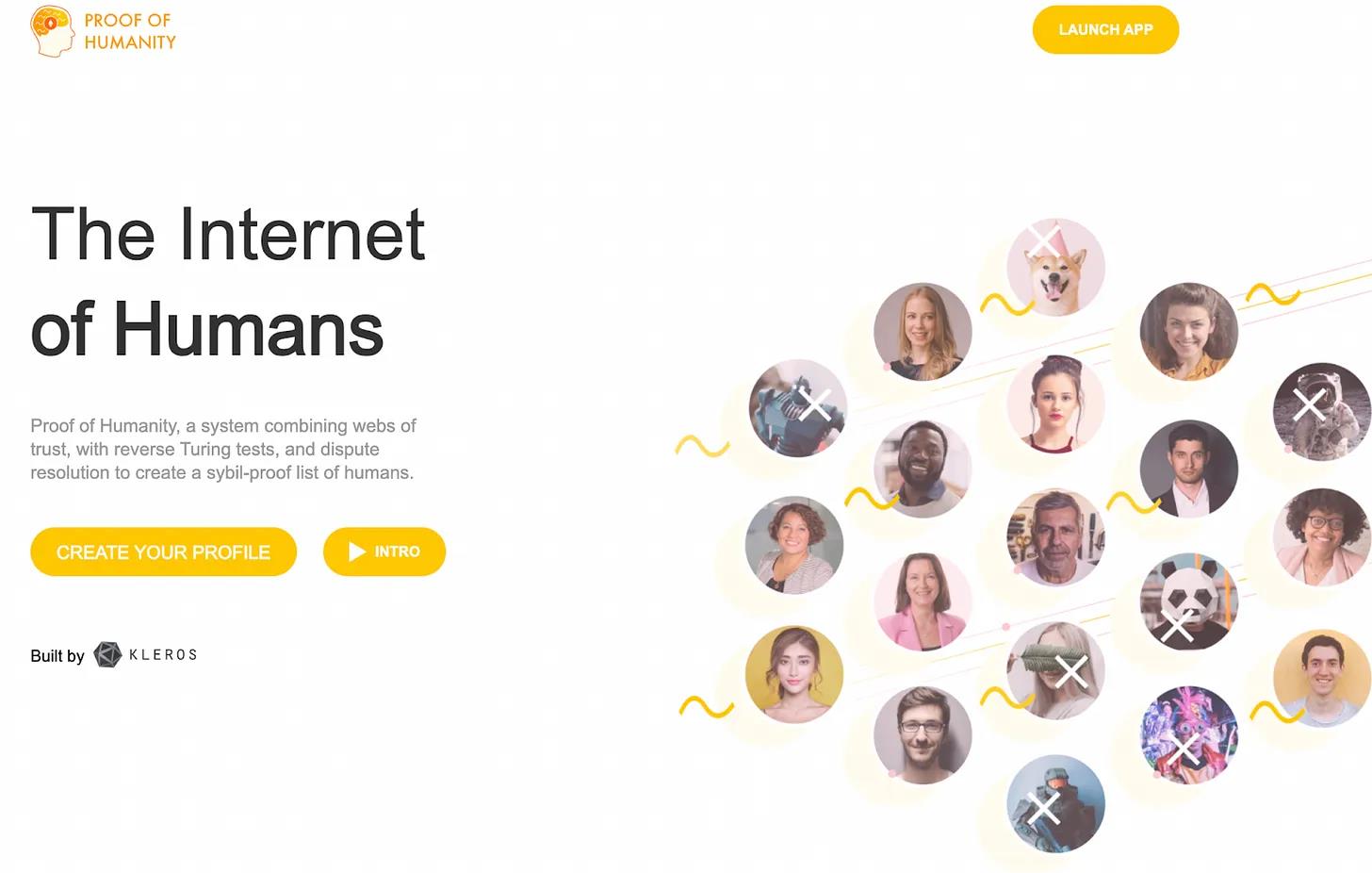
Proof-of-Humanity is one of the oldest and most important projects in this domain. To “prove your humanity,” you must:
(1) Submit personal information, photos, videos, and a deposit of 0.125 ETH,
(2) Be vouched for by someone already registered in the registry,
(3) Pass through “three challenge periods.” If someone disputes your application during this time, the case goes to the Kleros decentralized court, and your deposit is at risk.
During the process, users are first paired via a form with an introducer. After pairing, they conduct a video call to verify that the profile matches a real person. Like Worldcoin, the Proof-of-Humanity community has long championed the idea of a universal basic income (UBI), which would be distributed to those verified in the registry.
Other projects follow similar paths, leveraging social graphs to validate identity—including BrightID’s video-call verification where everyone verifies each other, Idena’s recurring captcha creation and solving game, and Circles’ trust-based circles.
The main appeal of these socially-verified platforms may lie in their non-intrusiveness compared to Worldcoin, which requires scanning your iris on a metal orb. Some methods, like Idena’s captcha “checkpoint ceremonies,” even preserve a degree of anonymity without requiring extensive personal data sharing or relying on third-party identity authorities.
The Future of Human Identity
As AI continues to advance and exhibit increasingly human-like behaviors, designing novel proof-of-humanity mechanisms becomes ever more critical—not just for universal basic income and other incentives discussed by many such projects, but more importantly as a way to better moderate and regulate future social networks.
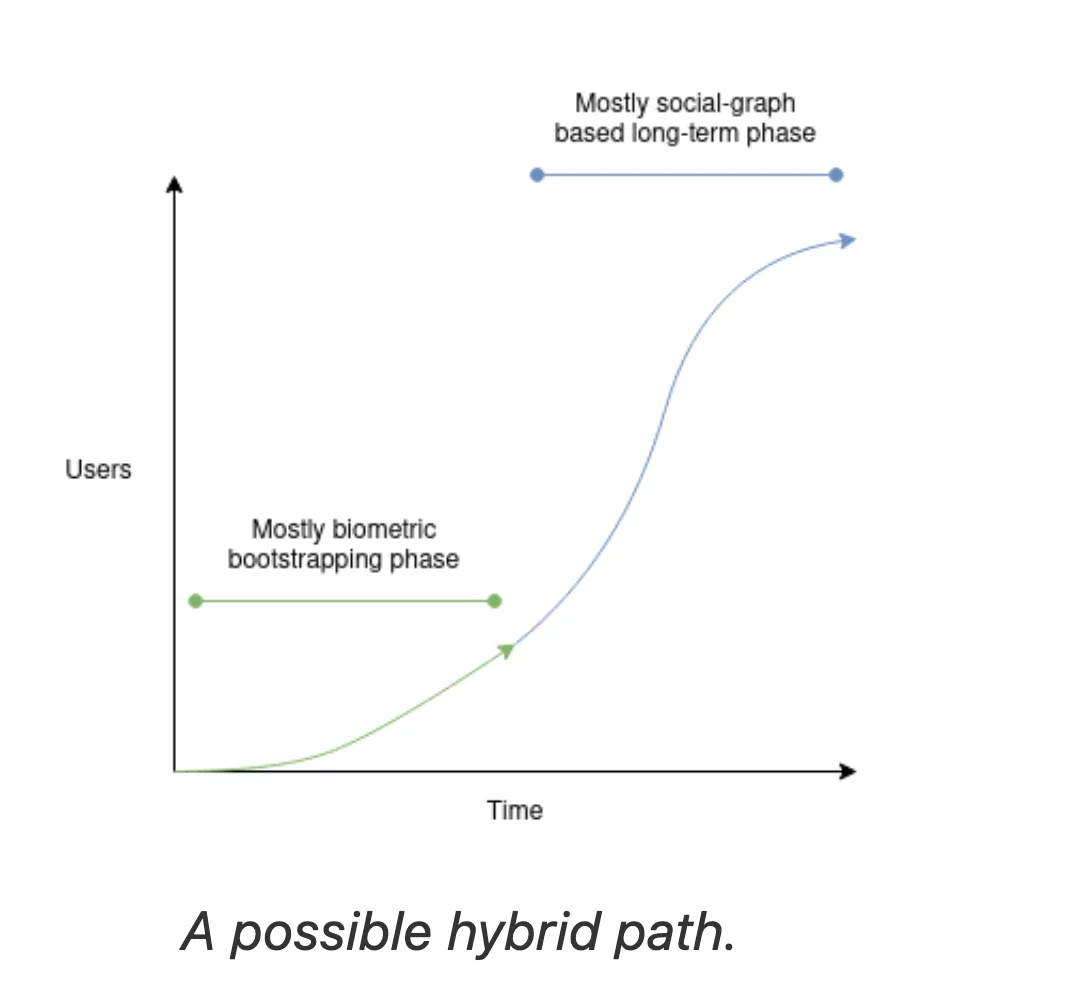
However, this process involves numerous trade-offs—from data privacy and intrusiveness to the effectiveness of verifying human identity—and represents one of crypto’s well-known “hard problems.” As Vitalik has pointed out, there appears to be no single optimal form of proof-of-personhood, and he suggests a hybrid path: **starting with biometric-based bootstrapping but transitioning over time toward more social-graph-based methods.**
Looking ahead, this field demands greater transparency in processes, code, and data. In short, there must be no ironic paradox where users are asked to “trust a trustless solution.” Only through such openness can we truly build a foundation for social networks that aligns with crypto’s original vision of decentralization and privacy.
Join TechFlow official community to stay tuned
Telegram:https://t.me/TechFlowDaily
X (Twitter):https://x.com/TechFlowPost
X (Twitter) EN:https://x.com/BlockFlow_News
 Pantera Capital