60 Perpetual Contract Protocol Reviews: Order Books Still Hold Edge, Oracle Dependence Intensifies, Market Begins to Saturate
TechFlow Selected TechFlow Selected
60 Perpetual Contract Protocol Reviews: Order Books Still Hold Edge, Oracle Dependence Intensifies, Market Begins to Saturate
The perpetual contract market has achieved substantial product-market fit, which to some extent could lead to market saturation.
 Navigating Web3 tides with focused insights
Author: Pablo Bartol
Translation: TechFlow
Introduction
In the derivatives space, perpetual contracts are more popular than options, gaining broad acceptance in both retail and institutional markets. The total daily trading volume of BTC perpetual contracts has grown from approximately $3 billion at the beginning of 2020 to $13 billion in 2023.
This series aims to provide an overview of the current DeFi perpetual contracts landscape and compare different protocols, focusing on how they work rather than their potential as investment tools.
The following 60+ protocols are covered in this analysis:
0x, Alex, Angle, Apollo, Avantis, BlueFin, bZx, Cap, Contango, ConvergenceRFQ, DDEX, DDX, Deri, Derivio, Digitex, Dolomite, Drift, dYdX, Futureswap, Gains Network, Gearbox, GMX, GMX Forks, Good Entry, Hubble, Hyperliquid, IDEX, Increment, InfinityPool, Injective, Kujira, Kwenta, Lendroid, Levana, Level, Lexer, Mango, MarketProtocol, MCDEX, Mux, NFTperp, Numoen, OpenBook, Opyn (Squeeth), Perennial, Perpetual Protocol, Perpy, Pika, Polynomial, Predy, RabbitX, RageTrade, Sentiment, Serum, STFX, Syndr, Synfutures Protocol, Synthetix, Tigris Trade, Tribe3, Unidex, Variabl, Vega, Vela, Vertex, Vyper, and Zeta Markets.
In this article, we will first briefly review perpetual futures, then broadly categorize the above protocols. Based on this classification, we will delve into the differences among these protocols, exploring the trade-offs they make in providing liquidity and pricing mechanisms.
Perpetual Contracts Concept Recap
In this section, you can find a brief introduction to perpetual contracts.
-
A futures contract is a legal agreement to buy or sell a specific commodity, asset, or security at a predetermined price at a specified time in the future. Unlike options, futures contracts do not include an option; the agreement is binding.
-
Perpetual contracts are a type of futures contract with no expiration date, hence the name. The concept of perpetual contracts was first proposed by Robert Shiller in 1992 and first implemented by BitMEX in 2016.
Perpetual contracts are Delta-1 products, meaning that for every $1 movement in the underlying asset, the contract price also moves by $1. For example, suppose Ethereum is trading at $2,000. You open a long position with a notional value of 1 ETH. After some time, if Ethereum reaches $2,200, the profit would be 1 ETH * ($2,200 - $2,000) = $200, minus trading fees and funding rates.
This allows traders to speculate on asset price movements without worrying about time horizons. Traders can keep their long or short positions open for as long as they wish. However, traders should note that they need to pay fees and, when using leverage, must closely monitor the health of their positions to avoid liquidation risks.
In most perpetual contract protocols, liquidation is a crucial component because the accumulation of bad debt could bankrupt the protocol and/or liquidity providers (LPs). Funding rates or borrowing rates (the exact term depends on the protocol) are implemented to promote market efficiency, create arbitrage opportunities, and compensate participants who take on less popular positions, balancing open interest (OI).
Classification of Perpetual Contract Protocols
We can make a very broad classification based on two main variables:
-
Does the protocol require liquidity to be locked within it? We can think of this as: Is there a liquidity pool, or is it entirely peer-to-peer (P2P)?
-
Does the protocol directly influence the market, thereby causing or affecting price discovery of the underlying asset or contract? Or does the protocol use oracles to obtain the fair price of the asset?
Based on this, we can propose this basic (possibly oversimplified) classification:

Classification matrix of perpetual protocols based on two key criteria: 1) External vs. Internal price discovery (Oracle vs. Oracle-less) and 2) No liquidity locking vs. Liquidity pools (P2P vs. P2Pool)
We will use this classification by liquidity provision and pricing mechanism in the protocol breakdown section of the article to deeply explore the different ways protocols offer perpetual contracts.
Order Book
In this section, we can find the following protocols:
Alex, Apollo, BlueFin (formerly Firefly Exchange), DDX, Digitex, dYdX, Hubble, Hyperliquid, IDEX, Injective, Kujira, Lendroid, Mango, Market Protocol, RabbitX, Variabl, Vega, and Zeta.
AMM-Based
AMM
-
Leveraged Spot: bZx, DDEX, Dolomite, Futureswap, MCDEX
-
Leveraged Accounts: Gearbox, Sentiment
-
Power Perpetuals: Deri, Numoen, Opyn (Squeeth), Polynomial, and Predy v2.
-
Perpetual Options: Predy v3.
VAMM
-
Drift, Increment, InfinityPools, NFTperp, Perpetual Protocol, Rage Trade, and Tribe3.
Although Predy and InfinityPools both use concentrated liquidity AMMs to build "perpetual options" or perpetual contracts, note that they implement them differently and thus belong to separate categories. In our previous options series, we introduced some protocols built on similar concepts but focused more on delivering option-like experiences, such as Gamma Swap, Panoptic, or Smilee.
Oracle-Based
In this section, we can find the following protocols:
Synthetic Liquidity
-
Avantis, Gains Network, Deri, Synthetix (Kwenta, Polynomial, etc.), Tigris Trade, and Vela.
Basket of Assets
-
Angle, Apollo V2, Cap, Deri, Derivio, GMX and its forks, Good Entry, Levana, Level, Lexer, Mux, Pika, and Synfutures Protocol.
Others
These protocols do not necessarily fit into the above categories or are better suited for inclusion in a separate category. They are listed here for completeness, but the rest of this article will focus on the above categories.
Aggregators
In this section, we can find the following protocols:
-
UniDEX and MUX.
Similar to spot aggregators like 1inch, Matcha, or DeFillamaSwap. These protocols compare fees and prices across perpetual contract venues to execute trades at the most favorable venue.
Social Trading / Copy Trading
In this section, we can find the following protocols:
-
Perpy and SFTX.
They allow users to replicate trades on other platforms. For example, a trader makes a trade on GMX, and other users copy the same trade.
Infrastructure
Protocols that allow other protocols to be built on top of them.
-
0x, Serum, OpenBook allow protocols to launch order book platforms.
-
Vyper, Derivio, Perennial, and Convergence RFQ have some more specific-case solutions. Generally, they can be seen as base layers on which other protocols can build their own markets.
Briefly introduce RFQ. RFQ stands for Request for Quote, where typically traders request quotes and market makers respond with pricing for specific instruments/assets/quantities, etc.
Expiring Assets
Contango offers expiring assets. This is neither perpetual—since clearly they expire—nor forwards. Contango has no order book or liquidity pool. When a position is opened, Contango borrows on fixed-rate markets, swaps on spot markets, and then lends again on fixed-rate markets. Pairs are based on assets available in fixed-rate money markets, such as yield or notionals. At expiry, contracts can be settled in cash or physically.
Market Analysis of Perpetual Protocols
Market Overview:
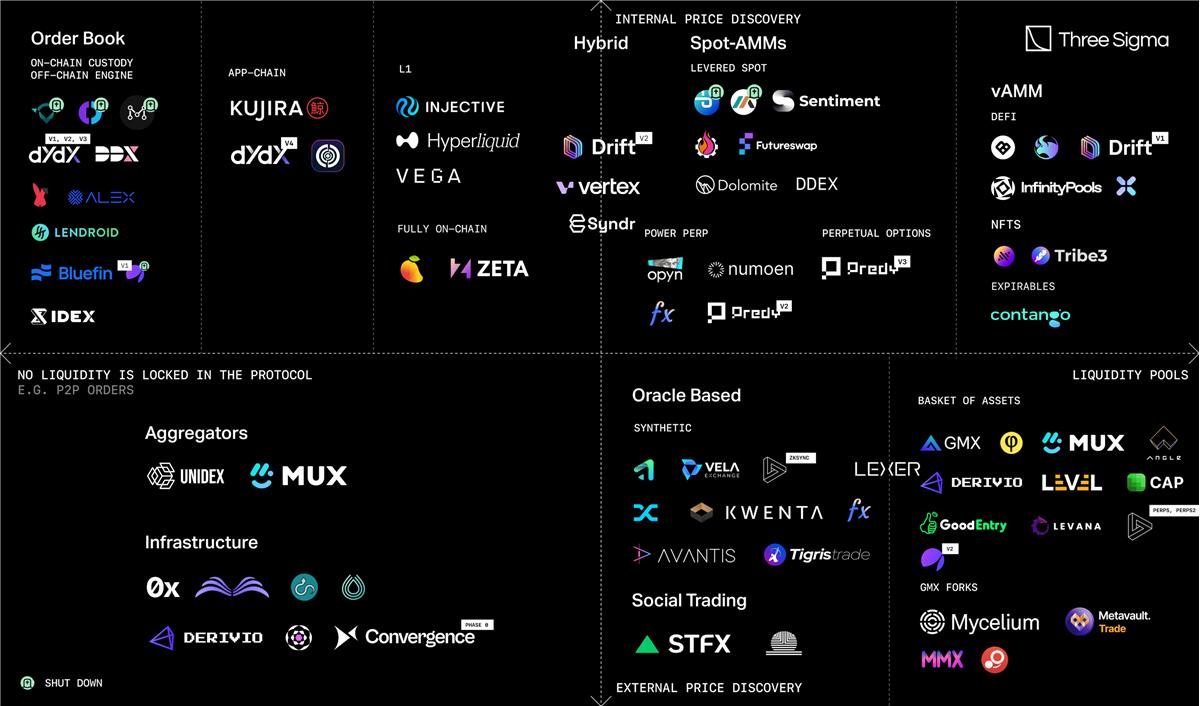
Note that our research suffers from survivorship bias. Nevertheless, we focused on including the above protocols despite varying degrees of success.
Before diving deeper into different types of perpetual protocols, two important considerations related to on-chain derivatives are regulatory uncertainty and pre-DeFi historical context.
On-chain derivatives face regulatory uncertainty. They encounter regulatory challenges that impact the market. Here are two significant cases:
-
Digitex, December 2017. The platform faced regulatory scrutiny after being sued by the Commodity Futures Trading Commission (CFTC) for illegally operating a commodity futures trading platform.
-
bZx or bZeroX (Fulcrum Trade), June 2019. bZx had a more complex history than Digitex. It suffered four major losses (links). The protocol was managed by Ooki DAO. The CFTC charged the founders and Ooki DAO with illegally offering off-exchange digital asset trading.
Before the arrival of DeFi Summer in 2020, not much happened on-chain, and some earlier projects did not see the light of day.
-
VariabL, Q4 2017. Last blog update was in Q2 2018. VariabL was a derivatives trading platform built by ConsenSys on Ethereum.
-
Market Protocol. Last Twitter update was in December 2019.
Order Book
The goal of order books is to fully realize peer-to-peer trading on-chain. However, the main issue is that most popular blockchains are unsuitable for fully on-chain order books.
Therefore, different solutions have been adopted.
1) Moving part of the system off-chain. Mainly the matching engine, as it is the resource-intensive (computationally expensive) component of the order book.
2) Fully on-chain. Transitioning to Alt layers such as Solana, which offer lower base-layer security but higher throughput. Order book updates can occur every block or every half-second.
3) Building their own L1. There are two ways to achieve this: either building an appchain on OP Stack or Cosmos, or building a standalone L1 from scratch.
Each approach has pros and cons. For example, putting parts of the application off-chain introduces trust assumptions. Lower security on the base chain is traded for faster throughput and less decentralization. Appchains can enable protocols to capture MEV, but at the cost of requiring more permissioned setups and adding friction layers.
Automated Market Makers (AMMs)
Unlike order books, where orders settle P2P, AMMs require liquidity to be locked into liquidity pools. The key difference between AMMs and vAMMs is that AMMs require real liquidity, while vAMMs derive liquidity directly from vaults outside the vAMM and thus do not necessarily require LPs.
Spot AMMs
In this case, although AMMs are not perpetual futures, they are included because they allow traders to gain Delta=1 exposure to underlying assets using borrowed funds for leverage.
However, this type of protocol also has some advantages.
AMMs like Uniswap offer flexibility to trade various assets as long as liquid markets exist. This enables traders to access leveraged exposure to assets that may not qualify on other perpetual futures protocols. Additionally, leveraging existing liquidity already embedded in spot AMMs ensures continuous liquidity to match buy and sell orders, aiding in price discovery of assets.
However, there are trade-offs. To enable traders to gain leverage, borrowers must be incentivized with attractive yields and/or rewards. Also, while we mentioned that potentially all assets can be traded via spot markets, some level of permissioning is still required to prevent users from losing lenders' funds through scams, honeypots, etc.
Since LPs are not direct counterparties to traders, they avoid bankruptcy risk. However, this comes at the cost of becoming lenders to traders and bearing credit risk.
Regarding Power Perpetuals, they were introduced by Paradigm in 2021. Opyn (SQUEETH) was the first team to implement this protocol. In short, they offer n^x returns, e.g., ETH².
vAMMs
vAMMs provide a decoupled market structure that helps independent price discovery from the underlying spot price. This could lead to discrepancies between futures prices and spot asset prices, creating arbitrage opportunities. On the other hand, what is the true price of a perpetual contract?
Another challenge facing vAMMs is liquidity. Lack of deep liquidity may trigger unexpected or undesirable price fluctuations during opening/closing positions.
The vAMM model relies on liquidating positions and maintaining balanced open interest to keep the mark price close to the spot price. However, this creates inherent imbalances and biases, especially over time and particularly during market crashes or extreme volatility.
Oracle-Based Protocols
Broadly speaking, oracle-based protocols can be defined as those having liquidity pools that act as counterparties to trades. Unlike AMMs, the protocol itself does not perform price discovery but uses oracles to price the underlying assets from other venues.
We can identify two prototypes of oracle-based perpetual futures:
-
Synthetic Liquidity. A single asset serves as the basis for all trading markets. By using oracles, LPs can become counterparties to all these markets.
-
Basket of Assets. Uses a basket of assets as counterparties. That is, in a hypothetical BTC/USDC pair, BTC serves as collateral for longs and USDC as collateral for shorts. More assets can be added, but this is the general principle.
Synthetic assets. Their advantage lies in the fact that since a single asset is the counterparty, there is practically no limit to which markets can be added—as long as sufficiently reliable oracles exist. This makes the protocol more flexible in adding markets. However, it is riskier for liquidity providers, as they bear the risk of certain assets they cannot hedge on-chain. For example, being the counterparty to gold or USD/JPY. On the upside, assuming the asset basket remains balanced at 50% USD in the pool, there is no unexpected impermanent loss, similar to the impermanent loss scenario in Uniswap V2.
Protocols using a basket of assets offer a more rigid setup for LPs, which benefits risk management (volatile assets back longs, stable assets back shorts, so even with sharp price swings, the system remains collateralized). This comes at the expense of traders, who have fewer markets to trade. For example, in GMX v1, you can only trade five assets. However, a very reasonable rebuttal or question is whether most traders really want access to markets beyond Bitcoin and Ethereum. Transaction volume data broken down by asset can be found here. A quick glance shows that for Gains Network, 50–70% of volume occurs on Bitcoin and Ethereum, while for Kwenta, it's around 40% to 80%.
Protocol Breakdown
From the market overview in the previous section, we now turn to exploring the different components into which protocols can be decomposed. This article will focus on liquidity provision and pricing.
Liquidity Provision
From a protocol perspective, we can broadly divide them into two groups:
-
P2P trading. Thus, no liquidity needs to be locked on the platform (TVL=0).
-
Liquidity pools. Trading via AMM, vAMM, or oracle.
Topics covered in this section include:
Liquidity mechanisms in decentralized protocols. Who is the counterparty to traders? – Roles and incentives of liquidity providers – Balancing liquidity across different assets and markets.
Order Book
Simply put, market makers and takers trade with each other. The protocol may incentivize maker/taker liquidity.
For the protocol, the complex task is how to timely match orders from market makers and takers. For example, according to a May 2023 report by Deutsche Börse Group, participants react in under 2,770 nanoseconds. Can this currently be handled via general-purpose chains like Ethereum? The answer is no.
This forces protocols to either move off-chain or to dApps, forcing validators to also run the order book. Hence, liquidity providers are active agents interacting with other participants. Aside from the fact that market makers may not provide liquidity for meme coins like HarryPotterObamaSonic10Inu, there are no real barriers preventing order books from listing such coins.
Spot AMMs
Here, liquidity used to settle trades comes from AMMs like Uniswap. Nonetheless, the protocol itself needs to incentivize borrowers to come, as they are the ones providing leverage to traders. Sentiment and Gearbox, while allowing users to do more, also fall into this category. Liquidity providers play a relatively passive role—they "just" provide leverage.
Power Perpetuals
Power Perpetuals, such as SQUEETH, consist of two participants. One side is long ETH², the other short ETH². Since each protocol follows a different design, generalizations cannot be made. For example:
-
In Opyn, the short side mints Power Perpetuals using ETH as collateral. Long traders can only buy SQUEETH on open markets, such as on AMMs like Uniswap. To profit, they also need to be able to sell.
-
In Numoen, the long side mints tokens, while LPs provide LP tokens as collateral, lending them to traders.
-
Deri uses a single liquidity pool as the counterparty to all derivatives, including Power Perpetuals. Therefore, although Deri is included here, its liquidity model is essentially the same as oracle-based protocols.
-
Polynomial has not yet released its model, but the team says it will use liquidity pools in a way different from competitors.
vAMMs
In terms of liquidity provision, vAMMs employ various different approaches.
-
Perpetual Protocol and protocols following its model (such as NftPerp). Theoretically, actual liquidity providers aren't needed here because the vAMM doesn't require a counterparty when minting virtual tokens. What happens without a counterparty? That's why in Perp v1, the team was one of the main LPs for a period, acting as market makers to facilitate trading. Later, LPs were introduced—though the goal remained to match longs and shorts—but by introducing LPs, continuous liquidity was ensured. Thus, in this model, LPs can be either passive (providing liquidity, traders settle among themselves) or more active (arbitraging prices and collecting funding fees).
-
Increment adopts a model similar to Perpetual Protocol, but instead of using the Uniswap v3 model, it concentrates liquidity by leveraging Curve’s V2 mathematics. Each liquidity pool in the protocol may use different parameterizations depending on the volatility of the assets in the pool.
-
Rage Trade introduced the concept of “on-chain circular liquidity.” What is on-chain circular liquidity? On-chain circular liquidity is a treasury split 80-20, where 80% of the liquidity is redeployed to provide liquidity on Curve, while the remaining 20% provides concentrated liquidity on Rage Trade (powered by Uni v3). The vAMM’s virtual liquidity is backed by the 80-20 treasury.
-
InfinityPools achieves its liquidity by building on Uniswap V3’s concentrated liquidity concept. By rebalancing liquidity positions similar to Uniswap, it enables very high leverage without liquidation risk. For example, an LP deposits $1,000 worth of assets in an ETH/USDC pool with a price range of 900–1,000. Then, traders can borrow against that LP’s position and redeem all liquidity for 1 ETH (1ETH = $1,000).
-
Drift V1. Drift uses a VAMM called Dynamic AMM (DAMM), where liquidity comes from LPs on Drift. This AMM implements a set of parameters to fine-tune market depth, such as price multipliers, fee pools, or segments. The Drift V1 AMM is now part of Drift V2.
Hybrid Model: AMM + Order Book
One potential problem with order books is: What if no market makers appear to post bids and asks? Therefore, some protocols have introduced hybrid models combining order books and AMMs to ensure continuous liquidity.
-
Drift v2 uses three different liquidity mechanisms. First, just-in-time Dutch auctions provided by market makers. This process lasts about 5 seconds. Second, a limit order book that executes only limit orders, run by a network of admin bots. Third, if no market makers participate in the first two steps, a constant-product AMM—Drift V1 AMM—is used to ensure traders have continuous liquidity.
-
Vertex uses a price/time priority algorithm, so orders are executed at the best price, whether offered by AMM or market makers. The AMM quotes discrete price levels on the order book to approximate xy=k.
-
Syndr combines an off-chain order book with a liquidity pool deployed on Arbitrum. The AMM integrates retail-provided liquidity, while the order book is designed to be quoted by market makers.
Oracle-Based, Synthetic Assets
Liquidity provision is relatively simple. A vault serving as the counterparty to all trades. While primary LPs are passively providing liquidity, we can also identify active participants who intentionally collect funding rates. By doing so, they balance the platform’s open interest, thus enabling more trading.
Vault liquidity can be provided through:
-
USD-denominated stablecoins, such as Avantis, Gains Network, Deri on zkSync, and Tigris Trade, where—depending on the protocol—DAI, USDC, or USDT funds support all trades. Another distinction among protocols is whether they implement tiered mechanisms like Avantis.
-
Volatile assets. For example, Kwenta and other protocols built on Synthetix, where SNX stakers are the counterparties to trades.
Oracle-Based, Basket of Assets
The core idea is the same as above, but the foundation is not a single asset but a basket or multiple baskets of assets.
-
Similar to the previous section, protocols may also have tiered mechanisms—Level—or not—GMX, Pika, and MUX.
-
Although Angle is listed here, the feature has been disabled due to the Euler hack. Briefly, Angle is the issuer of agEUR (euro stablecoin). Collateral assets used to mint agEUR serve as counterparties to traders. So someone deposits 1 ETH to get 1,000 agEUR, can go long ETH and short euro, keeping the protocol neutral. This also allows Angle to offer perpetuals in forex markets, such as agEUR/USDT pairs.
-
Worth noting here is Lexer Markets, which uses both asset baskets and synthetic liquidity.
Price Discovery
We can broadly classify protocols based on whether price discovery occurs internally within the protocol or externally and is subsequently broadcast via oracles.
Topics covered in this section include:
Price discovery methods – Price slippage – Settlement.
Order Book
Since order books facilitate P2P trading between buyers’ bids and sellers’ asks, they create a market for price discovery and trade execution. In this case, the protocol allows traders to execute trades at any price without using oracles.
Slippage exists because orders may be too large to fill at a specific price, or equivalently, insufficient liquidity exists at that price level, pushing the order toward a less favorable execution price.
Settlement in order book trading involves two participants: market makers and takers. Market makers place limit orders on the order book, while takers are traders who accept and execute existing orders on the book. A trade occurs when a taker’s market order matches a maker’s limit order.
Funding rates exist to balance long and short positions while keeping the derivative contract price close to the underlying asset price.
Spot AMMs
Price discovery happens outside the platform. Since these protocols integrate with spot AMMs or DEX aggregators, trades occur on platforms like Uniswap, Curve, etc. Thus, price discovery is limited by the number of integrated venues and the liquidity within them.
Oracles are crucial for spot AMMs, mainly to ensure best price execution for buyers and sellers. Oracles are also used to track the health of positions; detailed information on this will be discussed in the risk section.
Settlement occurs against the liquidity present (or transacted with) on the AMM where the trade is executed. However, it's important to note that two transactions are actually required: when opening a position, buying/selling the asset on margin, and when closing, selling/buying back the asset on the market.
Since there is no derivative pricing, there are no funding fees. However, to engage in margin trading, users must pay borrowing rates to lenders.
vAMMs
Very broadly, we can group all vAMMs into the same category, excluding InfinityPools. vAMMs will face slippage issues within their virtual liquidity reserves. Trades are settled against the assets used to mint virtual liquidity.
Perp Protocol, Rage
Join TechFlow official community to stay tuned
Telegram:https://t.me/TechFlowDaily
X (Twitter):https://x.com/TechFlowPost
X (Twitter) EN:https://x.com/BlockFlow_News
 @threesigmaxyz