Solana compatible with EVM: The right way to unite developers during a bear market?
TechFlow Selected TechFlow Selected
Solana compatible with EVM: The right way to unite developers during a bear market?
To break through in the current public chain competition dominated by one leader and multiple strong contenders, excelling in development smoothness is an inevitable strategic choice.
 Navigating Web3 tides with focused insights
Produced by: TechFlow Research
Written by: David

On July 19, Solana's official blog announced that developers can now use the Solidity programming language to build on Solana.
This means developers who previously built applications for Ethereum and the EVM can now easily do the same on Solana.
According to the blog post, this capability is enabled by Solang—a Solidity compiler that allows developers to write Solana programs using the Solidity programming language.

A few days earlier, Neon—the EVM-compatible solution for Solana—launched on the Solana mainnet, completing essential tools needed for Ethereum developers to migrate their projects to Solana, enabling them to build Ethereum-style applications directly on Solana.

Previously, Solana development primarily relied on Rust or C for smart contracts. Now with Solidity support, its intent to capture market share from Ethereum’s existing developer ecosystem has become increasingly clear.
From being a "rocket-powered warrior" during the new L1 competition phase, to falling sharply after the FTX black swan event, then launching smartphones, rebuilding its ecosystem, and now expanding development languages—Solana hasn't been idle during the bear market but has instead quietly laid the groundwork.
However, this preparation has mostly occurred on the supply side, making it less perceptible to end users.
Whether building phones or blockchains, both ultimately require abundant software and application-layer offerings: more apps enrich the ecosystem and expand user scenarios for hardware and chains alike.
How do you increase software and applications? The answer may lie in uniting all forces that can be united. This unification strategy is especially evident during bear markets. Supporting Solidity development is essentially an olive branch to Ethereum developers: you can build on Ethereum, but now you can also build on Solana—don’t let language barriers hold you back.
Build through bear markets, explode in bull markets. In this process, whoever wins the developers, wins the future.
Solang’s support for Solidity and EVM compatibility is merely one symptom. Perhaps we should look deeper into development strategies and examine what fundamental changes are required for chains like Solana to rise again.
“Parent” Ecosystems: The Best Way to Unite Developers
For Solana or any other blockchain aiming to grow its dApp ecosystem, attracting developers is just as crucial behind the scenes as marketing and promotion visible to users.
As regular users, our understanding of “blockchain development” is often vague: What should be developed? When? By whom? These questions seem distant from us.
Yet, how effectively a chain attracts developers profoundly impacts us. The level of developer activity directly determines the quantity and quality of on-chain applications, and indirectly influences short-term catalysts (e.g., token staking requirements for new projects or IEOs) and long-term trends (e.g., ETH upgrades) of the chain’s native token.
If we break it down, efforts to attract developers typically fall into three layers:
-
Protocol Layer: Encouraging developers to build around the core protocol itself
-
Community Layer: Encouraging developers to create tools, documentation, wallets, or other projects within the protocol’s community
-
Parent Ecosystem Layer: Enabling developers to integrate into a broader ecosystem and leverage shared foundational capabilities
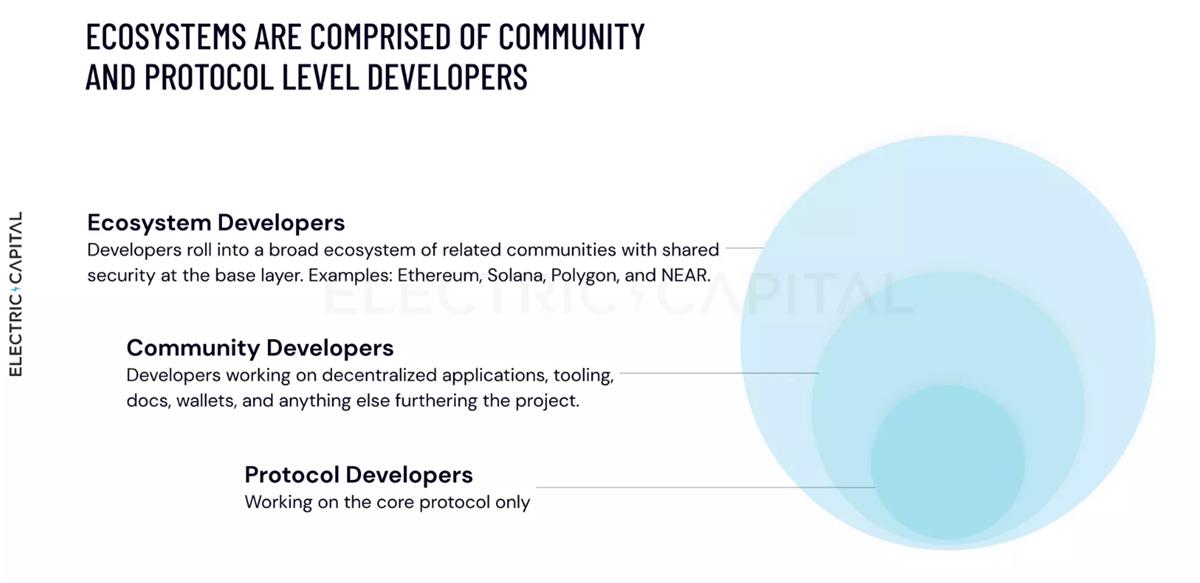
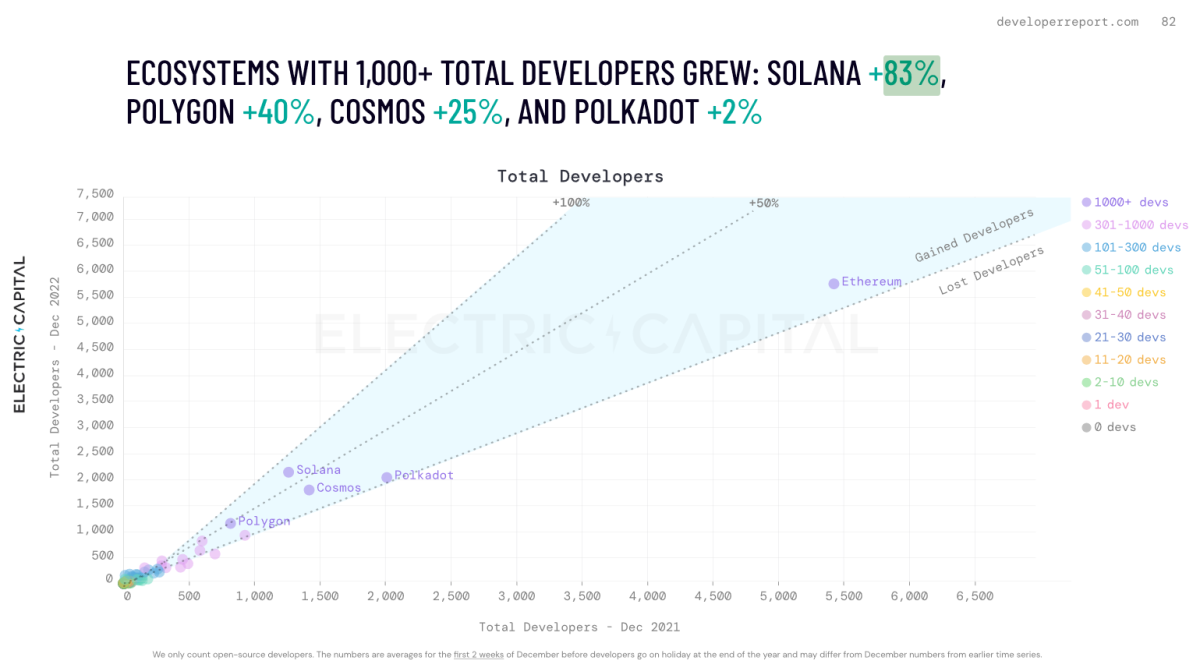
(Image source: 2022 Electric Capital Developer Report)
Among these, the parent ecosystem layer is key to expanding the developer base. Tapping into a larger circle enables broader reach. To illustrate, consider OP, an L2:
-
Protocol Layer: Developers working directly on the OP protocol;
-
Community Layer: Developers building apps within the OP ecosystem, such as DeFi protocols Velodrome and Lyra;
-
Parent Ecosystem Layer: Ethereum developers. The OP ecosystem is inherently parasitic on Ethereum’s ecosystem.
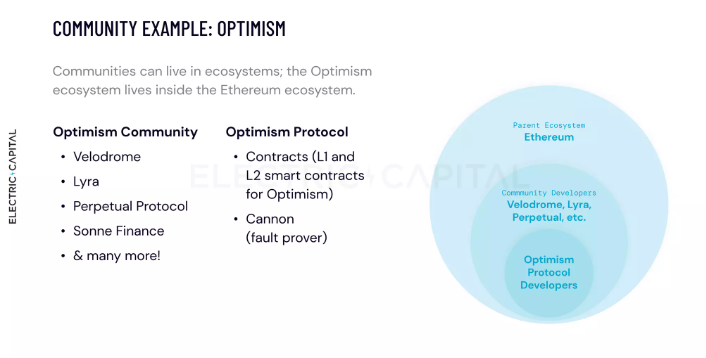
This means OP can naturally “adopt Ethereum as its parent,” allowing existing Ethereum developers to seamlessly build on its L2 with minimal friction.
In today’s crypto landscape, Ethereum remains the undisputed “parent”—unmatched in popularity and influence. Successfully tapping into Ethereum’s developer resources provides immense advantages for any competing chain.
While L2s like OP and ARB benefit from seamless integration due to their close ties with Ethereum L1, non-EVM chains like Solana must adapt their technical architecture to attract developers from Ethereum’s ecosystem.
Hence, we see initiatives like Solana’s Solang and Neon EVM—technical adaptations specifically designed to onboard Ethereum developers.
Note: The author believes “adopting Ethereum as a parent” isn’t a derogatory move but rather a smart survival strategy in a bear market. The crypto space is small; reusing technical capabilities and resources is natural. Attracting external developers to contribute to your ecosystem is not shameful—it’s strategic.
Rather than direct confrontation, unite all who can be united—and survive.
Solana Sees Surge in Developers, But Must Still Break Through Competition
If the above strategy still feels abstract, let’s turn to concrete data.
According to the 2022 Electric Capital Developer Report, Ethereum boasts the largest developer ecosystem, with total developer count 2.8 times larger than the second-place chain.

Moreover, compared to previous years, Ethereum added nearly 15,000 new developers in 2022 alone—the highest growth rate in its history.
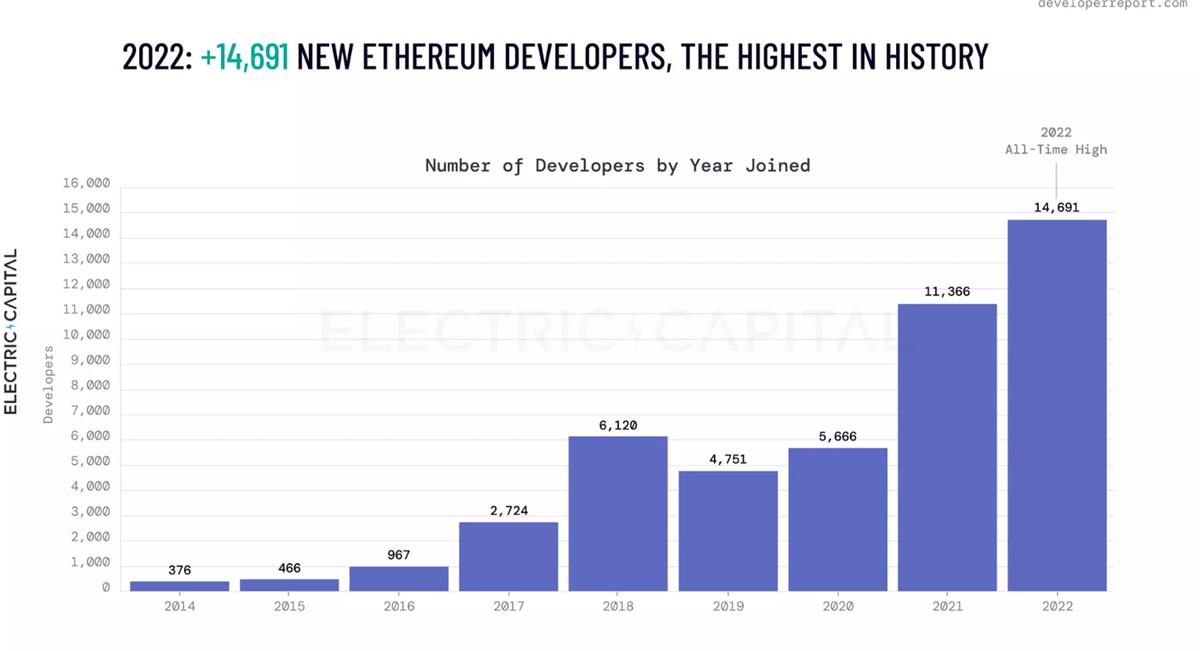
Developers aren’t inherently exclusive—they can work across multiple chains depending on incentives, migration costs, and technical barriers. Thus, Ethereum’s vast developer pool naturally attracts interest from other L1s and L2s.
Looking at newer blockchains, Solana is rapidly catching up: Among chains adding over 1,000 developers last year, Solana showed the strongest momentum, with an 83% year-on-year increase—the highest among all chains. In comparison, Polygon grew by 40%, Cosmos by 25%, and Polkadot by just 2%.
In an interview with TechCrunch, Solana co-founder Raj Gokal stated:
"Developers build where they see technical advantages—Solana offers faster transactions and lower costs than alternatives—but they also build where they see other strengths, such as an active community."
Now, there’s another reason to build on Solana: compatibility with established EVM and Solidity, lowering the barrier to entry.
Yet, competitors remain fierce—take Polygon, for example.
Regarding developer acquisition, Solidity is a high-level language that compiles to EVM bytecode. However, it has a steep learning curve, making secure smart contract development challenging for inexperienced programmers.
Thus, Solana chose Rust and C—languages more familiar to traditional developers—which offers advantages in attracting Web2 talent. But don’t overlook that Polygon also supports widely-used languages like Golang.
Meanwhile, in competing for existing Web3 developers, Polygon’s native support for Solidity and EVM puts significant pressure on Solana. This is likely a major reason behind Solana’s recent embrace of EVM and Solang.
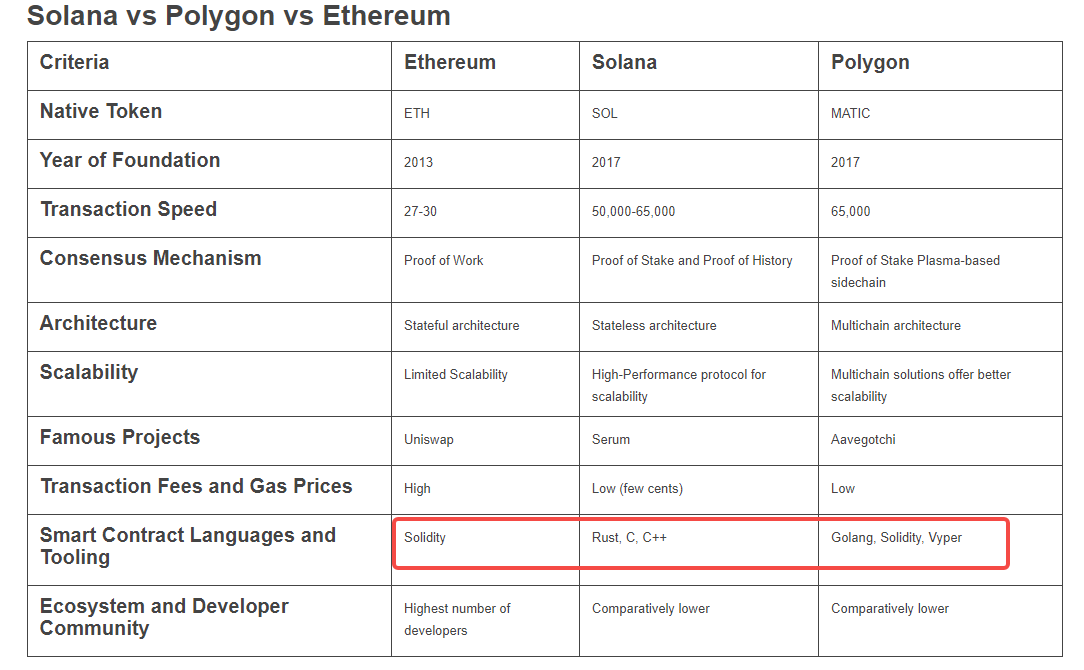
(Image source:Solana Vs. Polygon Vs. Ethereum – The Ultimate Comparison, Blockchain Council)
Additionally, both Solana and Polygon offer extensive developer tooling, such as Solana Studio and Truffle Suite. These tools simplify debugging, deployment, and testing, making it easier for developers to build and launch decentralized applications on their platforms.
Overall, while Rust and C are advantageous for Web2 developers, Solana must adopt Solidity to compete for Web3 developers against EVM-based chains.
To break through in the highly competitive L1 landscape—one dominant leader and several strong contenders—ensuring smooth developer experience is now a necessity.
Conclusion
From a fragmented landscape of diverse blockchains to a growing convergence toward EVM compatibility, we shouldn’t criticize chains for abandoning ideals or avoiding direct competition with Ethereum.
The crypto space is small, with limited supply and demand. Bear markets bring little new growth; revitalizing and reusing existing resources is the smarter approach.
On the supply side, mobilizing existing developers is better than resorting to predatory tactics on the demand side to exploit users.
Unite available forces, and wait for the next cycle to begin.
Join TechFlow official community to stay tuned
Telegram:https://t.me/TechFlowDaily
X (Twitter):https://x.com/TechFlowPost
X (Twitter) EN:https://x.com/BlockFlow_News
 深潮TechFlow