When AI and blockchain meet, how do they benefit from each other?
TechFlow Selected TechFlow Selected
When AI and blockchain meet, how do they benefit from each other?
Blockchain's permissionless and trustless characteristics also play a significant role at the intersection of AI and cryptocurrency.
 Navigating Web3 tides with focused insights
Compilation & Translation: TechFlow

When AI and blockchain meet, how can each technology benefit from the other?
This topic has already sparked extensive discussions. But what unique perspectives might industry insiders who have worked in both AI and blockchain offer?
Illia, co-founder of NEAR, recently delved into this subject on an episode of the Unchained podcast, exploring topics such as the definition of AI, potential intersections with blockchain, relationships with DAOs and regulation—offering a series of thought-provoking insights.
Given the length of the conversation, TechFlow has transcribed and organized the key points to help you save time while quickly grasping valuable insights from these practitioners.
Theme: When AI and Blockchain Meet, How Can Each Technology Benefit?
Program: Unchained Podcast
Date: 2023/07/12
Podcast Link: Link
Host: Laura Shin, Unchained Podcast
Guests: Illia Polosukhin, Co-founder of NEAR; Jason Warner, Founder of Poolside.
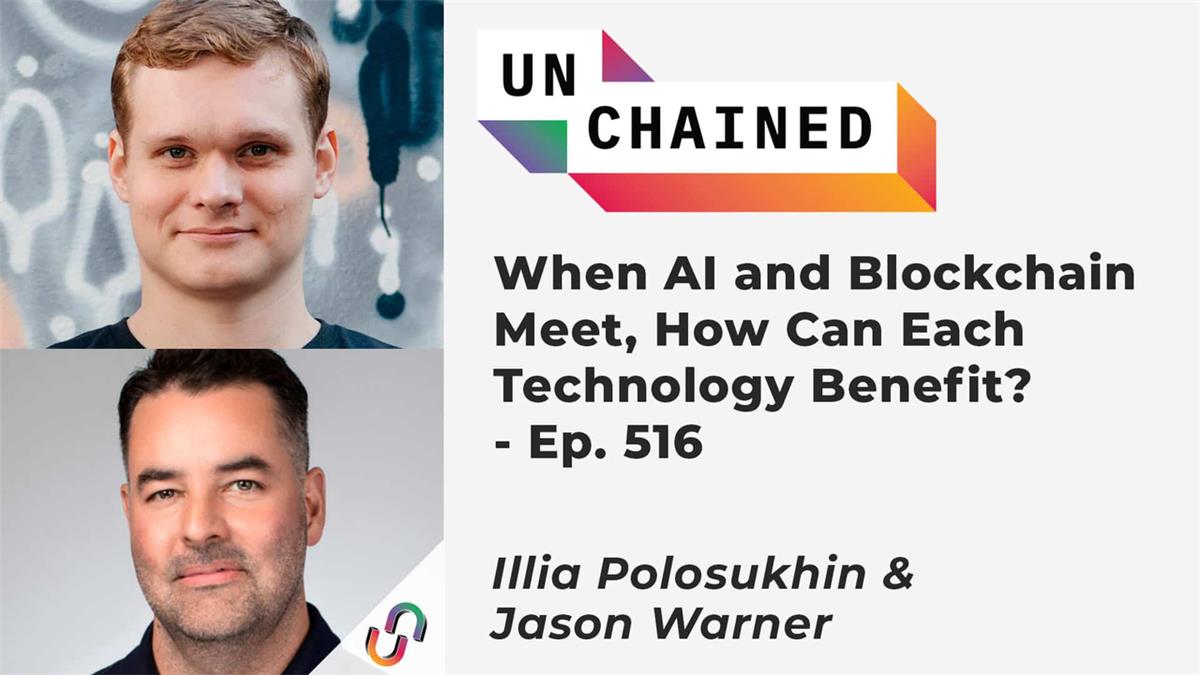
Illia and Jason on Their Backgrounds with AI and Crypto
-
Illia Polosukhin, co-founder of NEAR. He spent six years at Google working on machine learning and image generation. In 2017, he started a startup similar to GitHub Copilot called NEAR AI. Due to lack of funding, they attempted to crowdsource data creation globally using students to build better language-to-code datasets.
-
The challenge was paying these students across borders, leading them to explore blockchain as a global payment solution. By 2018, Illia realized no existing solutions addressed usability and scalability needs—this insight laid the foundation for the NEAR protocol. He has remained deeply engaged with AI, advising various AI projects.
-
Jason Warner, founder of Poolside. He focuses on building platforms to grow businesses and previously served as CTO of GitHub, after roles at Heroku and Canonical (the company behind Ubuntu Linux).
-
At GitHub, his small team incubated GitHub Copilot, a highly popular AI programming assistant. His current venture, Poolside, aims to be an OpenAI for software markets. He first met Illia around 2019 or 2020 and has since been actively discussing intersections between blockchain and AI.
Defining and Understanding AI Development
-
Illia Polosukhin believes AI is already tangible. From credit scoring to content suggestions in browsers or app recommendations when swiping your screen—nearly every digital action today involves machine learning. Thus, AI essentially refers to technologies that enable computers to achieve human-like or even superhuman capabilities.
-
Stages of AI development: Illia notes that AI, like crypto, has gone through multiple cycles and phases. The current wave is primarily driven by breakthroughs in large language models, particularly GPT-3 and GPT-4 pioneered by OpenAI.
-
Intersection of AI and crypto: Both Illia and Jason are excited about the convergence of AI and blockchain. For instance, blockchain can act as a powerful market enabler—its incentive mechanisms and transparency can facilitate access to resources like data, computing power, and model architectures. Additionally, blockchain’s permissionless and trustless nature plays a crucial role in ensuring reliable input/output sources and data provenance within AI systems.
-
Resource management in AI: Jason highlights that GPU access remains a critical bottleneck in AI, given GPUs are among the most valuable assets in the field.
Intersection Points Between AI and Crypto
-
Illia suggests blockchain can serve as an excellent market facilitator, enhancing liquidity for resources used in machine learning—such as data, computation, and model designs. For example, acquiring a GPU cluster typically requires committing millions of dollars and negotiating with cloud providers—an inefficient process. Blockchain could streamline this via decentralized, crowdsourced resource sharing.
-
Jason emphasizes two core principles of blockchain: permissionlessness and trustlessness. These features can play vital roles in AI applications—especially in verifying data origin, managing information flow, and ensuring integrity of inputs and outputs.
-
Illia discusses how AI—particularly language models—can lower barriers to accessing crypto and blockchain applications by enabling more natural interactions with complex systems.
-
Jason adds that when people think of trading bots, they often assume machine learning is involved. However, large language models will transform this space—for example, users could leverage GPT-4 chatbots to write trading algorithms and deploy them directly onto platforms like TradingView.
-
Both Illia and Jason discuss how AI aids software development, especially in writing smart contracts. They note AI excels at generating functional code, performing checks, and auditing—thanks to its broad knowledge of codebases and documentation, allowing it to catch subtle issues.
AI, Crypto, and Misinformation Generation
-
Illia argues misinformation is not inherently an AI problem—it's a human one. AI is simply a tool capable of efficiently producing vast amounts of content, including realistic-looking but factually incorrect material. Moreover, humans already generate massive volumes of misinformation. Web3 offers tools to verify content authenticity, link it to creators or authorized parties, and establish reputation systems around content origins.
-
Web3 can provide verification tools—tying content to its source and establishing credibility through cryptographic signatures and decentralized identities.
-
Illia gives an example: if a podcast is entirely AI-generated, how would listeners know? Web3 can solve this—after recording, all participants could sign the hash of the audio file, cryptographically confirming their involvement.
-
Jason adds that blockchain can be highly effective for identity verification. He stresses focusing on foundational technical solutions rather than speculative applications.
-
Both agree that combining AI and blockchain opens new possibilities—such as using AI for audits to prevent DeFi exploits.
AI, Regulation, Security, and DAOs
-
Illia believes integrating AI and blockchain can enhance DeFi security. He mentions using AI to audit smart contracts and prevent attacks. He also proposes a project concept—a platform as efficient and user-friendly as centralized exchanges, yet fully on-chain, where reserves can be proven and liabilities tracked transparently, giving users full visibility into fund flows and boosting security.
-
Illia comments on the concentration of power at organizations like OpenAI and Midjourney. These entities currently wield significant influence due to control over vast datasets and advanced AI models. This centralization risks creating imbalances, as they alone decide how models are used and applied across domains.
-
To address this, Illia advocates for greater transparency and openness so the public can understand how models work and how they’re deployed.
-
Illia sees AI playing a coordination role in DAOs. Combining AI with DAOs could alleviate fears around opaque, closed-source AI systems by giving communities a sense of ownership and control. Such integration may help prevent unintended negative impacts of AI on humanity. He anticipates seeing early results of AI-coordinated DAOs within the year, along with systems guiding real-world activities—all governed by DAO members to ensure AI operates within defined boundaries.
-
Jason believes combining DAOs and AI can help tackle societal challenges, such as preventing phishing attacks. He emphasizes the need for deeper understanding of these technologies to effectively combat malicious use cases.
-
Jason underscores the impact of regulatory environments on AI and blockchain. He criticizes many current regulations as superficial, failing to grasp the true potential and implications of these technologies. Instead, he promotes self-regulation using blockchain and AI—e.g., registering datasets and model weights on-chain, or using AI to interpret smart contract code. He insists regulators should adopt these tools, as they were designed to protect consumers, markets, and society.
-
Jason also values ongoing regulatory dialogues—the open discussions about how AI and related technologies should be governed. These conversations aim to shape rules and policies that ensure safe usage while supporting innovation and progress.
Join TechFlow official community to stay tuned
Telegram:https://t.me/TechFlowDaily
X (Twitter):https://x.com/TechFlowPost
X (Twitter) EN:https://x.com/BlockFlow_News
 深潮TechFlow