








Apple Vision Pro Aftermath: Reimagining the Future of XR, RNDR, and Spatial Computing
TechFlow Selected TechFlow Selected
Apple Vision Pro Aftermath: Reimagining the Future of XR, RNDR, and Spatial Computing
Goods in virtual worlds are easier to securitize than physical goods.
 Navigating Web3 tides with focused insights
By Scarlett Wu
On June 6, during the early hours of WWDC (Apple Worldwide Developers Conference), which also happened to be my fifth day of testing positive for a second Covid infection, I sipped herbal tea while chatting with a friend online: An hour had passed—could it be that this year’s “One More Thing” was going to be delayed again?
Then, at two in the morning, when Cook finally appeared and dramatically announced “One More Thing,” my friend and I on this end burst into cheers:
Macintosh introduced personal computing, iPhone introduced portable computing, and Apple Vision Pro is going to introduce Spacial Computing.
The Macintosh launched the era of personal computers, the iPhone ushered in the mobile internet era, and now Apple Vision Pro will pioneer the era of spatial computing.
As an enthusiast of cutting-edge technology, I cheered for my future new toy. But as a Web3 investor focused on gaming, the metaverse, and AI, this moment felt like a shiver down my spine—a landmark signaling a transformative new age.
You might wonder: “What does an upgrade in MR hardware have to do with Web3?” Let’s start by revisiting Mint Ventures’ thesis on the metaverse sector.
Our Thesis on the Metaverse, or Rather, the Web3 World
Asset premiums in the blockchain world stem from:
-
A trustworthy transactional foundation that reduces transaction costs: Ownership rights for physical goods are enforced through state-backed coercive mechanisms, whereas virtual asset ownership relies on “trust in data immutability (or non-modifiability) under consensus,” and market recognition of such ownership. Although anyone can right-click and copy an image, BAYC still commands prices comparable to an apartment in a third-tier city—not because the copied image differs significantly from the NFT metadata, but because the market consensus on “non-replicability” enables securitization.
-
Highly securitized assets generate liquidity premiums.
-
Decentralized consensus mechanisms enable permissionless transactions, creating a "permissionless premium."
Virtual goods are inherently easier to securitize than physical ones:
-
The history of digital content monetization shows that users' willingness to pay for virtual items didn’t emerge overnight—but there's no denying that paying for digital assets has already permeated mainstream life. In April 2003, the launch of iTunes Store revealed that beyond downloading pirated music, consumers could support creators by purchasing legitimate digital tracks. In 2008, the App Store debuted, popularizing one-time app purchases globally, followed by in-app purchases that further boosted Apple’s digital revenue streams.
-
This evolution subtly traces the transformation of gaming monetization models. Early arcade games charged per play (“pay-for-experience,” akin to movies). Console-era games sold via cartridges or discs (similar to albums or films). Later, digital-only game sales emerged alongside Steam’s digital marketplace and in-game purchases that turned some titles into revenue legends. The trajectory of gaming payment models mirrors declining distribution costs—from arcades to consoles, then to personal computers and smartphones accessible via digital platforms. As a result, games themselves trend toward lower technical distribution costs and broader reach; meanwhile, game assets have evolved from mere gameplay elements into purchasable commodities. (Though recently, due to low internet growth, intense competition, and attention monopolies at traffic gateways, the cost of distributing digital assets has paradoxically increased.)
So what comes next? Tradable virtual world assets remain a core theme we strongly believe in.
As virtual experiences improve, people will spend more time immersed in virtual worlds, shifting their attention. This shift in attention will gradually transfer valuation premiums from physical to virtual assets. The release of Apple Vision Pro will fundamentally transform how humans interact with virtual environments, dramatically increasing immersion duration and quality.

Source: @FEhrsam

Note: This is our adapted definition of pricing strategy. In premium pricing, brands set prices far above production costs, filling the gap between price and cost with brand narrative and experiential value. Other factors such as cost-based pricing, competitive pricing, and supply-demand dynamics also influence product pricing—we focus here solely on premium pricing.
The History and Current State of the MR Industry
Modern exploration of XR (Extended Reality, including VR and AR) began over a decade ago:
-
In 2010, Magic Leap was founded. In 2015, its viral ad showing a whale leaping inside a stadium stunned the tech world. However, when the product launched in 2018, poor user experience drew widespread criticism. By 2021, despite raising $500 million at a $2.5 billion post-money valuation—30% below its total funding of $3.5 billion—the company saw its actual valuation plummet below $1 billion after Saudi Arabia’s sovereign wealth fund acquired majority control via a $450 million equity and debt deal in January 2022.
-
Microsoft began developing HoloLens in 2010, releasing its first AR device in 2016 and a second version in 2019. Priced at $3,000, real-world performance disappointed.
-
Google Glass prototype unveiled in 2011, consumer version launched in 2013—initially hailed with great expectations, but flopped due to privacy concerns around cameras and subpar usability, selling only tens of thousands units. Enterprise edition released in 2019; a new test version trialed in 2022 received lukewarm responses. In 2014, Google introduced Cardboard VR platform and SDK. In 2016, Daydream VR launched, becoming today’s most widely adopted Android-compatible VR platform.
-
Sony PlayStation started developing its VR platform in 2011. PSVR debuted in 2016—initially well-received thanks to PlayStation loyalty—but failed to sustain momentum.
-
Oculus founded in 2012, acquired by Facebook in 2014. Oculus Rift launched in 2016, followed by four additional models emphasizing portability and affordability, achieving relatively high market penetration.
-
Snap acquired AR-focused startup Vergence Labs (founded 2011) in 2014, forming the basis for Snap Spectacles. First launched in 2016, three updated versions followed. Like many predecessors, Snap Spectacles initially attracted massive interest—with lines outside stores—but quickly faded. In 2022, Snap shut down its hardware division, refocusing on smartphone-based AR.
-
Around 2017, Amazon began developing Alexa-powered AR glasses. First Echo Frames released in 2019, second version in 2021.
Looking back at XR’s history, it's clear the industry’s expansion and cultivation have proven far harder than anyone anticipated, whether for well-funded tech giants with top scientists or brilliant startups backed by hundreds of millions. Since the 2016 launch of consumer-grade VR headset Oculus Rift, all VR brands—including Samsung Gear, ByteDance’s Pico, Valve Index, Sony PlayStation VR, HTC Vive—have shipped fewer than 45 million units cumulatively. Given that current VR usage centers largely on gaming, and no widely adopted AR devices existed before Vision Pro, SteamVR data suggests monthly active VR users number only in the low millions.
Why hasn't XR achieved mass adoption? Failed ventures and investor retrospectives offer clues:
1. Hardware Isn’t Ready
Visually, VR headsets suffer from wide fields of view and proximity to eyes. Even top-tier devices struggle with visible pixels. True immersion requires single-eye 4K resolution (8K combined). Refresh rate is equally critical—most agree XR needs 120Hz, even 240Hz, to prevent motion sickness and mimic real-world fluidity. Yet refresh rate trades off against rendering fidelity under fixed compute power: Fortnite runs at 4K clarity on 60Hz, but only 1440p on 120Hz.
Compared to vision, audio feels less urgent, so most VR devices neglect acoustic detail. Imagine voices always coming from overhead regardless of speaker position—that breaks immersion. Or consider a digital avatar fixed in your living room—if volume doesn’t change as you walk from bedroom to living room, spatial realism suffers.
Interaction-wise, traditional VR relies on handheld controllers. Some systems like HTC Vive require room-mounted sensors to track movement. While Quest Pro offers eye tracking, it suffers from latency and moderate sensitivity, mainly used for foveated rendering—not primary interaction. Oculus uses 4–12 external cameras to map surroundings, enabling basic hand gesture recognition (e.g., using left hand to pick up a virtual phone, right index finger to tap and open an app).
Weight-wise, ideal comfort lies between 400–700g (still enormous compared to ~20g regular glasses). Achieving high resolution, fast refresh rates, advanced interaction, matching computational power (chip performance, size, count), and multi-hour battery life makes weight a painful compromise.

In sum, for XR to become the next-generation smartphone and mainstream hardware, it must deliver over-8K resolution, >120Hz refresh to prevent dizziness, feature a dozen cameras, offer 4+ hours of battery (removable during lunch/dinner breaks), minimal heat generation, weigh under 500g, and cost $500–1,000. Today’s technological capabilities, though improved since the 2015–2019 XR boom, still fall short.

Even so, trying existing MR (VR+AR) devices reveals experiences vastly more immersive than 2D screens—though substantial improvements remain. Take Oculus Quest 2: most available VR videos are 1440p, not reaching its 4K limit, running well below 90Hz. Existing VR games often feature crude modeling and limited variety.

Source: VRChat
2. Killer App Still Missing
The absence of a killer app stems partly from hardware limitations—even with Meta minimizing profits, a few-hundred-dollar MR headset with a sparse ecosystem struggles to compete against established, rich-content, large-user-base gaming consoles. With ~25–30 million VR devices in use versus ~350 million AAA-capable devices (PS5, Xbox, Switch, PC), most developers skip VR support; those who do usually add it as an afterthought rather than designing exclusively for VR. Moreover, unresolved issues like visible pixels, motion sickness, poor battery, excessive weight mean VR experiences don’t surpass traditional AAA platforms. And attempts to highlight “immersion” fall flat when low device adoption means few developers optimize specifically for VR interaction design.
Thus, choosing VR gaming isn’t just “trying a new game”—it often means “giving up social experiences with most friends.” Such scenarios prioritize gameplay and immersion over social connectivity. You might cite VR Chat, but digging deeper shows ~90% of users access it via desktop, experimenting with avatars socially without VR gear. Hence, VR’s most popular title being rhythm game *Beat Saber* makes perfect sense.
We believe a killer app requires these elements:
-
Dramatic improvements in hardware performance and holistic details. As noted under “hardware unready,” this isn’t simply “better screen, better chip, better speakers,” but systemic integration across chips, peripherals, interaction design, and OS—precisely Apple’s strength. Compared to iPod and iPhone eras, Apple now leverages decades of cross-device OS synergy.
-
On the brink of explosive user device adoption. As analyzed earlier, the chicken-or-egg dilemma prevents killer apps emerging when XR MAUs hover in the millions. At its peak, *The Legend of Zelda: Breath of the Wild* sold more copies than Switch units in the U.S.—a textbook case of how new hardware achieves mass adoption. Users buying XR gear for niche experiences grow disillusioned as content disappoints, watching their headsets gather dust. But players drawn by *Zelda* often stay, discovering other Switch ecosystem titles.

Source: The Verge
-
And consistent operating habits plus stable backward compatibility across device updates. The former is intuitive—controller vs. controller-free creates distinct human-machine interaction patterns, a key differentiator between Apple Vision Pro and other VR headsets. The latter is evident in Oculus’ iteration history—major intra-generational hardware upgrades can actually hinder user experience. Meta Quest Pro (2022) vastly outperforms Oculus Quest 2 (2020): resolution jumps from 4K to 5.25K, color contrast improves 75%, refresh rate increases from 90Hz to 120Hz. Eight additional external cameras turn monochrome environment mapping into full-color, greatly enhancing hand tracking, plus facial and eye tracking. It introduces foveated rendering, focusing processing power where eyes look while reducing peripheral fidelity, saving computation and power. Despite these advances, Quest Pro users likely number under 5% of Quest 2’s base. This forces developers to build for both devices—limiting use of Quest Pro’s strengths and undermining its appeal. History rhymes: console makers adopt 6–8 year generational cycles precisely to avoid this fragmentation. A Switch owner won’t worry about OLED incompatibility, but a Wii user can’t play Switch games. For console-focused software studios producing titles for a smaller, less dependent user base (350M vs. billions), stable hardware across multiple dev cycles prevents excessive user splitting—or they must, like current VR devs, maintain backward compatibility to preserve audience size.
Can Vision Pro solve these issues? What changes might it bring?
The Turning Point Brought by Vision Pro
At the June 7 launch event, Apple unveiled Vision Pro. Mapping it against our framework analyzing “MR’s hardware and software challenges,” we see:
Hardware:
-
Visuals: Vision Pro features dual 4K displays totaling ~6K pixels—second only to flagship MR specs. Supports up to 96Hz refresh and HDR video playback. Tech reviewers report exceptional clarity and virtually zero motion sickness.
-
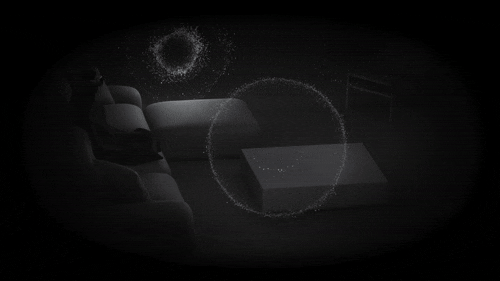
Audio: Since 2020, Apple has used spatial audio in AirPods to simulate directional sound. Vision Pro aims higher, employing “audio ray tracing” combined with LiDAR scanning to analyze room acoustics (materials, etc.), crafting spatial audio effects tailored to the environment with accurate directionality and depth.
-
Interaction: Controller-free hand gestures and eye tracking deliver near-instantaneous responsiveness (per tech media tests, almost zero perceptible lag)—thanks not only to sensor precision and processing speed but predictive algorithms anticipating gaze paths (discussed further below).
-
Battery Life: 2-hour runtime, roughly matching Meta Quest Pro (unimpressive, a common critique). However, Vision Pro uses an external battery pack with a 5,000mAh internal cell, suggesting potential for swappable power solutions.
-
Weight: ~1 pound (~454g), similar to Pico and Oculus Quest 2, lighter than Meta Quest Pro—respectable among MR devices (excluding tethered power pack weight). Still heavy and hot compared to ~80g pure AR glasses (e.g., Nreal, Rokid). However, most AR glasses rely on companion devices as secondary screens, whereas standalone MR with genuine immersion offers a fundamentally different experience.
-
Additionally, Vision Pro runs Apple’s top-tier M2 chip for system operations, plus a dedicated R1 chip optimized for MR-specific tasks: display rendering, environmental monitoring, eye/hand tracking.
Software: Beyond leveraging millions of existing Apple developers, Apple has long prepared via ARKit:
Back in 2017, Apple launched ARKit: a development framework compatible with iOS devices, enabling AR apps using native hardware/software. ARKit maps environments via device cameras, detects surfaces/floors/device positions via CoreMotion, allowing digital objects to interact naturally with the real world—e.g., Pokémon hiding underground or perched on trees in *Pokémon Go*, instead of floating unnaturally on-screen. No manual calibration needed—true seamless AR.

-
2017: ARKit launched, capable of automatic position/topology detection and facial expression modeling/capture.
-
2018: ARKit 2 brought enhanced CoreMotion, multiplayer AR games, 2D image tracking, and recognition of known 3D objects (sculptures, toys, furniture).
-
2019: ARKit 3 added People Occlusion (rendering AR content behind/in front of people), tracking up to three faces. Enabled collaborative sessions for shared AR experiences. Motion capture tracked body joints/skeletons, enabling human-centric AR beyond static objects.
-
2020: ARKit 4 leveraged LiDAR sensors in 2020 iPhones/iPads for better tracking/object detection. Introduced Location Anchors, placing AR experiences at specific GPS coordinates using Apple Maps data.
-
2021: ARKit 5 enabled custom shaders, procedural mesh generation, object capture, character control. Developers could scan an object and instantly convert it to USDZ format, importable into Xcode as 3D models for ARKit scenes/apps—greatly accelerating 3D model creation.
-
2022: ARKit 6 introduced “MotionCapture,” tracking human figures across video frames, providing developers with estimated head/limb positions (“skeleton”) to overlay or hide AR content realistically within scenes.
Reviewing ARKit’s seven-year evolution reveals Apple’s AR expertise wasn’t built overnight—it quietly integrated AR into widely adopted devices. By Vision Pro’s launch, Apple already amassed significant content and developer momentum. Furthermore, ARKit’s cross-compatibility means apps aren’t limited to Vision Pro users—they can also serve iPhone/iPad audiences. Developers aren’t constrained by a 3-million MAU ceiling but can test and engage with hundreds of millions of iOS users.
Moreover, Vision Pro’s 3D video recording partially addresses MR’s content scarcity: Most current VR videos are 1440p—low-res and pixelated on curved MR displays. Vision Pro captures high-resolution spatial video with strong spatial audio, potentially revolutionizing MR content consumption.
Despite these impressive specs, Apple’s MR ambitions go further. On launch day, a self-proclaimed former Apple neuroscientist developer @sterlingcrispin tweeted:
Generally as a whole, a lot of the work I did involved detecting the mental state of users based on data from their body and brain when they were in immersive experiences.
Overall, much of my work focused on detecting users’ mental states using bodily and cerebral data collected during immersive experiences.
So, a user is in a mixed reality or virtual reality experience, and AI models are trying to predict if you are feeling curious, mind wandering, scared, paying attention, remembering a past experience, or some other cognitive state. And these may be inferred through measurements like eye tracking, electrical activity in the brain, heart beats and rhythms, muscle activity, blood density in the brain, blood pressure, skin conductance etc.
When users enter mixed or virtual reality, AI models attempt to determine whether they feel curious, distracted, fearful, attentive, recalling memories, or experiencing other cognitive states—using inputs like eye tracking, brainwave activity, heartbeat patterns, muscle movements, cerebral blood flow, blood pressure, and skin conductivity.
There were a lot of tricks involved to make specific predictions possible, which the handful of patents I’m named on go into detail about. One of the coolest results involved predicting a user was going to click on something before they actually did. That was a ton of work and something I’m proud of. Your pupil reacts before you click in part because you expect something will happen after you click. So you can create biofeedback with a user’s brain by monitoring their eye behavior, and redesigning the UI in real time to create more of this anticipatory pupil response. It’s a crude brain computer interface via the eyes, but very cool. And I’d take that over invasive brain surgery any day.
Achieving precise predictions required numerous techniques detailed in several patents I co-authored. One standout achievement predicted user clicks before they occurred—a major accomplishment I’m proud of. Your pupils react pre-click because anticipation triggers physiological responses. By monitoring eye behavior and dynamically adjusting UI elements, we created real-time neural feedback loops amplifying this anticipatory pupillary response. It’s a rudimentary brain-computer interface via eyes—but incredibly cool. I’d choose this over invasive brain surgery any day.
Other tricks to infer cognitive state involved quickly flashing visuals or sounds to a user in ways they may not perceive, and then measuring their reaction to it.
Other methods included imperceptibly flashing visual or auditory stimuli and measuring subconscious reactions.
Another patent goes into details about using machine learning and signals from the body and brain to predict how focused, or relaxed you are, or how well you are learning. And then updating virtual environments to enhance those states. So, imagine an adaptive immersive environment that helps you learn, or work, or relax by changing what you’re seeing and hearing in the background.
Another patent details using machine learning with bodily and cerebral signals to assess focus, relaxation, or learning efficacy—and dynamically modifying virtual environments to reinforce these states. Imagine an adaptive immersive space that aids learning, productivity, or relaxation by altering background visuals and sounds.
These neuroscience-adjacent technologies may mark a new mode of synchronization between machines and human intention.
Of course, Vision Pro isn’t flawless. Its $3,499 price tag is more than double Meta Quest Pro’s and over seven times Oculus Quest 2’s. Runway CEO Siqi Chen commented:
it might be useful to remember that in inflation adjusted dollars, the apple vision pro is priced at less than half the original 1984 macintosh at launch (over $7K in today’s dollars)
It’s worth noting that, adjusted for inflation, Apple Vision Pro costs less than half the original 1984 Macintosh (equivalent to over $7,000 today).
With this comparison, Vision Pro’s pricing seems less outrageous… yet Macintosh sold only 372,000 units in its first generation. It’s hard to imagine Apple accepting similarly awkward sales figures for its heavily invested MR project. Realistically, little may change soon—AR doesn’t necessarily require glasses, Vision Pro won’t achieve mass adoption immediately, and may remain a tool for developers, creators, and affluent tech enthusiasts.

Source: Google Trend
Still, Apple’s MR device is already stirring the market—reigniting public interest in MR, signaling that MR has matured beyond PowerPoint demos. Consumers now recognize an alternative to tablets, TVs, and phones: a wearable immersive display. Developers see MR as a genuine next-gen hardware trend. VCs recognize its immense investment potential.

Web3 and Related Ecosystems
1. 3D Rendering + AI Concept Play: RNDR
RNDR Overview
Over the past six months, RNDR has repeatedly led market rallies as a meme combining metaverse, AI, and MR narratives.

RNDR powers Render Network, a decentralized protocol enabling distributed rendering. Backed by OTOY Inc. (founded 2009), whose GPU-optimized rendering software OctaneRender serves creatives. Local rendering demands heavy computing resources, creating demand for cloud rendering. But renting AWS/Azure servers can be expensive—hence Render Network connects creators with idle-GPU owners, enabling affordable, fast rendering while letting node operators earn passive income.
Within Render Network, participants have two roles:
-
Creators: Post jobs, pay via fiat or RNDR tokens. (Octane X, used to submit tasks, works on Mac/iPad; 0.5–5% fees cover network costs.)
-
Node Providers (idle GPU owners): Apply to host nodes; priority assigned based on reputation from prior completed jobs. After rendering, creators review/download files. Upon download, locked funds in smart contracts are released to node wallets.
RNDR’s tokenomics were revised in February—partially fueling its price surge (though as of publication, Render Network has not yet implemented the new model nor announced rollout timing):
Previously, $RNDR and Credit held equal purchasing power, with 1 credit = 1 euro. When $RNDR traded below €1, buying tokens was cheaper than fiat. But once $RNDR surpassed €1, users preferred fiat payments, risking $RNDR utility erosion (despite potential buybacks from protocol revenue, external buyers lacked incentives).
The new model adopts Helium’s “BME” (Burn-Mint-Emission) mechanism: Whether paid in fiat or $RNDR, 95% of the fiat-equivalent value is burned in $RNDR; 5% goes to the foundation as engine revenue. Node providers no longer receive direct payments but earn newly minted token rewards based on task completion metrics and customer satisfaction.
Notably, new $RNDR is minted each epoch (specific duration unspecified), with strictly capped issuance decreasing over time—regardless of burn volume (see official whitepaper release schedule). This shifts stakeholder incentives:
-
Creators / Service Users: Each epoch, a portion of consumed RNDR is refunded, with decreasing rates over time.
-
Node Operators: Rewarded based on workload and real-time uptime.
-
Liquidity Providers: Also rewarded to ensure sufficient $RNDR supply for burning.
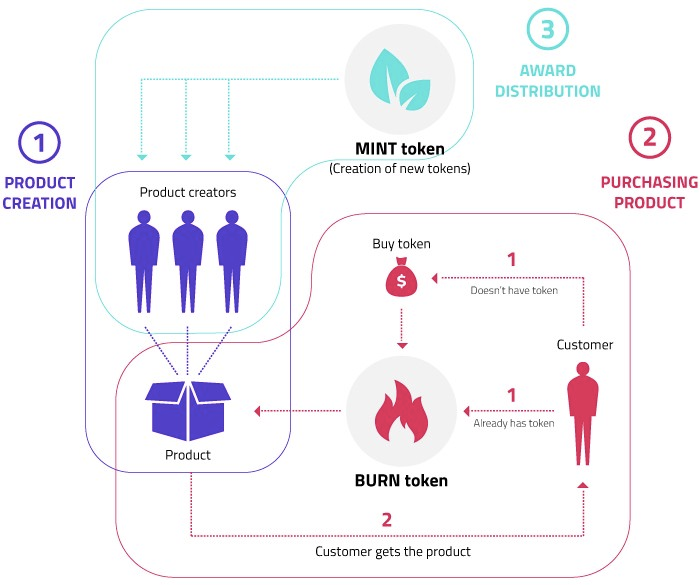
Compared to prior periodic buybacks, the new model benefits miners more during low-demand periods. When job demand exceeds total reward issuance, miners earn less (burn > mint), pushing $RNDR into deflation.
Despite RNDR’s stellar price performance, Render Network’s business hasn’t mirrored this growth: Node count remained flat over two years, monthly $RNDR distribution stable, though job volume increased—indicating creators shifted from large single jobs to multiple small ones.
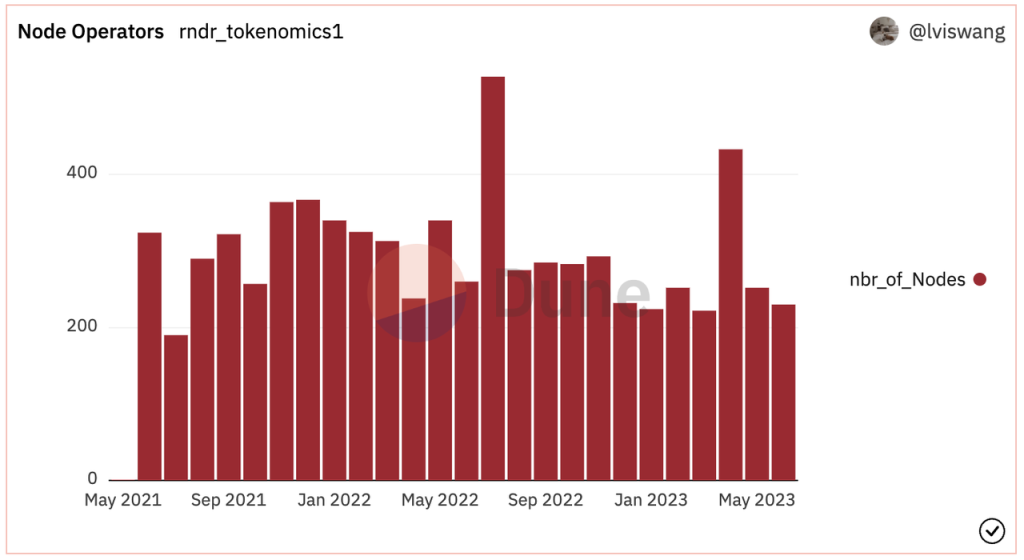


While failing to match fivefold price gains, Render Network’s GMV did grow substantially—up 70% YoY in 2022. Based on Dune dashboard data tracking total $RNDR distributed to nodes, 2023 H1 GMV was ~$1.19M, nearly flat vs. 2022 H1. This GMV appears inadequate relative to its $700M market cap.

Potential Impact of Vision Pro on RNDR
In a Medium post on June 10, Render Network claimed Octane’s M1/M2 rendering capability is unique—since Vision Pro also uses M2 chips, rendering within it would mirror desktop performance.
But why run rendering jobs on a 2-hour-battery device designed primarily for entertainment, not productivity? Only if Vision Pro drops in price, extends battery life, becomes lighter, and achieves mass adoption might Octane find its moment...
What’s certain is that migrating digital assets from flat screens to MR devices will drive infrastructure demand. Unity, which announced collaboration with Apple to adapt its engine for Vision Pro, saw its stock rise 17% that day—reflecting market optimism. With Disney partnering with Apple, traditional film/TV 3D conversion may see similar demand spikes. Render Network, experienced in cinematic rendering, launched AI-enhanced 3D NeRFs in February—using AI and 3D rendering to create real-time immersive 3D assets viewable on MR devices. Supported by Apple ARKit, anyone with a high-end iPhone can scan objects into 3D models; NeRF technology enhances these via AI, transforming crude scans into photorealistic, light-refracting 3D assets. This spatial rendering could become vital for MR content creation, offering latent demand for Render Network.

But will RNDR fulfill this demand? With 2022 GMV of $2M, it’s negligible compared to Hollywood budgets. Thus, RNDR may continue riding the “metaverse/XR/AI” meme wave to new price highs during sector booms, but generating revenue matching its valuation remains challenging.
2. Metaverse – Otherside, Sandbox, Decentraland, HighStreet, etc.
While I see limited fundamental changes—I acknowledge discussions around MR inevitably touch major metaverse projects: ApeCoin’s Otherside, Animoca’s The Sandbox, blockchain’s oldest metaverse Decentraland, and Highstreet aiming to be the Shopify of VR worlds. (For comprehensive analysis refer to https://research.mintventures.fund/2022/10/14/zh-apecoin-values-revisited-with-regulations-overhang-and-staking-rollout/, section 4: Business Analysis – Industry Analysis & Potential.)
Yet as discussed under “Killer App Still Missing,” most existing VR-supporting developers don’t design exclusively for VR (even leaders in a sub-million MAU niche lack dominant leverage). Current products rarely tailor UX or interactions to MR. Unreleased projects stand on nearly equal footing with all other companies recognizing Vision Pro’s potential: Once Unity better integrates with Vision Pro, MR game development barriers should drop, making past narrow-market expertise hard to transfer to mass-adoption products.
That said, early movers in VR may enjoy slight advantages in development progress, technical know-how, and talent accumulation.
One More Thing
If you haven’t seen the video below, this will be your most visceral glimpse into the MR world: convenient, immersive, yet chaotic and disordered. Virtual and real blend seamlessly. People spoiled by virtual realities treat losing their digital identity as apocalyptic. Details seem sci-fi and incomprehensible today—but this likely represents our imminent future.
Video link: https://youtu.be/YJg02ivYzSs
It reminds me of another video: In 2011—twelve years ago—Microsoft launched Windows Phone 7 (hard to recall for Gen Zers unfamiliar with Microsoft’s mobile ambitions) and aired a satirical ad titled “Really?”: People constantly clutch phones—riding bikes staring at screens, sunbathing at beaches glued to devices, showering while gripping phones, falling down stairs at parties fixated on screens, even dropping phones into urinals… Microsoft intended to show “our phone will rescue you from smartphone addiction”—a disastrous flop. The ad’s name “Really?” could’ve been renamed “Reality.” Smartphones’ “presence” and intuitive interfaces proved more addictive than unnatural “mobile Windows PCs,” just as blended realities prove more compelling than pure physical existence.
Video link: https://youtu.be/4mhrKWVQ0sk
How do we navigate this future? Here are directions we’re exploring:
-
Creation of Immersive Experiences and Narratives: Starting with video—after Vision Pro, filming “3D-depth” movies has never been easier, transforming digital content consumption from “distant viewing” to “first-person immersion.” Beyond video, “interactive 3D spaces with native content” represent another promising frontier—not templated generic scenes or extractable game zones, but spaces with interactivity, original content, and spatially intuitive experiences. Examples include a charismatic piano coach highlighting correct keys and gently encouraging you when frustrated; a mischievous sprite hiding a level-key in your room corner; or an empathetic AI girlfriend joining you on walks. Blockchain can underpin this creator economy—enabling trustless automation, digital asset ownership, frictionless transactions. Creators can directly engage fans without intermediaries—no need to register companies or set up Stripe, avoiding 10% (Substack) to 70% (Roblox) platform cuts, or fearing platform collapse wiping out their work. A wallet, composable content platforms, and decentralized storage suffice. Similar upgrades will transform gaming and social spaces—even blurring boundaries between games, films, and social realms: When experiences shift from distant floating screens to immediate, dimensional, spatially-audio interactive environments, users cease being passive viewers and become active participants whose actions affect virtual worlds (e.g., butterflies landing on your fingertip in a jungle).
-
Infra and Communities for 3D Digital Assets: Vision Pro’s 3D capture drastically lowers 3D video creation barriers, spawning new content production and consumption markets. Upstream/downstream infra like asset trading and editing may remain dominated by incumbents or disrupted by startups like in AIGC.
-
Hardware/Software Upgrades Enhancing Immersion: Whether Apple’s research into “detailed human sensing for adaptive environments” or adding tactile, gustatory dimensions, these represent highly promising frontiers.
Join TechFlow official community to stay tuned
Telegram:https://t.me/TechFlowDaily
X (Twitter):https://x.com/TechFlowPost
X (Twitter) EN:https://x.com/BlockFlow_News
 Mint Ventures







