
Vitalik's 2020 Summary: How to Reassess the Way the World Operates?
TechFlow Selected TechFlow Selected
Vitalik's 2020 Summary: How to Reassess the Way the World Operates?
Even with $1 billion in hand, one cannot compete with a project that has a soul.
 Navigating Web3 tides with focused insights
Author: Vitalik Buterin
Translation:律动
As I write this article, I am residing in Singapore. I’ve spent nearly half a year here—an amount of time that may seem short to many, but for me, it’s the longest I’ve stayed abroad in nearly a decade.
After a long battle, the COVID-19 pandemic—the first boss-level crisis humanity has faced since 1945—appears to be coming under control, and cities are beginning to return to normal. While some regions still face severe challenges for the world’s 7.8 billion people, we can now see a glimmer of light in the darkness. Rapid development and deployment of vaccines will help humanity overcome this formidable challenge.
Due to a series of events, 2020 could be called a magical year. As "AFK" (away from keyboard) lifestyles made life more restrictive and challenging, internet development accelerated in extraordinary ways, with consequences that were both positive and negative.
Politics around the world have also taken a strange turn. I find myself increasingly concerned about the prospects of many political factions, as certain politicians readily abandon fundamental principles for personal gain. Yet at the same time, unexpected glimmers of hope are emerging from unusual dark corners—transportation, medicine, AI, and of course blockchain and crypto—which may open a new chapter in human development.

This is where we started

This is where we’re going
Thus, 2020 was an excellent moment to reflect on critical questions: How should we reassess the way the world operates? Which frameworks for viewing, understanding, and projecting the world's functioning will be more useful over the coming decades, and which will become less valuable? And which approaches have always been valuable but previously overlooked?
In this article, I’ll offer my own answers. While my thoughts may not be comprehensive, I aim to dig into some interesting ideas. Moreover, it’s often difficult to clearly distinguish between insights grounded in real-world changes and those derived from my own prolonged observations—most often, they are intertwined. I believe these reflections carry deep significance not only for the crypto space but for broader domains as well.
The Changing Role of Economics
Traditionally, economics has focused on physical “goods”: food, manufactured parts, houses being bought and sold. Physical assets possess unique characteristics: they can be transferred, destroyed, or traded, but cannot be copied. It’s impractical for one person to use something simultaneously occupied by another, and many items derive value only through direct “consumption.”
Producing ten physical copies requires roughly ten times the resources needed for one copy (approaching exactly ten times as scale increases). But on the internet, entirely different rules apply. Copying digital content is effortless—I can easily duplicate an article or a piece of code, even though writing it required significant effort. Once created, countless people can download and use it; these goods aren’t “consumables.” Though eventually replaced by better alternatives, until then they can provide lasting value indefinitely.
On the internet, “public goods” dominate. Of course, private goods exist online too, particularly in the form of individuals’ scarce attention and virtual assets. But overall, most digital goods follow a one-to-many rather than one-to-one model. What complicates matters further is that the “many” rarely maps neatly onto traditional one-to-many interaction structures like corporations, cities, or nations. Instead, these public goods are typically used openly by globally dispersed populations.
Many online platforms serving broad audiences require governance to determine their functionality, content moderation policies, and other measures vital to user communities. Yet in these platforms, user communities rarely map cleanly to any entity beyond themselves. When Twitter becomes a public arena for debate between U.S. politicians and geopolitical rivals, how should the U.S. government govern Twitter fairly? Clearly, governance challenges persist, demanding more creative solutions.
This isn't merely of interest to “pure” online services. Although physical-world goods—food, housing, healthcare, transportation—remain as important as ever, their improvement depends more than ever on technology, which itself advances primarily via the internet.
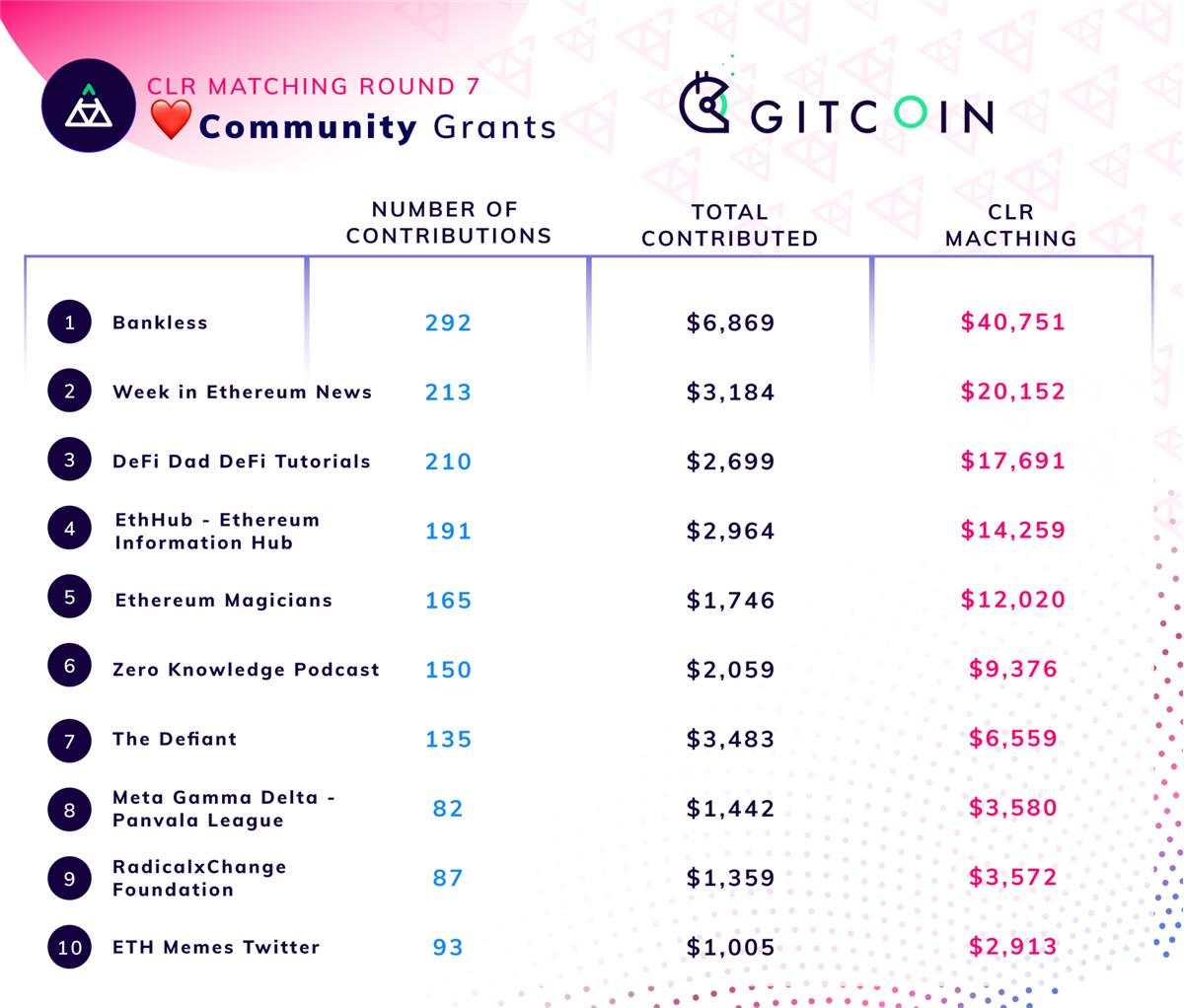
In the Ethereum ecosystem, examples of key public goods funded by recent Gitcoin grant rounds. Open-source software ecosystems, including blockchains, rely heavily on public goods.
Yet economics itself seems an inadequate tool for addressing these issues. How many of 2020’s challenges could be understood simply by examining supply and demand curves?
One approach is to examine the relationship between economics and politics. In the 19th century, they were often seen as intertwined, under the discipline of “political economy.” In the 20th century, they diverged. But in the 21st century, the boundary between “private” and “public” is blurring again. Governments act more like market participants, while corporations behave more like governments.
We see this convergence emerging in crypto as well, with researchers increasingly focusing on governance challenges. Five years ago, the main economic topics in crypto revolved around consensus theory—a well-defined, tractable problem in economics—yielding clear results in specific contexts, such as the selfish mining paper. Subjective notions (like quantifying decentralization) existed but were easily compartmentalized apart from formal mechanism design mathematics.
But in recent years, we’ve witnessed increasingly complex financial protocols and DAOs emerge on blockchains, along with growing internal governance challenges. For example: Should BCH redirect 12.5% of its block rewards to fund developer teams? If so, who decides which team qualifies? Should Zcash extend its 20% developer reward for another four years? These questions can be analyzed economically to some extent, but the analysis inevitably involves prolonged coordination, constant adjustments, and concepts like “Schelling points” and “legitimacy,” which are far harder to quantify mathematically. Thus, we need an interdisciplinary approach combining formal mathematical reasoning with softer forms of humanistic reasoning.
We wanted to digitize the state, but we got digitalism instead
Around 2014, I began noticing one of the most fascinating aspects of crypto—one that emerged quite early in my involvement: how rapidly it began replicating real-world political dynamics. I don’t just mean abstractly, in the sense that “people are forming tribes and attacking each other.” I mean the similarities are surprisingly deep and concrete.
Let me tell a story. From around 2009 to 2013, the Bitcoin world was relatively innocent and joyful. The community grew rapidly, prices rose steadily, and although disagreements existed—over block size or long-term direction—they remained largely academic, overshadowed by the shared goal of helping Bitcoin grow and thrive.
But in 2014, divisions began to surface. Transaction volume on the Bitcoin blockchain reached 250 kilobytes per block and kept rising, raising the first serious concerns that usage might actually hit the 1MB limit before it could be increased. Non-Bitcoin blockchains had previously played minor roles, but from then on suddenly became significant players, with Ethereum leading the pack.
These developments caused previously hidden disagreements to explode. The ideology of “Bitcoin maximalism”—the belief that the goal of crypto should not be a diverse ecosystem of cryptocurrencies but solely Bitcoin—evolved from a niche curiosity into a passionate, angry movement. Dominic Williams and I quickly recognized its nature and coined the term “Bitcoin maximalism.” Its proponents advocated for extremely slow or even permanent small-block policies, regardless of transaction fees.
Internal Bitcoin disputes soon escalated into full-blown civil war. Theymos, a primary moderator of the /r/bitcoin subreddit on Reddit and several other key public Bitcoin discussion spaces, used his position to impose extreme censorship, enforcing his (pro-small-block) views on the community.
In response, large-block supporters migrated to a new forum: /r/btc. Some attempted diplomatic efforts to ease tensions, including a famous meeting in Hong Kong that appeared to reach consensus—though a year later, the small-block faction ultimately broke the agreement. By 2017, the large-block faction had clearly lost, and in August of that year, they forked to continue their vision on a separate Bitcoin blockchain, calling it “Bitcoin Cash” (ticker BCH). (Note from Lüdong: For details on Bitcoin’s first hard fork, see the article “The Story of Bitcoin Forks”)
The community split was chaotic, evident in the fragmentation of communication channels. /r/bitcoin came under control of Bitcoin (BTC) supporters. /r/btc was controlled by Bitcoin Cash (BCH) supporters. Bitcoin.org fell under BTC supporters’ control, while Bitcoin.com was taken over by BCH supporters. Both sides claimed to be the true Bitcoin. The result closely resembled civil wars that split countries in two, where both sides adopt nearly identical names—differing only in combinations of words like “democratic,” “people,” and “republic.” Neither side could eliminate the other, nor was there any higher authority to settle the dispute.
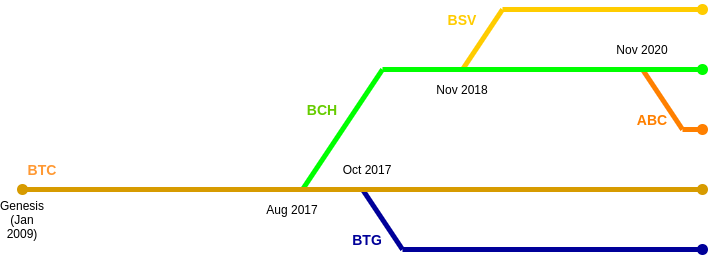
The above chart shows major Bitcoin fork events up to 2020, excluding lesser-known forks like Bitcoin Diamond, Bitcoin Rhodium, Bitcoin Private, or others. I strongly recommend either ignoring these forks entirely or selling them (you might also consider selling some listed forks—BSV is absolutely a scam!)
Around the same time, Ethereum experienced its own chaotic split through the DAO fork—a controversial resolution to the theft of over $50 million from Ethereum’s first major smart contract application. As with Bitcoin, internal conflict lasted about four weeks, followed by a blockchain fork creating two chains: Ethereum (ETH) and Ethereum Classic (ETC). The naming dispute was equally intriguing: the Ethereum Foundation held the ethereumproject account on Twitter, while Ethereum Classic supporters held ethereumproject on GitHub.
Some in the Ethereum camp believed Ethereum Classic had very few genuine supporters and that the entire event was primarily a social attack by Bitcoin supporters—either to promote a version aligned with their values or to create chaos and destroy Ethereum outright. Initially, I somewhat believed this narrative, but over time I realized it was greatly exaggerated. While some Bitcoin supporters did try to shape outcomes according to their vision, much like in many conflicts, the “outsider interference” narrative served as a subconscious psychological defense mechanism among many Ethereum supporters (myself included), shielding us from acknowledging that our own community harbored divergent values. Fortunately, relations between the two projects later improved, partly due to Virgil Griffith’s excellent diplomacy, and Ethereum Classic developers even agreed to move to another GitHub page.
Infighting, alliances, factions, and alignment with infighting participants—all of these dynamics are visible in the crypto space. Fortunately, these conflicts remain virtual and online, avoiding the deeply harmful personal consequences that often accompany such events in real life.
So what can we learn from these events?
A key insight is that if such phenomena occur across vastly different contexts—international conflicts, religious disputes, and relationships within and between purely digital cryptocurrencies—what we’re observing may be an indelible expression of human nature, something far more difficult to resolve by simply changing the types of groups we organize. We should expect such patterns to continue unfolding in various settings over the coming decades. Perhaps it’s harder than we think to distinguish the benefits from the harms: the energies that drive us to fight are also those that drive us to contribute.
What truly motivates us?
An important intellectual backdrop of the 2000s was recognizing the importance of non-monetary motivations. People aren’t motivated solely by earning as much money as possible at work or deriving enjoyment from money in family life. Even at work, our motivations stem from social status, honor, altruism, reciprocity, a sense of contribution, and differing societal views on what is good and valuable.
These differences are highly meaningful and measurable. Consider, for example, this Swiss study on compensating wage differentials for morally objectionable work: how much extra must employers pay to convince someone to take a job considered unethical?
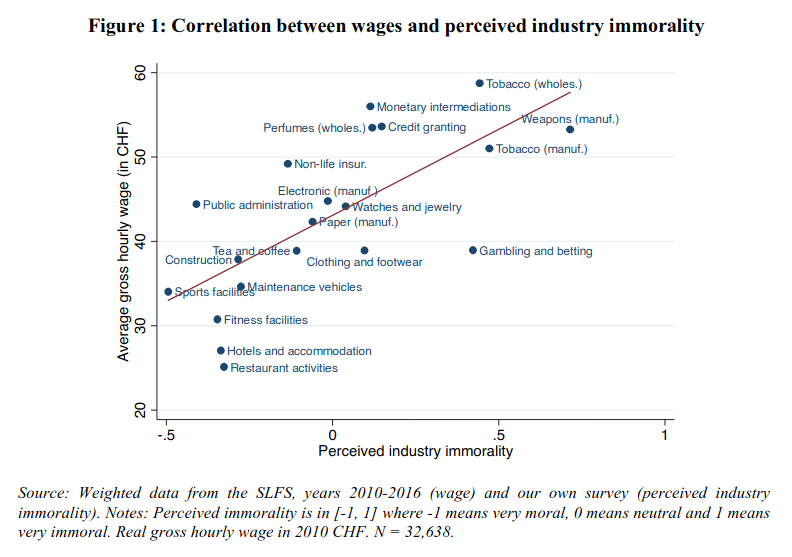
We see the effect is massive: if a job is widely seen as unethical, you must pay employees nearly twice as much to get them to accept it. Based on personal experience, I’d argue even double pay is an underestimate—in many cases, top-tier workers would refuse to work for a company they perceive as harmful to the world at almost any cost.
Similar effects apply to hard-to-quantify “work” (like word-of-mouth marketing): if people believe in a project, they’ll promote it for free; if not, they won’t bother at all. This may explain why blockchain projects that raise vast sums through unscrupulous means—or mere profit-driven “VC chains” controlled by enterprises—often fail: even with $1 billion, they cannot compete with a project that has soul.
That said, it’s possible to idealize this reality too much.
First, while subsidies for decentralized, non-market, non-governmental, socially well-regarded projects are enormous—potentially reaching tens of trillions of dollars annually worldwide—their impact is not infinite. If a developer faces a choice between earning $30,000/year through “pure ideology” or $30 million via an unnecessary token ICO inserted into a project, they will choose the latter.
Second, idealistic motivations are unevenly distributed. Rick Falkvinge’s Swarmwise highlights political activism as a key example of decentralized, non-market organization potential—and indeed, political activism doesn’t require payment. But longer, more laborious tasks—even something as simple as building a good user interface—are far less intrinsically motivating. Over-reliance on intrinsic motivation leads to some tasks being over-completed while others are poorly executed or entirely ignored.
Third, perceptions of a task’s intrinsic appeal can shift—and may even be manipulated.
For me, a key takeaway is the importance of culture (and the critically important concept of “narrative”—a term unfortunately corrupted by influential figures in crypto). If a project enjoys high moral standing, it effectively commands twice or more funding; thus, culture and narrative are immensely powerful forces directing value equivalent to tens of trillions of dollars. This doesn’t even account for their role in shaping our perception of legitimacy and coordination.
Therefore, anything influencing culture profoundly impacts the world and people’s economic interests. We will increasingly see various actors making systematic, conscious, and increasingly sophisticated efforts. This is the dark conclusion of non-monetary social motivations: they establish the permanent and final battlegrounds of war. Fortunately, this war is usually non-lethal—but unfortunately, peace treaties are impossible because determining what constitutes victory in cultural wars is inherently subjective.
Big XXX has always been around
One of the most important debates of the 20th century was between “big government” and “big business”—in various configurations: Big Brother, big banks, tech giants—all taking turns on center stage. In this context, great ideologies were often defined by attempts to abolish whichever “big XXX” they disliked: corporatism, anarcho-capitalism’s opposition to government, and so on.
Looking back at 2020, one might ask: which grand ideologies succeeded, and which failed?
Consider a concrete example: the 1996 “Declaration of the Independence of Cyberspace”:
“Governments of the Industrial World, you weary giants of flesh and steel, I come from Cyberspace, the new home of Mind. On behalf of the future, I ask you of the past to leave us alone. You are not welcome among us. You have no sovereignty where we gather.”
And a similarly spirited Crypto Anarchist Manifesto:
“Computer technology is on the verge of providing the ability for individuals and groups to communicate and interact with one another in a totally anonymous manner. Two persons may exchange messages, conduct business, and negotiate electronic contracts without ever knowing the true name or legal identity of the other. As through the use of remailers, mix networks, and encryption packages, interactions over networks will be untraceable, with almost perfect assurance of anonymity maintained by the network routing mechanisms and the encryption protocol.”
Reputation would be paramount, becoming even more crucial in transactions than today’s credit ratings. These developments would fundamentally alter the nature of government regulation, the ability to tax and control economic interactions, the capacity to keep information confidential, and even the nature of trust and reputation itself.
How have these predictions fared? The answer is intriguing: I’d say they succeeded in one aspect but failed in another.
What succeeded? We conduct diverse interactions over networks, backed by strong cryptography that even nation-states struggle to break. We now have powerful cryptocurrencies with smart contract capabilities far beyond what 1990s thinkers imagined, and we’re increasingly moving toward anonymous reputation systems using zero-knowledge proofs. What failed? Governments didn’t disappear.
What was completely unexpected?
Perhaps the most interesting plot twist is that these two forces mostly act cooperatively. Overall, they don’t behave like mortal enemies, and even within governments, many are seriously exploring blockchain- and crypto-friendly approaches, as well as new forms of cryptographic trust.
What we saw in 2020 was this: big government remains as powerful as ever, and so does big business. “Big protesters” remain powerful too, as do big tech companies—and perhaps soon, big cryptography as well. It’s a densely populated jungle, marked by an uneasy peace among many complex actors.
If you define success as the disappearance of one powerful actor—especially one you dislike—you may leave the 21st century disappointed. But if you define success more by what happens than by what doesn’t, and if you accept imperfect outcomes, there’s ample room for everyone to find satisfaction.
Thriving in the dense jungle
So we inhabit a world where:
- One-to-one interactions matter less; one-to-many and many-to-many interactions matter more.
- The environment is far messier, resistant to clean, simple mathematical modeling. Many-to-many interactions follow strange rules we still poorly understand.
- The environment is dense, forcing powerful actors of different kinds to coexist in close proximity.
In many ways, this world is inconvenient for someone like me. I grew up studying economics, which focuses on analyzing simple physical objects and transactions. Now I must grapple with a world where such analysis, while not irrelevant, is clearly less central than before. Transition is always challenging.
Indeed, the transition is especially challenging for those who don’t perceive it as such—because they believe it merely confirms what they’ve always thought. If you’re still following a script written in 2009 (when the financial crisis was the most recent pivotal event in memory), you’ve almost certainly missed key developments of the past decade. A finished ideology is a dead ideology.
In this world, blockchain and cryptocurrency will play important roles—more complex reasons than many imagine, tied closely to cultural forces and any financial power (cryptocurrency is one of the most underrated bull markets; I’ve long believed gold is overvalued, and younger generations realize this, so their $9 trillion needs a new home).
Likewise, complex forces make blockchain and crypto useful. It’s easy to claim centralized services can perform any application more efficiently. But in practice, social coordination problems are very real—people resist joining systems perceived as non-neutral or perpetually dependent on third parties. Hence, centralized or consortium-based alternatives claiming to replace blockchain have made no real progress, while “stupid and inefficient” blockchain-based public solutions quietly advance and gain real adoption.
Finally, this is a highly interdisciplinary world, difficult to decompose into distinct layers for separate analysis. You may need to switch analytical styles mid-way through a single layer. Things happen for strange and inexplicable reasons, always bringing surprises. The remaining question is: how do we adapt?
Join TechFlow official community to stay tuned
Telegram:https://t.me/TechFlowDaily
X (Twitter):https://x.com/TechFlowPost
X (Twitter) EN:https://x.com/BlockFlow_News
 @VitalikButerin