









Vitalik's 11 Predictions from 2013–2017: Most Aligned with Expectations, NFT Rise and Sharding Challenges Unanticipated
TechFlow Selected TechFlow Selected
Vitalik's 11 Predictions from 2013–2017: Most Aligned with Expectations, NFT Rise and Sharding Challenges Unanticipated
In terms of technology, I'm more accurate when dealing with abstract ideas than with practical software development issues. One must learn to understand the latter over time.
 Navigating Web3 tides with focused insights
Source: Vitalik's Twitter
Compiled by: Gu Yu, ChainCatcher
This is a small Twitter thread about some things I said and wrote over the past decade, and my views on these topics today.
One
In 2013, I wrote an article about "how Bitcoin could actually help Iranians and Argentinians." Core point: Bitcoin’s main benefit is its internationality and censorship resistance, not the "21 million supply cap." I predicted stablecoins would thrive.
Last week, I actually went to Argentina! My judgment: largely correct. Cryptocurrency adoption is high, but so is stablecoin adoption; many businesses operate using USDT. Of course, this might change if the dollar itself starts having more issues.
Two
This article from 2013 about the consequences of Bitcoin services becoming more "regulated."
Core argument: Bitcoin resists governments not by cleverly knowing what legal category it belongs to, but through technical censorship resistance.
My view today: certainly, Bitcoin’s decentralization will allow it to *survive* even in extremely hostile regulatory environments, but it cannot *thrive*. A successful censorship-resistance strategy requires a combination of technical robustness and public legitimacy.
Three
My prediction in 2015 that we’d get PoS and sharding. Honestly, both were quite wrong and deserve a good laugh; I’ll share a screenshot of a presentation I gave in 2015 so everyone can enjoy the joke more fully.
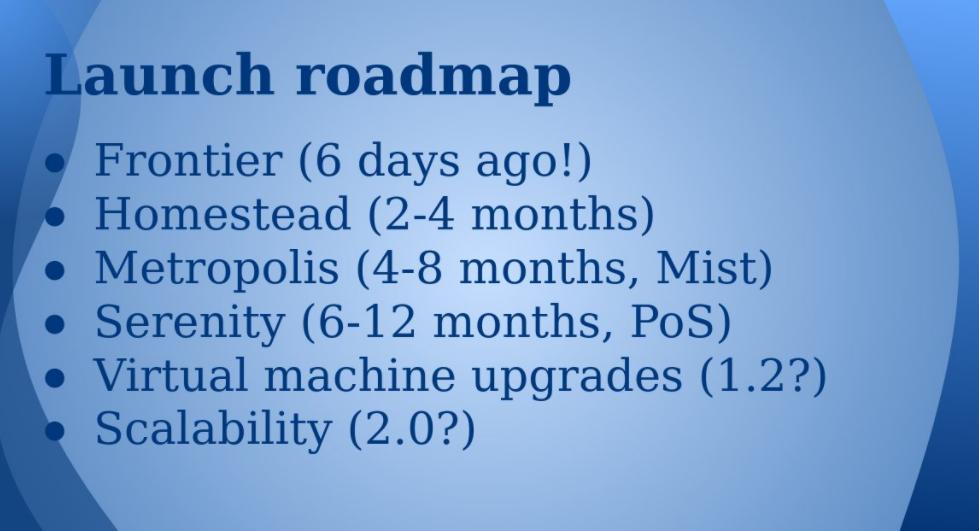
But what was my core underlying mistake? In my view, it was deeply underestimating the complexity of software development and the gap between a Python PoC and a proper production implementation. The ideas in 2014 were too complex—e.g., "12-dimensional hypercube."
Today, the Ethereum research team values simplicity much more—simplicity in final design and simplicity in the implementation path. Greater appreciation for pragmatic compromises. Dankrad’s new sharding design fits very well with this spirit.
Four
Regarding this article from five years ago, I still 100% stand by my comment that "the internet of money should not cost more than 5 cents per transaction." This was the goal in 2017, and it remains the goal today. This is exactly why we spend so much time researching scalability.
I should also add that the core idea behind sharding remains completely intact.
Blockchain 1.0: every node downloads everything, with consensus
BitTorrent: every node downloads only a little, but no consensus
Ideal: BitTorrent-like efficiency, but with blockchain-like consensus
Five
In 2012, I briefly defended PoW energy waste. Fortunately, by 2013, I became excited about proof-of-stake as a promising alternative.
This reflects a broader intellectual evolution I've gone through: from "X is something I must defend, so anything favoring X must be right" to "I like X, but X has flaws, and Y seems to fix them, so now I support X+Y." Soldier mindset → Scout mindset.
Six
An article from 2014 about self-executing contracts. Basically, it tried to argue that making society more like a formal system is good, and we should be excited about it.
Through my work on collusion (here), I’ve seen the limitations of this way of thinking. Essentially, the problem with pushing everything into formal systems is that nearly any formal system with more than two participants is attackable.
Seven
I liked altcoins before the altcoin market cooled down. Check out this article from September 2013.
Three core arguments: (i) different chains optimize for different goals, (ii) having many chains is low-cost, (iii) need an exit option in case the core dev team makes mistakes.
Do I still agree? The above arguments are less strong today because (i) chains are more general-purpose, (ii) apps are more complex, hence bridge risks are higher, (iii) experimentation is feasible on L2s. But even so, I think there are things you simply can’t do on L2s, and space for different L1s.
Eight
I was particularly bullish on Bitcoin Cash because I agreed more with the big-block side in the scaling debate than the small-block side.
Today, I think BCH has largely failed. My main point: communities formed around rebellion, even if they have a good cause, often struggle long-term because they value bravery over competence and unite around resistance rather than a coherent forward vision.
Nine
These posts from 2016–17 were essentially advocating for someone to build Uniswap. Obviously proud of that.
Though interestingly, while I got the concept here of "do something very simple and dumb, even if it's suboptimal," it took me a long time to apply that lesson to PoS mechanisms and sharding design.
Ten
Applications envisioned in the Ethereum whitepaper: ERC20-style tokens, algorithmic stablecoins, domain name systems (like ENS), decentralized file storage and computing, DAOs, wallets with withdrawal limits, oracles, prediction markets.
Many correct (basically predicted "DeFi"), though incentivized file storage + computing hasn’t taken off as much (yet?), and of course I completely missed NFTs. I’d say the biggest thing I missed in detail was collusion issues in DAO governance.
Eleven
More detailed thoughts from 2014 on stablecoins.
A large part of this article tried to solve whether you can have stablecoins without oracles by using blockchain data (e.g., PoW difficulty) as pseudo-price oracles.
I’m now more pessimistic about this, especially with PoS. We will need oracles. And if we want stablecoins to remain robust when the dollar collapses (if that happens, by switching to their own local CPI), we’ll need more active governance.
Conclusion: I was more naive back then in how I thought about politics and large-scale human organization. Too focused on simple, complete formal models; didn’t appreciate the cultural challenges and legitimacy issues.
Summary
Early on, I did have good instincts to avoid the craziest parts of Bitcoin maximalist thinking. There were some early mistakes, but I corrected them quickly. A flaw in X doesn’t mean any particular rebellion against X will succeed smoothly.
On the technical side, I was more correct on abstract ideas than on production software development issues. I had to learn the latter over time. I now have a deeper understanding of the need for things to be simpler than I imagined.
Join TechFlow official community to stay tuned
Telegram:https://t.me/TechFlowDaily
X (Twitter):https://x.com/TechFlowPost
X (Twitter) EN:https://x.com/BlockFlow_News
 @VitalikButerin










