









Token Terminal: Recent DEX Data Analysis Report
TechFlow Selected TechFlow Selected
Token Terminal: Recent DEX Data Analysis Report
We expect future DEX development to prioritize improving token pricing, slippage, and user experience.
 Navigating Web3 tides with focused insights
Author: Tokenterminal
Compiled by: TechFlow
This article focuses on the decentralized exchange (DEX) market sector and analyzes data from Token Terminal's designated dashboard to uncover the most interesting charts and trends.
Overview
The following charts show the daily trading volume and total value locked (TVL) over the past 180 days for top projects in the DEX market sector, based on data from Token Terminal.
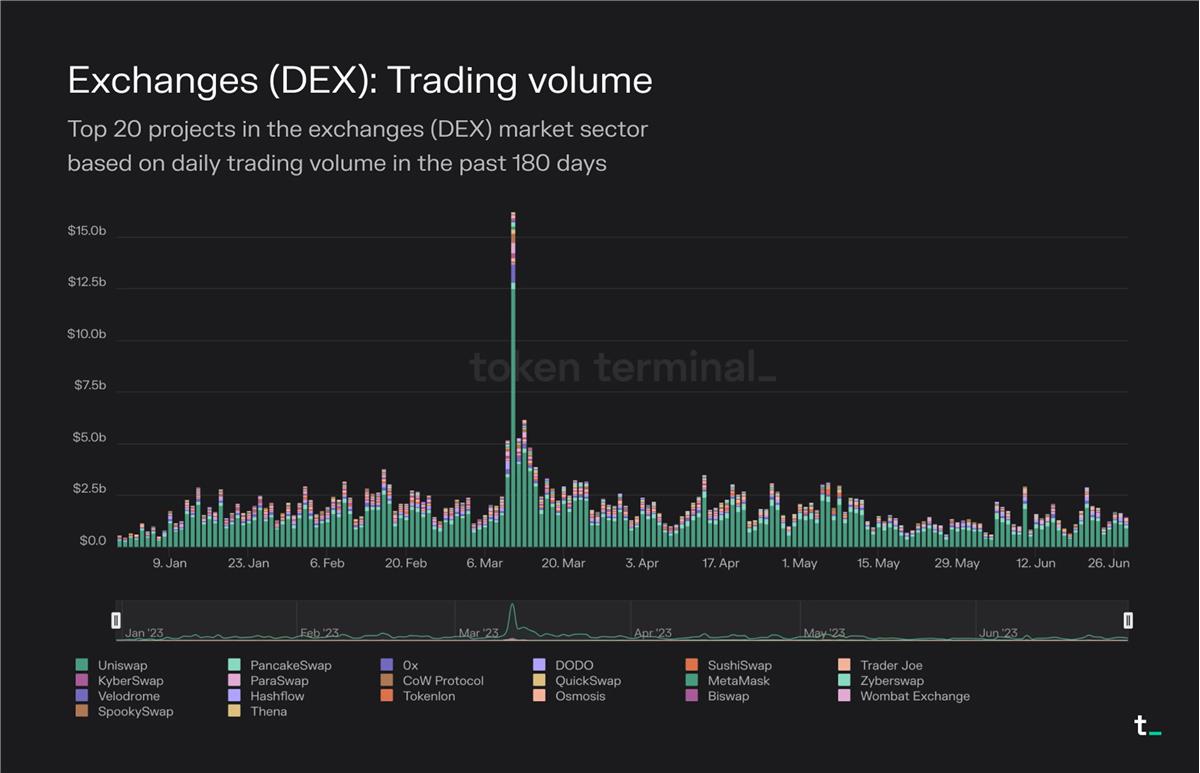
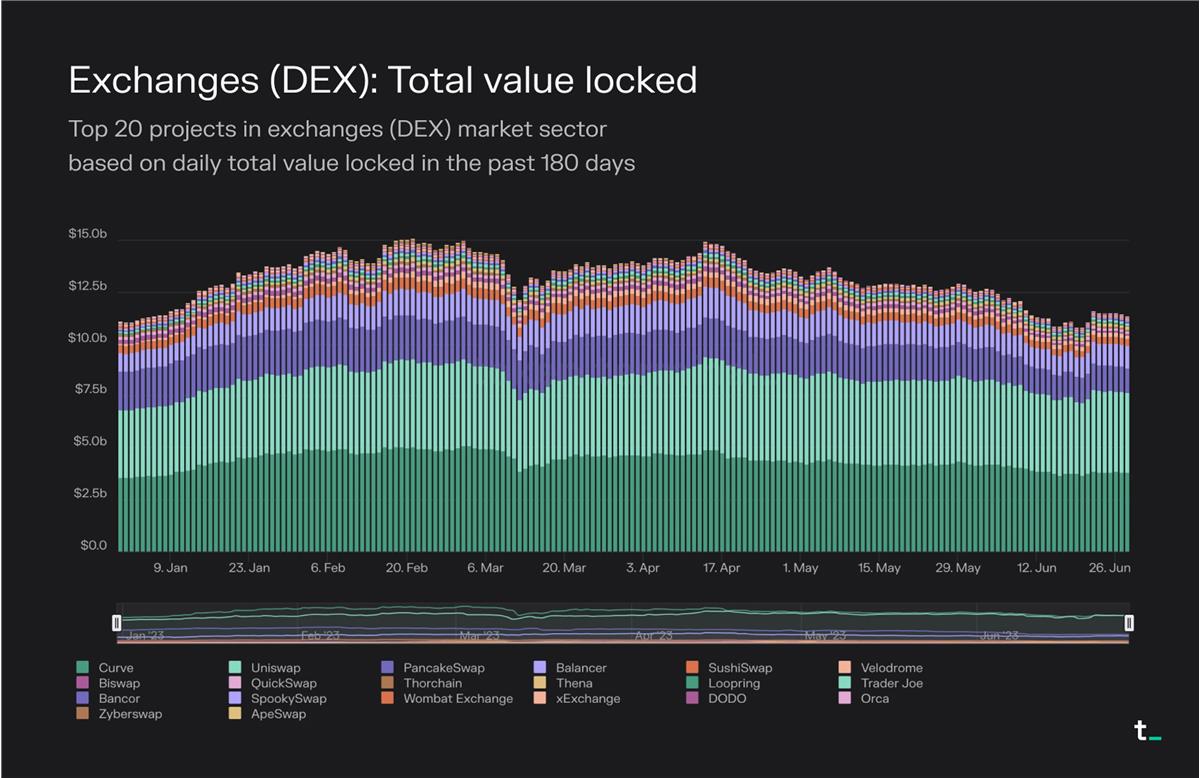
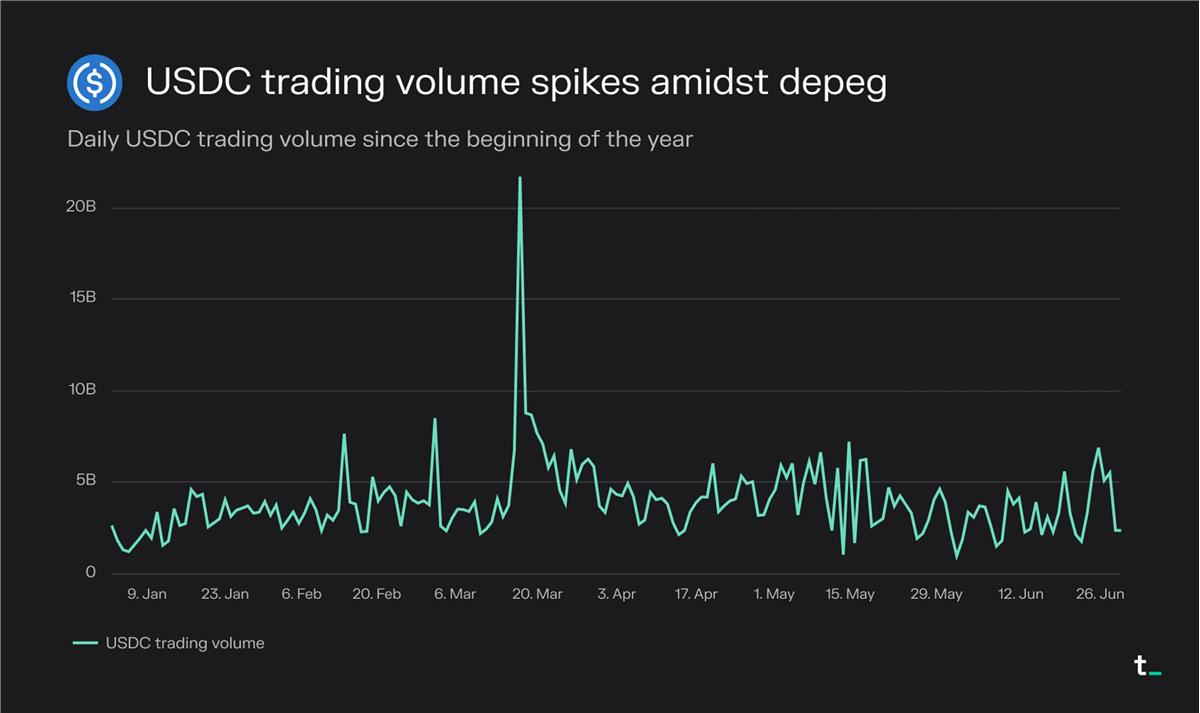
Over the past 180 days, both trading volume and TVL have remained relatively stable, with one notable exception in mid-March. DEX trading volume peaked at $16.2 billion on March 11, 2023—more than eight times higher than the average daily volume of $2 billion over the same period. Meanwhile, DEX TVL dropped 14% between March 9 and 12, falling from $14 billion to $12.1 billion.
The primary cause of these dramatic shifts was the depegging of USDC. On March 10, Circle announced it had up to $3.3 billion exposed to the troubled Silicon Valley Bank, triggering a loss of confidence and causing USDC to lose its peg to the U.S. dollar. As a result, users rushed to swap their USDC holdings into other tokens, driving up DEX trading volumes. The TVL in DEXs also declined sharply, partly due to the reduced value of USDC within liquidity pools. For example, the USDC-WETH pool on Uniswap held over $450 million in liquidity on March 9 but dropped to just $300 million by March 12. In contrast, the WETH-USDT pool maintained relatively stable TVL during the same period.
Macroeconomic conditions and regulatory developments significantly impact the DEX sector and the broader cryptocurrency industry. These external factors can lead to sudden changes in trading volume and the value of user-held liquidity positions. Investors and market participants should keep these influences in mind when analyzing market dynamics and making financial decisions.
DEX Trading Volume Is Shifting from Ethereum to Other Chains
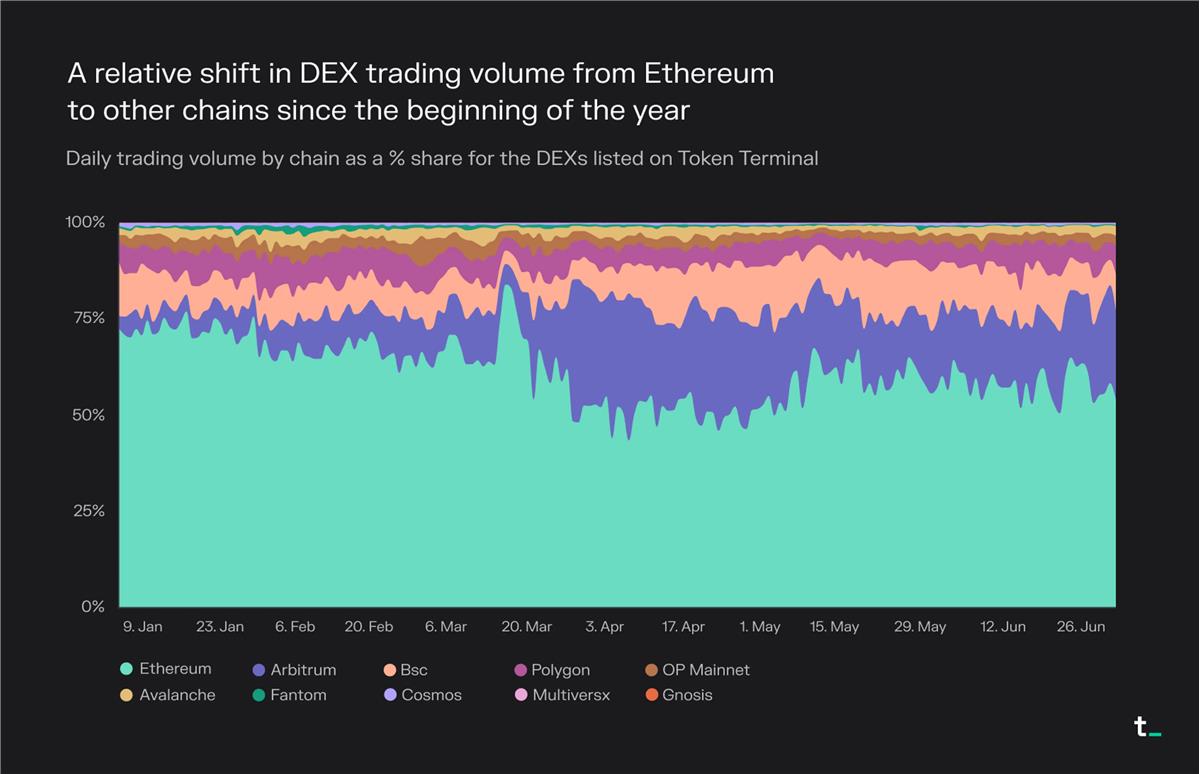
Since the beginning of 2023, Ethereum’s share of DEX trading volume has decreased from 72% to 54%, primarily due to growth on Arbitrum. During the same period, Arbitrum’s share of total DEX volume rose from 3.3% to 23.3%. Meanwhile, shares of trading volume on Polygon, Optimism, and BNB Chain have remained relatively stable.
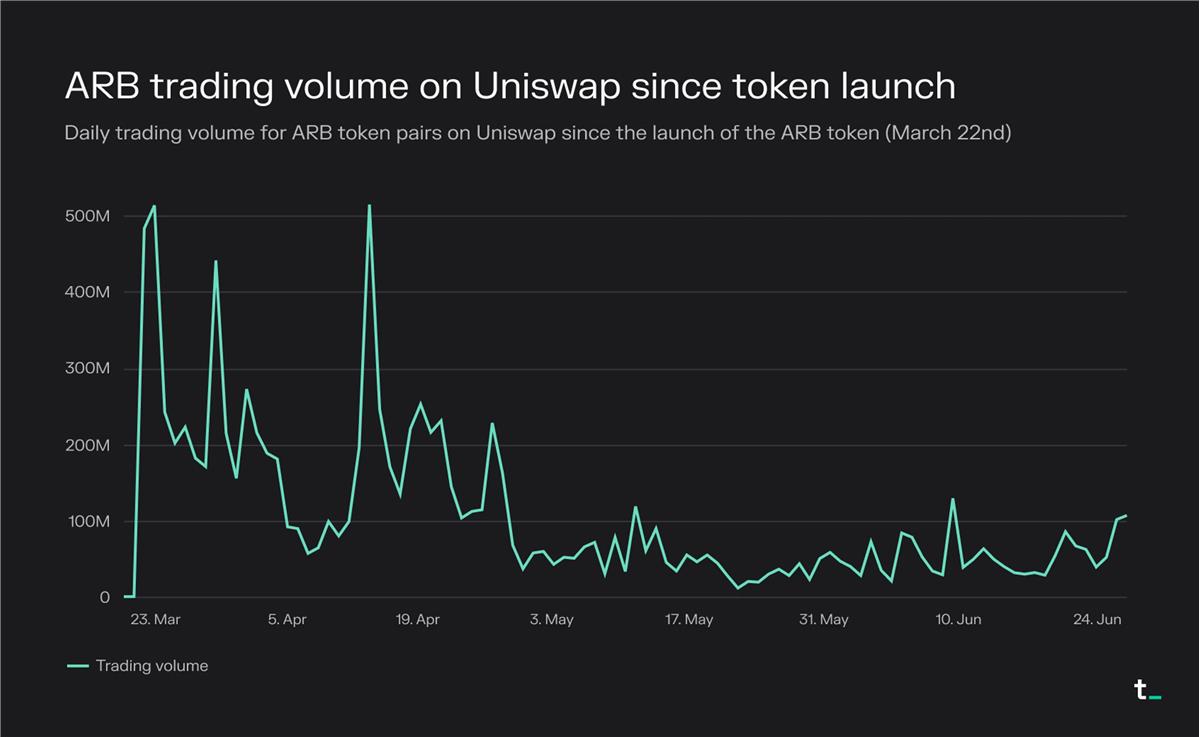
Arbitrum’s peak in DEX trading volume share coincided with the launch of its ARB token on March 23, 2023. On that day alone, trading volume for ARB on Uniswap—the leading DEX on Arbitrum—exceeded $480 million. This surge was likely driven by users converting their airdropped ARB rewards into other tokens. Although DEX trading volume on Arbitrum has slightly declined since the end of March, Arbitrum remains the second-largest chain by DEX trading volume after Ethereum.
Growing demand for token trading on Arbitrum has spurred the emergence of new DEXs. While Uniswap remains the dominant player on Arbitrum, completing over 3.38 million trades in the past 90 days, newer native DEXs are beginning to emerge as competitors. A notable example is Camelot, a relatively new DEX on Arbitrum that completed nearly 1 million trades in the last 90 days.
Case Study: Prominent DEXs Expanding Beyond Their Native Chains
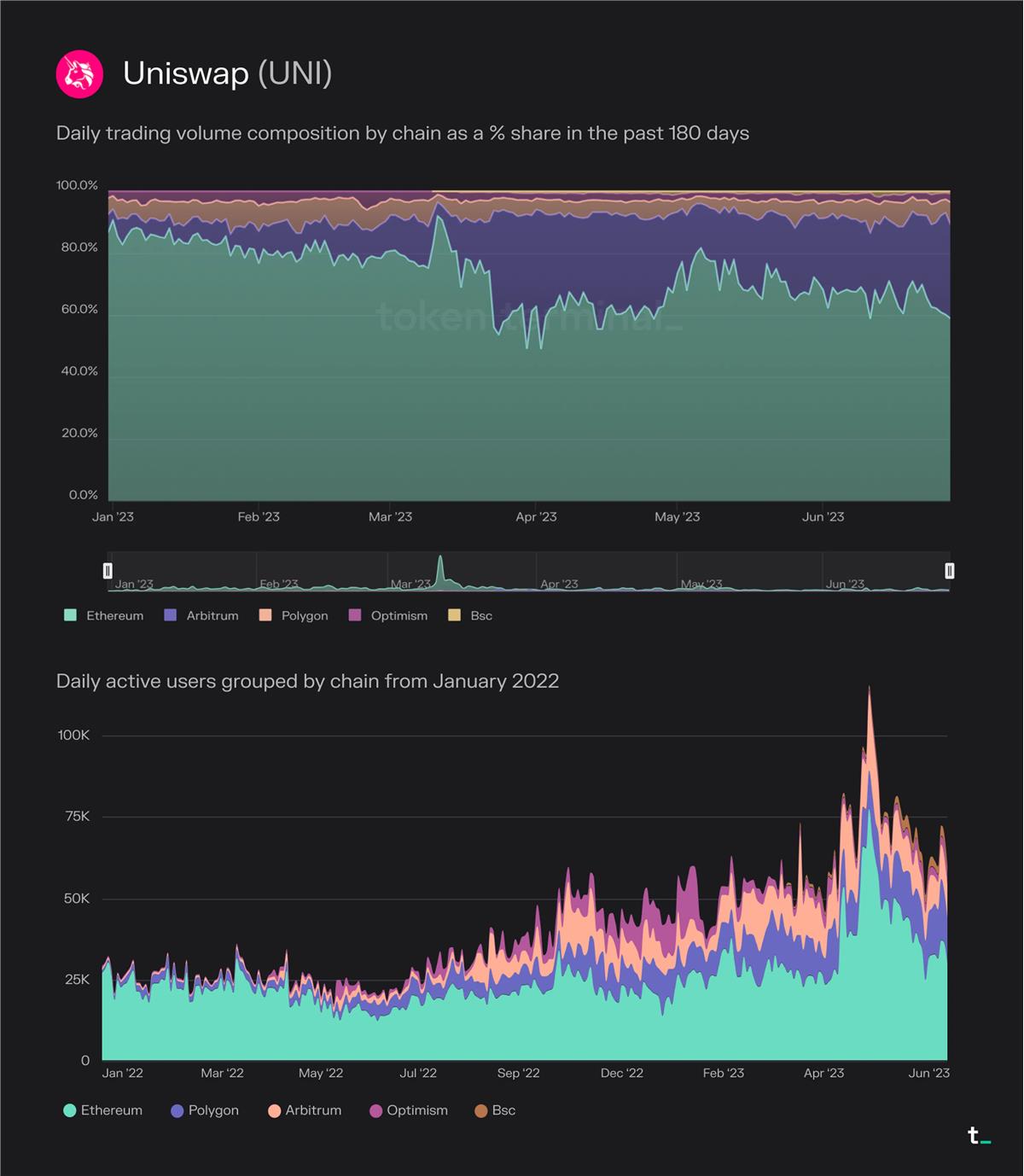
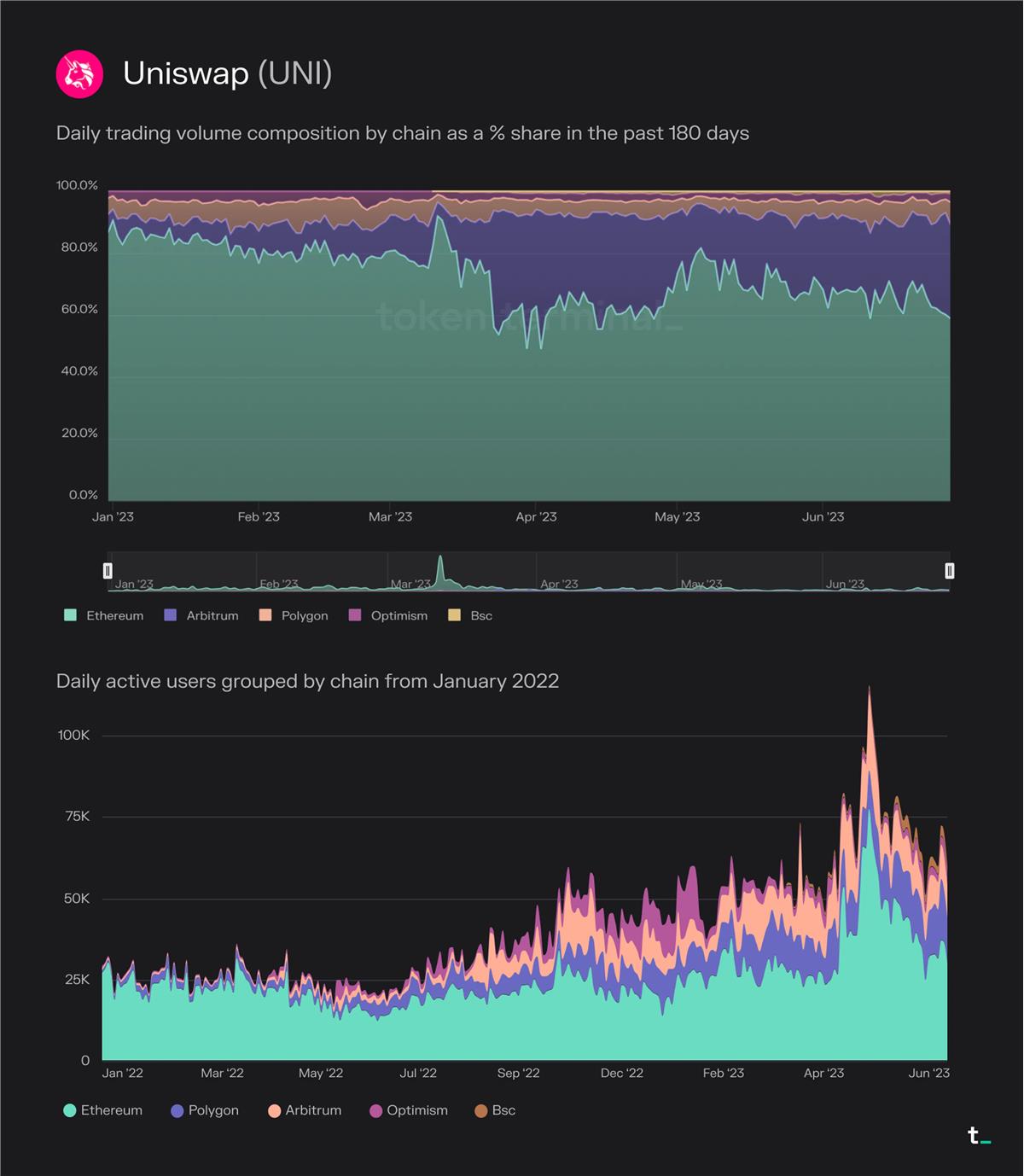
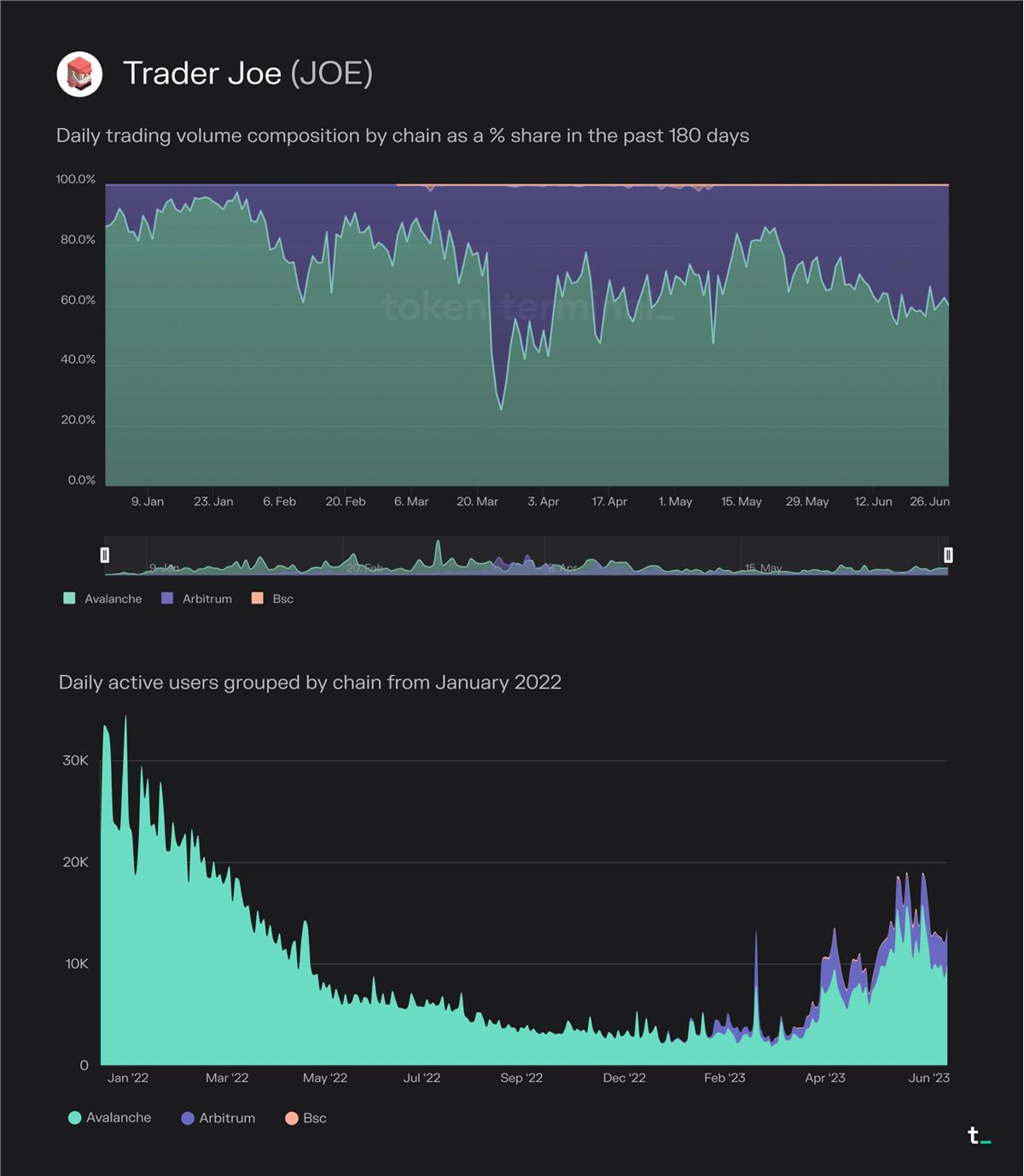
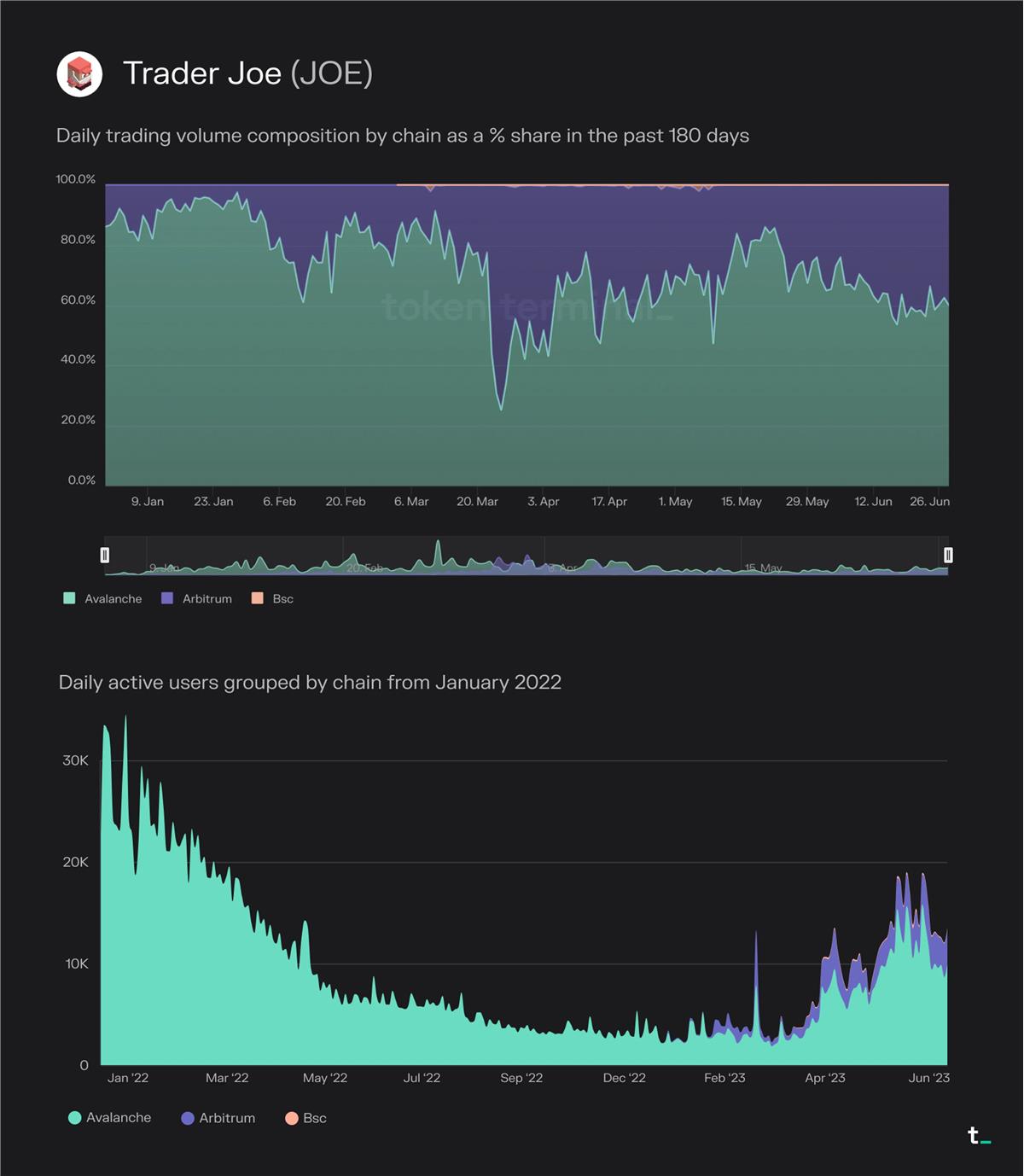
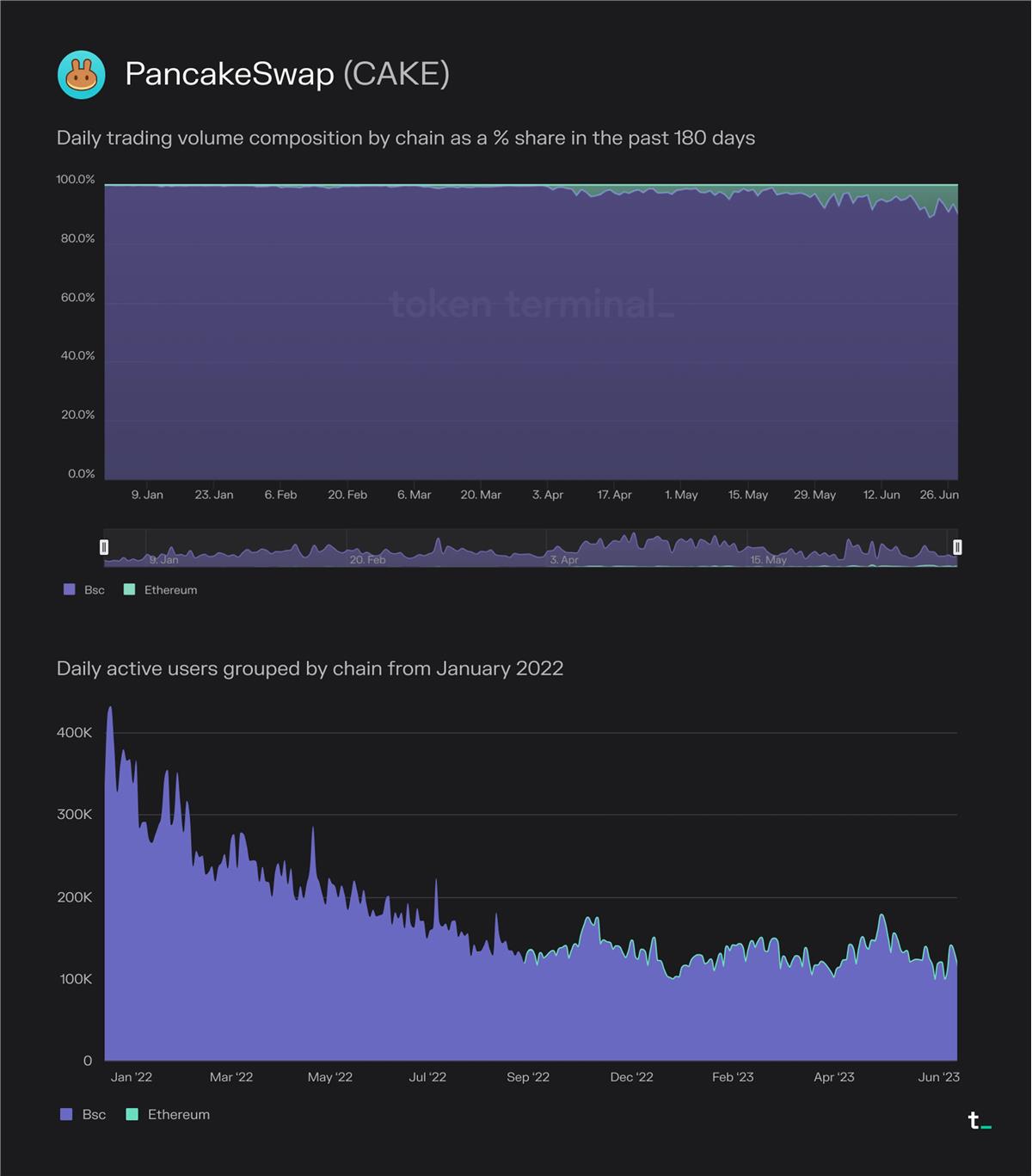
Uniswap and Trader Joe have successfully expanded beyond their native chains, while PancakeSwap has struggled to gain momentum on Ethereum. Although Uniswap has long been anchored on Ethereum, PancakeSwap on BNB Chain, and Trader Joe on Avalanche C-Chain, all three DEXs have since extended to other blockchains. Currently, 40% of Uniswap’s and Trader Joe’s trading volume comes from chains outside their native ecosystems. In contrast, PancakeSwap generates only 4.2% of its trading volume from non-BNB Chain networks.
Expansion into new chains has driven growth in daily active users for Uniswap and Trader Joe. Most of Uniswap’s growth stems from new traders on Polygon and Arbitrum, while Trader Joe has seen rising activity on Arbitrum.
By expanding to Arbitrum, Trader Joe has attracted users conducting larger trades. As much as 40% of Trader Joe’s trading volume and 25% of its active users now come from Arbitrum. The increased volume per user suggests that Trader Joe is drawing in traders with larger average trade sizes on Arbitrum compared to those on Avalanche C-Chain.
The DEX landscape on Ethereum has become increasingly competitive and challenging, especially for new entrants. The comparison above indicates that expansion strategies should target chains with growing market share, such as Arbitrum.
Trends
Below are some notable trends observed among projects in the DEX sector.
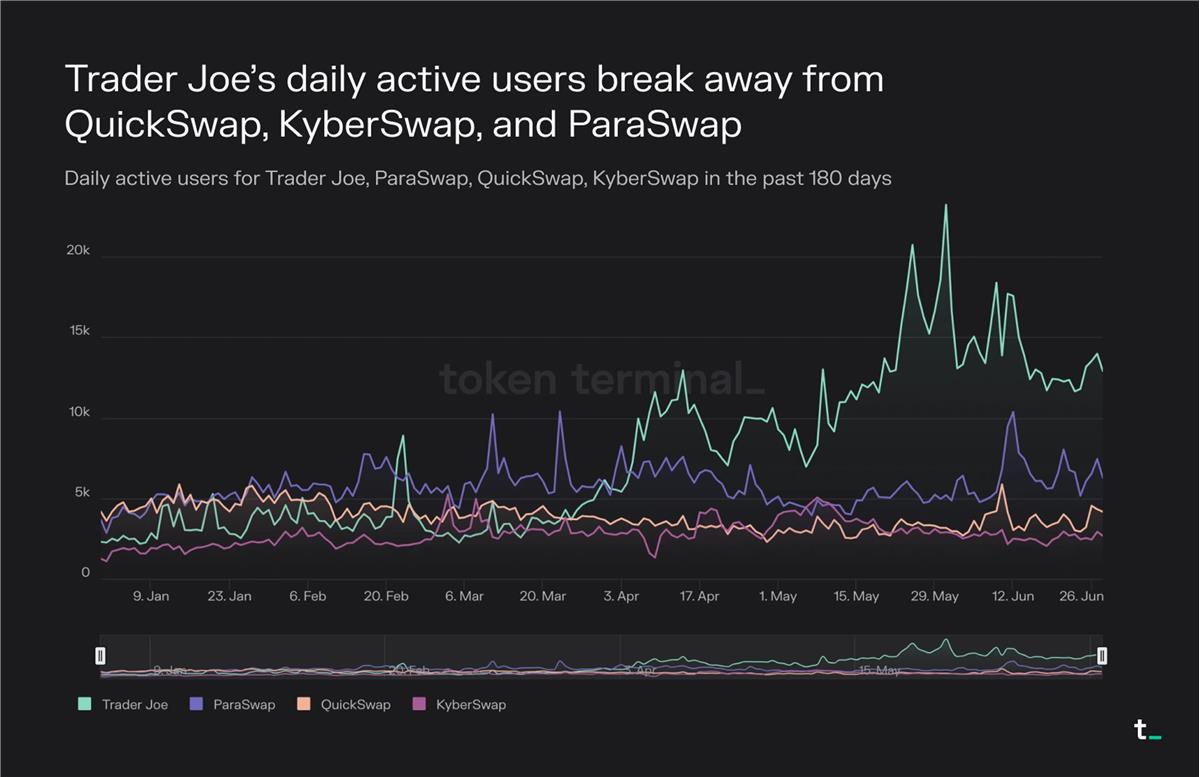
Over the past 180 days, Trader Joe, Quickswap, KyberSwap, and ParaSwap were the top-performing projects in the DEX sector, with trading volume growth of 237.2%, 91.8%, 61.8%, and 38.6%, respectively.
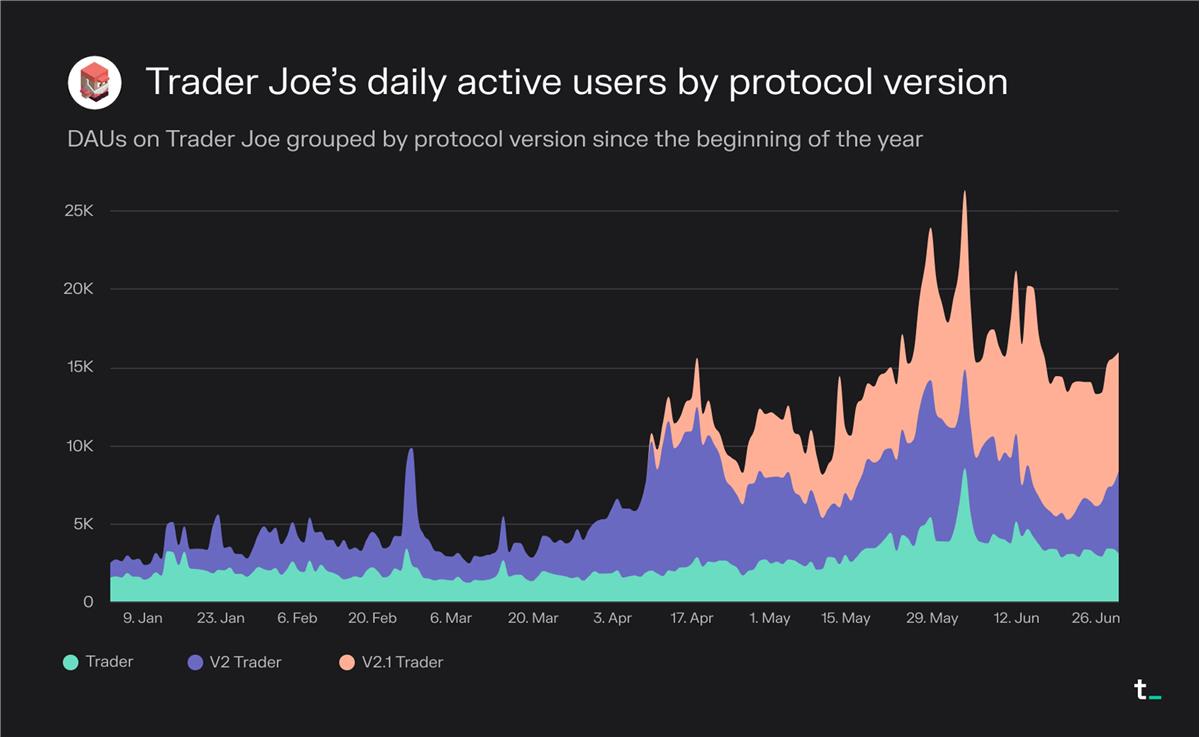
During this period, Trader Joe’s daily active user count quadrupled, outpacing competing platforms such as Quickswap, KyberSwap, and ParaSwap. Until the end of March, the daily active user counts of Quickswap, KyberSwap, ParaSwap, and Trader Joe followed similar trends and remained at comparable levels. Afterward, Trader Joe’s user base nearly tripled.
The growth in Trader Joe’s user base is largely attributed to the launch of its new Liquidity Book solution and its expansion onto Arbitrum. Trader Joe introduced updated versions (v2 and v2.1) of its Liquidity Book, improving token pricing and reducing slippage.
Trader Joe v2.1 also automatically reinvests fees earned by liquidity providers back into their liquidity positions, enhancing user experience. These upgrades benefited from increased overall activity on both Avalanche C-Chain and Arbitrum.
Future DEX development is expected to prioritize improvements in token pricing, slippage reduction, and user experience. Upcoming DEX versions are likely to focus on better pricing mechanisms, lower slippage, customizable fee tiers, improved liquidity position management, and automated user position handling. We see early examples of these trends in the latest updates to Uniswap v4, which introduces more customizable liquidity pools through Hooks.
Other Key Highlights in the Sector
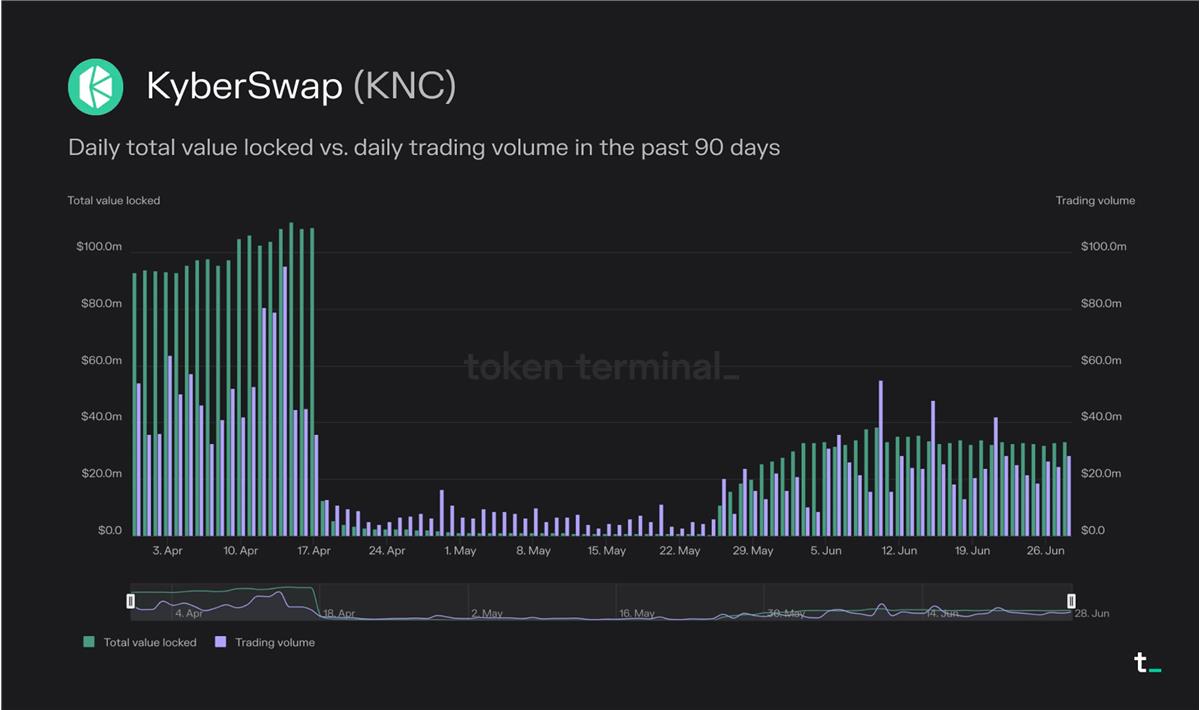 KyberSwap relaunched its Elastic contracts after identifying and fixing a vulnerability.
On April 17, 2023, KyberSwap discovered a smart contract vulnerability. The affected liquidity pool contracts were immediately paused, causing a sharp drop in KyberSwap’s trading volume and total value locked (TVL). New Elastic contracts have since been deployed, and the protocol resumed operations by the end of May. Although volume and TVL have not yet returned to pre-pause levels, a 200% increase in 30-day trading volume indicates that KyberSwap Elastic is regaining traction.
Concentrated liquidity solutions are seeing faster adoption following the expiration of Uniswap v3’s license.
Uniswap v3 was initially released under the Business Source License 1.1 (BUSL 1.1), which restricted commercial or production use of its source code until April 1, 2023. After the license expired, it transitioned to a public open-source license, allowing anyone to freely fork the code as long as they maintain openness. Since then, both PancakeSwap and SushiSwap have deployed their own concentrated liquidity solutions using Uniswap v3’s codebase.
Prior to the license change, KyberSwap, Trader Joe, QuickSwap, Zyberswap, and Thena had already developed alternative concentrated liquidity models. Additionally, Biswap plans to launch its own concentrated liquidity solution in the coming weeks.
Velodrome launched its v2 version.
The new version includes UX improvements, supports custom pool fees, single-token liquidity positions, and an upgraded governance voting mechanism.
Join TechFlow official community to stay tuned
Telegram:https://t.me/TechFlowDaily
X (Twitter):https://x.com/TechFlowPost
X (Twitter) EN:https://x.com/BlockFlow_News
 Token Terminal


