Centralization vs. Decentralization: Deconstructing the Pragmatic Principles of the New Stablecoin HOPE
TechFlow Selected TechFlow Selected
Centralization vs. Decentralization: Deconstructing the Pragmatic Principles of the New Stablecoin HOPE
The crypto world might need a stablecoin not backed by fiat currencies or algorithmic mechanisms.
 Navigating Web3 tides with focused insights
When we talk about stablecoins, what are we really talking about?
Beyond the differences in design principles among various stablecoins, the emergence of such products actually reflects the evolution of the crypto world: cryptocurrencies have grown from a small-scale geek experiment into something that now parallels real-world financial assets on a much broader scale.
As the industry grows, so too does the role of stablecoins—evolving from safe havens against crypto volatility, to gateways attracting traditional investors, and potentially even serving as instruments for cross-border settlements. It’s undeniable that stablecoins have become tightly linked with the real world. Today's stablecoins must fulfill a dual function of "bringing in" and "going out"—attracting traditional investors into areas like DeFi while also acting as settlement tools within traditional economic activities.
Yet the reality is that stablecoins aren’t actually stable. In recent years, algorithmic stablecoin collapses and fiat-backed stablecoins impacted by banking crises have been stark reminders, shaking confidence in stablecoins both inside and outside the market.
So do we still need new stablecoins?
The answer is yes. We need a free, practical, and secure asset to bridge the real world and the crypto world—one that remains insulated from traditional finance yet is intuitive and easy for users to adopt, better fulfilling this dual “bring in and go out” role.
In observing the latest developments in the space, a newly launched stablecoin called HOPE has recently attracted attention: backed by native crypto assets, with a floating value, and featuring distributed custody of funds... These features differ significantly from traditional notions of stablecoins. Could this be an innovative project that understands current industry pain points? And for most ordinary users, could it represent a new investment opportunity?
With these questions in mind, TechFlow will examine HOPE from multiple angles—including its design philosophy, product mechanics, user experience, and economic model—to offer deeper insights for practitioners and users alike.
I. Stability, Standing Apart from the Storms
Before diving into HOPE, let’s first consider the external environment surrounding stablecoins today.
In the popular drama *The Knockout*, the line “the greater the waves, the more valuable the fish” seems to romanticize risk-taking. But in the crypto world, bigger waves often mean people get swept away.
Let’s identify some sources of turbulence affecting the crypto ecosystem:
-
Collapse of CeFi ecosystems: The failures of Three Arrows Capital and FTX devastated associated assets, reminding everyone not to be complacent about assets held by centralized institutions.
-
Stablecoins aren't calm either: First came the collapse of the UST algorithmic stablecoin; then Silvergate Bank and Silicon Valley Bank failed during interest rate hikes, sparking fears over USDC redemption. Even DAI, which relies heavily on USDC as collateral, struggled to remain unaffected when storms hit.
-
Geopolitical tensions and globalization: Escalating regional conflicts and high transaction costs in global payments highlight the need for a decentralized stablecoin solution accessible to all.
Summing up these points, one clear conclusion emerges: the crypto world may need a type of stablecoin not backed by fiat currency or algorithmic mechanisms, capable of becoming a widely accepted reserve asset that isolates itself from significant risks posed by traditional finance, centralized entities, and flawed algorithms.
So, is using Bitcoin or Ethereum as backing for a stablecoin feasible?
This is precisely what HOPE aims to explore—building a stablecoin independent of the above-mentioned risks, starting with crypto-native asset backing.

BTC and ETH have built strong consensus over years of development, with relatively stable prices (compared to altcoins), and their influence spans globally. Using them as collateral for generating HOPE appears to best align with the vision of a “crypto-native stablecoin.” Moreover, according to preliminary research by TechFlow, HOPE initially does not adopt a fully pegged design—the price of HOPE floats along with BTC and ETH, differing sharply from most existing stablecoins.
If it doesn't even maintain a stable peg, is HOPE truly suitable as a stablecoin?
But setting aside this concern momentarily, under its crypto-native design, several advantages become apparent:
-
First, BTC and ETH can help isolate risks from CeFi single-point failures and systemic fiat influences;
-
Second, BTC’s upcoming halving cycle and potential end to rate hikes create bullish expectations for BTC and ETH, implying possible market cap expansion.
Within the current competitive landscape of stablecoins, a BTC/ETH-backed model represents a promising direction worth exploring. Returning to the key issue—how HOPE’s price floats with BTC and ETH—this brings us to the specific mechanics behind its product design.
Next, we’ll walk through how HOPE is created, stored, circulated, and used.
II. Emergence: Born in Volatility
According to official definitions, HOPE is a “pricing token backed by BTC and ETH reserves, evolving through a multi-stage plan into a distributed stablecoin.” Here, “pricing” and “distributed” refer respectively to how HOPE is generated and custodied—our main focus areas.
Let’s begin with pricing based on BTC and ETH—i.e., how HOPE is minted.
-
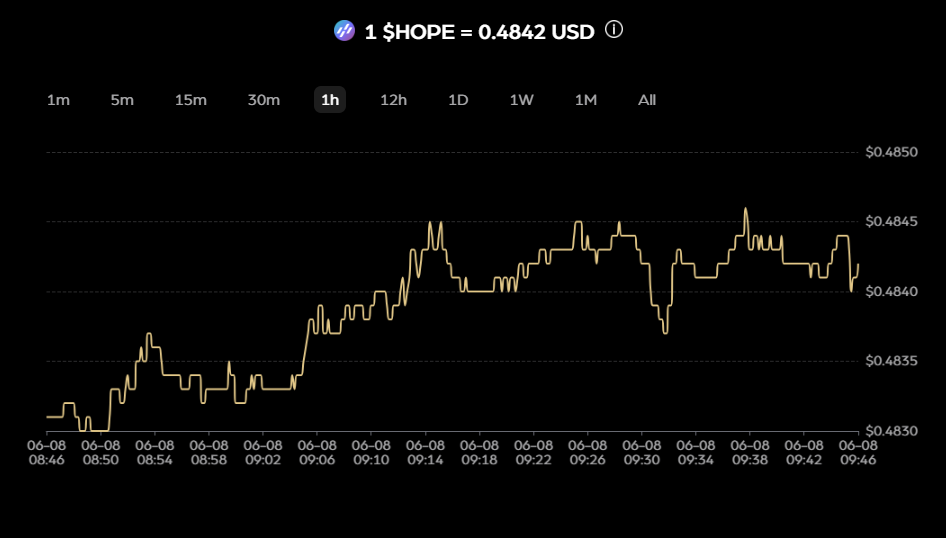
Reference Assets: Pegged to BTC/ETH, HOPE was initially issued at 50% face value ($0.5). As BTC and ETH appreciate, its market value is expected to gradually reach 100% ($1). Currently, HOPE’s price floats with BTC and ETH while maintaining a fixed ratio.
Based on current data provided by the team, HOPE trades around $0.48. Notably, HOPE isn’t directly pegged to $1 USD but instead to the value of Bitcoin and Ethereum. If BTC and ETH rise in value, HOPE could grow toward $1 as the underlying crypto market expands.
Until then, HOPE isn’t strictly a “stablecoin,” but rather functions more like a crypto-collateralized asset isolated from fiat. When exchanged against other altcoins, it behaves similarly to a major coin-denominated purchasing power standard.
-
Minting/Pricing Mechanism: After establishing initial BTC/ETH peg ratios, a price discovery process determines the exact挂钩ratio. As shown below, each HOPE minted requires a certain amount of BTC and ETH held in reserve.
This resembles LSD models like stETH, where ETH is deposited to generate yield-bearing derivatives. However, unlike LSDs where the derivative-to-collateral ratio is fixed at 1:1, HOPE uses a weighted formula combining BTC and ETH. The current weightings are as displayed on the project’s website.
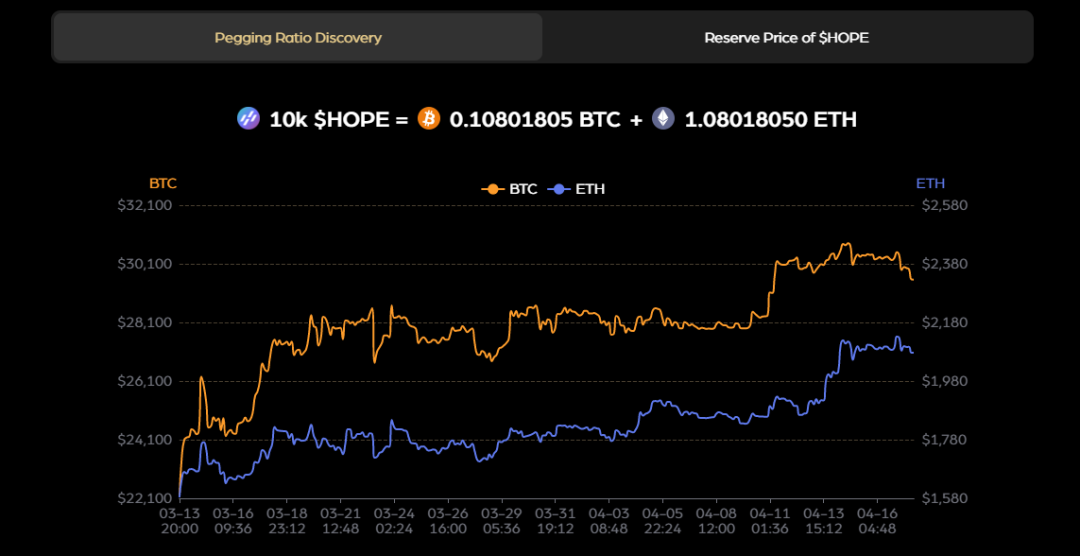
To date, HOPE has completed its price discovery phase. The calculation formula used is:

In practice, to ensure fair price discovery, the team collects OHLC (open, high, low, close) data for BTC and ETH every minute from three exchanges—Binance, OKX, and Coinbase—and calculates the average. From the formula, we see the current BTC/ETH ratio is 1:10, though this may change over time via market dynamics and governance voting.
Using this math, $0.5 worth of HOPE corresponds to $0.5 worth of weighted BTC and ETH. Should BTC and ETH prices rise beyond a critical threshold, HOPE’s intrinsic value would exceed $1.
At that point, it becomes a true stablecoin pegged to $1. Once HOPE exceeds $1 in value, its price will stabilize at $1, while the underlying BTC and ETH collateral will be worth more than $1—effectively making HOPE an over-collateralized stablecoin. According to the official design, the ideal over-collateralization rate is 110%.
This ratio is designed to maintain HOPE’s price stability while allowing room to adjust supply based on demand. Reserve swaps and issuance adjustments will be decided through community proposals and votes.
Now, where are these BTC and ETH reserves kept? How is trust ensured?
HOPE Gömböc: Distributed Reserve Design
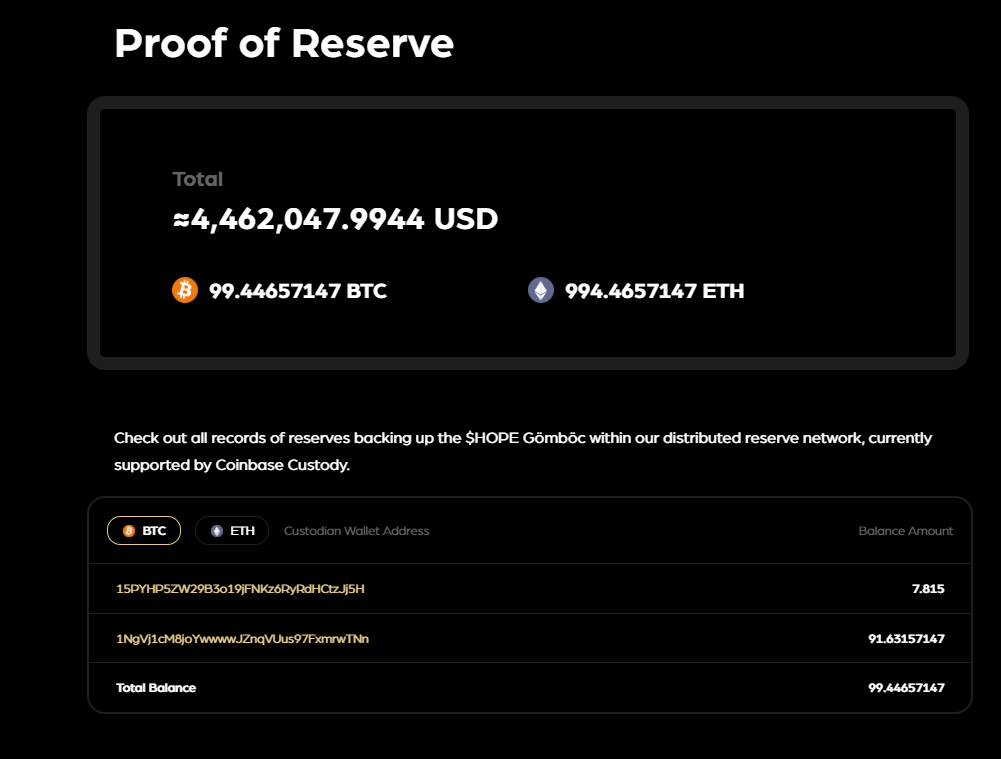
The HOPE Gömböc is a set of distributed reserve pools, spreading crypto assets across trusted third-party custodians for security. The name “Gömböc” comes from a geometric shape known for self-righting stability.
At launch, HOPE chose Coinbase as its custodian, with plans to add other custodians or on-chain decentralized custody protocols later. Additionally, the BTC and ETH in reserve will gradually be converted into distributed, stable-value, and liquid assets to mitigate price volatility risks.
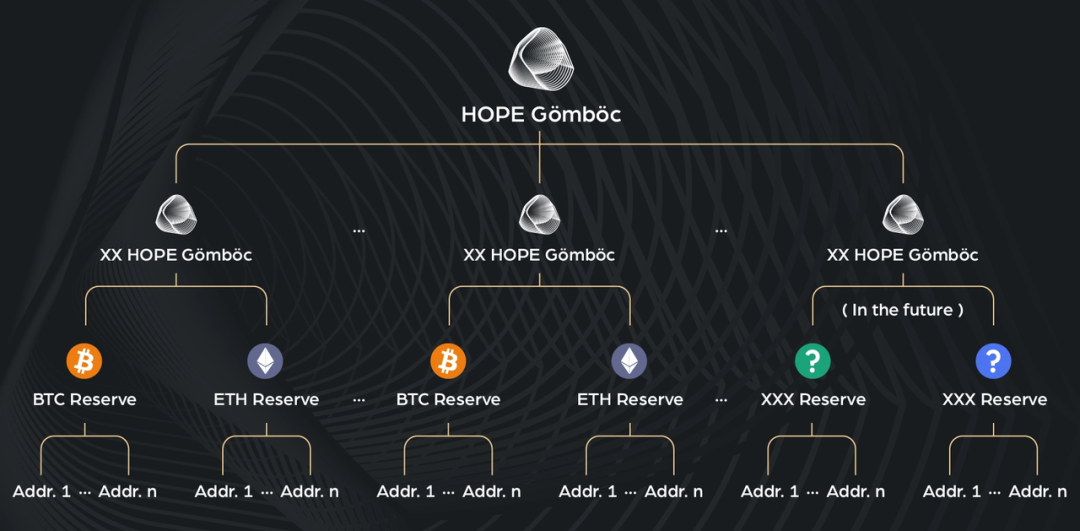
HOPE has made public all custodial wallet addresses, amounts, and fund movements, which can be verified using BTC and ETH blockchain explorers.
Notably, while public addresses prove equivalent collateral exists, details such as ownership, legal entities behind them, or inter-address relationships have not yet been disclosed, requiring further observation and analysis.
Naturally, one might question: Is relying on multiple third-party custodians merely replacing one form of centralization with another?
TechFlow raised this with the HOPE team, who described it as a pragmatic approach: choosing a distributed path between centralization and decentralization, aiming to combine strengths and avoid weaknesses for optimal feasibility.
Traditional DeFi promotes self-custody and full decentralization. But many traditional investors interested in HOPE emphasized one crucial requirement—they want auditability.
Currently, regulatory-compliant audits mainly recognize large custodians like Coinbase. Therefore, to attract traditional capital, HOPE collaborates with global institutions including Coinbase to provide secure, distributed custody of user assets.
From the perspective of a stablecoin’s “bring-in” function, attracting traditional investors is vital. Thus, pursuing full decentralization would sacrifice stability and capital efficiency—an impractical choice in the current market cycle. For HOPE’s long-term vision of bridging real-world payments, complete detachment from traditional capital rules would hinder adoption by mainstream funds and participants.
After understanding HOPE’s creation and custody design, another key aspect is circulation.
Phased Circulation Strategy:
$HOPE development falls into two broad phases: growth phase (price between $0.5–$1) and mature phase (price stabilized at $1). During the growth phase, only BTC/ETH can be used as reserve assets to mint $HOPE; market makers can arbitrage based on deviations between market price and intrinsic value.
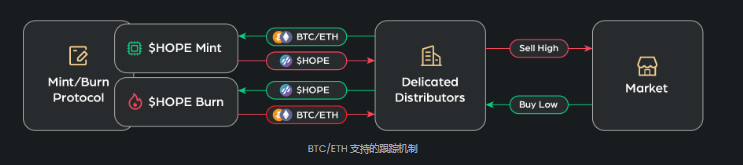
In the mature phase, other stable assets like USDC/USDT will be accepted as reserves for minting $HOPE. The project will also open automated on-chain mint/burn protocols at appropriate times, enabling broader participation.
Join TechFlow official community to stay tuned Telegram:https://t.me/TechFlowDaily X (Twitter):https://x.com/TechFlowPost X (Twitter) EN:https://x.com/BlockFlow_News
 深潮TechFlow