








Analyzing zkSync Era: The Pioneer of Zero-Knowledge Proof Scaling Solutions
TechFlow Selected TechFlow Selected
Analyzing zkSync Era: The Pioneer of Zero-Knowledge Proof Scaling Solutions
This article provides a comprehensive analysis of zkSync, the first Layer 2 network utilizing zk-rollup technology to launch on the mainnet, covering everything from the underlying public blockchain to the development of its ecosystem, and examining its fundamentals, data metrics, and ecosystem landscape.
 Navigating Web3 tides with focused insights
Produced by: DODO Research
Edited by: yaoyao & Lisa
Author: dt
Ethereum Layer 2 scaling mechanisms are currently the most prominent and fiercely contested area in blockchain technology.
This article provides a comprehensive analysis of zkSync—the first Layer 2 network using zk-rollup technology to launch on mainnet—from its foundational blockchain architecture to ecosystem development, covering fundamentals, data metrics, and the broader ecosystem.
I. Introduction to zkSync Era
zkSync is an Ethereum Layer 2 scaling solution built on a zk-rollup architecture, aiming to enable high-performance, low-cost smart contracts and decentralized applications. By leveraging zk-rollup technology, it achieves significant scalability improvements, reducing transaction fees and accelerating confirmation times. zkSync Era, built upon the zkSync protocol, offers faster transactions, greater scalability, and enhanced cost efficiency. It supports diverse use cases across DeFi, cross-chain bridges, NFTs, and more. Due to its high efficiency and low costs, zkSync has attracted widespread attention from capital markets and is rapidly growing.
Matter Labs, the company behind zkSync, has completed four funding rounds to date, raising a total of $458 million. Prominent investors include a16z, Dragonfly, 1KX, OKX Ventures, Bybit, and Blockchain Capital. This level of funding stands out not only within the Web3 space but also compared to typical Web2 startups, positioning zkSync as one of the leading unicorn projects in the blockchain industry.
With strong financial backing, cutting-edge technology, and recognition from Ethereum co-founder Vitalik Buterin as one of the pioneering zk-rollup projects, zkSync Era is among the few live zkEVM rollups available today. In terms of narrative appeal, capital support, and technical execution, zkSync Era stands out as a top contender—making it arguably the most anticipated and hottest blockchain in 2023.
History of zkSync Era
-
zkSync 1.0 - zkSync Lite launched on the Ethereum mainnet on June 15, 2020, achieving around 300 TPS in transaction throughput, though without EVM compatibility.
-
zkSync 2.0 - zkSync Era went live on March 24, 2023, supporting arbitrary smart contract functionality via Solidity (through zkEVM) and Zinc (the internal programming language for the rollup). Additionally, with zkPorter—a protocol combining zk-rollup and sharding—throughput scales exponentially to over 20,000 TPS.
The biggest selling point of zkSync Era over zkSync Lite is EVM compatibility, enabling execution of smart contracts written in Solidity or other high-level languages used in Ethereum development. This allows developers and users to seamlessly integrate into the ecosystem. Moreover, transaction costs have dropped by up to 50x compared to earlier versions, while the 20,000 TPS speed delivers a vastly improved user experience relative to both Ethereum and zkSync Lite.
Competitors of zkSync
zkSync’s competitors are various Layer 2 blockchains. Besides established leaders like Arbitrum One and Optimism, newer entrants using zk-rollup pose a critical challenge:
These include already-launched projects such as Polygon zkEVM, heavily funded Starkware, Consensys-developed Linea, Scroll (also focused on zkEVM), privacy-centric Aztec, exchange-backed solutions like Taiko (backed by OKX) and Mantle (developed by Bybit). Even Metis—an existing Optimistic Rollup—has announced plans to develop a Hybrid Rollup combining zk-rollup with its current model. Lastly, Kakarot, which received a pre-seed investment directly from Vitalik Buterin, has also drawn significant attention.
Currently, zkSync enjoys a full first-mover advantage. To maintain leadership and deliver superior user experiences going forward, cultivating a robust ecosystem will be just as crucial as technological advancement.
II. zkSync Era Data Overview
Before diving into specific ecosystem projects, let's examine key metrics such as Total Value Locked (TVL), official bridge inflows/outflows, and daily on-chain transaction counts to better understand the current state of the zkSync Era ecosystem.
In terms of TVL, zkSync Era reached $459 million just two months after launch. It has maintained steady growth since inception and currently ranks third among Layer 2 networks, trailing only Arbitrum One and Optimism, both of which use Optimistic Rollup.


Similarly, the official bridge data reflects ongoing ecosystem expansion, with cumulative deposit addresses reaching 800K. On average, about 10K new deposit addresses are added daily in June so far.

On the other hand, daily transaction volume (TX) peaked near 100K at launch but dipped to a low of only 1,300 transactions per day in early May, now stabilizing around 20K daily transactions. The decline may stem from the lack of a killer DApp on zkSync Era—initial transaction spikes were likely driven by novelty rather than sustained usage.

In summary, the ecosystem remains in an early stage. Achieving these results within less than three months of launch is impressive. After the initial FOMO phase, activity is now steadily rising, with expectations for breakthroughs as more on-chain projects deploy.
III. zkSync Era Ecosystem Projects
Established Projects
Even before launch, zkSync Era secured commitments from numerous projects including Balancer, Uniswap, Frax, OHM, and LayerZero—renowned protocols on Ethereum. However, actual deployments remain limited. Among those live, 1inch and iZUMi Finance stand out as the largest.
-
1inch Network
As a cornerstone DeFi aggregator, 1inch officially launched on zkSync Era on April 20, becoming the 11th blockchain to support the platform. Its presence provides a unified gateway for fragmented liquidity, allowing users to swap tokens without needing to choose between individual DEXs—boosting overall ecosystem development.
-
iZUMi Finance
Another multi-chain DeFi player, iZUMi was among the earliest and most proactive protocols to deploy on zkSync Era. With strong TVL, it currently ranks second on-chain and has emerged as a major competitor in the DEX space on zkSync Era.
Top Projects by TVL on zkSync Era
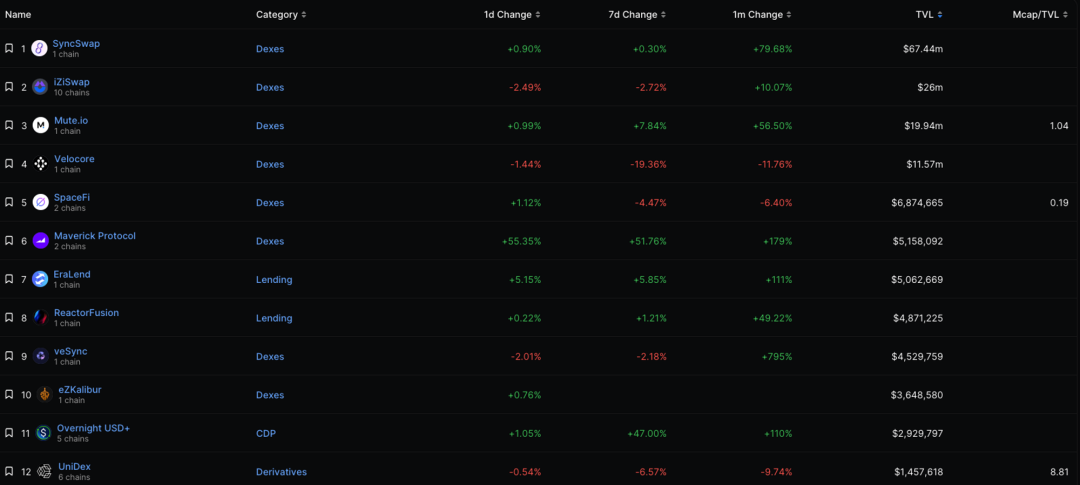
Data from Defillama reveals that the ecosystem is still very early-stage. The top five projects by TVL are all DEXs, and eight of the top ten are DEXs, with the remaining two being lending platforms. More complex sectors such as derivatives and GameFi have yet to see strong contenders. Below is a categorized overview of key projects.
DEX – Decentralized Exchanges
1. SyncSwap
SyncSwap is a decentralized exchange built on zkSync Era, offering low transaction fees while inheriting the full security guarantees of zkSync.
Features include gauge-based pool incentives, customizable fee structures, advanced routing, vote-escrowed token models, and governance.
Recently, SyncSwap launched Move, a cross-chain bridge based on zkSync Era’s official bridge, enabling transfers between Ethereum and zkSync Era for assets including USDC, ETH, USDT, WBTC, LUSD, LSD, MUTE, and others. Effectively, Move acts as a third-party frontend for the official zkSync bridge, with identical gas costs. Bridged tokens are 100% native zkSync assets, eliminating third-party risk. When users approve or transfer via Move, they interact directly with the official zkSync smart contracts.
2. iZUMi Finance
iZiSwap is a limit-order-book DEX launched by iZUMi Finance on zkSync Era. It uses iZUMi’s Discrete Liquidity AMM (DL-AMM), similar to Uniswap V3’s concentrated liquidity model, allowing liquidity providers to allocate funds at precise price points, improving capital efficiency.
iZiSwap builds on the legacy of AMM-based DEXs like Uniswap. Its innovative design enhances liquidity provision efficiency and significantly improves user trading experience, setting it apart in the competitive DEX landscape.
Notably, iZiSwap introduced a fully decentralized limit order book system. All limit orders at a single price point are treated as one unit during execution, enabling O(1) time complexity for trades. Whenever the market price crosses a given price level, filled orders are moved to a separate storage space called "legacy," ensuring clear ordering and correctness of trade settlement.
Finally, users must manually claim their executed assets. This design ensures full control over funds and avoids potential security issues arising from automatic asset transfers.
This approach brings several benefits: First, treating all orders at a price level as a single unit enables O(1) execution speed. Second, if the price crosses a target level (at time A) and later returns (at time B), orders placed after time B won’t be marked as filled, preserving correctness. Third, when the price sits exactly at the target level, the first user to initiate a claim receives the proceeds, ensuring fairness under a “first-come, first-served” principle.
Overall, iZiSwap’s innovative limit order management system delivers significant improvements in security, efficiency, and fairness, offering users a superior trading environment.
3. Maverick Protocol
Maverick Protocol is a DeFi liquidity infrastructure designed to serve traders, liquidity providers, DAO treasuries, and developers through liquidity markets powered by Maverick AMM.
Users can trade and provide liquidity on Maverick AMM. There are four liquidity modes: Mode Right, Mode Left, Mode Both, and Mode Static. Once selected, the AMM automatically shifts liquidity following price movements according to predefined rules. Maverick allows LPs to open Boosted positions, where incentive rewards attract targeted liquidity. Other users can add liquidity to these boosted positions to earn shares. LPs earn revenue from trading fees and liquidity incentives.
4. Mute
Mute.io is a zkRollup-based DEX on zkSync Era, featuring modules such as limit orders, staking, and bond platforms. It supports wallet integration, trading, LP pools, Amplifier, bonds, and DAO governance. Supported assets include ETH, USDC, MUTE, WISP, ZKINA, MVX, IDO, WETH, USD+, ZKDOGE, DOF, BOLT, ZKFLOKI, and more.
After providing liquidity, users receive LP tokens, which can be staked in the Amplifier to earn additional yield. Bonds are a novel feature: users can purchase MUTE tokens from the Mute DAO at a discount using their LP tokens. After purchasing a bond, MUTE unlocks after seven days. If ROI is positive, users earn more MUTE than the value of their LP tokens. This mechanism helps the Mute DAO increase protocol-owned liquidity, treasury income, and long-term liquidity health. dMute is the DAO governance token of the Mute.io ecosystem. Users lock MUTE for 7 to 364 days in exchange for dMUTE and can redeem MUTE after the lock period ends.
5. SpaceFi
SpaceFi is a Web3 platform bridging the Cosmos and Ethereum Layer 2 ecosystems, offering products including a DEX, NFT marketplace, Starter (launchpad), and Spacebase, with future plans for gaming and social networking features.
It supports trading and liquidity provisioning for ETH, USDC, SPACE, and WETH. Users can stake xSPACE or LP tokens like SPACE-USDC in farms to earn xSPACE rewards. Starter serves as an incubation and fundraising platform where users stake USDT, ETH, or LP tokens to receive project tokens at initial offering prices. Spacebase is an on-chain community tool—creating or joining one grants extra mining rewards. Planet NFTs are minted with SPACE tokens, and holders can submit on-chain proposals. Both Planet NFT and xSPACE holders participate in governance voting.
6. Velocore
Velocore is the first ve(3,3) DEX on zkSync Era, built on codebases from Velodrome Finance and Solidly.
Its core function is enabling low-cost, low-slippage digital asset trading. Users can add liquidity to LP pools (divided into Stable Pools and Volatile Pools) and earn VC token incentives. VC is Velocore’s native token. VC holders can vote-lock their tokens to receive veVC (veNFT), which is transferable, mergeable, and splittable. VC lockup periods extend up to four years—the longer the lock, the higher the voting power and reward share. veVC holders also receive protocol fees, bribes, and rebates. Bribes incentivize others to vote for specific LP pools. Velocore also operates a Launchpad and has launched a memecoin called WAIFU.
7. veSync
veSync is another ve(3,3) DEX on zkSync Era, forked from Velodrome Finance. It has a TVL of approximately $4.85 million, ranking seventh on zkSync Era, with nearly 20% growth over the past week.
Its native token is VS, and its governance token is veVS (veNFT), which is transferable, mergeable, and divisible. Using the ve(3,3) incentive model, token holders can vote-lock their tokens to receive veNFTs, with longer lock-up periods yielding greater voting power and rewards. Currently, veSync liquidity pools are split into Stable Pools and Volatile Pools, with trading fees ranging from 0.02% to 0.05%. In the future, veSync plans to introduce Concentrated Pools, allowing users to customize their liquidity ranges. Users select specific pools to vote on and earn bribes.
8. eZKalibur
eZKalibur is a newly launched DEX this week. It raised 653 ETH during its token sale and is a fork of Camelot, a leading DEX on Arbitrum. Mimicking Camelot’s xGrail, it employs a unique token lock-and-dividend mechanism and includes a launchpad. Given its recent launch, users should remain cautious about potential security risks.
Lending – Lending Markets
Lending remains one of the most critical infrastructures on any blockchain after DEXs. However, Chainlink has not yet integrated with zkSync Era, so Redstone Finance currently provides oracle services. Without trusted price feeds, whale users remain hesitant to participate. Combined with the limited availability of only two major assets—ETH and USDC—and few real-world use cases, the lending sector on zkSync Era remains lukewarm. Most users are likely short-sellers or yield farmers.
1. Eralend
Previously known as Nexon Finance, Eralend is a Compound fork, sharing similarities with ReactorFusion. Mechanically, it lacks major innovation. However, it was featured in an official zkSync Era Twitter post highlighting ecosystem projects. As it hasn't issued a governance token yet, it has attracted many short-sellers. Its TVL is comparable to ReactorFusion, both around $5 million, making it one of the leading lending protocols on zkSync Era.
2. ReactorFusion
ReactorFusion is the first project launched from Velocore’s Launchpad. It is a Compound fork with a unique bribe-reward token mechanism, closely tied to Velocore’s token economy. Its current TVL is approximately $5 million.
CDP – Overcollateralized Stablecoins
Overnight USD+
Overnight is a multi-chain project originating on Polygon, now supporting five chains: Polygon, BSC, OP, ARB, and zkSync Era. It was among the few protocols to quickly deploy across chains upon zkSync Era’s launch. Its main offerings are USD+, a yield-bearing stablecoin pegged to USDC, and ETS, a delta-neutral yield-generating vault strategy. Operational for about a year, the team is relatively trustworthy, making it suitable for DeFi farmers seeking high-yield stablecoin opportunities.
Derivatives
Unidex
Unidex is a multi-chain project whose flagship product is a decentralized perpetual futures exchange. It aggregates order book depth from other perpetual exchanges and supports features like limit orders, take-profit, and stop-loss. Beyond crypto assets, it offers trading in U.S. stocks and forex, functioning as an on-chain perpetual contract aggregator. Additional products include spot trading aggregation and limit order capabilities.
Other Projects
Kreatorland
Kreatorland is an OpenSea fork operating on zkSync Era, serving as a one-stop NFT platform. Featured in an official zkSync Twitter thread, it offers NFT minting, a launchpad, and a marketplace. Currently, only one NFT collection, Poop Genesis, is listed.
Goal3
Goal3 is a betting platform on zkSync Era, previously shared on zkSync’s official Twitter. Its $ZKG Lockdrop event attracted 2.8M USDC in deposits, nearly 50% of which came from addresses locking for one year. Funds from the Lockdrop are used to provide market depth for the betting platform. The beta version is live, allowing users to place bets on various sports events.
Conclusion
zkSync boasts a rich development history and promising future outlook. As Ethereum technology advances, competition in the zk-rollup and zk-EVM space intensifies. zkSync Era’s first-mover advantage has enabled it to establish an ecosystem early. Current data and ecosystem developments confirm that zkSync Era is in a stable growth phase.
From the number of protocols, the DEX sector is clearly the most mature in the zkSync ecosystem. Whether traditional Uni V2 forks, ve(3,3) Solidly forks, or concentrated liquidity DEXs, all have achieved notable success. In contrast, sectors like lending, derivatives, NFTs, and GameFi lack standout, innovative applications that attract broad user engagement. We can expect more exciting DeFi Lego projects to emerge as foundational infrastructure—including cross-chain protocols, oracles, and stablecoins—becomes more widely deployed.
That said, alongside rapid ecosystem growth come increasing risks—rug pulls occur frequently, and there have been instances where code compatibility issues led to user funds being locked. Participants should carefully evaluate project teams and other factors. Nonetheless, new ecosystems bring new opportunities, and active participation may uncover high-potential early-stage projects.
Join TechFlow official community to stay tuned
Telegram:https://t.me/TechFlowDaily
X (Twitter):https://x.com/TechFlowPost
X (Twitter) EN:https://x.com/BlockFlow_News
 Dr.DODO






