zkSync Airdrop Imminent: Quickly Understand the Project's Advantages and Potential
TechFlow Selected TechFlow Selected
zkSync Airdrop Imminent: Quickly Understand the Project's Advantages and Potential
The zkSync system is highly scalable, high-performance, and highly secure, fundamentally different from other systems unfortunately grouped together as "L2".
 Navigating Web3 tides with focused insights
Author: Anthony Rose, zkSync developer
Compiled by: TechFlow
The L2 landscape has changed dramatically over the past few years—previously, you never had to scroll down on @l2beat to see a long list of various L2s.
I also know that understanding the differences between these systems isn't easy. Let me briefly explain what we’re building at @zksync. This space is extremely complex—even developers within the Ethereum ecosystem struggle to understand the distinctions between rollup projects—and with all the hype and marketing, it’s even harder to identify what actually matters.
Optimistic rollups and ZK rollups are still poorly understood, let alone newer solutions emerging in the blockchain space like optimiums, volitions, and validiums. I’ll try to simplify this topic because the system we're building is truly exciting, and I want more people to understand it clearly.
Our vision is to build a foundational system beneath the application layer that adds value to the lives of billions of people. Just as today’s internet enables applications that improve people’s lives, blockchain can enhance these applications even further by delivering greater value and ownership.
To achieve this vision, it's clear the system must be scalable, just like the internet. Engineers refer to this kind of scaling as "horizontal scaling"—essentially, we need only add more hardware and expand the network. We must deliver this without compromising any of the key metrics.
You can verify the correctness of a massive system—one performing enormous computational work—with a tiny proof that can be checked on any smartphone. This is why ZK systems can (reasonably) achieve horizontal scaling, while Optimistic systems cannot. This is the core advantage of ZK.
This horizontal scaling practically means: deploying more rollups on top of this protocol layer. These rollups can be application-specific or general-purpose, but they can all be abstracted away from end users. Here’s a very scientific diagram to help illustrate the idea:
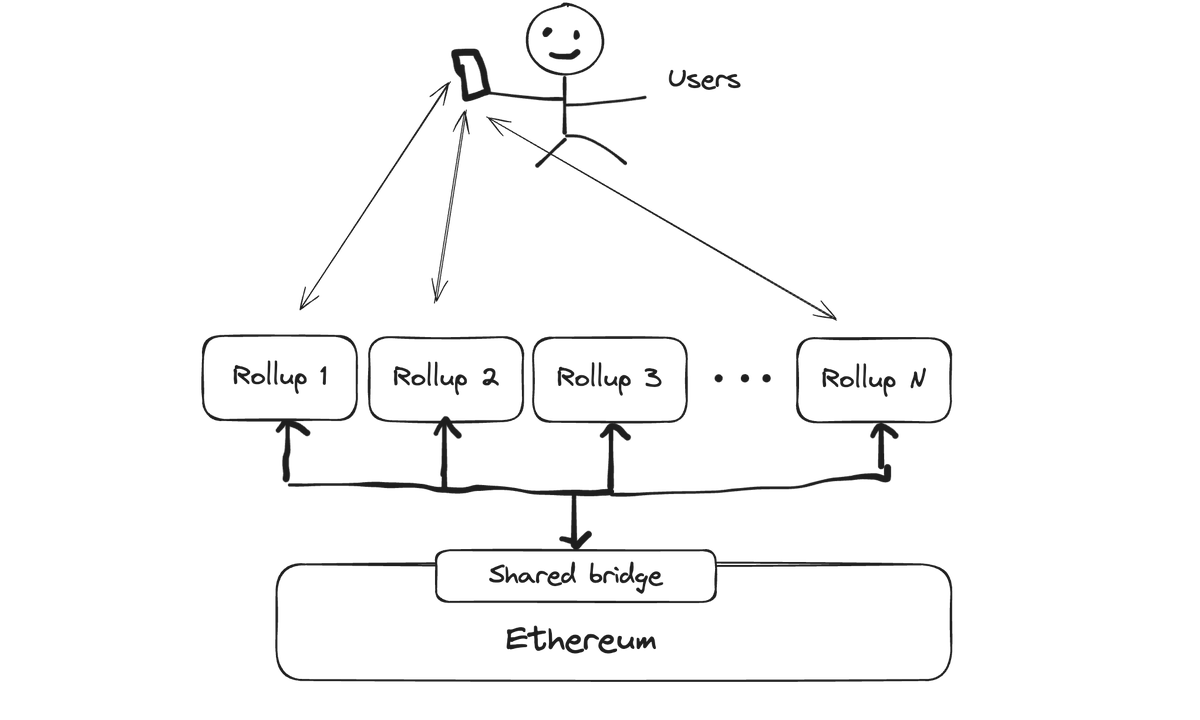
At the protocol layer, these systems must interact trustlessly. Without this, the entire user experience becomes fragmented—just like it is today when using different L2s or L1s.
Optimistic systems cannot properly enable such interactions. The options are essentially limited to:
-
Waiting 7 days (challenge period) for interaction
-
Each L2 running a full node for every other L2 its users wish to interact with
-
Using intermediaries who charge users fees
None of these are ideal. With ZK technology, however, these systems can achieve trustless interoperability—any rollup can communicate with another and cryptographically verify the correctness of the other’s state. This is guaranteed by mathematical proofs. Users don’t even need to know where the game they’re playing is hosted, or which rollup their friend is using when they want to send $20 for lunch.
Optimistic rollups also require publishing all transaction inputs to L1, as this is how they operate—the data is necessary to resolve potential challenges around state transitions. This creates a huge amount of data, a problem that ZK systems do not face.
You can prove the correctness of a system without publishing all of its state to L1 (you can publish elsewhere, or build a private system). This is a validium. You know it’s correct, but there is no state record on Ethereum.
I’ve also mentioned that across the entire @zksync ecosystem, proofs can be combined—you can verify the entire network with a single proof. This means that as the system scales, on-chain costs approach zero, and verification remains possible on any smartphone.
The @zksync system we are building is highly scalable, high-performance, and highly secure—fundamentally different from other systems unfortunately lumped together under the term "L2". These systems are not the same, and many will disappear within a year.
The future ecosystem will consist of many ZK chains, configured differently for specific use cases, but all sharing the same strong security guarantees, speed, and ability to interact trustlessly. Anyone can permissionlessly deploy a new ZK chain into the ecosystem and immediately interoperate across the entire network.
There’s much more to say about @zksync, but the above captures the core points I wanted to share today. This is why I’m excited about @zksync, why ZK systems will truly change the world, and why ZK is ultimately the solution.
Join TechFlow official community to stay tuned
Telegram:https://t.me/TechFlowDaily
X (Twitter):https://x.com/TechFlowPost
X (Twitter) EN:https://x.com/BlockFlow_News
 @zksync