zkSync’s Founder “Personally Laid Off” Core Team; Former Ethereum Scaling Star Fully Shifts Focus to Serving Banks
TechFlow Selected TechFlow Selected
zkSync’s Founder “Personally Laid Off” Core Team; Former Ethereum Scaling Star Fully Shifts Focus to Serving Banks
The community’s response is divided, with the sharpest question being: “You raised $458 million—where did the money go?”
 Navigating Web3 tides with focused insights
Author: Claude, TechFlow
TechFlow Intro: On June 17, Alex Gluchowski, founder of Matter Labs—the parent company of zkSync—announced another round of layoffs. The company is now fully pivoting to Prividium, a permissioned privacy blockchain designed specifically for regulated financial institutions.
This marks Matter Labs’ second round of layoffs within two years. A founder who once identified himself as a “freedom maximalist” has ultimately steered the project toward compliance, permissioned access, and banking. Community reactions are sharply divided, with the most pointed question being: Where did the $458 million raised go? The $ZK token currently trades at approximately $0.019—down roughly 93% from its all-time high.

The zkSync story is veering sharply away from its original promise.
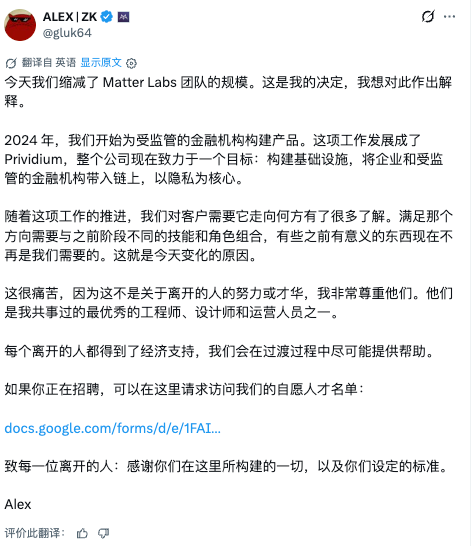
On June 17, Matter Labs founder and CEO Alex Gluchowski posted on X announcing a reduction in the company’s team size. “Today we reduced the size of the Matter Labs team. This was my decision, and I’d like to explain why,” he wrote at the start of the post.
Those laid off included senior engineers, designers, and operations staff—whom Gluchowski described as “the strongest group I’ve ever worked with.” This is Matter Labs’ second round of layoffs since September 2024; the official layoff ratio was not disclosed.
What truly matters isn’t how many people were cut—but what this company has decided to become.
A Complete Strategic Pivot: From “Serving Everyone” to “Serving Banks”
In his post, Gluchowski clearly laid out the rationale behind the layoffs: since 2024, the company has been building products for regulated financial institutions—a project that later evolved into Prividium. “The entire company is now focused on a single goal: building infrastructure enabling enterprises and regulated financial institutions to go on-chain—with privacy at its core,” he stated.
What is Prividium?
In short, it’s a permissioned blockchain—directly opposed to zkSync’s long-standing ethos of being public, permissionless, and open to anyone. Permissioned means only approved institutions may join; ordinary users are excluded.
Matter Labs’ official website describes Prividium as an Ethereum-based platform tailored for financial institutions and fintech firms, currently running pilot programs with Deutsche Bank and UBS.
The irony lies in Gluchowski himself.
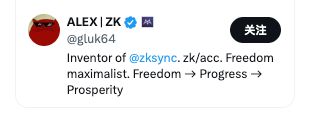
His X bio reads “freedom maximalist,” echoing his belief in the sequence “freedom → progress → prosperity.” zkSync technology had long been regarded by the crypto community as a public good. In 2024, when Matter Labs attempted to trademark “ZK,” zero-knowledge researchers collectively opposed the move, prompting Matter Labs to withdraw the application—on the grounds that such foundational technologies should not be monopolized by any single entity.
Today, the company has deliberately shifted focus—from a public blockchain serving retail users and developers—to a permissioned chain serving licensed banks.
The $458 Million Question—and Immediate Community Backlash
Gluchowski likely anticipated the reaction beneath his post.
Matter Labs has raised approximately $458 million across multiple rounds, backed by prominent firms including Dragonfly and Blockchain Capital. Its Series C round alone brought in $200 million in 2022. Community responses split sharply: one camp expresses cautious optimism about Prividium’s direction, while the other directly questions where the funds went. One widely shared comment read: “Can you explain? You raised $450 million to build a product. Where is the money? Why are you still fundraising while laying people off?”
This isn’t the first time Matter Labs has faced scrutiny over layoffs.
In September 2024, the company cut 16% of its workforce—24 employees—reducing headcount to 126. At the time, official statements repeatedly stressed that the company remained “financially sound,” framing the layoffs as necessary to “maintain lean operations,” not due to cash constraints. The phrasing used in both rounds is nearly identical: “misalignment between team structure and current needs.”
The issue is that, for a company raising nearly $500 million—and still actively fundraising—two rounds of layoffs within two years significantly erode credibility around the claim that “this isn’t about funding.”
$ZK Down 93%: Retail Token Holders Bear the Cost of Strategic Shift
The most immediate cost of this strategic pivot falls squarely on retail investors in the secondary market.
The $ZK token currently trades at ~$0.019—down roughly 93% from its all-time high of $0.27, reached shortly after its June 2024 launch. For most of its trading life, $ZK has traded below its issuance price. Its current market cap stands at ~$180 million, ranking outside the top 150 among crypto assets.
The token’s awkwardness stems from a fundamental misalignment between its value-capture logic and the company’s new direction. Prividium serves banks—and relies on an off-chain business model centered on enterprise licensing fees.
A Survival Move Amid L2 Saturation
Zooming out, Matter Labs’ pivot reflects broader intensifying competition across the Ethereum Layer 2 landscape.
Ethereum Layer 2 networks—scalability solutions built atop Ethereum’s mainnet aiming for faster, cheaper transactions—have seen an influx of players in recent years: Coinbase’s Base, Arbitrum, Optimism, Polygon, and others—all competing fiercely for the same pool of developers and users. zkSync had previously ranked as the most active ZK-based L2, but user engagement dropped sharply after its June 2024 airdrop. Active addresses peaked above 200,000 in July, falling to just ~30,000 by year-end (7-day average). In a highly commoditized, undifferentiated general-purpose L2 space, shifting toward the higher-margin, lower-competition niche of “serving banks” is a commercially rational decision.
Yet this decision carries a cost. It means abandoning part of the early adopter base—those who believed in and bought $ZK precisely because they trusted the narrative of “permissionless, for everyone.” Matter Labs chose a more pragmatic—and more profitable—path, paying for it by dismantling the very brand identity it once built.
In closing his post, Gluchowski told departing team members: “Thank you for everything you built here—and thank you for setting the standard.”
That sentence applies equally well to the company itself.
Join TechFlow official community to stay tuned
Telegram:https://t.me/TechFlowDaily
X (Twitter):https://x.com/TechFlowPost
X (Twitter) EN:https://x.com/BlockFlow_News
 深潮TechFlow