








US SEC Sues Binance: Key Points Summary – Is It All About the Money?
TechFlow Selected TechFlow Selected
US SEC Sues Binance: Key Points Summary – Is It All About the Money?
In the eyes of many industry professionals, the SEC's core motivation this time is still financial gain—"the SEC might as well become the U.S. government's main profit-making department."
 Navigating Web3 tides with focused insights
On June 5, according to Bloomberg, the U.S. Securities and Exchange Commission (SEC) filed lawsuits against Binance Holdings Limited, its CEO Changpeng Zhao (CZ), and two other subsidiaries—BAM Trading Services ("BAM Trading") and BAM Management US Holdings Inc. ("BAM Management"). After having ChatGPT review the 130-page complaint, we believe the following key points are worth noting.
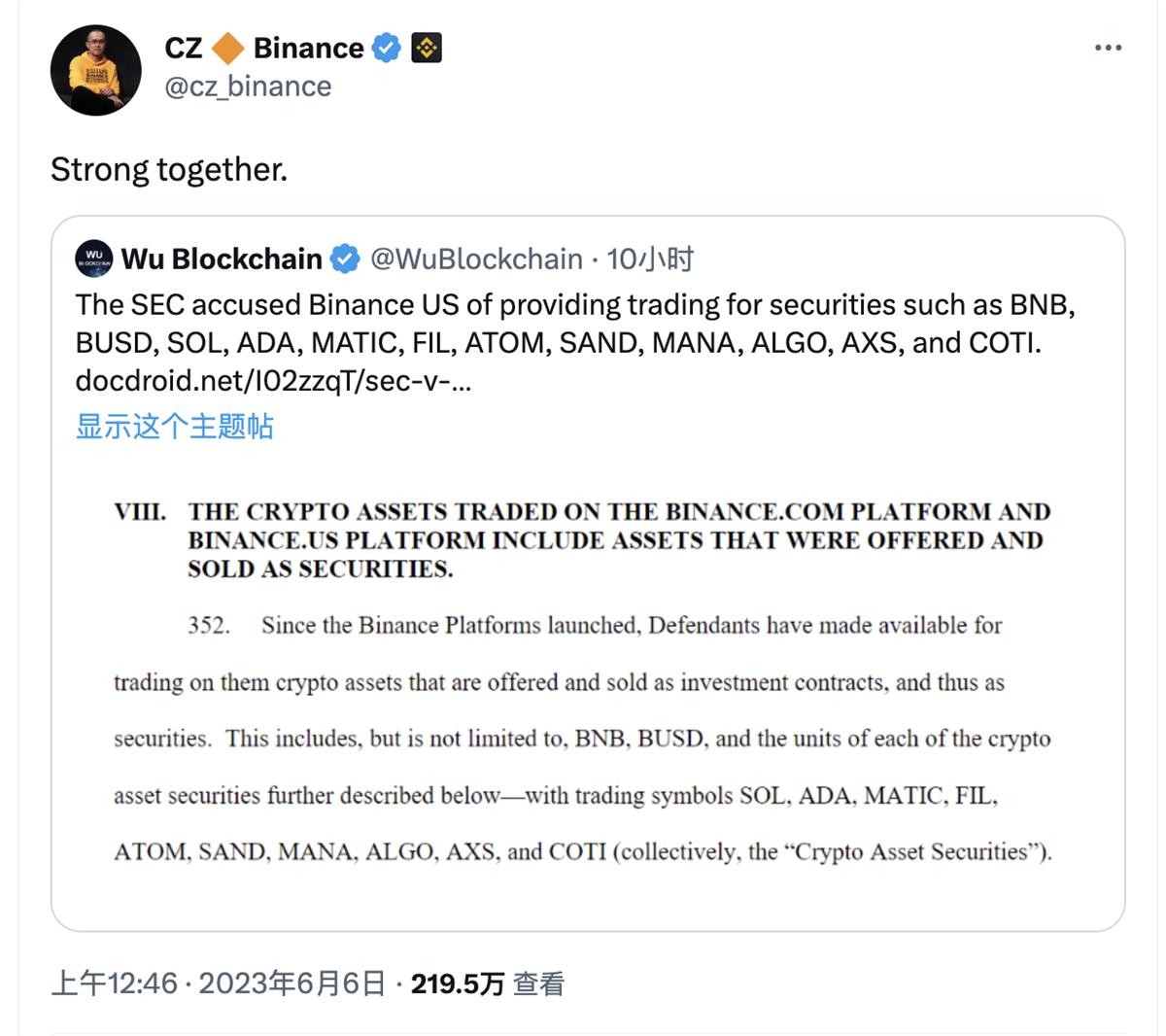
1. In its lawsuit against Binance, the U.S. SEC classified several tokens traded on Binance.US—including SOL, ADA, MATIC, FIL, ATOM, SAND, MANA, ALGO, AXS, and COTI—as securities, though this list is non-exhaustive. Previously, SEC Chair Gary Gensler repeatedly stated publicly that under U.S. law, proof-of-stake (POS) tokens using staking protocols should be considered securities. This would naturally include ETH. However, Rostin Behnam, Chair of the Commodity Futures Trading Commission (CFTC), opposes this view, arguing Ethereum is a commodity.
This stance dramatically broadens the SEC’s scope from just Binance to the entire cryptocurrency industry. CZ responded on social media: “We need to stand strong together.”
2. Notably, during his tenure as an MIT professor, SEC Chair Gary Gensler once said in class that 75% of cryptocurrencies are not securities but commodities, stating specifically that Ethereum was sufficiently decentralized to not qualify as a security—and even praised Algorand for its superior technology.
Ironically, after becoming SEC Chair, the agency proceeded to sue Algorand, alleging its native token $ALGO is an unregistered security.
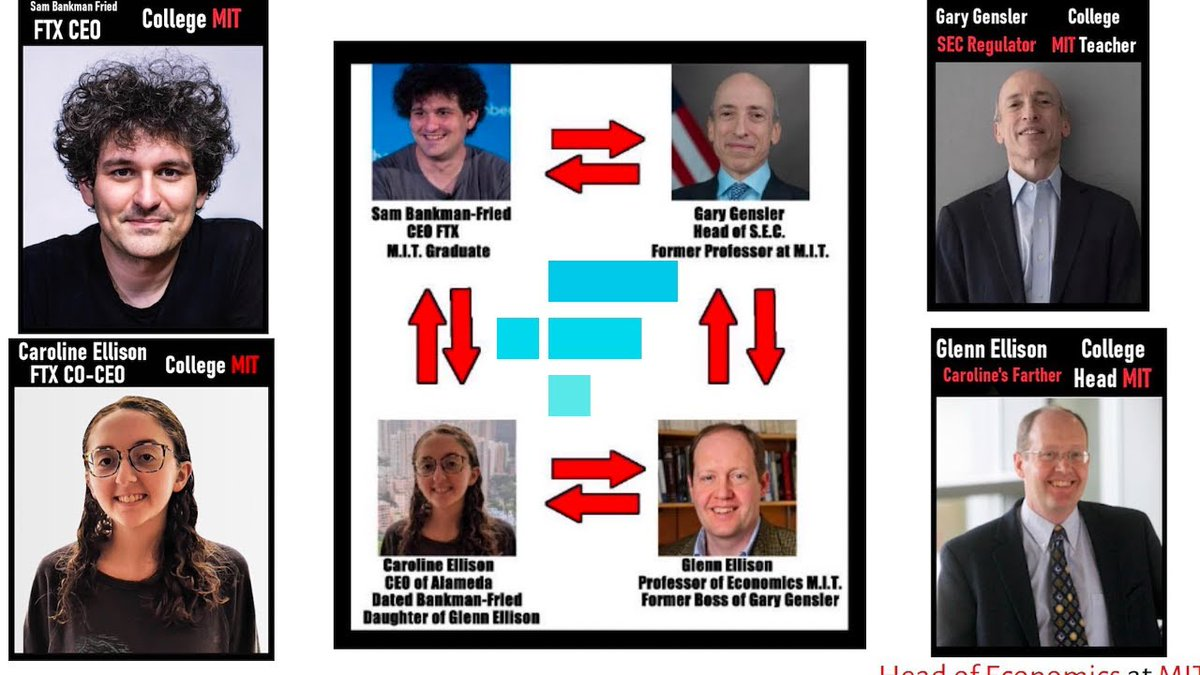
Additionally, Gary Gensler has faced scrutiny over alleged close ties with individuals connected to FTX founder SBF.
3. According to the complaint, Sigma Chain—the primary market maker for Binance—is in fact owned by CZ and operated by multiple Binance employees. The后勤 manager at Binance also serves as president of Sigma Chain.
After the launch of Binance.US, Sigma Chain became one of its first market makers. Furthermore, since Binance.US began offering over-the-counter (OTC) trading, conversion services, and one-click buy/sell (OCBS) features, Sigma Chain has acted as the counterparty for Binance.US customers—and sometimes the sole counterparty.
The SEC alleges that from September 2019 to June 2022, Sigma Chain engaged heavily in spoofing trades, artificially inflating Binance.US trading volume, with wash trading accounting for between 70% and 99% of activity.
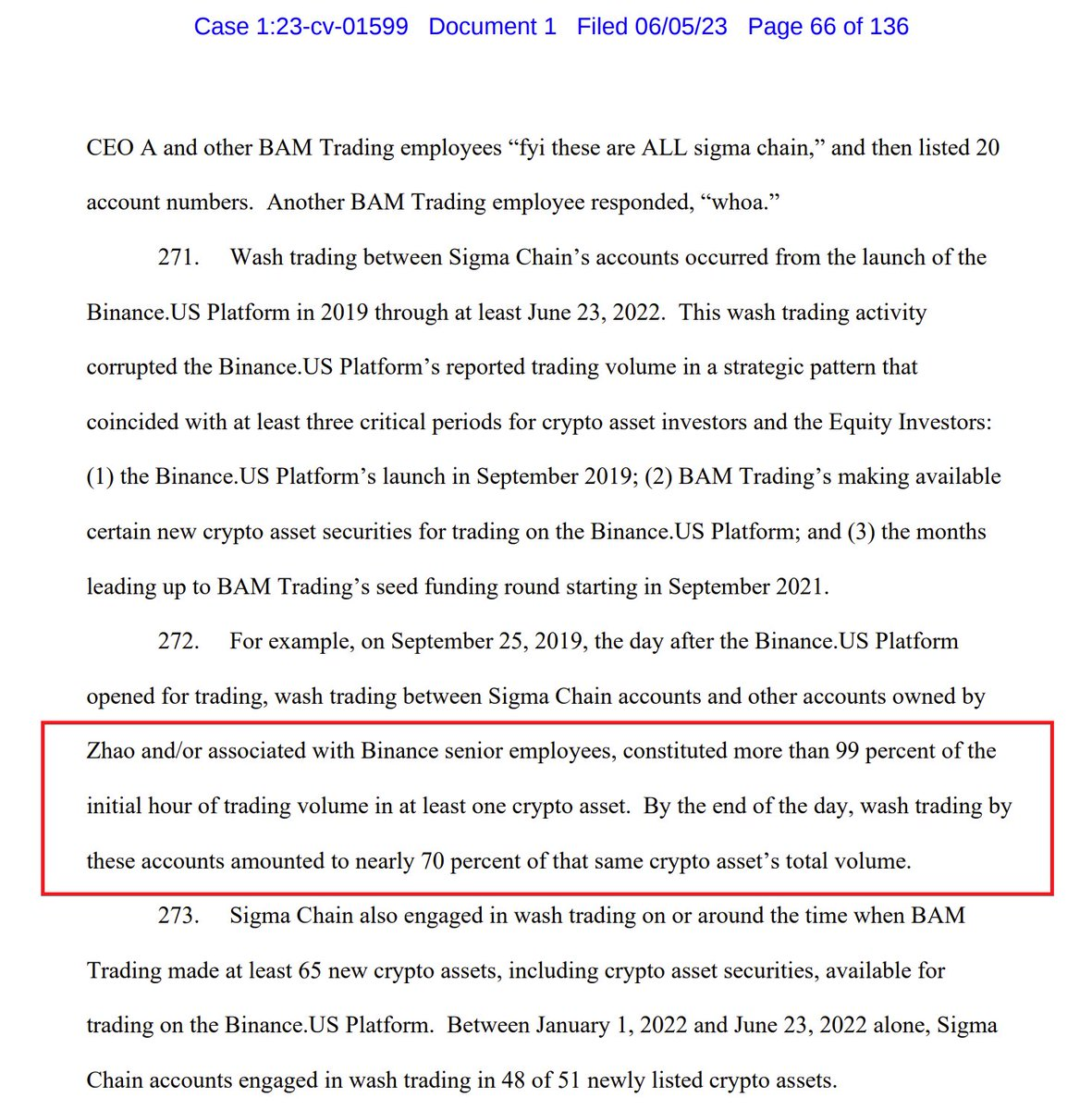
Has the mysterious Binance market maker finally been exposed?
4. The SEC has brought 13 main allegations against Binance and CZ, which can be summarized as follows:
-
Binance illegally provided three core securities market functions—exchange, brokerage, and clearing—activities that require registration under U.S. law. Binance chose not to register, thus evading regulatory oversight.
-
Binance illegally issued and sold unregistered crypto asset securities, including “BNB,” “BUSD,” “BNB Vault,” “Simple Earn,” and staking services.
-
BAM Trading and BAM Management made false statements about Binance.US, securing approximately $200 million in investments and billions in trading volume.
-
Binance and affiliated entities commingled or transferred customer assets and made false representations to investors.
5. The SEC is seeking the following remedies:
-
Permanent injunctions against further violations
-
Disgorgement of ill-gotten gains plus prejudgment interest
-
Civil monetary penalties
-
Appropriate and necessary relief for investor compensation
-
Prohibition of CZ and related parties from using interstate commerce channels (i.e., commercial rights) to engage in the issuance, purchase, offer, or sale of securities—including crypto asset securities—or other financial services.
6. It's important to note that the SEC’s case against Binance is a civil lawsuit, not criminal. Its purpose—as outlined above—is to prevent future violations and require Binance to pay fines and compensate investors.
Criminal proceedings involve breaches of criminal law, are brought by government authorities, and may result in fines, imprisonment, or other criminal penalties. In the securities space, criminal cases are typically handled by the U.S. Department of Justice—for example, the arrest of several BitMEX founders on money laundering charges was a DOJ-led criminal prosecution.
Therefore, many in the industry see the SEC’s current move primarily as financially motivated. Lan Ling, General Counsel at Fenbushi Capital, commented on social media: “The SEC might just become the U.S. government’s most profitable department.”
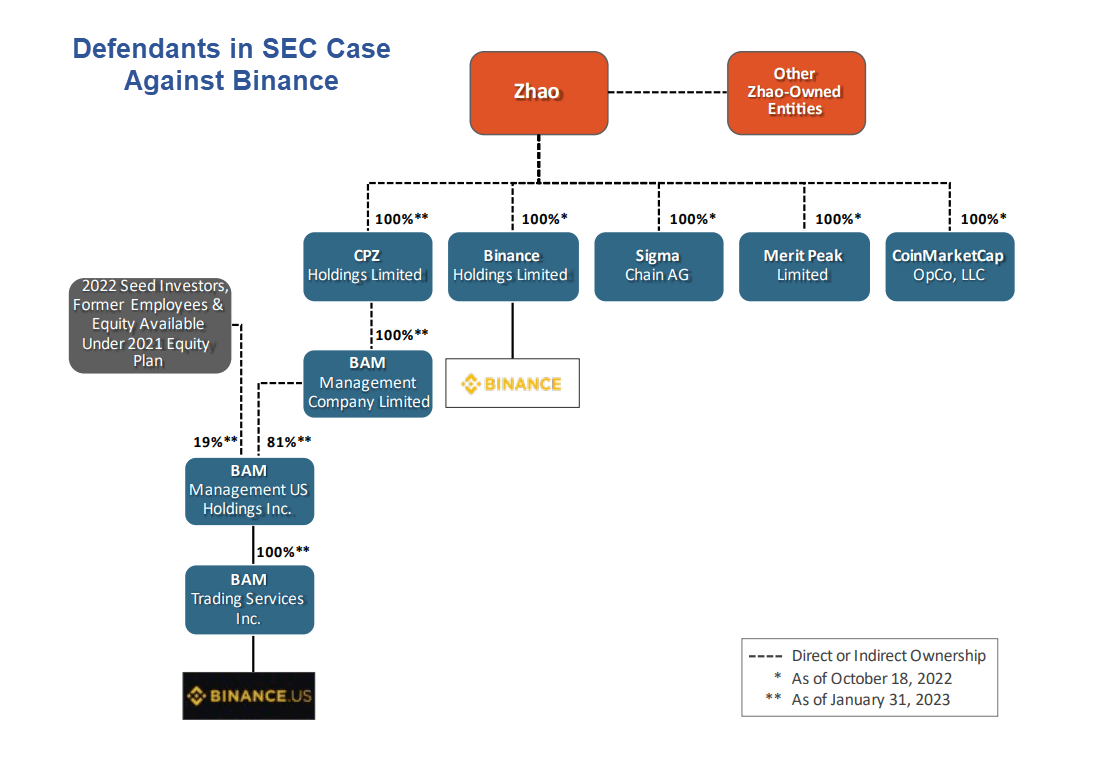
7. Organizational chart of CZ and Binance:
8. Throughout the 136-page complaint, one of the most frequently cited individuals is Binance’s Chief Communications Officer (CCO).
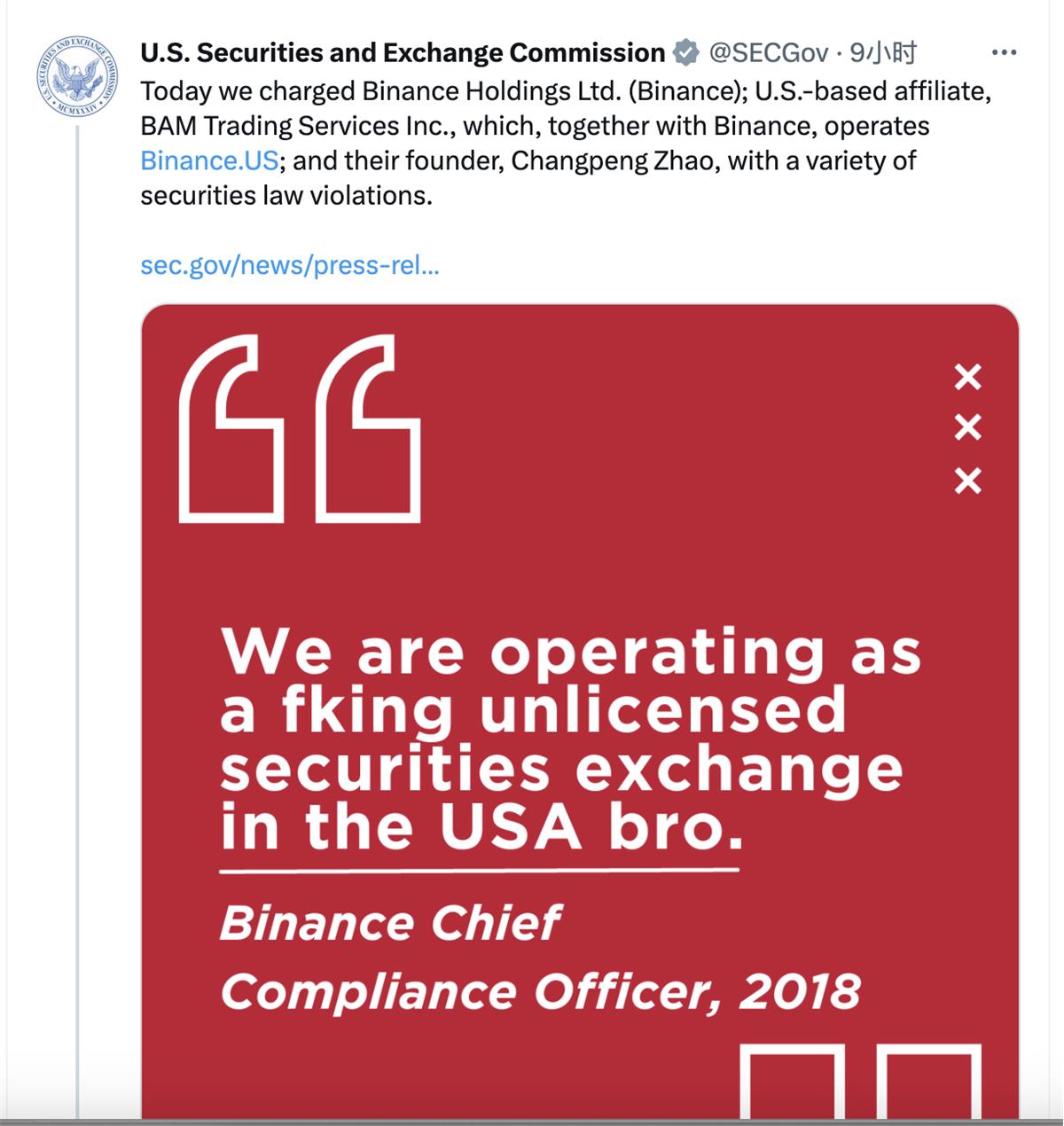
His most infamous quote, from December 2018: “Bro, we’re an unlicensed fucking securities exchange in the U.S.”
The SEC even turned this quote into a graphic and posted it on Twitter.
The CCO also stated, “We don’t want [Binance].com to ever be regulated.” In a 2020 communication, he added: “On the surface, we don’t have U.S. users, but in reality, we should obtain them through other creative methods.”
So who exactly is this CCO? Publicly available information identifies Binance’s Chief Communications Officer as Patrick Hillmann.
So in the workplace, it’s better to avoid making provocative remarks.
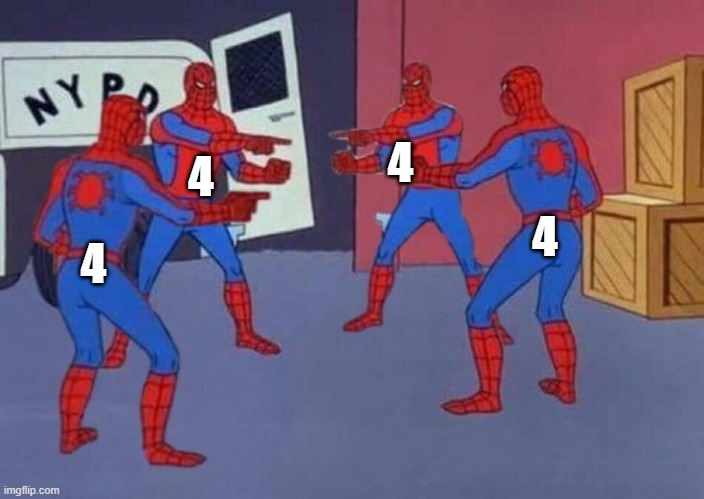
9. Finally, some memes:

Join TechFlow official community to stay tuned
Telegram:https://t.me/TechFlowDaily
X (Twitter):https://x.com/TechFlowPost
X (Twitter) EN:https://x.com/BlockFlow_News
 深潮TechFlow


