








Trader Joe's Business Overview, Token Model, and Valuation: Has It Found a Second Wind on Arbitrum?
TechFlow Selected TechFlow Selected
Trader Joe's Business Overview, Token Model, and Valuation: Has It Found a Second Wind on Arbitrum?
Trader Joe's core strengths lie in its resilient, highly capable, and innovative core team, strong product experience, and innovative liquid order book that has driven rapid user growth. Currently, Arbitrum serves as the primary engine for its business expansion.
 Navigating Web3 tides with focused insights
Author: Mint Ventures
1. Key Report Highlights
1.1 Core Investment Thesis
Trader Joe’s core strengths lie in its resilient team with strong execution and innovation capabilities, excellent product experience, and the innovative liquidity orderbook that has driven rapid user growth. Currently, Arbitrum serves as the primary engine for its business expansion.
Although competition within the Dex sector remains intense—leaving projects with little pricing power over traders or liquidity providers, and leaving most platforms operating at a loss or with minimal profit—this market dynamic is unlikely to improve in the short term. However, due to the dual cyclicality of both the crypto market and the Dex sector, projects like Trader Joe still have the potential to outperform the broader market during bull cycles.
1.2 Major Risks
The main risks stem from fierce competition. Its home chain Avalanche faces ecosystem contraction and competition from Uniswap v3. While Arbitrum is currently the key growth market, it remains in a phase of low pricing and subsidy-driven volume growth, where trading volume and fee income are unstable and heavily dependent on event-driven projects for transaction activity.
1.3 Valuation
Currently, Trader Joe trades at higher valuation multiples across PF, PS, and PE compared to similar projects—see section 4.2 for details.
2. Project Overview
2.1 Business Scope
Trader Joe is a comprehensive DeFi platform offering spot DEX, decentralized lending (Banker Joe), NFT marketplace (Joepeg), and launchpad services (Rocket Joe). Its operations span Avalanche, Arbitrum, and BNB Chain. Spot trading remains Trader Joe's core and leading business segment.
2.1.1 Spot DEX
Trader Joe’s spot DEX, its flagship service, features several product innovations, most notably its V2 product—the Liquidity Orderbook (LB).
The liquidity orderbook represents an evolution of Uniswap V3’s concentrated liquidity concept. At its core, it combines mechanisms from both “order books” and “liquidity pools.”
a. Orderbook: Collection of Bins
LB introduces “Bin,” a price interval unit, building upon the concept of concentrated liquidity. Each Bin (or liquidity bin) represents a fully funded price range.
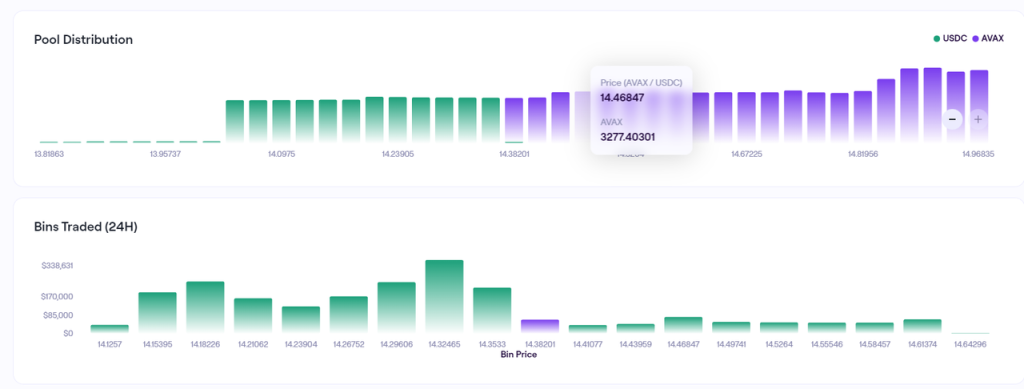
Bin distribution and trading volume for AVAX-USDC pair on Trader Joe
Each liquidity pool has fixed-width Bins. The difference between adjacent Bins is known as the “Bin step”—for example, 20 basis points (0.02%) for the AVAX-USDC pair shown above. Pool creators can set the Bin step parameter, allowing different pools for the same trading pair with varying Bin steps.
Bins on Trader Joe function similarly to limit orders on centralized exchanges (CEX), while the Bin step corresponds to the minimum price increment between CEX orders.
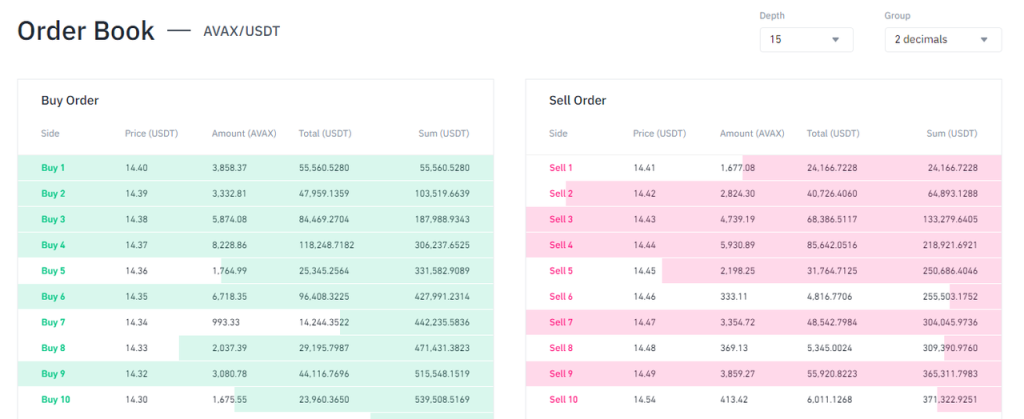
Order book for Avax-USDT pair on Binance
Thus, Trader Joe’s DEX operates as a customizable order book using Bin width as the trading unit.
b. Liquidity: Bin Capacity
While Uniswap V3 concentrates liquidity within a single price range using the X*Y=K (constant product) formula, Trader Joe distributes liquidity across equal-width price intervals called Bins. Within each Bin, liquidity follows the P·X+Y=K (constant sum) equation (where P=Y/X). Each Bin functions as a separate liquidity pool and the smallest unit of liquidity management.
Despite sharing the principle of concentrated liquidity, LB’s innovation lies in how liquidity is vertically aggregated within each Bin, whereas Uniswap V3 spreads liquidity horizontally and stacks it heterogeneously.
Put simply, Uniswap V3 LP positions are independent and stacked directly based on price range and liquidity amount. In contrast, LB splits liquidity into different price ranges, stacking them vertically—liquidity within the same Bin is homogeneous.
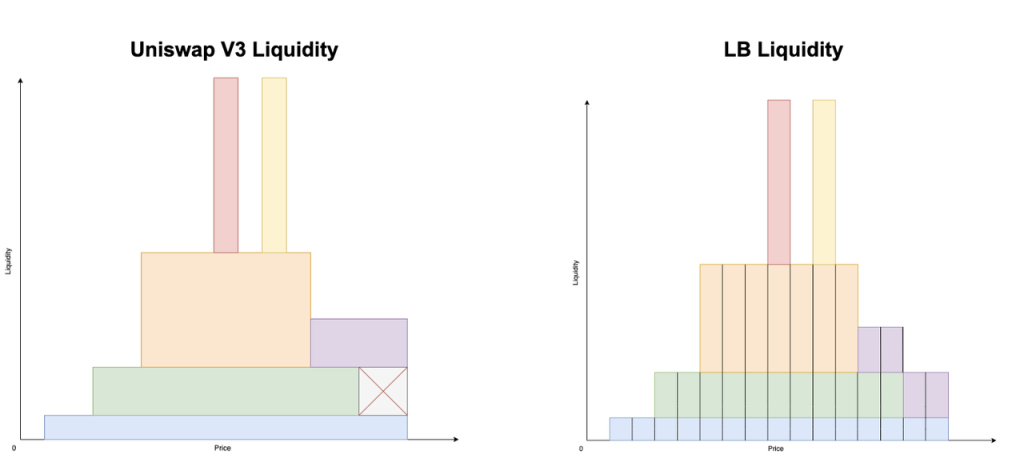
Comparison of liquidity structure between Uni V3 and LB. Y-axis shows liquidity, X-axis shows price. Different colors represent different users.
Source: Trader Joe V2.1 Documentation
The vertical aggregation of liquidity via Bins allows LB liquidity tokens to follow an ERC1155-like standard. Before discussing LB token characteristics, here’s a brief overview of ERC1155.
Developed by Enjin, ERC-1155 solves the limitation of smart contracts supporting either fungible (ERC20) or non-fungible (ERC721) tokens. An ERC-1155 contract can manage both types under one standard. Each token is identified by an ID rather than a contract address, enabling a single contract to manage multiple IDs—each potentially representing many identical tokens or a unique NFT.
ERC-1155 is commonly used in gaming, where systems often require multiple types of both fungible and non-fungible tokens.
LB adopts a similar approach, leveraging the ID system concept:
-
LB liquidity tokens within the same Bin are fungible. Fungibility reduces gas costs and simplifies protocol-level fee calculations and accounting;
-
Different Bins have unique IDs to distinguish their internal homogeneous liquidity;
-
Combining the above enables LPs to deploy more complex and flexible liquidity strategies.
As shown below, Trader Joe offers diverse LP deployment options to meet user needs:
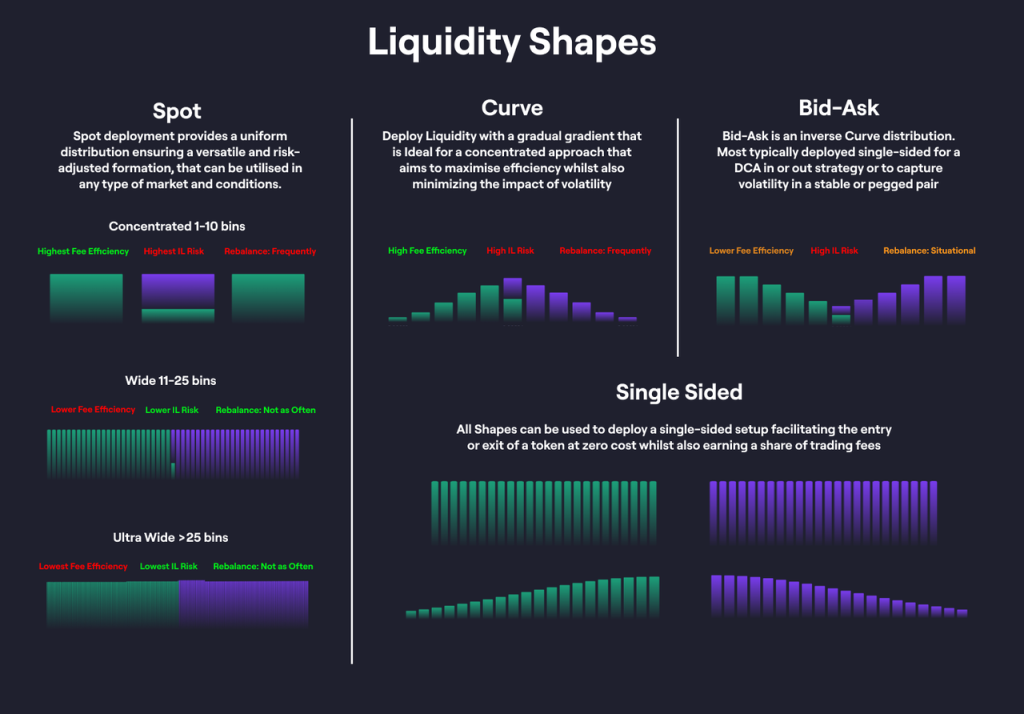
Image source: Trader Joe documentation
Additional features of Trader Joe’s LB include:
-
Price remains constant within a Bin until its liquidity is exhausted, giving Trader Joe a quoting advantage that helps capture routed volume—but also amplifies impermanent loss;
-
Variable fees: Higher volatility leads to higher trading fees, increasing fee revenue to compensate LPs for impermanent loss;
-
Improved composability: Unlike Uniswap V3’s LP tokens, which use the ERC-721 NFT format (difficult to integrate with ERC20-focused DeFi protocols), LB’s Bin-based LP tokens resemble ERC1155 standards, making them more fungible and composable—closer to ERC20 equivalents.
c. Use Cases for Liquidity Orderbook
The ease of market-making and order placement, along with high composability, enables new applications built on the liquidity orderbook model.
-
Project Experiments
On May 9, “White Lotus” launched, utilizing Trader Joe’s orderbook model for token issuance and a Ponzi mechanism:
1. The project issued 30 million LOTUS tokens, sold evenly through Bins on Trader Joe’s pool. The first token was priced at $0.20 per Bin, rising to $4.20 in the final Bin. All ETH used to buy LOTUS is locked as liquidity in the pool. LOTUS listings occur every 5 Bins, as illustrated below:

Image source: White Lotus documentation
2. A 10% tax applies when selling LOTUS: 8% is permanently burned (deflationary), and 2% rewards stakers.
3. LOTUS includes an automatic liquidity rebalancing mechanism. Every time the price moves five Bins, liquidity is automatically reallocated as follows:
a. 10% of the ETH in the pool is designated as “direct trading liquidity” and placed in Bins adjacent to the current active price, facilitating trades around the prevailing price.
b. The remaining 90% of ETH is concentrated in a single Bin at the “floor price” (calculated as total ETH value divided by total LOTUS supply), which can absorb all circulating LOTUS tokens at any time.
After rebalancing, the LOTUS liquidity layout appears as follows:
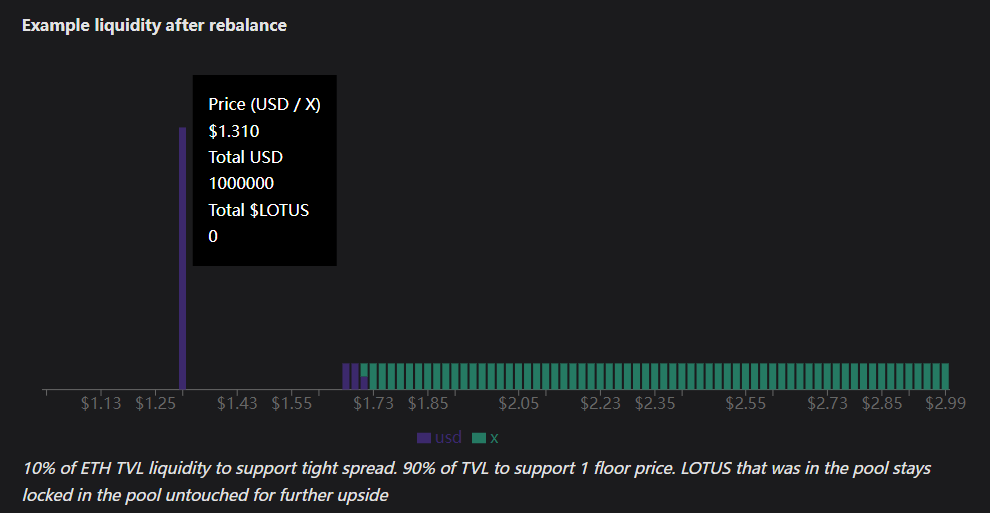
c. Ideally, with a finite supply, token burns from trading, and upward pressure on the floor price, LOTUS could exhibit a self-reinforcing upward spiral.
However, White Lotus failed quickly due to various issues (e.g., competing pools not contributing fees or burns, large gaps between concentrated liquidity and floor price). Nonetheless, its forks like Jimbo have adopted Trader Joe’s liquidity orderbook as their foundational mechanism.
-
User Practices
The ease of market-making via LB has been well received by users. After ARB’s airdrop in March, trading volume surged on-chain. While early-mover Uniswap V3 on Arbitrum captured most liquidity and volume, Trader Joe leveraged its LB product experience and market-making incentives to become the second-largest Dex for ARB trading, briefly capturing up to 45% of ETH-ARB volume.
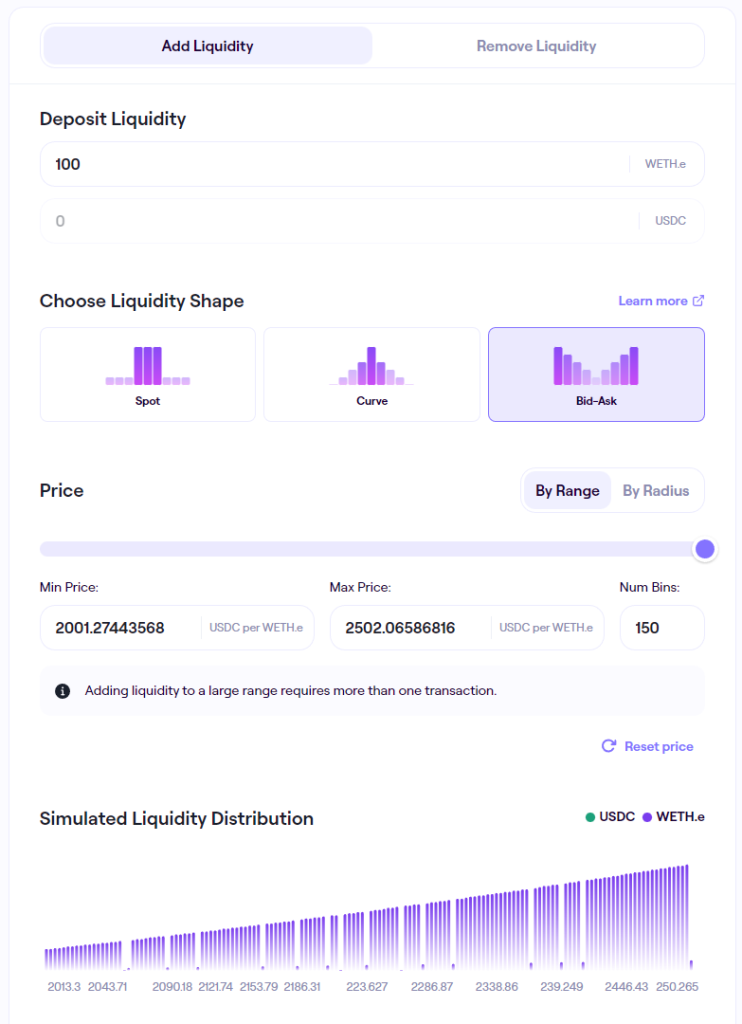
Additionally, Trader Joe V2 is ideal for implementing Dollar-Cost Averaging (DCA)-style asset sales or accumulation via its order placement feature. For example, a user may want to sell 100 ETH gradually as prices rise from $2,000 to $2,500, selling more as the price increases, and fully exiting near $2,500—essentially a modified DCA exit strategy.
This can be easily achieved using LB V2: deposit 100 ETH unilaterally, set the sell range (2,000–2,500), and select the Bid-Ask mode (increasing sell size with rising price).
As shown below:
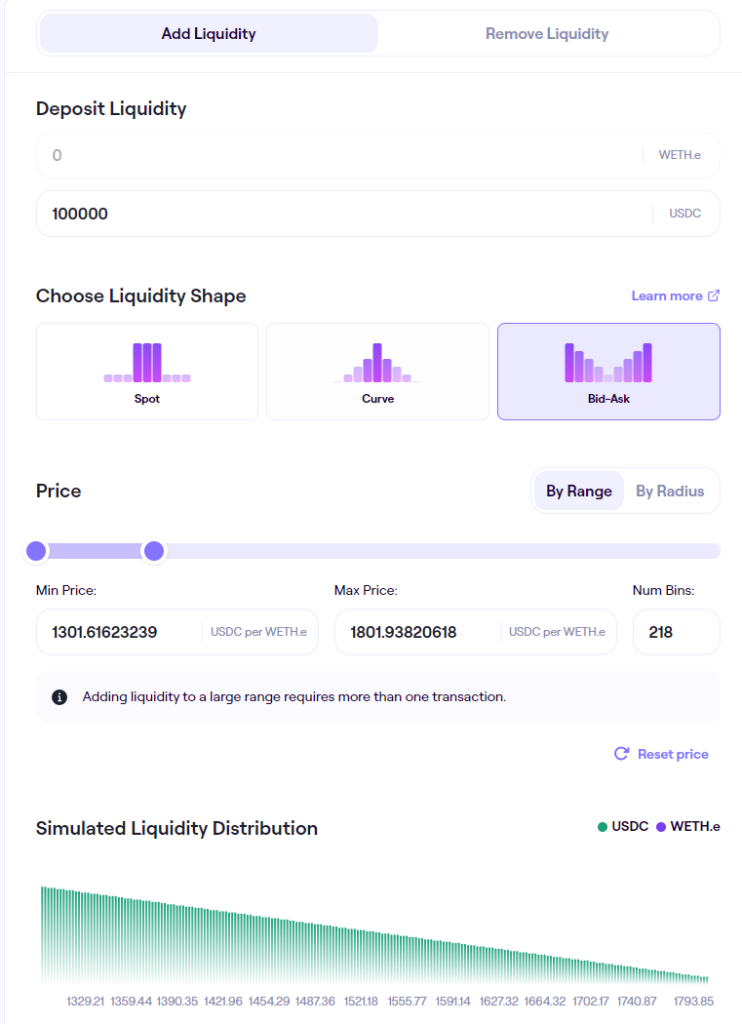
Conversely, to accumulate $100,000 worth of ETH as prices drop from $1,800 to $1,300—buying more as prices fall and completing the purchase near $1,300 (a variant DCA entry strategy)—simply deposit $100,000 USDC, set the buy range (1,300–1,800), and choose Bid-Ask mode. The position will be filled automatically once ETH enters this range, as shown below:
In summary, Trader Joe’s liquidity orderbook, built on Bins and orderbook mechanics, lowers the barrier for LPs in managing concentrated liquidity, enabling richer trading and market-making strategies.
Beyond this, among numerous DEXs surveyed, Trader Joe stands out for its superior product interaction design:
-
Clean, aesthetically pleasing UI with intuitive navigation, easy for even new users;
-
Rich, transparent, and comprehensible data on pools and staking volumes. Real-time, transparent data is a hallmark of DeFi versus TradFi, but effective data visualization is equally critical.
2.1.2 Lending: Banker Joe
Banker Joe, launched in 2021, is a lending product forked from Compound and Cream. It once reached a peak TVL of $1 billion, but deposits have since declined to around $10 million, contributing minimally to the project’s operations and profits. It is no longer a strategic focus.

Current Banker Joe metrics. Source: https://v1.traderjoexyz.com/lend
2.1.3 NFT Trading: Joepegs
Launched in April 2022, Joepegs supports NFT trading on Avalanche and BNB Chain. However, trading volume on both chains remains low.
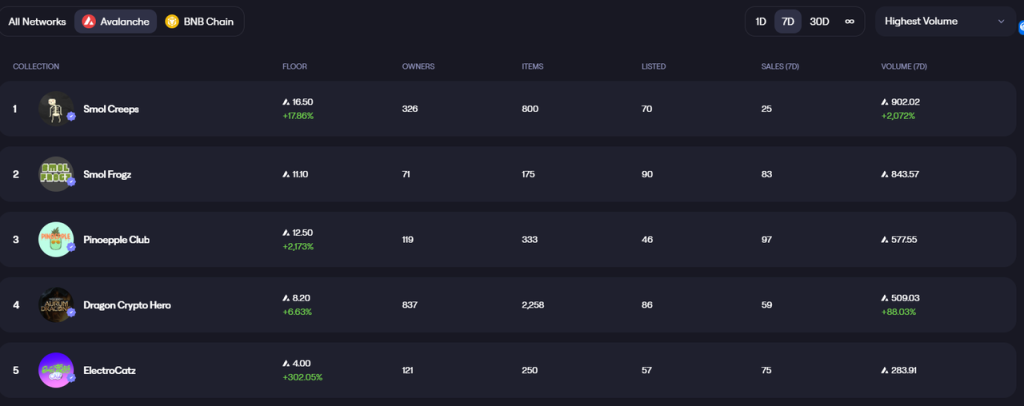
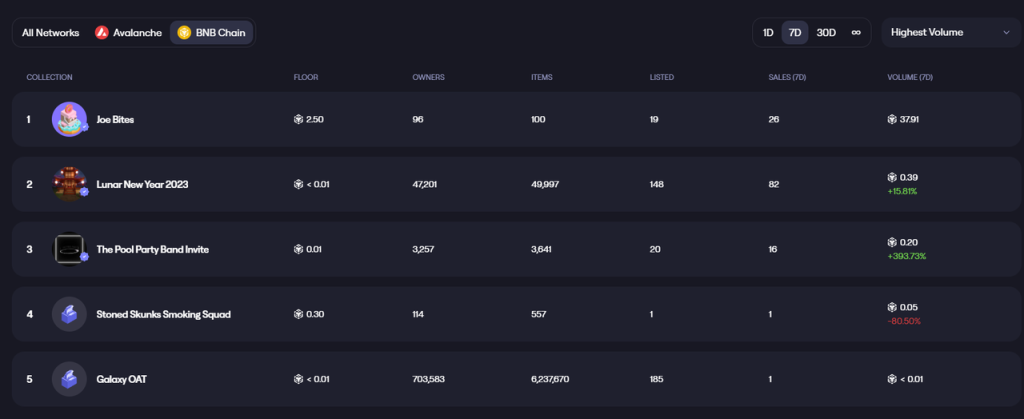
Avalanche NFT trading volume on Joepegs peaked at 902 AVAX (~$12,600) over seven days; the highest weekly volume on BNB Chain was just 37.9 BNB (~$11,470).
NFT-related revenues remain negligible, making it a marginal operation (though still actively promoted). Additionally, Trader Joe launched a launchpad module, Rocket Joe, in early 2022, but it has since stalled. The last project launched was CHRO in June 2022.

2.2 Project History and Roadmap
Key milestones of Trader Joe since launch, as of mid-May 2023:
Timeline Event Jun 1, 2021: Project announced. Contract code open-sourced later in June. Official launch at end of June. Sep 2021: Raised $5M strategic investment led by Defiance Capital, GBV, and Mechanism Capital. Other investors included Three Arrows Capital, Coin98 Ventures, Delphi Digital, Avalanche Foundation, and Stani Kulechov (Aave founder). Valuation: $50M. Oct 2021: Launched Banker Joe, a lending product forked from Compound and Cream, using Chainlink oracles. Oct 2021: Announced joint $20M liquidity mining program with Avalanche, contributing $10M in JOE and $10M in AVAX.
Jan 2022: Launched launchpad Rocket Joe. Users staking JOE earn rJOE points for launchpad access. Feb 2022: Introduced Staking V2 economic model featuring veJOE. veJOE is earned through JOE staking, with longer lock-up durations yielding more veJOE, which boosts liquidity mining rewards. Apr 2022: Launched NFT marketplace Joepegs. Aug 2022: Released V2 whitepaper introducing Liquidity Book (LB), a concentrated liquidity solution using “bins” as price units and dynamic fees to increase LP income during high volatility. Nov 2022: Liquidity Book (V2) officially launched.
Dec 2022: Deployed on Arbitrum. Jan 2023: Announced plans to deploy Trader Joe and Joepegs on BNB Chain, completed by end of March. Jan 2023: Previewed Trader Joe V2.1 features: incentive programs based on liquidity orderbooks, automated liquidity management, limit orders, and permissionless liquidity pools.
Jan 2023: Adjusted token model: native multi-chain JOE deployment, sJOE application on Arbitrum and BNB Chain, veJOE acceleration in LB pools, and deprecation of rJOE. Feb 2023: Announced partnership with LayerZero to make JOE natively multi-chain. Apr 2023: Officially launched Trader Joe V2.1.
2.3 Team
The Trader Joe team operates anonymously. @cryptofishx and @0xmurloc are co-founders. @cryptofishx is a full-stack engineer with extensive Web3 experience, having contributed to Avalanche projects @throwsnowballs, @Pandaswapex, and @sherpa_cash. He previously worked at Google and a decentralized derivatives exchange.
On May 13, @cryptofishx shared an emotional Twitter thread reflecting on his 2017–2018 bear market experience. At age 30, then a doctor, he lost all profits and two-thirds of his principal. During that time, he studied programming and advanced math part-time, earning two degrees over 2.5 years, joined Google, and later founded Trader Joe as a side project—eventually achieving success.
On May 17, @cryptofishx posted a heartfelt pinned message:
“When we first started Joe, I made a promise to myself: stay committed for at least two years, because that’s when most projects die. Our second birthday is coming soon, and I’m thrilled to say: we’re still here, building with the same energy as day one.”
This reflects the founder’s enduring entrepreneurial spirit and deep emotional commitment to the project.
Little is known about the other co-founder, @0xmurloc. Public information describes him as a full-stack engineer and product manager who previously served as a product lead at a recently public unicorn company. He holds an electrical engineering degree from a prestigious university and joined Trader Joe full-time in 2021.
When asked about team size, a community representative declined to comment.
In the fast-moving, often volatile crypto landscape, Trader Joe’s team stands out for its diligence. This is evident not only in launching multiple products (DEX, lending, launchpad, NFT marketplace) within two years and adapting to emerging trends, but especially in driving native mechanism innovations in its core DEX product and experimenting with novel economic models (see Token Model analysis).
2.4 Funding and Key Partnerships
Public records show Trader Joe raised funding once—in September 2021 (three months after mainnet launch). The $5M round valued the project at $50M. Led by Defiance Capital, GBV, and Mechanism Capital, participants included Three Arrows Capital, Coin98 Ventures, Delphi Digital, Avalanche Foundation, and Stani Kulechov (founder of Aave).
3. Business Analysis
3.1 Market Opportunity and Potential
Dexs are a long-term focus area for Mint Ventures. We’ve previously analyzed Curve and the ve(3,3) ecosystem. Spot trading remains the largest and most active crypto use case in terms of user count and capital flow. According to DeFiLlama, Dexs recorded $2.27B in 24-hour trading volume, representing 14.75% of total crypto spot volume. While still modest, this marks nearly a 100% increase from our previous report “Understanding Curve: Business Status, Ecosystem Development, Moats, and Valuation Comparison” published in February 2023.
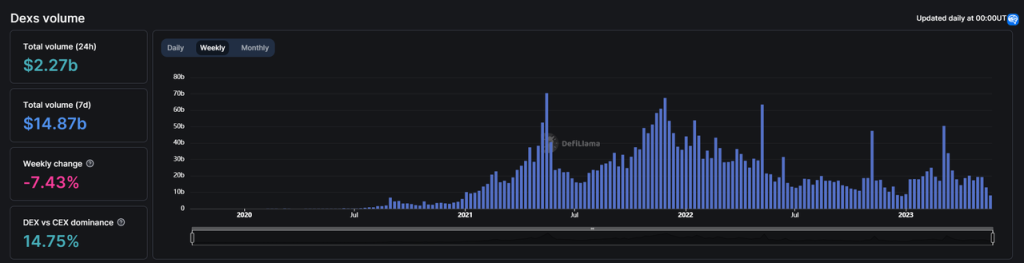
Data source: https://defillama.com/dexs
Beyond spot trading, Dexs also offer liquidity procurement services. Leading projects in this space adopt Curve’s pioneering ve-token model (e.g., Balancer) or modified ve(3,3) models (e.g., Velodrome). If considering only bribe revenue (fees paid by other projects to secure liquidity), this income stream appears far larger than spot trading revenue. However, treating a Dex’s own token emissions as “liquidity acquisition cost” and bribe income as “liquidity sales revenue,” most such Dexs are currently operating at a loss (excluding indirect revenue from direct token purchases for governance rights).
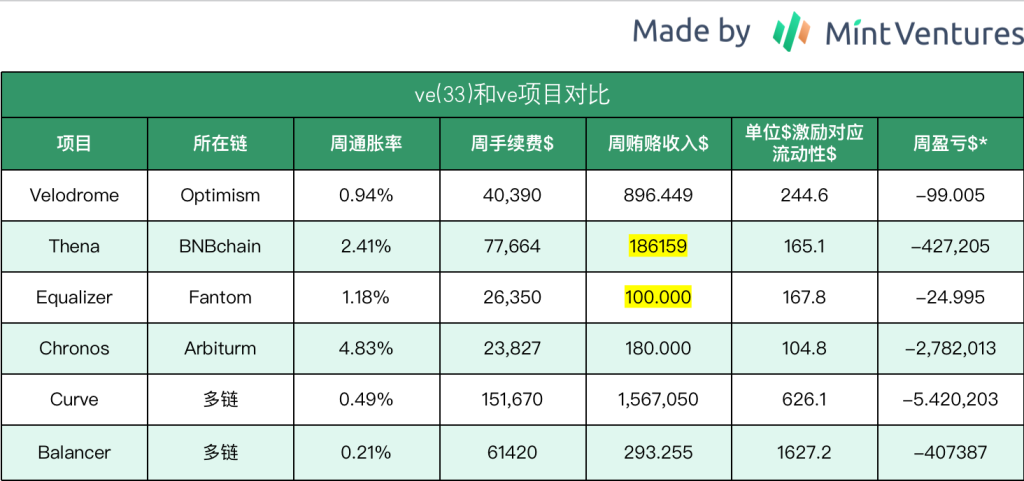
PS:
1. Data compiled as of May 5, 2023. Yellow-highlighted figures are estimates. Source: Mint Ventures report “From Velodrome to Chronos: Is ve(3,3) the Better Dex Model?”
2. Base data sourced from official disclosures and DefiLlama.
3. Bribe revenue for Curve and Balancer derived from Votium, Hiddenhand, and Votemarket.
*【Profit/Loss】refers to (revenue: fees + bribes) – liquidity emissions
Drivers of Dex sector growth include not only overall expansion of crypto assets, but also:
-
Declining trust in centralized institutions and rising demand for asset self-custody
-
High composability within the DeFi ecosystem, significantly improving capital efficiency and user freedom
-
Most native Web3 projects choose Dexs as their first stop for trading and liquidity deployment
On the other hand, as one of the clearest and most fundamental business models, the Dex sector has entered a fiercely competitive red-ocean phase. Market leader Uniswap V3 continues to operate fee-free, while countless variants based on minor innovations flood the space. Token subsidies show no sign of ending, leaving the entire industry in a state of loss-making competition when subsidies are accounted for.
To escape this state, beyond hoping for market recovery to boost revenues, Dexs must find ways to build sustainable moats and achieve profitability.
3.2 Business Metrics
This section analyzes Trader Joe’s DEX performance across TVL, trading volume, fees/income, and active users. Lending and NFT segments are excluded due to negligible impact on fundamentals.
3.2.1 TVL
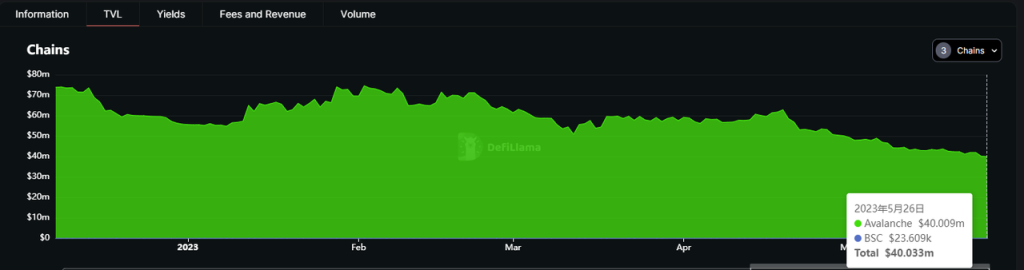
During the last bull market, Trader Joe reached a peak TVL of $2.6B. As the market turned bearish, liquidity rapidly declined. Current combined TVL (V1, V2, V2.1) stands at approximately $110M.

Trader Joe TVL composition
Data source: https://defillama.com/protocol/trader-joe
Breakdown: 65% on Avalanche, 33% on Arbitrum, 2% on BNB Chain. TVL trends show steady growth on Arbitrum and decline on Avalanche.
V1 TVL trend
Data source: https://defillama.com/protocol/trader-joe
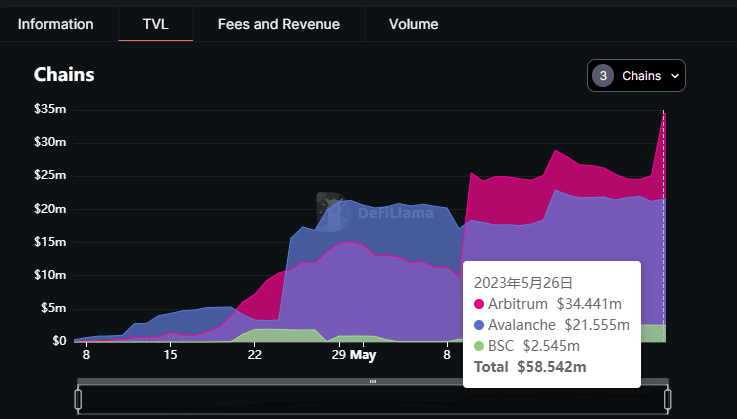
V2.1 TVL trend
Data source: https://defillama.com/protocol/trader-joe
Examining V1 and V2.1 separately, V1 has seen gradual decline since the start of the year, while V2.1 has grown rapidly—driven primarily by Arbitrum activity.
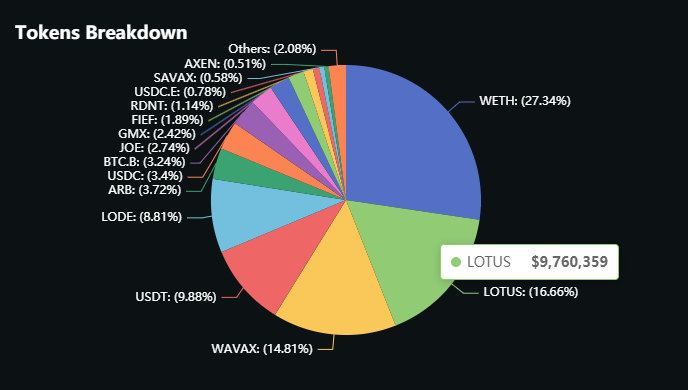
V2.1 TVL composition
Data source: https://defillama.com/protocol/trader-joe
Looking deeper into V2.1’s token composition, beyond major assets like ETH, the second-largest component is White Lotus—a project that uses Trader Joe’s orderbook for liquidity deployment—accounting for 16.66% of total liquidity.
3.2.2 Trading Volume & Fees
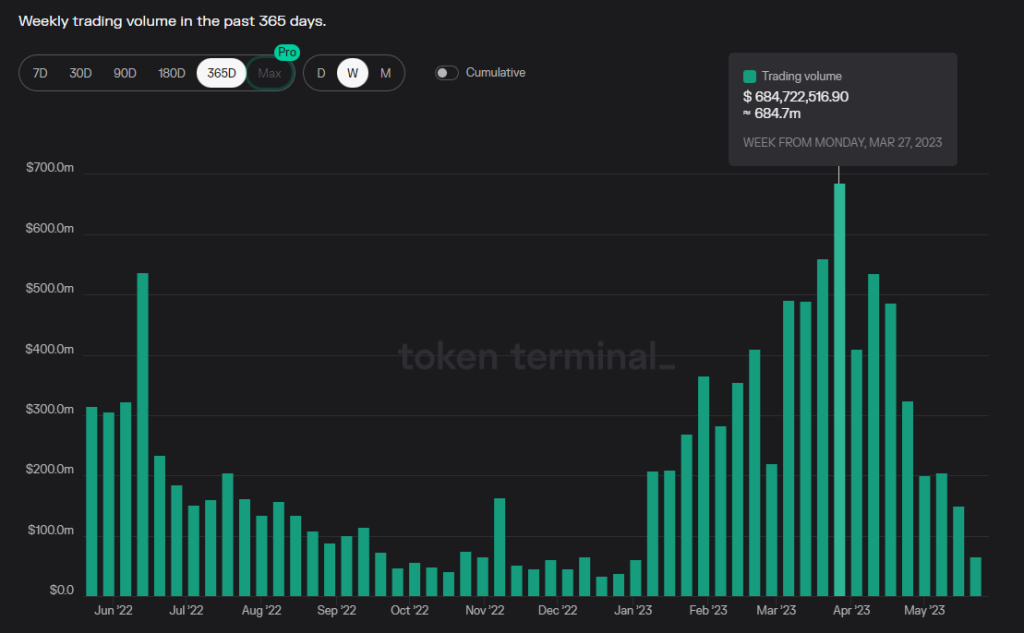
Data source: https://tokenterminal.com/terminal/projects/trader-joe
Trading volume hit a one-year high in late March—coinciding with Arbitrum’s post-airdrop surge—reaching $688M weekly.
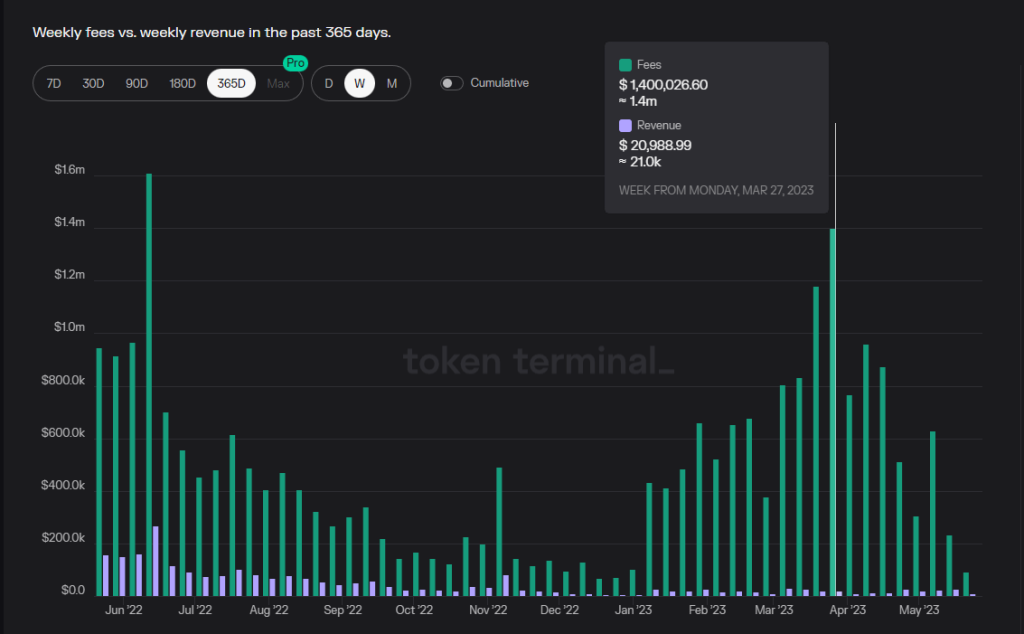
Data source: https://tokenterminal.com/terminal/projects/trader-joe
Despite matching volume highs, fee revenue remains far below last year’s peak. Weekly fees in late March were $21,000—less than one-tenth of the $260,000 weekly fees recorded at the June 2022 high.
This discrepancy stems from Trader Joe allocating all V2 fees to LPs from November 2022 to April 2023. Only with the V2.1 launch did protocol fees resume, distributed to JOE stakers. Unlike Curve and similar protocols (which take 50% of fees), Trader Joe employs multiple models:
V1: 0.05% of all trades collected as protocol revenue
V2: No protocol fees; all fees go to LPs
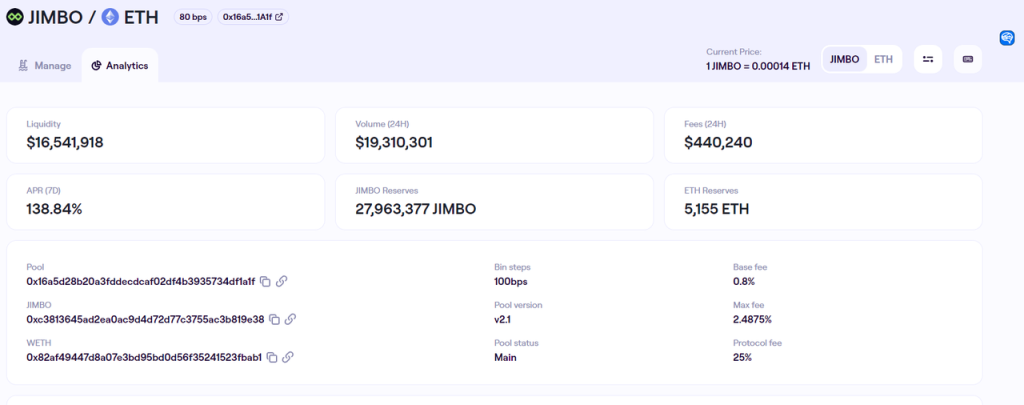
V2.1: Variable protocol fee rates across LB pools (0–25%). For example, the JIMBO/ETH pool has a base fee of 0.8%, dynamic cap of 2.4875%, and allocates 25% of fees to the protocol
Since V2.1’s launch, the protocol revenue-to-total-fees ratio has rebounded from a March low of 0.62%, now averaging 9.57%.
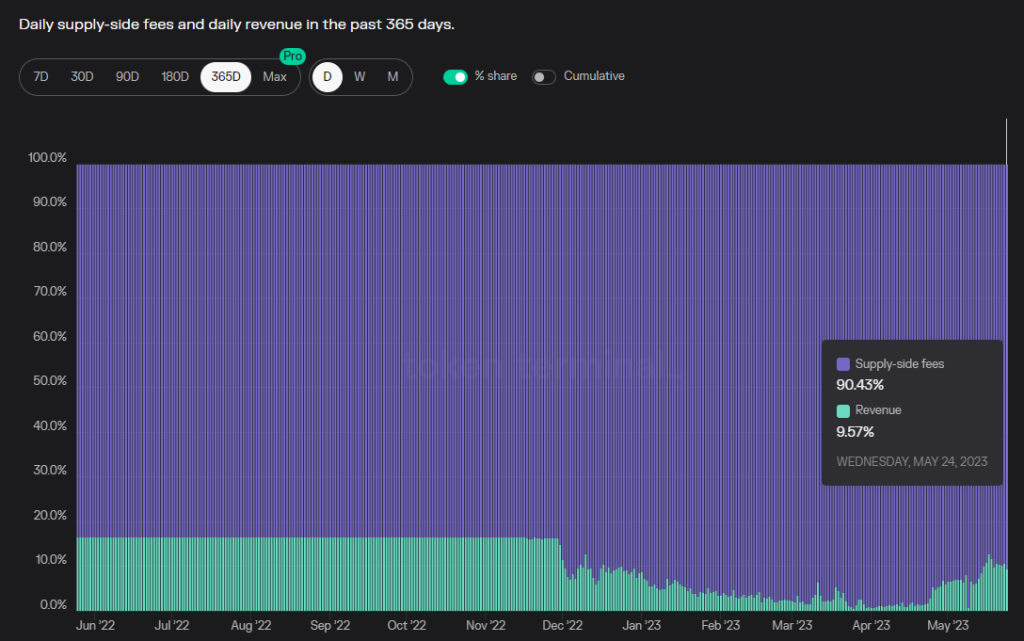
Data source: https://tokenterminal.com/terminal/projects/trader-joe/revenue-share
To understand Trader Joe’s V2.1 fee structure, we analyzed protocol fee rates across high-volume LB pools:
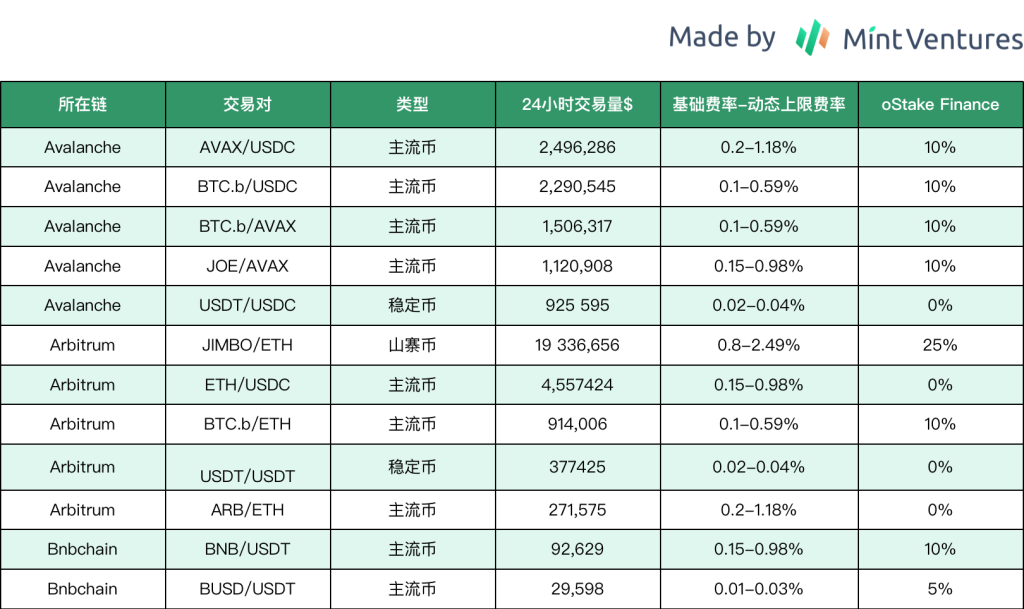
Data as of: May 26, 2023
The table reveals Trader Joe’s current fee strategy:
-
Prioritizing Arbitrum growth with low or zero protocol fees
-
Waiving fees for major stablecoins—prioritizing volume and TVL over revenue
-
Charging normal fees on BNB Chain, where business is negligible
-
Charging higher fees for new projects, especially those leveraging LB mechanics (e.g., JIMBO, LOTUS)
3.2.3 Active Users
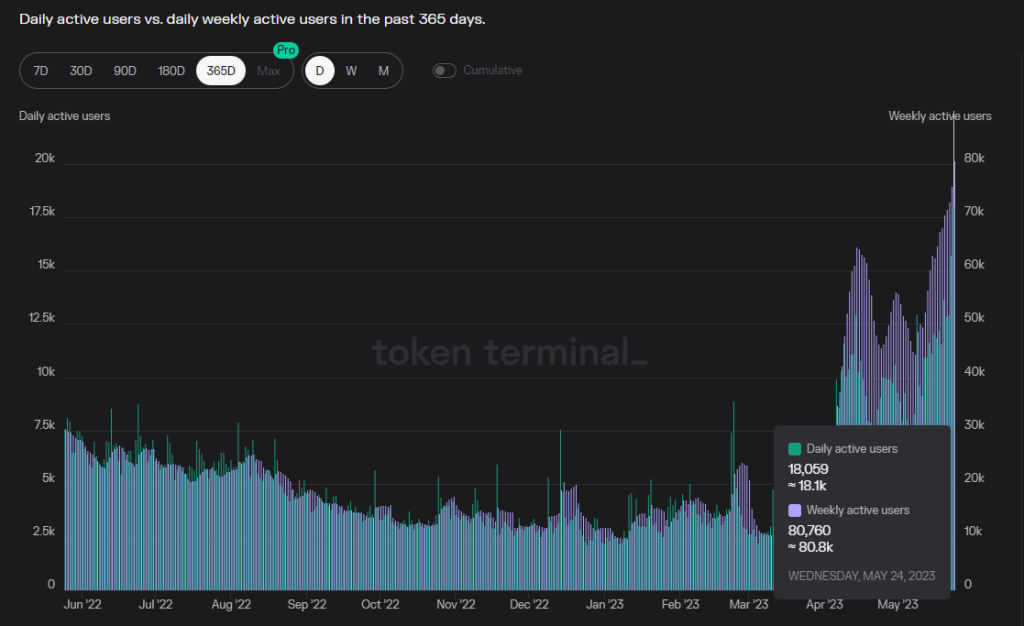
Data source: https://tokenterminal.com/terminal/projects/trader-joe
Active user counts have risen sharply since V2.1 deployment, reaching all-time highs: ~18,000 daily active addresses, over 80,000 weekly (DefiLlama reports 110,000), and nearly 200,000 monthly. This sustained C-side growth likely owes much to Trader Joe’s strong product experience.
3.3 Competitive Landscape
Currently, Trader Joe maintains Avalanche as its core base while focusing expansion efforts on Arbitrum—which will serve as its primary growth driver in the near term. We analyze its market share on both chains.
3.3.1 Avalanche
Avalanche was one of the fastest-growing L1s during the last bull run. However, during the bear market, its market share in both TVL and trading volume has steadily declined—from 9.8% to 1.51% in TVL, and from 9.84% to 1.19% in trading volume.
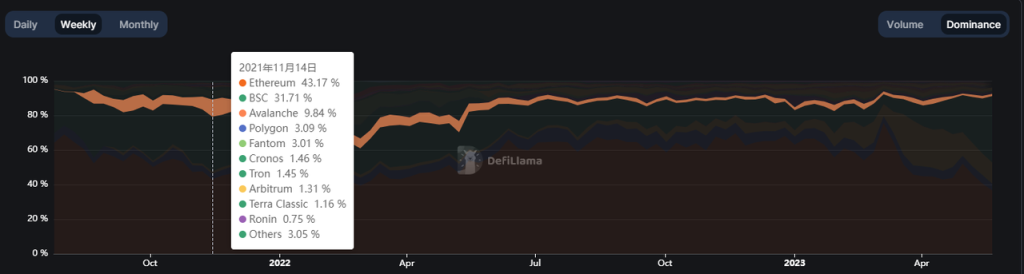
Avalanche’s trading volume market share. Data source: https://defillama.com/dexs/chains
On Avalanche, Trader Joe benefits from early mover advantage, maintaining clear leads in both TVL and trading volume.

Data source: DefiLlama. Note: percentages calculated against top 5 totals
As of: May 26, 2023
Notably, in March, Avalanche Labs and University of Michigan Blockchain Club (Uniswap governance member) proposed deploying Uniswap V3 on Avalanche. The proposal passed on March 19, with estimated deployment taking ~5 weeks—meaning Uniswap V3 will soon arrive, posing direct competition to Trader Joe.
3.3.2 Arbitrum
Arbitrum has emerged as the fastest-growing L2 ecosystem over the past year, ranking third in TVL and trading volume behind only BNB Chain and Ethereum (excluding Tron). Greater activity brings fiercer competition: Arbitrum hosts numerous DEXs, including cross-chain deployments like Uniswap V3, Curve, and Balancer, as well as native platforms like Camelot, Chronos, and Ramses.

Data source: DefiLlama. Note: percentages calculated against top 8 totals
As of: May 26, 2023
Despite trailing in liquidity rankings on Arbitrum, key observations include:
-
Exceptionally high capital efficiency (VOL/TVL): Highest among top eight DEXs, even surpassing Uniswap V3 despite both using concentrated liquidity;
-
Trader Joe is the only DEX besides Chronos (launched early May) to see significant month-over-month TVL growth—and this trend has persisted for nearly six months

Data source: https://defillama.com/chain/Arbitrum?tvl=true

Trader Joe’s Arbitrum TVL growth trend. Data source: https://defillama.com/protocol/trader-joe
We believe the drivers behind Trader Joe’s Arbitrum TVL growth are:
-
Adoption of the LB mechanism, which is more LP-friendly, creating a virtuous cycle of growing liquidity and volume;
-
Emergence of new assets sparking user interest in market-making and trading (see three red circles in chart). Trader Joe’s LB effectively attracted and absorbed this capital and user activity
The first factor represents the foundational growth engine, while the second acts as event-driven catalysts, producing pulse-like surges in Trader Joe’s LB product. The three red circles mark pivotal events that boosted TVL and volume—each with slightly different underlying dynamics:
a. ARB Airdrop Event
The ARB airdrop on March 24 generated massive on-chain trading volume. Anticipation of this volume prompted widespread participation in ARB market-making for various reasons: some sought fee income, others aimed to employ modified DCA strategies to sell or accumulate ARB (see Section 2.1.1.c). Trader Joe benefited from both a smoother market-making and order placement experience than Uniswap V3 and increased funding for its Liquidity Book Rewards Program. This resulted in denser dynamic market-making capital near the ARB price, significantly reducing slippage. Consequently, Trader Joe’s LB pools briefly surpassed Uniswap V3 in ARB-ETH trading volume (which further boosted LP APRs).
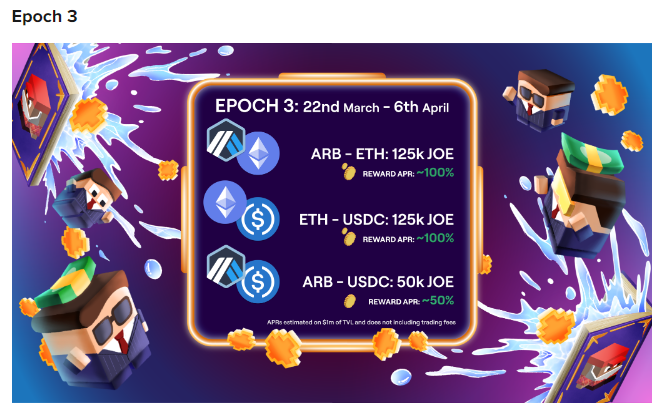
During the week following the ARB airdrop (Epoch 3), Trader Joe allocated 175,000 JOE tokens as rewards for ARB LB LPs
* The Liquidity Book Rewards Program is a dynamic LP incentive initiative akin to flexible marketing campaigns—discussed further in the Token Model section.
b. LOTUS and JIMBO Launches
LOTUS was introduced earlier—a Ponzi-style DeFi project using Trader Joe for token issuance and price stabilization. JIMBO is a forked and improved version of LOTUS (two versions exist; the top-volume one in the chart is V2). These projects brought substantial TVL growth to LB (as raised ETH and floor liquidity remained in LB pools) and generated high trading volume and fee revenue due to extreme price volatility early on. As shown below, JIMBO reached $20M in 24-hour volume on May 25, with $16M in liquidity. LOTUS still maintains $13M in liquidity.
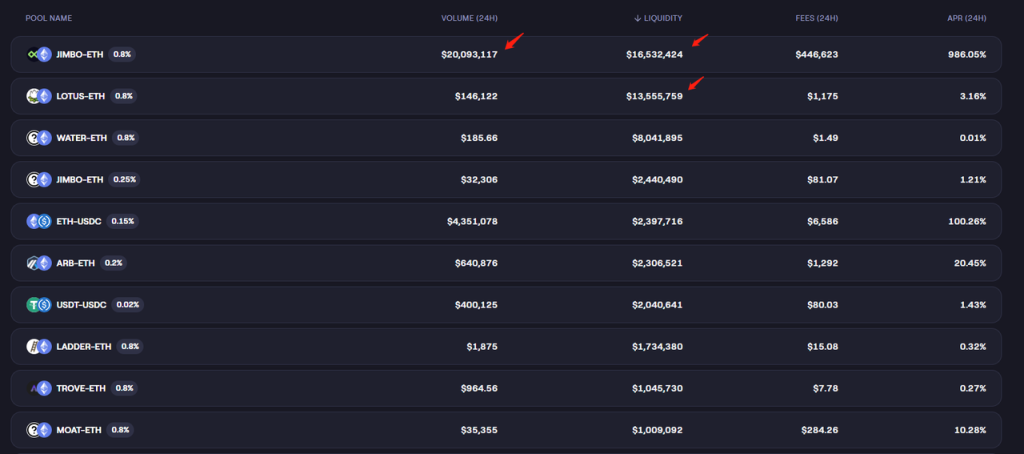
Image source: https://traderjoexyz.com/arbitrum/pool
The Ponzi nature of LOTUS and JIMBO suggests limited project lifespans. Trading volumes around such projects tend to be pulse-like and lack sustainability.
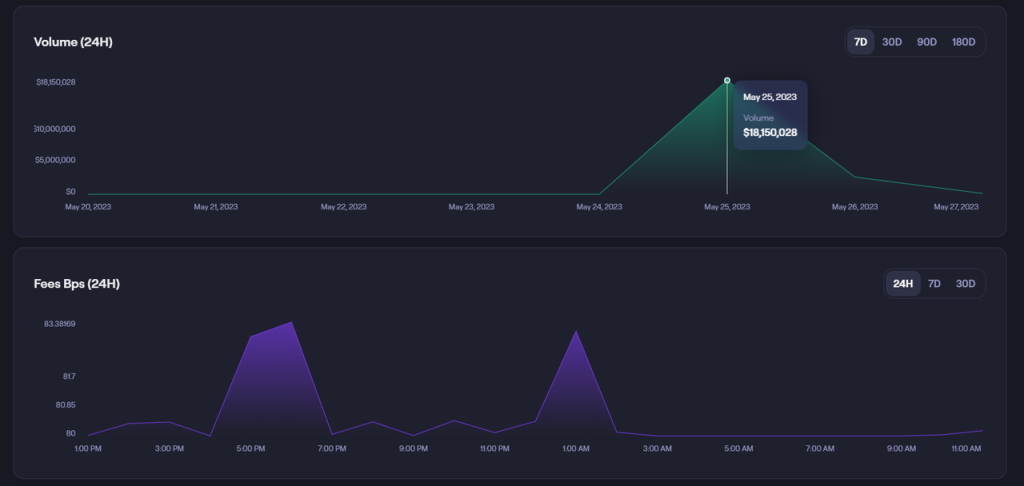
For instance, JIMBO V2’s LB pool saw daily volume spike to $18M at launch, then plummet to $2.7M the next day.
Nevertheless, these innovative experiments leveraging Trader Joe’s LB—and their successful fundraising—may inspire more projects to build liquidity or design creative mechanisms on LB, bringing additional TVL and volume to Trader Joe. However, the sustainability of such incremental liquidity and trading remains to be seen.
3.4 Token Model Analysis
3.4.1 Token Supply, Distribution, and Release Schedule
Trader Joe’s token is JOE, with a maximum supply of 500 million, unlocked over 30 months. Token allocation is as follows:
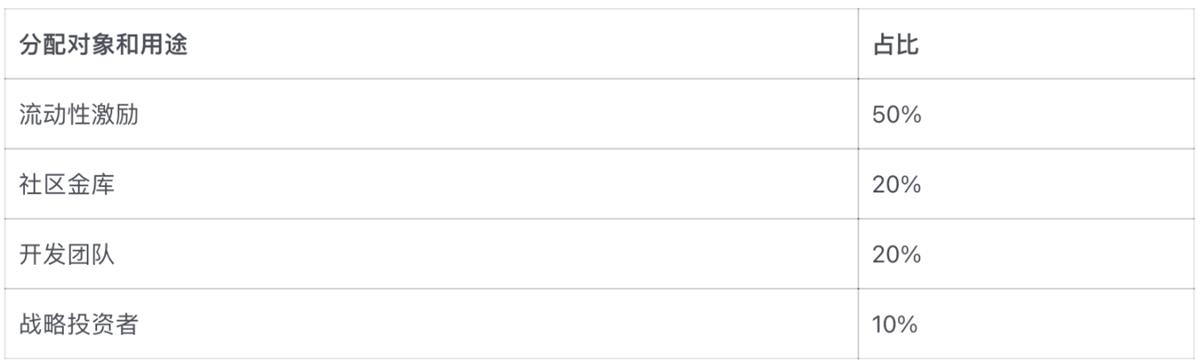
According to the official vesting schedule, by May 27, approximately 488 million JOE tokens should have been unlocked:
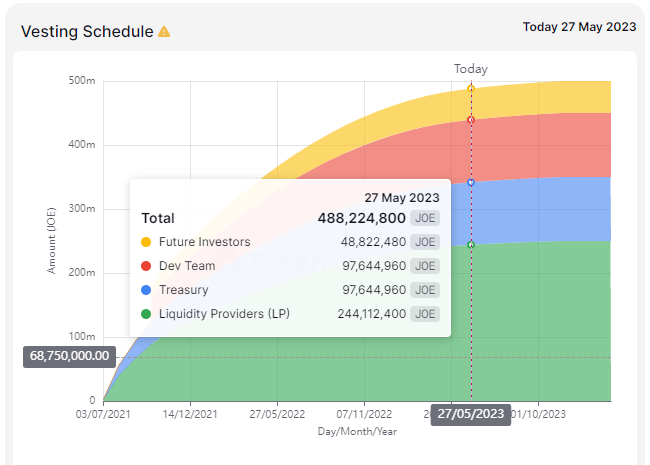
Data source: https://token.unlocks.app/joe
However, actual circulating supply is around 340 million. Most unlocked but non-circulating JOE tokens are staked.
Notably, unlike most DEXs or DeFi projects still emitting high incentive rewards, Trader Joe’s baseline liquidity emissions are extremely low—only 850 JOE tokens daily (~$300), nearly negligible. After accounting for minor emissions, Trader Joe has achieved positive net profit for five consecutive weeks.
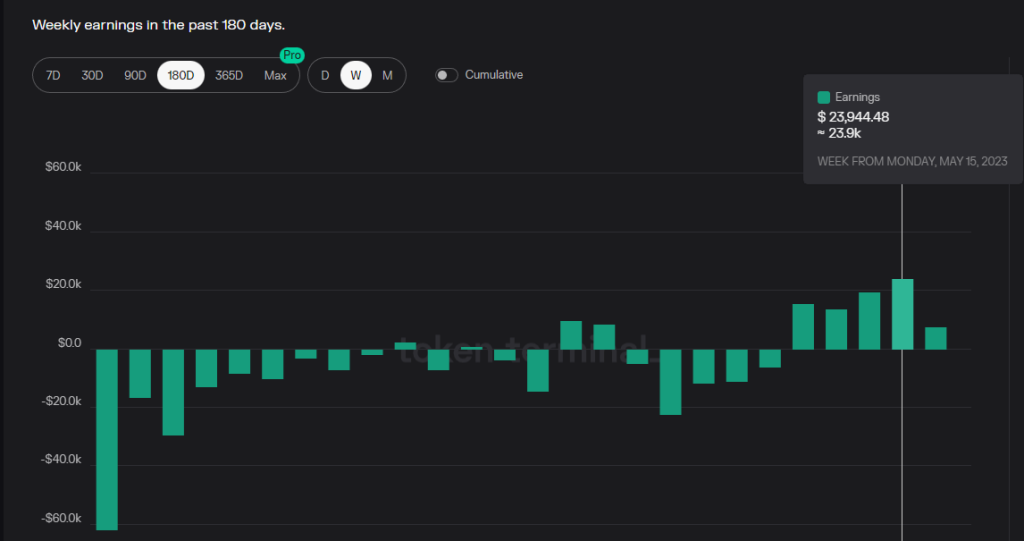
Trader Joe profit chart. Source: https://tokenterminal.com/terminal/projects/trader-joe
This does not mean Trader Joe has ceased incentivizing liquidity. Instead, the team uses a phased, short-cycle, and flexible approach via the “Liquidity Book Rewards Program,” targeting LPs in specific LB pools (e.g., ARB-ETH and ARB-USDC during the ARB airdrop). Unlike standard liquidity programs, this plan features:
-
Points-based competition: Points are calculated based on “LP fee earnings during the campaign period,” requiring LPs to provide sufficient liquidity and dynamically adjust their price ranges to stay in high-volume zones;
-
No universal rewards: To qualify, LPs must capture over 1% of the pool’s total fees;
-
Short cycles: Weekly campaigns allow agile adjustments based on market conditions and trends, continuously optimizing cost-effectiveness.
In our view, this is a well-designed token incentive model built on concentrated liquidity, effectively balancing liquidity depth and trading volume.
3.4.2 Token Use Cases
The Trader Joe team has explored multiple JOE utility dimensions:
-
Staking for dividends: Stake JOE to earn dividends, withdrawable anytime. Revenue sources include 0.05% of V1 AMM trading volume and protocol fee shares from V2.1 LB pools. Initially, xJOE was the staking receipt with JOE as reward; later changed to sJOE with USDC rewards. Dividend staking is currently the primary use of JOE.
-
Staking for boosting: Stake JOE to receive veJOE, also withdrawable anytime. veJOE boosts yield for V1 AMM LPs. The amount depends on: 1) quantity of staked JOE; 2) cumulative staking duration (time without withdrawal). Longer duration yields more veJOE and higher boosts. However, once withdrawn, veJOE resets to zero. With V1 AMM rewards now minimal, veJOE is largely symbolic.
-
Launchpad allocation: Stake JOE to earn rJOE for launchpad participation. This mechanism was discontinued in January 2023.
-
Governance participation: Although JOE is the governance token, current governance powers are highly limited—restricted to voting on which base tokens are added to LB and their quote pairings. Even core LB parameters are centrally managed by the team.
In summary, JOE’s primary utility today is dividend staking.
Overall, JOE’s current tokenomics reflect a design philosophy focused on: 1) empowering token utility by linking it to core cash flows or essential functionalities; 2) limited decentralization: product roadmap and parameters remain tightly controlled by the team. Despite numerous experiments, the model ultimately reverted to simple dividend staking—avoiding excessive complexity, which may not be a bad thing.
3.5 Risks
Beyond common industry risks like smart contract security, regulation, and slow crypto adoption, Trader Joe’s biggest risk lies in intensifying DEX competition.
On Avalanche: The chain’s ecosystem growth has stagnated or contracted, directly limiting Trader Joe’s volume growth. Moreover, Uniswap V3’s imminent arrival on Avalanche may further divert trading volume.
On Arbitrum: Despite rapid growth in liquidity and users, concerns remain:
-
Many mainstream LB pools charge low or zero fees. Intense competition may constrain future fee collection and rate increases
-
Both liquidity and volume growth are driven by short-term events or highly speculative projects. Long-term retention and sustainable growth remain uncertain. Notably, after volume peaks driven by the ARB airdrop, LOTUS, and JIMBO launches, we quickly observed declines in volume and market share
On BNB Chain: Operations are progressing slowly, and BNB Chain itself has seen very sluggish growth.
4. Preliminary Valuation Assessment
4.1 Five Core Questions
What stage of development is the project in? Maturity, or early/mid-growth?
The Dex sector appears mature, and Trader Joe’s business model and products are well-established.
Does the project possess durable competitive advantages? If so, what are they?
The Dex sector remains fiercely competitive, with no clear dominance among platforms—including Trader Joe. However, Trader Joe exhibits notable strengths:
1. Resilient team with strong execution, innovation, and operational capabilities;
2. Excellent product experience.
Investors and founders often seek industries with strong moats and natural monopolies, but such cases are rare in Web3. In less-defensible sectors, survival hinges on relentless operational efficiency—running a marathon at sprint speed. This includes strategic planning, product innovation, and meticulous execution in community management and development. Trader Joe exemplifies such a resilient, efficient team thriving amid cutthroat DEX competition.
Is the medium-to-long-term investment thesis clear and aligned with macro trends?
Dexs remain foundational infrastructure in the Web3 economy—the largest in terms of capital and users. As market cycles turn favorable, sector valuations are likely to recover from current lows.
What are the key operational variables? Are they quantifiable?
The brutal DEX competition. Quantitatively, we can track liquidity, volume, and profitability to assess market share shifts. Qualitatively, monitoring whether new projects adopt Trader Joe’s LB for token launches and liquidity provisioning is a crucial indicator.
What is the governance model? How decentralized is it?
Governance remains highly limited, far from true community-led decentralization.
4.2 Valuation Metrics
We apply vertical and horizontal valuation comparisons using fee multiples (PF) and revenue multiples (PS). Due to strong cyclical patterns in Dexs, vertical comparisons offer limited insight, while horizontal benchmarks are more meaningful.
Vertical Valuation
Below is the trend of Trader Joe’s market cap and Price-to-Fee (PF) ratio. Dex valuations, like traditional brokerage firms, exhibit strong cyclicality.
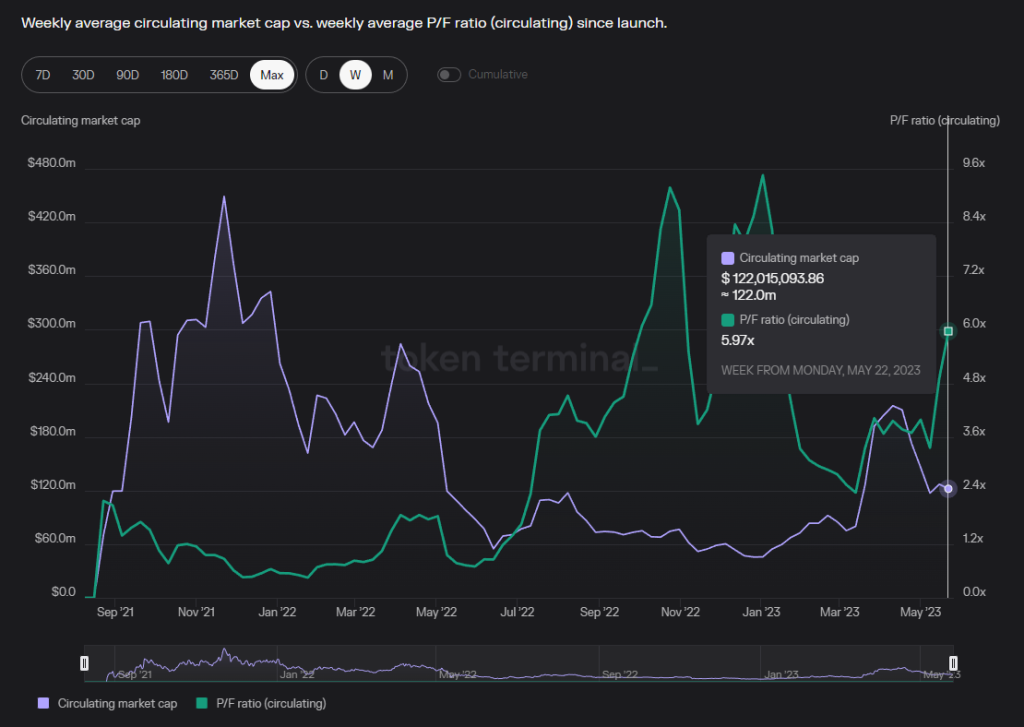
PF ratio, timeframe: Aug 2021–May 2023
Data source: https://tokenterminal.com/terminal/projects/trader-joe
During bull markets: High trading volume drives fee income rapidly. Though market caps rise, volume growth outpaces valuation, resulting in declining PF and PS ratios.
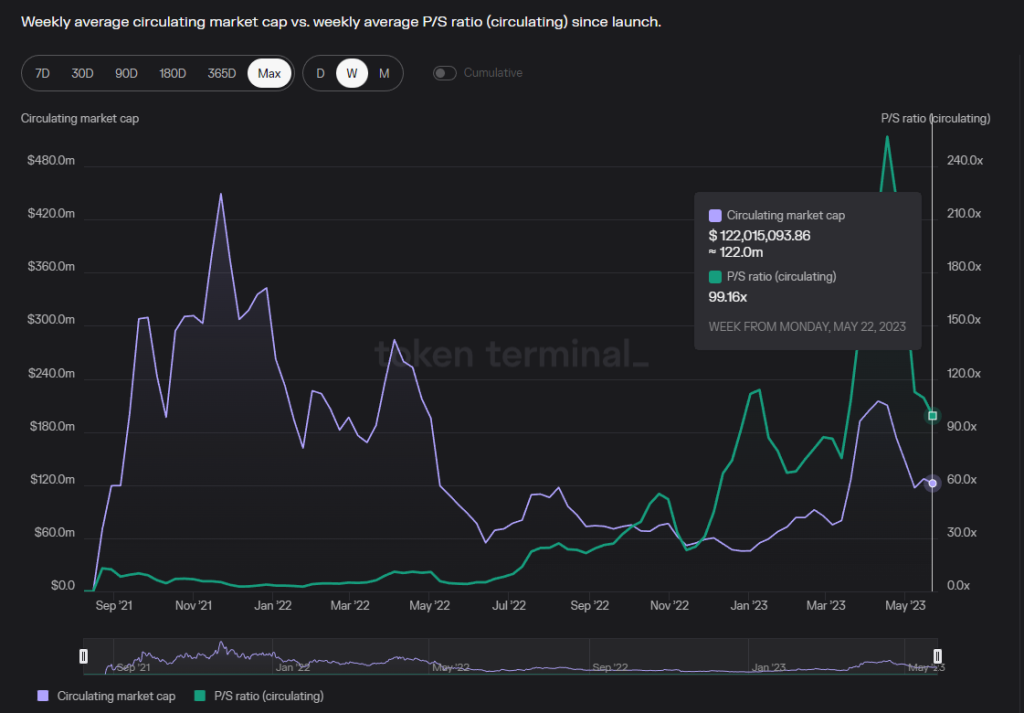
PS ratio, timeframe: Aug 2021–May 2023
Data source: https://tokenterminal.com/terminal/projects/trader-joe
During bear markets: Fee and protocol revenues shrink rapidly. Market caps decline too, but slower than revenue drops—leading to sharp increases in fee and revenue multiples.
Horizontal Valuation Comparison
Among numerous DEXs, we exclude those offering liquidity trading services (e.g., Curve, Balancer, Velodrome), comparing Trader Joe instead with peers of similar business models: Uniswap, PancakeSwap, SushiSwap, and Quickswap.

Data source: Circulating market cap from CoinGecko, fees and revenue from Token Terminal, as of May 28, 2023
Note: Circulating market cap refers to the total market value of unlocked tokens, including those not yet liquid, staked, or freely traded.
The comparison shows that across fee, revenue, and profit multiples, the market assigns Trader Joe a relatively high valuation. This premium may reflect confidence in its resilient and innovative team or optimism about the future of the LB mechanism—interpretations vary.
4.3 Summary
Trader Joe’s core strengths lie in its resilient team with strong execution and innovation capabilities, excellent product experience, and the innovative liquidity orderbook that has driven rapid user growth. Currently, Arbitrum serves as its primary engine for business expansion.
However, intense competition within the Dex sector persists—leaving projects with little pricing power over traders or liquidity providers, and most platforms operating at a loss or with minimal profit. This competitive landscape is unlikely to improve in the short term. Nevertheless, due to the dual cyclicality of both the crypto market and the Dex
Join TechFlow official community to stay tuned
Telegram:https://t.me/TechFlowDaily
X (Twitter):https://x.com/TechFlowPost
X (Twitter) EN:https://x.com/BlockFlow_News
 Mint Ventures






