









Exploring the Fully On-Chain Gaming Engine: An Emerging Field with Permissionless Interoperability
TechFlow Selected TechFlow Selected
Exploring the Fully On-Chain Gaming Engine: An Emerging Field with Permissionless Interoperability
The rapid iteration of engines is beginning to show us the arrival of a fully open, composable, and scalable era of on-chain gaming.
 Navigating Web3 tides with focused insights
Author: Ishanee@IOSG
Introduction:
Fully on-chain games like Dark Forest have proven that it's possible to place all game logic on-chain, and due to their permissionless interoperability, they encourage communities to create new tools, alliances, DAOs, and more. While the paradigm and motivation for building autonomous worlds have been well documented before, there has so far been little discussion about on-chain game engines—one of the most fascinating emerging frontiers in this space.
Game Development: Traditional Games vs. On-Chain Games
In the past, game engines such as Unreal, Unity, and Phaser served as one-stop solutions for traditional game development. These included essential building blocks like motion control, 2D and 3D rendering, object collision detection, sound, color, physics engines, scripting, and even server-client architecture, platform frameworks for PC/console/mobile, distribution mechanisms, and marketplaces.
When World of Warcraft was launched, Blizzard had spent four years developing its networking technology stack but only one year on actual game content. Shortly after Unity’s release in 2005, modular tech stacks reduced development time from four years down to just a few months.
In fully on-chain games, game states are entirely stored on the blockchain, introducing unique challenges and requiring new infrastructure. The first engine developed for the Ethereum ecosystem was MUD by Lattice. Since then, several other engines targeting different ecosystems and using various programming languages have emerged, including DojoEngine for StarkNet.
The First Game Engine: MUD
Lattice created MUD during the third quarter of 2022 at the 0xParc Residency. During this period, Lattice experimented with building multiple on-chain games. Despite differing gameplay styles and designs, they consistently encountered similar blockchain-related issues—not complex technical hurdles, but rather massive amounts of repetitive work. This led them to launch MUD—the first fully on-chain game engine.
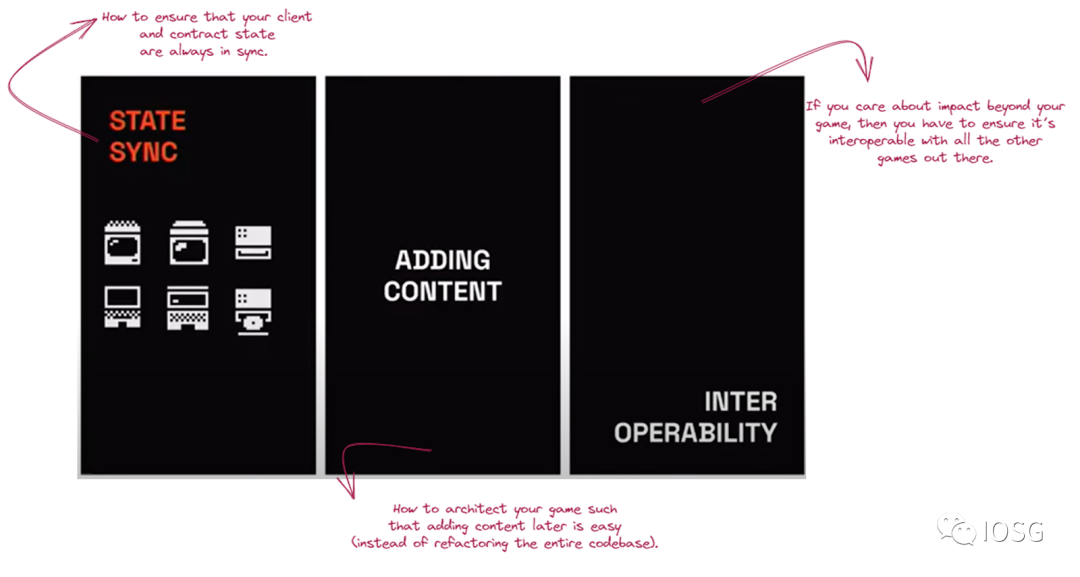
While developing these games, the MUD team used existing tools like PhaserJS, Three, and Godot—client-side engines primarily responsible for reading the world state and making it playable for users. In the past, what was shared was the state of the world—"Is the piece on the chessboard?" Meanwhile, readability refers to "fancy 3D-rendered chess pieces with a click-and-drag UI that moves according to movement rules."
Understanding MUD’s Engine Architecture: ECS
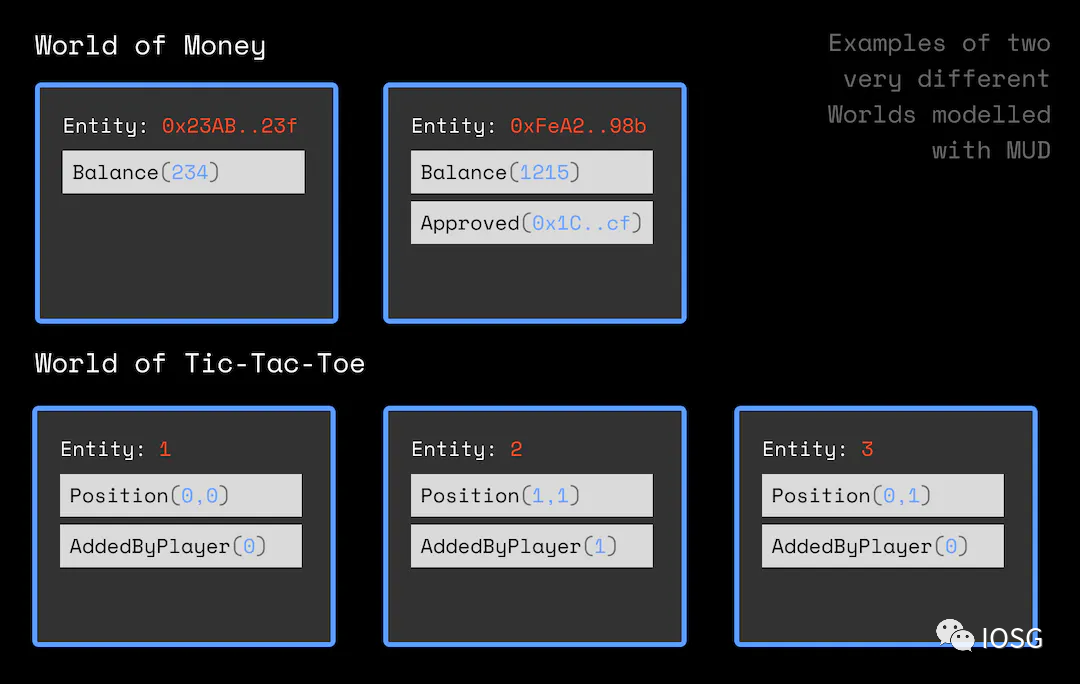
They adopted the ECS (Entity-Component-System) architecture. Under this framework, each on-chain game deploys a World contract serving as a registry for all entities within the world. An Entity is a numeric ID, and Components are data attributes attached to an entity that can be added into the world.
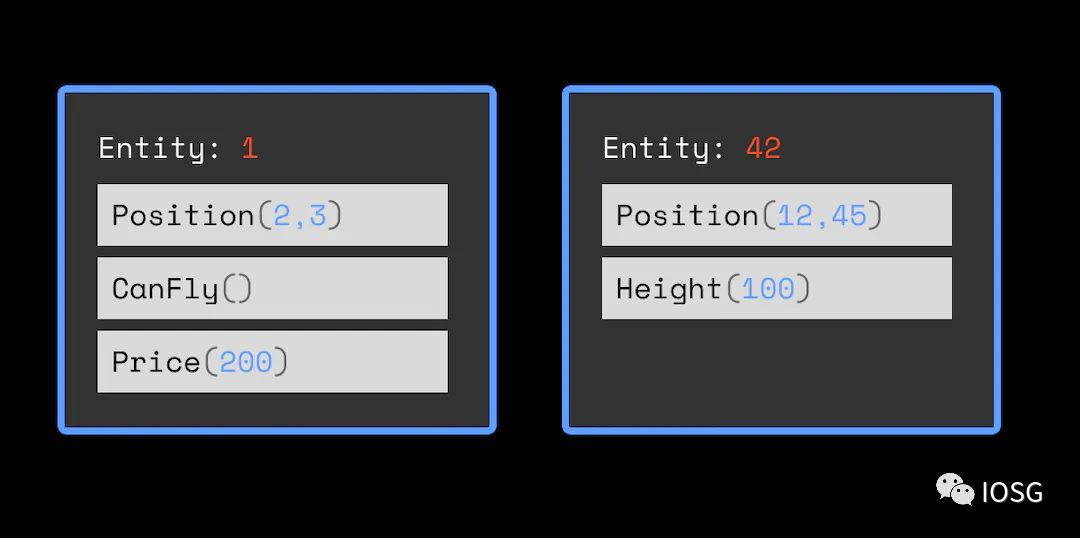
In this example, Entity 1 could represent a dragon character, while Position, CanFly, and Price are three distinct components. Components themselves contain no logic; they can be added to new entities via System contracts. A system contract requires write access to the owner's components. In MUD, there is no distinction between first-party and third-party developers.
Dojo Engine on StarkNet
Dojo Engine is an open-source ECS framework built for the StarkNet ecosystem—similar in concept to MUD but incompatible with EVM, written in Cairo. The engineering team behind Dojo includes contributors from projects such as Realms, Briq, cartridge_gg, topology, and StarkNet.
First Game: Dark Forest
Dark Forest is an MMORTS space conquest game where players discover and conquer planets in an infinitely procedurally generated universe. Its prototype launched in 2020, and version 0.3 ran for one week on the Ropsten testnet. Players were whitelisted and competed for a prize pool of 1,024 DAI. To date, over 10,000 players have participated across rounds on Ropsten, xDai, and Gnosis Chain, collectively consuming trillions of gas.
Dark Forest Ecosystem
-
Plugins
-
Alternative clients
-
GPU miners
-
Corporate players
-
Data/broadcast markets — players can introduce new features through data markets and apply them in-game.
Dark Forest does not distinguish between EOA and smart contract players, leading to the emergence of new types of player communities.
-
DF DAO – established in May 2021
-
Orden GG – another alliance competing with DF DAO
-
Astral Colossus is a smart contract (bot) player belonging to DF DAO. It operates under certain constraints—for instance, it cannot extract resources—and plays solely to boost DF DAO’s ranking score. Any victories contributed by this player are officially recorded.
On-Chain Gaming Ecosystem
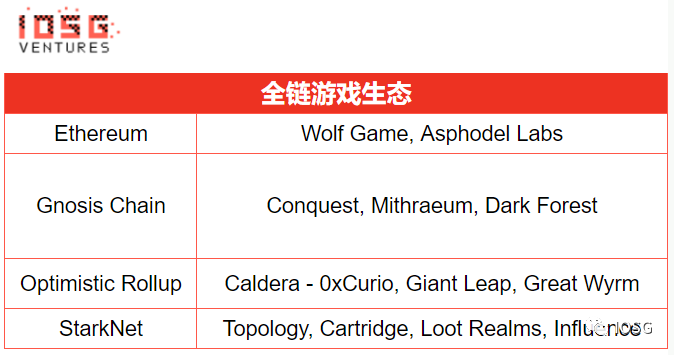
As seen here, Ethereum, OP, and StarkNet represent three key ecosystems.
Challenges in On-Chain Game Development
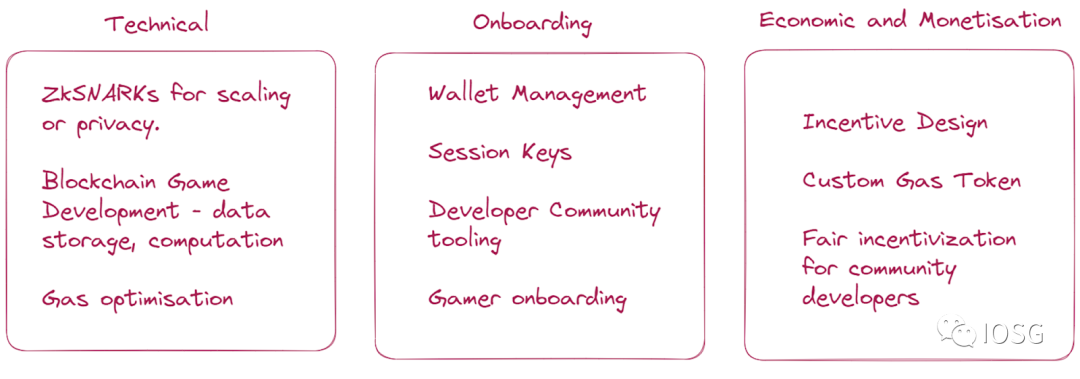
These challenges fall into three main categories: technical, onboarding, and monetization.
Technical Challenges
Developing fully on-chain games involves complex technologies and remains a difficult task. Although MUD and DOJO have lowered the entry barrier, they still don’t offer the same ease of use for developers as Unity. Technical challenges also include scalability.
This is why some teams use rollup-as-a-service providers like Caldera to build OPStack-based solutions, leverage client-side proofs, or build directly on L2s. Some builders are closely watching verifiable decentralized computing networks like RiscZero to expand the scope of their smart contract applications. Gas optimization is another major concern, intersecting both technical/scalability aspects and game design considerations.
SNARKs are used either for privacy or scalability. Dark Forest uses ZKPs to introduce partial information into the game—without them, any player could see the entire game state. Others use SNARKs to offload heavy computation to the client side while synchronizing state (e.g., Playmint).
Onboarding
For on-chain games to attract broader gaming communities (especially ahead of mass adoption), wallet management is critical. Because everything happens on-chain, players may need to sign pop-up transactions for every in-game action—an experience that can quickly become frustrating. Session Keys provide a minimal solution, but come with potential security risks. Currently, game developers often discourage players from holding high-value assets in their wallets, so this isn't yet urgent. However, as more players join, this issue will eventually need resolution.
Another aspect is developer onboarding—encouraging modders and creators to contribute to and extend games, which naturally increases the value of autonomous worlds. This is achieved primarily by providing proper tooling and ensuring fair monetization or rewards for contributions.
Monetization
As early on-chain games succeed, this challenge becomes clearer. In-game economies enhance the fun, mining, and resource-gathering aspects of any on-chain game and require constant tuning to ensure player enjoyment.
An interesting monetization approach today involves earning revenue from sequencer fees, using native tokens within games, and leveraging L2 tokens to secure desired gas rates.
Outlook
Rapid iteration of these engines is beginning to reveal the arrival of an era defined by composability, scalability, and full openness in on-chain gaming. Although current on-chain games still face limitations in playability, interaction complexity, deployable game genres, and technological constraints, the on-chain path genuinely disrupts traditional game logic. It stands out as one of the most promising sectors post-DeFi where narrative and product converge. This ideologically driven nature also fosters a highly active and high-quality developer community. Soon, a rich ecosystem of games, tools, guilds, and other projects will emerge atop these foundational engine architectures, giving rise to a true metaverse economy and social layer.
Join TechFlow official community to stay tuned
Telegram:https://t.me/TechFlowDaily
X (Twitter):https://x.com/TechFlowPost
X (Twitter) EN:https://x.com/BlockFlow_News
 IOSG Ventures







