Understanding IDO: From Concept to Practice, Exploring Its Profit Model, Popular Platforms, and Participation Methods
TechFlow Selected TechFlow Selected
Understanding IDO: From Concept to Practice, Exploring Its Profit Model, Popular Platforms, and Participation Methods
Each IDO platform has different rules. This article uses BSCPAD as an example to explain how to participate in an IDO.
 Navigating Web3 tides with focused insights
Author: Wang Xiaolou, One Step at a Time
Before learning a new concept, it's essential to first establish a systematic understanding. I will present the information in the following logical sequence, which also serves as an organization of my own learning process:
-
What is IDO?
-
How does IDO generate profit?
-
Popular IDO platforms
-
How to participate in an IDO
-
Practical walkthrough
-
Drawbacks
-
Supplementary notes
Previously, I wrote a series of articles on BSCPAD, but didn't cover foundational concepts. This article aims to explain those basics from the ground up.
What is IDO?
IDO (short for Initial Digital Assets Offering) refers to the initial issuance of blockchain-based digital assets. Originating from the stock market concept of IPO (Initial Public Offering), it describes how blockchain projects issue digital assets backed by products or assets and raise universal digital currencies through crowdfunding.
Simply put, IDO enables decentralized fundraising without intermediaries.
Participants include enterprises (single or multiple), users, investors, and communities who collectively maintain the ecosystem. These digital assets are continuously generated through multi-centered business operations, relying primarily on self-regulation rather than heavy regulatory oversight.
The most significant aspect of IDO (Initial Token Offering with buyback commitments) is that issuers guarantee the safety of investors' principal via repurchase commitments.
For project teams, IDO may be the optimal cold-start method—quickly attracting attention and user engagement, issuing tokens at near-zero cost to reward liquidity providers in DeFi, and allowing the market to autonomously anchor and capture token value.
For users, IDO offers relative fairness. During early mining phases, everyone starts roughly on equal footing, unlike ICOs where institutional investors gain significant cost advantages by acquiring tokens cheaply during private rounds before ordinary users get access. While IEOs typically list and exit through centralized exchanges (CEX), IDOs allow tokens to autonomously achieve listing, circulation, and exit via decentralized exchanges (DEX).
Note: Rules vary across different IDO launchpad platforms. The examples in this article are based on BSCPAD.
How Does IDO Generate Profit?
High-quality projects with strong backing from institutional investors often receive enthusiastic market reception. Tens or even hundreds of thousands of people worldwide may simultaneously participate in new token sales. Due to high demand outstripping supply, prices are often driven up significantly—similar to the effect seen in Hong Kong or U.S. stock IPOs. If you're allocated tokens ("win the lottery"), you'll likely make a profit; the only difference is how much.
Popular IDO Platforms
-
PolkaStarter
PolkaStarter is a Polkadot-based DEX designed specifically for cross-chain token pools and auctions, enabling startups to quickly raise funds.
Since launching an IDO on PolkaStarter requires approval from its governance committee—including due diligence and support from over 60% of committee members—the quality of projects listed there tends to be relatively high.
Users can participate in two ways: public pools (open to all whitelisted participants) and POLS pools (requiring minimum token holdings).
-
DuckSTARTER
DuckSTARTER is an IDO platform launched by DuckDAO. As a community-driven platform, holding DUCK tokens grants users access to more project information and the ability to decide whether to join private sales. Thus, DuckDAO considers itself a decentralized DeFi venture capital fund.
-
Dao Maker
Dao Maker grants participation eligibility through a whitelist application process. Recently, many active DeFi projects have chosen Dao Maker to release portions of their token allocations.
-
Bounce
Bounce is an Ethereum-based bulk auction tool. It allows setting caps and durations for auctions—any excess funds beyond the cap are returned to users. Additionally, Bounce supports OTC trading and NFT auctions.
-
Mesa
Mesa is a DEX project built on the Gnosis Protocol. Projects can set auction quantities and price ranges, while users participate via limit order submissions.
-
CoinList
Strictly speaking, CoinList isn't community-driven nor focused on DeFi, so it doesn't qualify as a true IDO platform but rather a traditional token issuance platform.
Co-founded by Protocol Labs, CoinList places strong emphasis on compliance, with funds stored offline.
CoinList has extremely high standards for selecting projects. In some ways, launching a token on CoinList carries similar credibility to later listing on Coinbase—providing substantial trust validation.
The XXXPAD series includes BSCPAD, which will be used as an example in this article.
How to Participate in an IDO?
Rules may differ across various IDO platforms. Here, we’ll use BSCPAD as our example.

First, ensure you visit the correct website: https://bscpad.com/
Second, connect your wallet to purchase tokens. BSCPAD uses a staking model where membership levels are determined by staked amounts. Also, complete KYC verification. Simply put, KYC is identity verification. After connecting your wallet, a question mark appears in the top-right corner—click it to learn about KYC requirements. Key points summarized below:
-
KYC is not conducted directly by the platform but through third-party companies.
-
You must hold at least 1,000 platform tokens (BSCPAD) to undergo KYC—requirements vary by platform.
-
You need a government-issued ID such as national ID card, passport, or driver’s license. Mainland Chinese users can use their passports.
-
You must handwrite "BSCPAD," the current date, and the last four digits of your wallet address on paper and take a photo. Additionally, submit a selfie holding your passport to verify your identity.
Then wait—approval usually comes within 24 hours. If unsure how to buy platform tokens, click the PANCAKE SWAP button on the homepage. (Always double-check the contract address before purchasing. For added security, verify it against the BSCPAD listing on https://coinmarketcap.com/.)
Next, stake your tokens. Since IDO allocations are limited, the platform assigns tiers based on staking amount.
Important for the first three tiers: You must complete staking at least three hours before allocation begins—not right before launch. Additionally, you must complete whitelist tasks on Twitter—liking, commenting, and retweeting project-related posts—to become eligible. Meeting these criteria earns you a lottery ticket. Allocations vary and depend partly on luck.
Higher-tier members enjoy greater privileges—such as exemption from whitelist tasks—and guaranteed allocations. If you’re Blue Diamond tier and the first round ends with leftover tokens, you can join the second round (first-come, first-served), though availability isn’t guaranteed—you’ll need fast reflexes.

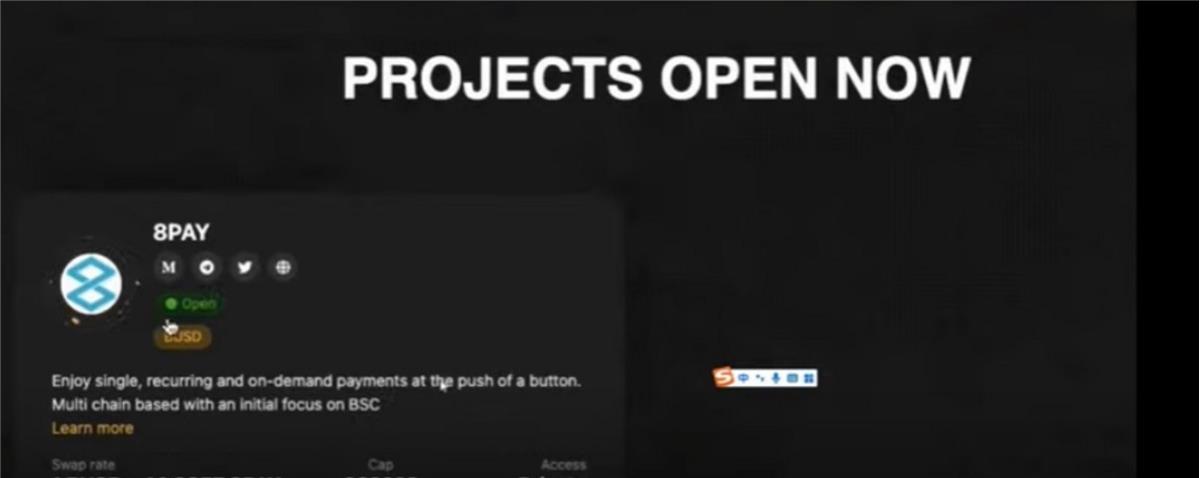
Click the second tab labeled Projects at the top. Click any project to view details. On the left, you’ll see your pre-funded amount. Remember: besides staking platform tokens, you must also have BUSD, since all purchases are made using BUSD—it’s separate from your staked platform tokens. This section also shows your tier level, number of participants, and other relevant data.

Then click “Approve” and follow the steps—enter the desired amount. Upon successful purchase, you’ll see the swap amount and token quantity received. Because IDO participation involves prerequisites like staking and eligibility checks, entry barriers are relatively high. But don’t worry if you miss out—after the IDO, these tokens typically move to secondary markets, where you can still try your luck.
Stay updated via official channels like Twitter and Telegram groups.
After participating in an IDO, go to your account page. You’ll see your pre-purchase amount and a “Claim Tokens” button. Click it to receive tokens in your wallet. With that, the entire cycle is complete—a useful reference for beginners.

Practical Walkthrough
BSCPad is the first decentralized IDO platform on Binance Smart Chain. According to its official description, BSCPad aims to create a fair, inclusive, and low-barrier decentralized IDO mechanism to incentivize and reward all token holders. Unlike other IDO platforms that operate on a first-come-first-served basis—which often leads to bot-dominated rushes—BSCPad adopts a dual-round system. Round One ensures every tier receives a guaranteed allocation (provided you belong to one of the six tiers), offering equitable distribution. Round Two operates on a first-come-first-served basis.

Round One, known as the "Allocation Mode," allows users to purchase tokens according to their tier-based allocation. Based on the amount of BSCPad tokens staked, users are categorized into six tiers—from Bronze to Blue Diamond—requiring between 1,000 and 75,000 BSCPad tokens (see official list). Each tier receives different allocation weights: Bronze = 10, Diamond = 400, Blue Diamond = 500 (plus private sale allocation). The IDO token allocation per tier equals total IDO supply × (tier weight / sum of all weights). Clearly, Blue Diamond receives significantly larger allocations than others.
Bronze and Silver tiers require not only sufficient BSCPad holdings but also completion of whitelist tasks (e.g., liking, commenting, posting specific content on the project’s official Twitter feed—details vary per project).
Example calculation for Round One allocation: Consider a hypothetical project XYZ Token launching via BSCPad. For simplicity, assume 1,000,000 XYZ tokens are sold in the public pool. There are 100 Bronze members, 25 Silver, 10 Gold, and 5 Platinum.
Weightings: Bronze = 10, Silver = 30, Gold = 65, Platinum = 145. Total qualifying weight = (100×10)+(25×30)+(10×65)+(5×145) = 3,125. Tokens per weight unit = 1,000,000 ÷ 3,125 = 320. Formula for each tier’s allocation: number of members × tokens per unit × tier weight.
-
Bronze allocation: 100 × 320 × 10 = 320,000
-
Silver allocation: 25 × 320 × 30 = 240,000
-
Gold allocation: 10 × 320 × 65 = 208,000
-
Platinum allocation: 5 × 320 × 145 = 232,000
Formula for individual allocation per tier: tier allocation ÷ number of members in tier
-
Each Bronze user gets: 320,000 ÷ 100 = 3,200 tokens
-
Each Silver user gets: 240,000 ÷ 25 = 9,600 tokens
-
Each Gold user gets: 208,000 ÷ 10 = 20,800 tokens
-
Each Platinum user gets: 232,000 ÷ 5 = 46,400 tokens
Round Two operates under a “first-come, first-served” model, opening only if tokens remain after Round One. All tier members can purchase additional amounts calculated based on their tier formula. Regardless of tier, all members gain simultaneous access to the purchase window. This round lasts until all remaining tokens are sold—often just minutes—so speed matters. Once all tokens are sold, the IDO concludes.
In short: “Buy BSCPad → Stake → Complete KYC → Finish Project Whitelist Tasks.” Therefore, if you believe in BSCPAD, aim to increase your tier level to maximize token allocations and shorten payback periods.
When no active projects exist, consider staking your BSCPad tokens to earn yield. Ignore short-term price fluctuations—your goal is acquiring tools (“shovels”), not profiting from token appreciation.
Risks of IDO
IDO may appear to circumvent regulations. In the ICO era, projects were funded by public capital; today, they leverage public resources—essentially similar in nature. Moreover, if a project’s tokenomics are poorly designed, its IDO token may resemble mere loyalty points. Conversely, if the project succeeds, token value rises, making IDO participation highly rewarding. However, IDO participation involves门槛s—meeting conditions, staking requirements—with rules differing across platforms.
Risk One: Decline in staked BSCPad price leading to principal loss. However, this could also represent a buying opportunity—accumulate at lower prices, upgrade your tier, secure larger allocations in future projects, and accelerate return on investment.
Risk Two: Risk of post-listing price drop (break-even failure). High-quality projects backed by reputable institutions are typically well-received and heavily contested by the market and community. Hence, the likelihood of listing price depreciation is low.
Risk Three: Risk of personal wallet theft. When participating in new projects, always use newly created wallet addresses to isolate funds. Secure your seed phrase and private key carefully, and avoid excessive permissions on untrusted smart contracts to enhance asset security.
People have varying opinions on BSCPAD, but the most important thing is to conduct your own research before making any judgment.
Join TechFlow official community to stay tuned
Telegram:https://t.me/TechFlowDaily
X (Twitter):https://x.com/TechFlowPost
X (Twitter) EN:https://x.com/BlockFlow_News
 日拱一卒王小楼