TechFlow: Uncovering Block, the Company Founded by Twitter's Former CEO — Sold $2.2 Billion in BTC in Q1, Quietly Profiting
TechFlow Selected TechFlow Selected
TechFlow: Uncovering Block, the Company Founded by Twitter's Former CEO — Sold $2.2 Billion in BTC in Q1, Quietly Profiting
Compared to Tether and Coinbase, is Block truly another example of "quietly making a fortune" in the crypto world?
 Navigating Web3 tides with focused insights
Author: Terry
Recently, Block (formerly Square), the payments company founded by former Twitter CEO Jack Dorsey, released its Q1 2023 earnings report, revealing that it sold $2.2 billion worth of Bitcoin in the first quarter, a 25% year-over-year increase, with gross profit reaching $1.71 billion, up 32% annually, including $931 million in gross profit from Cash App.
Judging purely from these figures, Block is undeniably profitable. Consider Tether—the so-called "passive income poster child"—which reported an audited net profit of $1.48 billion for Q1. Meanwhile, Coinbase’s Q1 report showed revenue of $773 million but a net loss of $79 million.
Therefore, compared to frequently mentioned names like Tether and Coinbase, could Block be another prime example of quietly making big profits in the crypto world?
What Is Block?
Block (formerly Square) is another company founded by Jack Dorsey, former CEO of Twitter. Its business is primarily divided into two parts: the Square ecosystem serving merchants, and the Cash App digital wallet ecosystem serving individual users.
Cash App (formerly Square Cash), a mobile payment service developed by Square, mainly allows users to transfer funds via smartphone applications. It has supported Bitcoin transactions since 2018, meaning Block's core Bitcoin operations are handled through the Cash App segment.
Specifically, Cash App purchases Bitcoin and earns money by selling it to users. Users can also sell their Bitcoin through Cash App and deposit the proceeds into their bank accounts or debit cards.
As early as Q1 2019, Bitcoin generated $65.5 million in revenue for Square. Beyond product integration, Block actively entered the space as an investor in October 2020, purchasing $50 million worth of Bitcoin for the first time.
Since then, Block has continued to invest in Bitcoin multiple times, disclosing in its Q4 2020 earnings report an additional purchase of $170 million worth of Bitcoin.
Given that Jack Dorsey has long been a well-known figure in the Bitcoin community—and among the most steadfast supporters of Bitcoin within traditional internet elites—Block can essentially be viewed as a “believer” unlikely to sell its holdings in the medium term. (Block was also founded during Dorsey’s break from Twitter, and after leaving Twitter again, he has shifted more of his focus toward cryptocurrency assets and Block.)
In March 2021, CFO Amrita Ahuja stated in an interview with Fortune magazine that it makes absolute sense for every company to hold Bitcoin on its balance sheet, reiterating Block’s commitment to long-term Bitcoin holding.
Notably, the high-profile case in April that drew attention across the crypto and tech industries—the fatal stabbing of a tech executive in San Francisco—involves Bob Lee, former Chief Technology Officer of Square and founder of Cash App.
Did Bitcoin Help Cash App Make a Killing?
Let’s break down Cash App’s specific offerings: it centers on free P2P transfers between individuals, expanding into C2B payments, co-branded debit cards, installment shopping (Afterpay), stock investing (commission-free), and Bitcoin services.
So while we noted earlier that Cash App sold $2.2 billion worth of Bitcoin in Q1—an increase of 25% year-on-year—it may seem at first glance that Bitcoin plays a significant role.
However, upon closer inspection, the segment’s quarterly gross profit was $931 million. After excluding Bitcoin-related activities, Cash App still achieved $1.1 billion in revenue—a robust 52% year-over-year growth—and gross profit of $880 million, exceeding market expectations of $840 million.
This implies that Bitcoin contributed only about $50 million in gross profit for the quarter—nearly negligible both in proportion and growth contribution—remaining very much a peripheral business line.
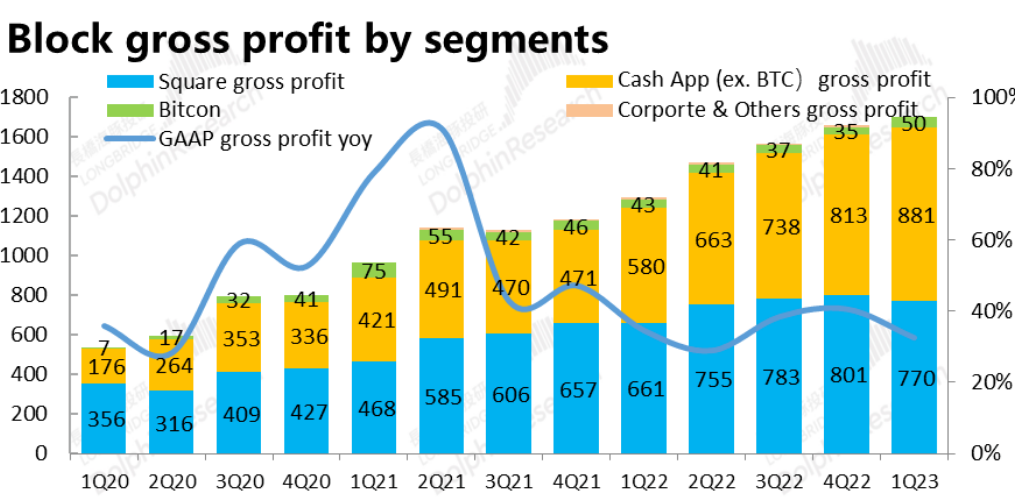
Source: Longbridge Dolphin Research
Moreover, because Cash App acts as a market maker—directly taking the opposite side of user trades rather than facilitating peer-to-peer matching on an exchange—it records the total sales price of Bitcoin sold to users as revenue and the purchase price as cost.
This approach leads Block to record the total transaction volume of Bitcoin (rather than net spreads) as revenue, causing Bitcoin-related revenue to appear large and highly volatile, closely tied to fluctuations in the broader crypto secondary market (unlike other revenues, which are typically recorded as net commissions).
Thus, even though Bitcoin isn’t a core business, amid renewed market interest in Bitcoin this past quarter, Block saw improvements in revenue and gross margin in this segment, while profitability in newer ventures declined.
Overall, for both Cash App and Block, Bitcoin-related revenue accounts for nearly half of the segment’s top line, yet contributes minimal gross profit, remaining a marginal innovation.
Additionally, in March this year, short-selling firm Hindenburg Research released a report accusing Jack Dorsey’s payment provider Block (formerly Square) of “misleading investors” by inflating real user numbers and underestimating customer acquisition costs. This caused Block’s stock to plummet sharply, and the situation remains unclear.
This isn’t Hindenburg’s first move against the crypto industry; previously, it targeted Tether—in late 2021, when global crypto market capitalization hit a record high of $3 trillion, Hindenburg offered a $1 million bounty for undisclosed information about stablecoin Tether, yet Tether continues to thrive today.
Summary
From the perspective of direct Bitcoin investment, Block is indeed a hands-on “Holder”:
According to the earnings report, as of March 31, Block held Bitcoin with a fair value of $229 million, while the carrying value recognized on its balance sheet was $126 million.
Based on previous disclosures, Block likely still holds around 8,207 BTC, never having sold any. The average purchase cost is approximately $27,407 per BTC. At the current market price of around $27,150, the position remains close to break-even after several years of holding.
But perhaps the greater significance lies elsewhere. Despite Jack being a longtime Bitcoin advocate, and despite Bitcoin contributing only a tiny fraction of Block’s overall revenue, the company provides over 40 million U.S. users with a convenient gateway to own and interact with crypto assets (though Block has stated it does not plan to offer access to cryptocurrencies beyond Bitcoin).
Especially in today’s relatively cold market environment, even if it cannot attract growing numbers of new users, maintaining such a peripheral service represents a commendable contribution to advancing the adoption of crypto payments.
Join TechFlow official community to stay tuned
Telegram:https://t.me/TechFlowDaily
X (Twitter):https://x.com/TechFlowPost
X (Twitter) EN:https://x.com/BlockFlow_News
 白话区块链
白话区块链