
Will the addition of Autopools on TraderJoe bring us the next surprise?
TechFlow Selected TechFlow Selected
Will the addition of Autopools on TraderJoe bring us the next surprise?
This article will guide you through Liquidity Book and the impact of Autopools on the Trader Joe protocol.
 Navigating Web3 tides with focused insights
A recent interesting discussion I came across was: "Thoughts on Exchange Incentive Models: Which Is More Worth Incentivizing—Liquidity or Trading Behavior?" In the end, Alex Xu, Research Partner at Mint Ventures, concluded that “liquidity providers are more worth incentivizing.”
One of the most important reasons is retention rate—whether users are willing to stay bound to the platform and how strong their willingness to migrate might be. Clearly, traders tend to be more rational, always choosing exchanges with better liquidity for instant trades in order to minimize trading friction. Liquidity providers, on the other hand, entrust their capital to a platform and thus choose exchanges offering lower risk exposure and better liquidity incentives.
During the wave of liquidity provision sparked by the $ARB airdrop, Uniswap remained a top choice for many liquidity providers despite offering no additional incentives. This can be attributed to Uniswap’s brand strength, its V3 concentrated liquidity model, and its clean security track record with no history of hacks.
Another standout decentralized exchange is TraderJoe. Initially deployed on Avalanche, TraderJoe faced challenges as the bear market arrived and multiple black swan events unfolded. Avalanche failed to retain users who had initially joined due to foundation-led liquidity incentives. The withdrawal of ecosystem liquidity significantly impacted TraderJoe, a core DEX within the Avalanche ecosystem, and consequently affected its business performance.

However, opportunities come to those who prepare.
With the launch of Liquidity Book and migration to Arbitrum, TraderJoe—previously a bright star during the last bull market—has truly re-entered the spotlight of the crypto market. The $ARB airdrop has further served as a new growth catalyst for the platform.
Next, let’s briefly explore the Liquidity Book mechanism and then analyze in detail its upcoming upgrade—Autopools—from the perspective of incentivizing liquidity providers.
Understanding Liquidity Book
Most traditional DEX product architectures fall into two categories: automated market makers (AMM) and central limit order books (CLOB).
-
AMMs use the x*y=k formula to determine token prices based on the liquidity of two tokens. Regardless of changes in X and Y values, their product must remain constant at K (though this can lead to impermanent loss).
-
CLOBs resemble centralized exchange order books, matching buy and sell orders according to predefined rules. Traders can place limit orders directly on the platform.
AMMs are more commonly used in spot DEXs, while CLOBs are typically applied in derivatives trading.
TraderJoe's Liquidity Book model combines both approaches. Although similar to CLOB, strictly speaking, Liquidity Book is actually a DLOB—decentralized limit order book. It divides price ranges into discrete units called Bins. Liquidity providers can select specific Bins based on their strategies. When the market price enters a particular Bin, it becomes an Active Bin and begins generating fees for its liquidity providers.
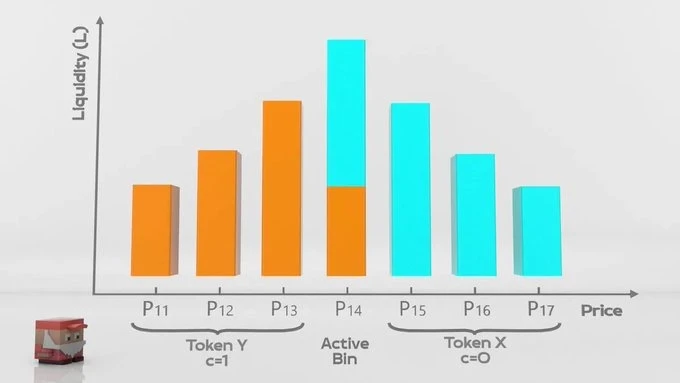
Unlike Uniswap V3’s concentrated liquidity model, Liquidity Book not only lowers the barrier to providing liquidity but also raises the ceiling for sophisticated liquidity strategies. With Liquidity Book, providers can execute more flexible and complex strategies.
Liquidity Book Upgrade: Autopools
As mentioned earlier, although the Liquidity Book model reduces entry barriers, non-professional liquidity providers still struggle to maximize returns through strategic adjustments.
Old Fashion Research partner @jx_block summarized six common liquidity provision strategies on TraderJoe via Twitter:
-
Spot-Concentrated (suitable for stablecoin pairs or tokens with extremely low volatility);
-
Spot-Spread (for token pairs with moderate price fluctuations);
-
Spot-UltraWide (for highly volatile token pairs);
-
Wide (for token pairs with medium volatility);
-
Curved (for tokens fluctuating around a specific price point);
-
Bid-Ask (opposite of Curved, suitable for extremely high-volatility token pairs).
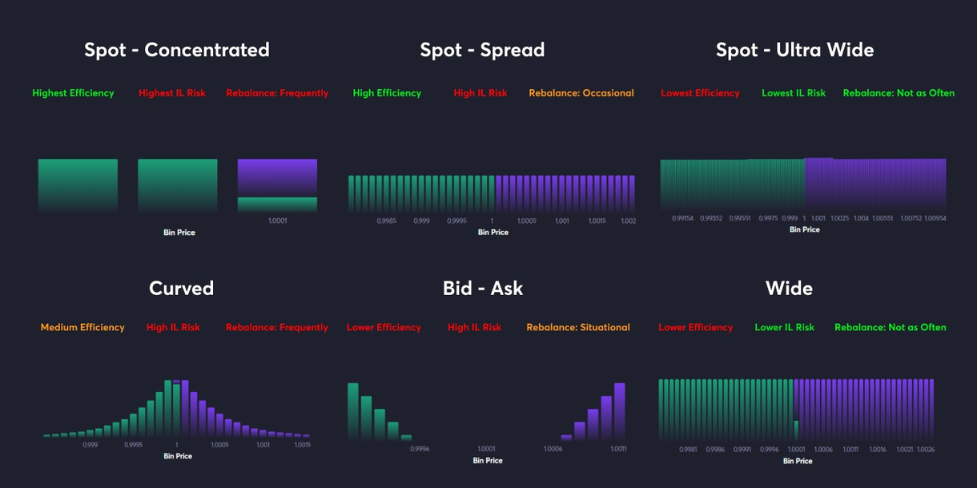
When liquidity providers use TraderJoe to earn fee revenue, they must choose a market-making strategy. This requires forecasting future price movements and selecting the appropriate strategy accordingly.
The key issue is that not all investors are skilled at designing market-making strategies—the decision-making process poses too high a barrier:
For popular liquidity pairs like $ARB-$ETH, non-professional liquidity providers may follow community-suggested strategies on social media to make informed decisions. However, when dealing with more routine liquidity provisioning, amateur providers often find it difficult to identify the optimal strategy and thus fail to maximize their returns.
The upcoming Liquidity Book upgrade introduces a new feature called Autopools, which aims to further lower the barrier for non-professional liquidity providers. Providers who do not wish to actively manage their liquidity positions can now rely entirely on Autopools to execute automated market-making strategies.

The Autopools strategy works as follows:
-
When volatility is low, concentrate liquidity in Bins near the active price range;
-
As volatility increases, expand the range of Bins eligible to receive liquidity;
-
Input time-weighted average price and volatility metrics to ultimately determine position size.
Autopools functions like an automated program or smart contract. As we know, programs and contracts operate by "executing logic based on given inputs to produce outputs." Therefore, in Autopools, the input is the ‘strategy,’ and the output is the ‘market-making behavior.’”
According to Joe Content’s article, the execution of Autopools strategies is handled off-chain by a script called the “Black Box.” A key benefit is that this off-chain component can be updated in real-time, allowing it to adapt quickly to changing market conditions and continuously improve strategies through iteration. In the future, Autopools will integrate additional strategies, including off-chain signals and multi-asset combinations.
However, we should also raise a concern: the transparency of the Black Box. Since Autopools’ strategy logic runs off-chain, oversight mechanisms must be strengthened—for instance, governance via DAO control over the Black Box. Whether the Black Box is open-source and transparent remains an important consideration.
In addition, TraderJoe plans to roll out features such as Autopool Receipts, sJOE trading dividends, permissionless liquidity pools, gas fee optimizations, and market-maker-style limit orders.
Adding more features enhances TraderJoe’s overall product competitiveness.
Impact of Autopools
I’d like to explain the impact of Autopools on the TraderJoe protocol using a more relatable analogy from everyday life.
Exercise is hard for most people. Even after paying for a gym membership, ordinary individuals often lack the discipline to go regularly. The fundamental reason is that exercise delivers negative short-term feedback. In contrast, although studying also brings negative immediate feedback for students, the private tutoring industry remains hugely popular among parents. This is because in tutoring, payment and action are decoupled—parents pay, while students attend classes.
Now let’s return to TraderJoe’s new Autopools upgrade. At its core, Autopools decomposes liquidity provision: separating capital contribution from strategy execution, delegating the high-barrier task to Autopools itself.
What are the benefits?
User retention improves—just as successive waves of students attend tutoring centers. And just as better teaching attracts more students, Autopools will bring more liquidity to TraderJoe and help retain moreLPs.

Finally
At the end of his article, Mint Ventures’ research partner Alex Xu noted: “In Web3, monopolies seem harder to establish. For any project to survive and grow in this 'low-barrier' environment, it must continuously compete on operational efficiency. Here, ‘operations’ is a broad term encompassing product innovation, marketing campaigns, team management, and many other aspects—with accurate and efficient incentive design being one of the most critical components.”
Recently, the TraderJoe team has maintained a high level of operational efficiency: launching Liquidity Book to great acclaim, expanding onto Arbitrum, and now preparing to roll out the Autopools upgrade. They have accurately captured the rhythm of the crypto market and seized key opportunities to shine. This is precisely why its native token JOE surged from $0.2 to $0.6 in a short period. As such, we have even greater expectations for TraderJoe’s future development.
Join TechFlow official community to stay tuned
Telegram:https://t.me/TechFlowDaily
X (Twitter):https://x.com/TechFlowPost
X (Twitter) EN:https://x.com/BlockFlow_News
 雨中狂睡Sleeping in the Rain