








Data Insights: MEV Opportunities and Impact in the LSD Sector Before and After the Shanghai Upgrade
TechFlow Selected TechFlow Selected
Data Insights: MEV Opportunities and Impact in the LSD Sector Before and After the Shanghai Upgrade
Ordinary users usually don't pay much attention to MEV, but opportunities and risks often lie within data beyond their focus.
 Navigating Web3 tides with focused insights
Author: EigenPhi
Translation: TechFlow

Tomorrow (April 13) is expected to be the most anticipated day since "The Merge." The Shanghai upgrade paves the way for liquid staking derivatives (LSD) markets on Ethereum.
Get ready for a transformation in the Ethereum world, as it enables withdrawals of staked assets and fundamentally reshapes the LSD market. Trading volume is expected to surge, accompanied by a wave of new MEV opportunities. This article analyzes recent MEV trends and forecasts the future development of the Ethereum MEV market.
Ordinary users often pay little attention to MEV, yet opportunities and risks frequently lie hidden within overlooked data. Let’s dive into a detailed analysis together through the data presented in this article.
Overview of MEV Opportunities in LSD
Below are highlights from the MEV market in the LSD sector between May 2022 and February 2023.
-
MEV activities—including arbitrage, liquidations, and sandwich attacks—generated over $4.8 million in total revenue, with the majority coming from arbitrage.
-
The rising frequency of arbitrage trades alongside declining average arbitrage income indicates continuously improving market efficiency.
-
The revenue-to-cost ratio has decreased across all three types of MEV, indicating increased competition in the LSD MEV market.
Scale of the LSD MEV Market

According to recent data, from May 1, 2022, to February 28, 2023, MEV involving LSD generated a remarkable total revenue of $4,844,957.15.
-
In terms of MEV frequency, the vast majority (93.6%) of LSD-related MEV stems from arbitrage trades, while sandwich attacks account for only 4.8% and liquidations just 1.6%.
-
Interestingly, when looking at income distribution, the bulk of total revenue ($3.51 million) flowed to arbitrageurs, followed by liquidators ($820,000), and sandwich attackers ($500,000).
These figures illustrate the dominance of arbitrage trading in the LSD MEV market.
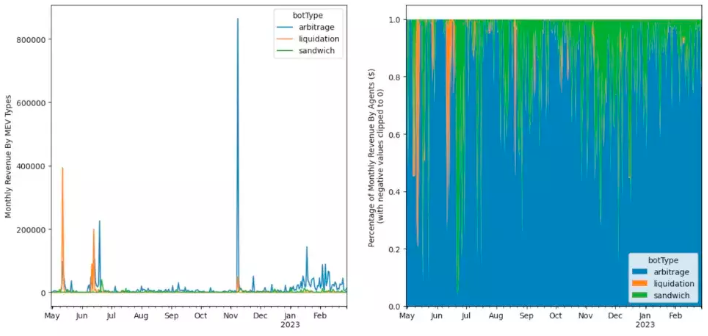
MEV opportunities are unevenly distributed over time. Notably, two major liquidation events occurred in May and June, but most months saw no significant trading opportunities. This imbalance arises because liquidation opportunities are closely tied to price volatility of LSD tokens. Additionally, the large arbitrage opportunities in November 2022 were triggered by the collapse of FTX.
Trends in the LSD MEV Market
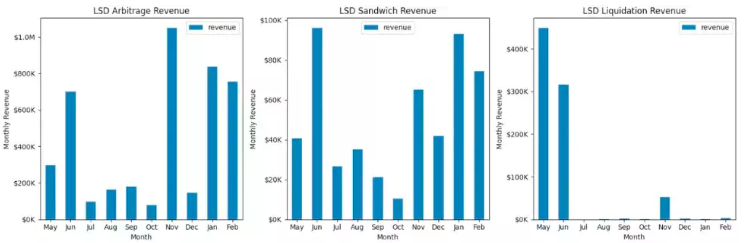
Figure: Average monthly revenue for three MEV strategies
The data shows monthly revenue trends for different LSD MEV strategies:
-
Arbitrage strategies averaged $351,000 per month, though they experienced notable fluctuations due to market changes;
-
Sandwich MEV bots had smaller scale operations, averaging $50,000 in monthly revenue;
-
Liquidation bots earned substantial income in May, June, and November, but their earnings dropped sharply or even approached zero in other months.
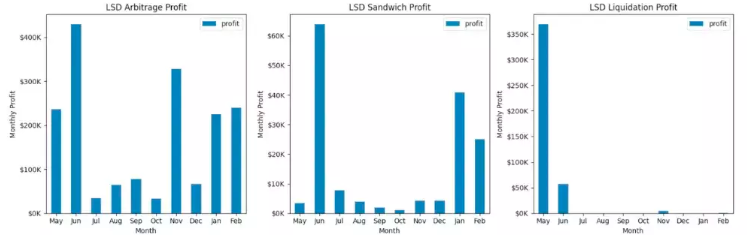
Figure: Average monthly profit for three MEV strategies
Note that revenue does not equal profit. Profit is calculated by subtracting costs (including transaction fees and coinbase transfer fees) from revenue. For the profits of the above three MEV strategies, we summarize as follows:
-
Arbitrage strategy: average monthly profit of $150,000;
-
Sandwich MEV bots: average monthly profit of $15,000;
-
Liquidation bots: average monthly profit of $43,000.
Overall, all three strategies remain profitable, with differences in profitability likely attributable to market conditions and competition among bots executing similar strategies.

Figure: Execution frequency of three different MEV strategies
Beyond revenue and profit, execution frequency is another critical factor in the LSD MEV market. The frequency of each strategy can reflect market conditions and the effectiveness of the strategy.
From the data:
-
The frequency of arbitrage strategies has significantly increased over time. Notably, a sharp rise in frequency occurred in January 2023 due to EigenPhi (the original author) adopting a new algorithm to identify arbitrage opportunities, detecting more arbitrage transactions;
-
The frequency of sandwich MEV bots also shows a significant upward trend;
-
In contrast, the frequency of liquidation bots varies depending on market conditions.
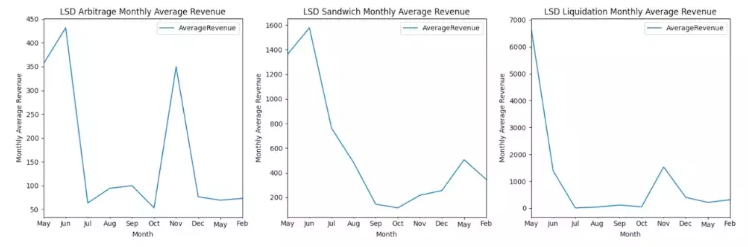
Based on the above data, the average revenue per strategy appears to gradually decline as market efficiency in the LSD sector improves. This implies that small arbitrage opportunities are quickly identified and exploited, leading to lower average profits. However, due to FTX's bankruptcy, all three strategies saw a significant increase in average revenue in November, driven by market volatility and larger arbitrage opportunities. Similarly, sandwich bot operators have become more cautious, reducing their profit potential. It should be noted that these trends are not uncommon in financial markets—competition and innovation can quickly lead to diminishing returns. Therefore, maintaining profitability may require constant adjustment and optimization of trading strategies to stay ahead.
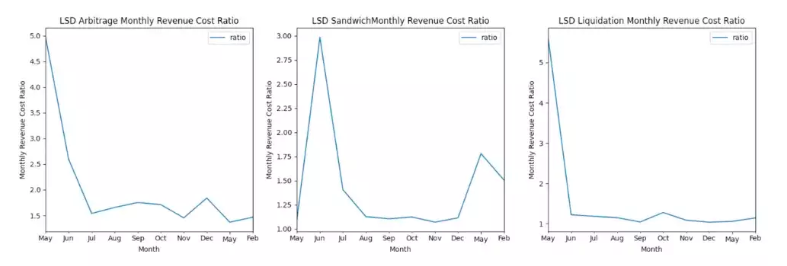
Figure: Revenue-to-cost ratio for three MEV strategies
The declining revenue-to-cost ratio is another trend worth noting. In this context, revenue refers to the net profit earned by an MEV bot in a single transaction, while cost includes gas fees and coinbase transfer fees.
A coinbase transfer refers to the tip paid by searchers to validators/builders to successfully execute a strategy. The decreasing revenue-to-cost ratio for arbitrage and sandwich bots means that searchers are capturing a smaller share of profits in LSD MEV.
This trend stems from two main reasons:
-
First, increasing numbers of searchers are focusing on the LSD MEV market, intensifying competition.
-
Second, the LSD MEV market is maturing, with opportunities being more fully exploited.
To maintain profitability in such an environment, MEV bots may need to continuously improve their strategies and find new ways to gain competitive advantages. For example, the Shanghai upgrade could present excellent opportunities. Additionally, they may need to carefully manage costs—including gas fees and tips paid to validators and builders—to ensure long-term profitability.
Distribution of MEV Opportunities
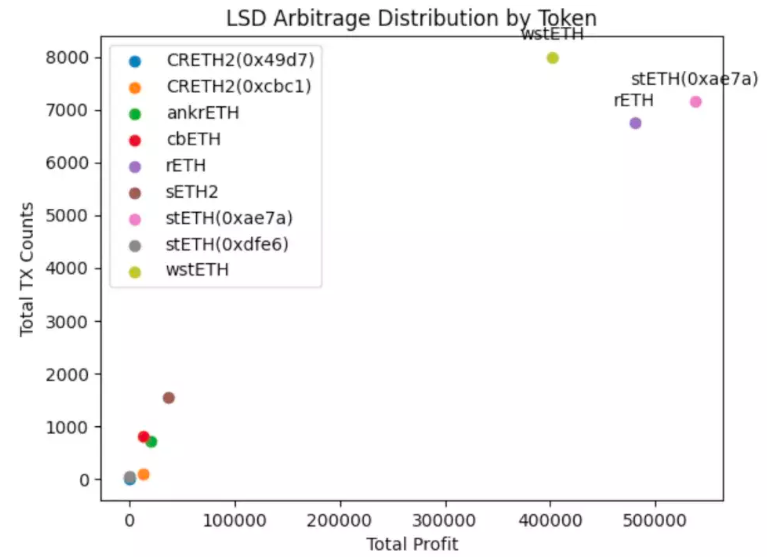
In DeFi markets, arbitrage opportunities typically arise when traders execute large buyback trades or discover price discrepancies of the same token across different decentralized exchanges. Specifically, in LSD, most arbitrage opportunities involve stETH, wstETH, and rETH tokens. These findings suggest traders may have opportunities to profit from price differences of these tokens across various DEXs, highlighting the importance of closely monitoring these markets for profitable opportunities.

Furthermore, sandwich attacks are frequently observed in transactions involving cbETH, wstETH, rETH, and stETH tokens. However, it's important to note that profits from these sandwich attacks are not evenly distributed across all tokens. Specifically, sandwich attacks on stETH and rETH yield higher average profits. These findings suggest that searchers should carefully evaluate the potential profit and risk of each token before deploying sandwich attack strategies.
LSD liquidations represent a profitable opportunity, but they are currently not widely utilized across different tokens and protocols. Currently, all observed LSD liquidations have occurred on stETH within AAVE v2. Data shows over 426 liquidation transactions have been executed, generating total profits of $432,000. However, it's worth noting that AAVE v2 is not the only lending protocol accepting LSD as collateral. For instance, MakerDAO has included both stETH and rETH as collateral types. Therefore, there may be some liquidation transactions we failed to detect.
Future Opportunities in LSD MEV
With the approaching Shanghai upgrade, validators will be able to withdraw staked ETH from the Beacon Chain. Stakers may also be able to burn LSD tokens and reclaim their staked ETH. This could have significant implications for the LSD MEV market.
-
ETH price volatility concerns. According to Beaconcha.in, as of March 14, 17,573,625 ETH were staked on the Beacon Chain. The Shanghai upgrade allows users to withdraw ETH and reduce their ETH exposure. Allowing many users to withdraw ETH simultaneously in a short period could trigger sharp fluctuations in ETH prices across DeFi markets, creating abundant opportunities for arbitrage, liquidations, and sandwich attacks. Therefore, users planning to sell large amounts of ETH in DeFi markets are advised to prepare defenses against sandwich attacks. Meanwhile, users employing WETH as collateral should consider adjusting their debt positions accordingly.
-
Short-term arbitrage opportunities between staking protocols and markets. For example, over the past two years, most LSD tokens have experienced significant price declines in open markets. However, after the Shanghai upgrade, most staking protocols will allow users to exchange LSD tokens for ETH at rates higher than market prices, creating arbitrage opportunities. That said, different protocols may design their withdrawal mechanisms to prevent such arbitrage behaviors.
-
In the long term, the LSD MEV market is expected to grow substantially. LSD tokens with strong liquidity and additional rewards are anticipated to experience higher trading volumes, leading to more liquidity pools involving LSD and lending protocols using LSD as collateral. Due to extra rewards associated with LSD, LSD is expected to capture part of the liquidity currently held by WETH on Ethereum. Consequently, LSD-related MEV is expected to increase significantly post-Shanghai upgrade.
-
Opportunities related to LSD price movements and overall MEV rewards. Most LSD rewards originate from MEV rewards in the ecosystem. Higher aggregate MEV rewards will lead to higher LSD rewards, thereby driving up LSD prices. New trading strategies will also emerge. For example, going long on stETH while shorting ETH could be an effective way to express a long-term bullish view on overall MEV. A clear understanding of MEV trends may help searchers develop superior trading strategies around LSD.
Join TechFlow official community to stay tuned
Telegram:https://t.me/TechFlowDaily
X (Twitter):https://x.com/TechFlowPost
X (Twitter) EN:https://x.com/BlockFlow_News
 EigenPhi MEV Alert


