AI Applications in Web3: Challenges, Risks, and Prospects
TechFlow Selected TechFlow Selected
AI Applications in Web3: Challenges, Risks, and Prospects
Famous author William Gibson once described the future of AI: "The future has already arrived—it's just not very evenly distributed."
 Navigating Web3 tides with focused insights
Author: crypto.com
Compiled by: TechFlow
Key Takeaways:
-
Generative AI is an artificial intelligence technology used to generate synthetic content such as text, images, audio, and video.
-
AI applications in Web3 include deploying digital collectibles, NFTs, asset creation, and software development within games.
-
Beyond content generation, AI can advance the Web3 space by streamlining development processes and improving user experiences for decentralized applications (DApps).
-
Despite ongoing challenges related to copyright, accuracy, and creativity, the AI era has arrived—AI models are transforming businesses and industries.
Introduction to AI-Generated Content
Recently, AI-generated content (AIGC) has become highly popular, with applications like DALL-E and ChatGPT producing impressive visual assets and engaging in human-like conversations.
Broadly speaking, generative AI refers to artificial intelligence that uses computer models to generate content such as text, images, audio, and video. Following professionally generated content (PGC) and user-generated content (UGC), AIGC is widely regarded as the next stage of content creation.
PGC is typically created by creative professionals such as graphic designers and animators for brand use or publication, while UGC is produced directly by end users and shared on social media platforms like YouTube, Facebook, or Twitter.
With rapid advancements in AI in recent years, it can now generate various types of content. Key AI fields involved include natural language processing (NLP), which studies how computers process and analyze text, and generative adversarial networks (GANs), designed to create new data—such as images and videos—that resemble features from training datasets.
AI-generated content can accelerate the creative process, and businesses are beginning to recognize its potential to transform how content is created and how creative teams operate across industries.
Below are potential scenarios and use cases connecting AI and Web3.
Applications of AIGC in Web3
Text AI and Its Impact on Web3
Text AI refers to using artificial intelligence to generate written content. It is a form of natural language processing technology capable of generating human-like text from given inputs and is used in various applications such as summarization, dialogue systems, and machine translation. Today’s text generators are being used to produce original, creative content for diverse purposes and have numerous high-potential applications within Web3.
With text AI tools, online search can be reimagined to offer more intuitive ways of navigating the web. The latest integration of ChatGPT with Microsoft's Bing search engine has already launched a chat interface as a method for searching the internet.
Meanwhile, Google has released its own version of an NLP model called Bard—an experimental conversational AI service powered by LaMDA—designed to simplify complex topics and synthesize insights from queries.
Generative AI Could Transform How People Search the Web
Generative AI has the potential to change how people filter information online and could reduce reliance on the advertising-based models of current search engines—a long-standing issue many Web2 users have sought to avoid.
Text generation tools allow users to cut through the noise of SEO-driven content during queries (though still requiring human oversight and fine-tuning). If search preferences shift toward text AI tools, traditional search engines may be replaced, resulting in fewer ad-heavy search results—an outcome aligned with one of Web3’s core principles: returning technological control to users.
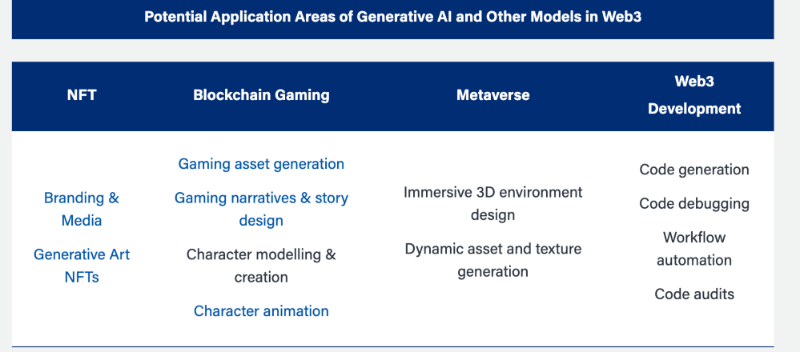
In blockchain gaming, text AI can enhance the creativity and productivity of game developers and artists. By leveraging text AI, foundational game elements such as dialogue, storylines, and character design can be rapidly developed and refined, streamlining the creative process by accelerating idea generation.
AI NFTs
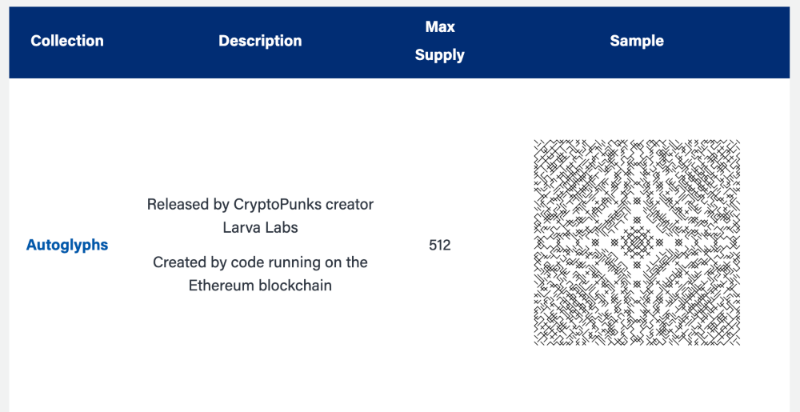
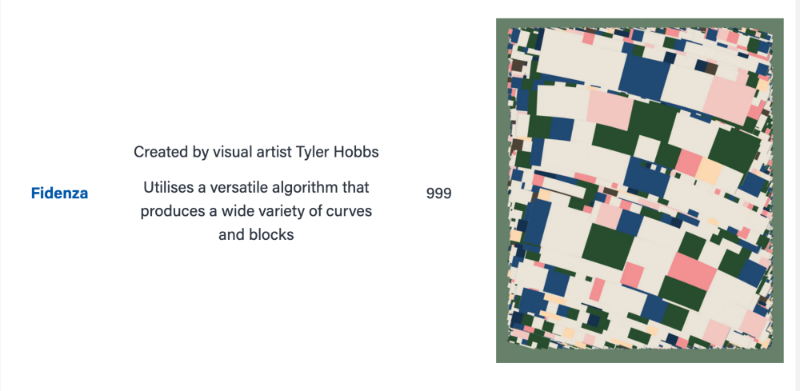
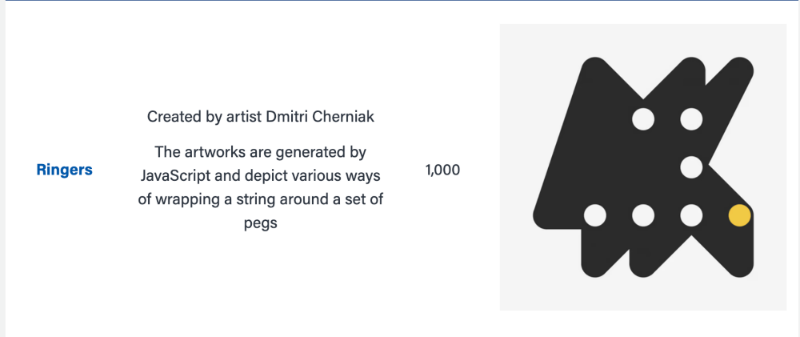
AI can also assist in generating images and videos, which can then be minted as NFTs. These AI-generated NFTs are known as generative art NFTs, where artists first input a set of rules (e.g., color schemes and patterns), along with parameters such as number of iterations and degree of randomness. The computer then generates artwork within this defined framework.
One example is the "Autoglyphs" NFT collection by Larva Labs, creators of "CryptoPunks." Below are additional examples of NFT collections generated with AI assistance.

AI Avatars and Items in Blockchain Games
Generative AI models can assist in creating large-scale game assets within Web3 environments, including avatars, equipment, vehicles, and artifacts. The gaming industry can apply text-to-image generative AI models to produce creative assets and content from textual descriptions. Within specified parameters, modern language models can also help establish context for these assets, such as item strength statistics, character attributes, or lore.
Today, AI-generated images and videos are so advanced they can even be used to create visual effects for blockchain games and virtual products in the metaverse. For instance, Mirror World, a GameFi project, leverages AI-powered virtual "mirrors" as in-game character assets. Mirror assets are fully interoperable across games, ensuring asset holders can use them to meet new challenges when games launch.
Alethea AI has introduced CharacterGPT as another example of generative AI. This project employs a multimodal AI system called CharacterGPT to generate interactive AI characters from text descriptions, enabling text-to-character creation. These interactive characters can have unique appearances, voices, personalities, and identities based on different natural language inputs.
These characters can be tokenized and recorded on the blockchain. Owners can further customize their personalities, train their intelligence, and trade or use them across various other dApps within Alethea's AI Protocol. These interactive characters open up numerous application scenarios, including digital twins (virtual models reflecting physical object designs), digital guides, digital companions, virtual assistants, and AI-powered non-player characters (NPCs).
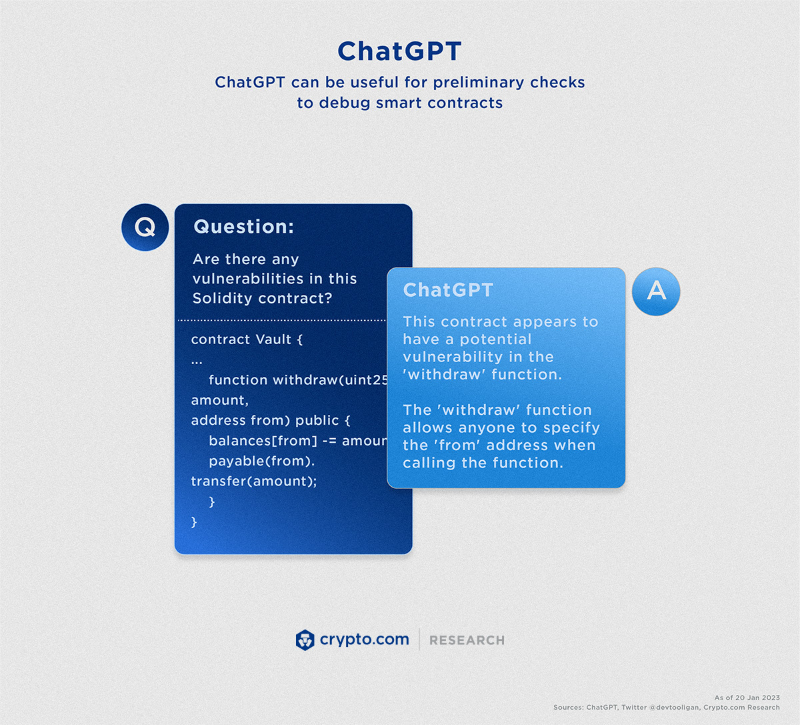
AI Can Help Identify Vulnerabilities
When it comes to building Web3 infrastructure and applications, AI can help streamline the development process.
For example, AI applications can be used for debugging code. With AI, ChatGPT has already demonstrated some ability not only to read and write code but also to identify bugs within it.
Some crypto professionals are now using this AI-powered tool for simple code auditing tasks: developers at Certik, a smart contract auditing firm, have used ChatGPT to “quickly understand and summarize the semantics of complex code snippets.”
Final Thoughts: Challenges, Risks, and Prospects of AI Applications in Web3
As AI continues to evolve, its possibilities are limitless—constrained only by the imagination of users. Even at an early stage, AI models continue to demonstrate their capacity to transform enterprises and entire industries. Due to low barriers to entry and widespread adoption, AI is likely to become a fundamental part of our digital future. However, this technology also presents certain challenges and risks.
One challenge may be consumer and organizational resistance to AI-generated content. For example, one of the leading stock image platforms, Getty Images, has banned the upload and sale of illustrations created using AI art tools. Copyright concerns are cited as the reason, as some AI-generated images replicate copyrighted material, with original artists’ watermarks still visible.
Another challenge facing AIGC is quality issues. Stanford University professor Andrew Ng provided an example where ChatGPT incorrectly claimed that abacuses are faster than GPUs (fortunately not true).
For many, the concern that this technology will disrupt jobs is a significant challenge. However, the belief that AI will replace humans in the workforce is a misconception. In fact, AI is more likely to either augment existing roles or create new types of AI-related jobs, requiring some degree of skill upgrading.
As renowned author William Gibson once described the future of AI: “The future has already arrived—it's just not evenly distributed.” This also applies to today’s intersection of AI and Web3.
Join TechFlow official community to stay tuned
Telegram:https://t.me/TechFlowDaily
X (Twitter):https://x.com/TechFlowPost
X (Twitter) EN:https://x.com/BlockFlow_News
 @cryptocom