








Celt's "Diving" Revelation: Don't Blindly Trust Crypto KOLs and "Favorite Projects"—The Role and Responsibility of Exchanges
TechFlow Selected TechFlow Selected
Celt's "Diving" Revelation: Don't Blindly Trust Crypto KOLs and "Favorite Projects"—The Role and Responsibility of Exchanges
In the crypto industry, it's easy to become a profitable company, but hard to become a respected one.
 Navigating Web3 tides with focused insights
By 0xlol
In the crypto market, there's a spectacular kind of K-line known as the "Super Mario"—soaring upward in a rush, then plummeting dramatically—legends of which still circulate within the industry.
Around 2019, "Super Mario" was synonymous with scams and frauds—a price surge lasting just one or two months, followed by a collapse back to its original level in a single day, leaving investors terrified and astonished.
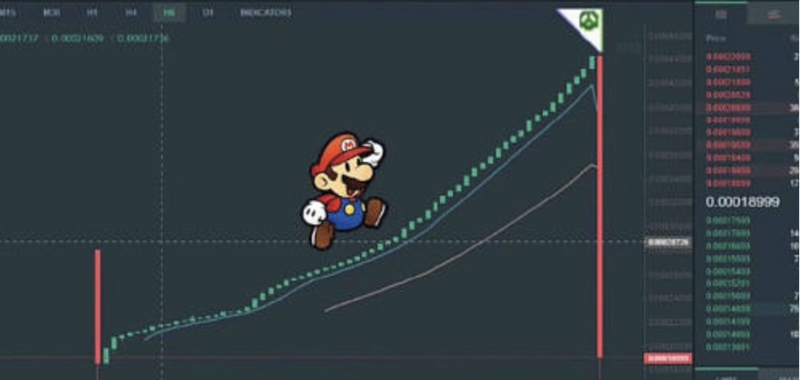
We thought such phenomena had gradually faded into obscurity, but now they’ve reappeared.
On February 27, after several days of continuous gains, Celestial’s token CELT suddenly plunged during the evening session—from a high of $0.00538 down to $0.00166, a drop exceeding 69%. This replayed the infamous “Super Mario dive,” triggering a chain reaction across the market.
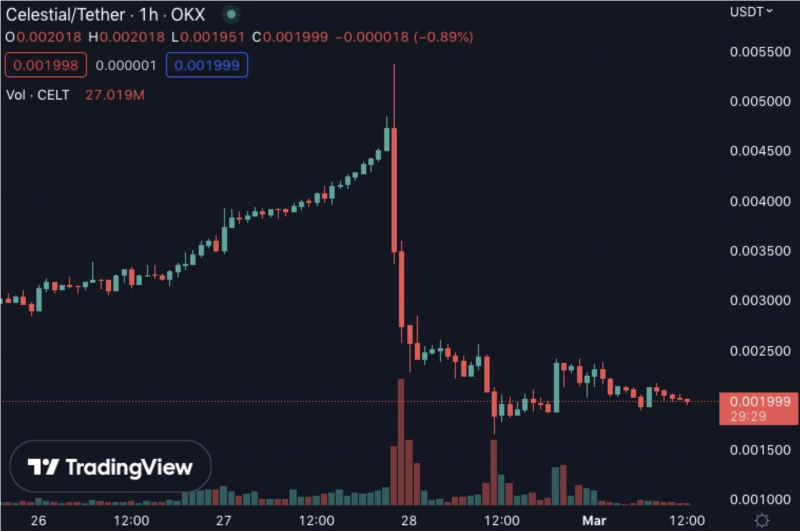
Previously, this project had been heavily promoted simultaneously by numerous crypto KOL accounts on Twitter and other social media platforms, branding it as the “OKX’s favored son.” Given that OKX was the primary trading venue for the token, both the KOLs and OKX found themselves at the center of public scrutiny.
Compared to the awkward position of the KOLs, OKX managed a skillful turnaround in public opinion this time.
On February 27, Xu Mingxing of OKX tweeted that this situation disappointed them deeply. The team will review its listing standards to prevent similar junk tokens from being listed and is considering delisting CELT. OKX is a neutral exchange; apart from OKB and OKT, no token may leverage any association with OKX for promotion.
Regarding whether there was any strategic partnership between OKX and CELT, OKX officially stated that it invested $100,000 in Celestial in September 2021, with related tokens scheduled to unlock over one year per the investment agreement. These tokens remain locked in the OKX Ventures account and have not undergone any operations.
Additionally, “OKX Ventures has no further connection with the project team,” and the campaign promoting the project under the name “OKX’s favored son” involving multiple KOLs was conducted without OKX’s authorization.
Following an investigation, OKX identified five suspicious profit-making accounts and immediately froze them. After repeated communication, the project team ultimately agreed to return 1.3 million USDT.
Finally, OKX proposed a resolution plan, including an airdrop totaling 3,014,381 USDT to users affected by this incident.
1. Deduct the full balance of 2,014,381 USDT from the five market-manipulating accounts.
2. OKX will also contribute 1 million USDT from its own funds.
Compensation has now been distributed, and some impacted investors have expressed approval of OKX’s handling of the incident.
After this farce, we want to reflect on the lessons behind it—for individual investors, KOLs, and exchanges. In a crypto world where everyone rushes to claim lineage, independent thinking matters more than ever.
Don’t Blindly Trust KOLs
At some point, “influencers” and “KOLs” began carrying increasingly negative connotations across many fields, especially since the barrier to entry is so low that all kinds of people now call themselves KOLs.
Not only in crypto, but also in stocks and real estate, KOLs often face widespread skepticism. There are even cases where fans followed KOL advice to buy property, suffered losses, and ended up suing in court.
Places close to money are dazzling yet dangerous.
On Twitter, many overseas bloggers always include DYOR and NFA as hashtags.
Do Your Own Research (DYOR): Conduct your own due diligence before investing;
Not Financial Advice (NFA): Not financial advice.
As investors, we should always keep these two principles in mind: think independently and take responsibility for our own investment decisions.
Warren Buffett once shared a poker table theory: when you sit at the table, if you don’t know who the sucker is, then you’re the sucker.
Protect Your Reputation
For KOLs, although we often say, "With great influence comes great responsibility," and that they should protect their reputation, many KOLs also express their frustrations: “Promotions don’t actually earn much money. Sometimes I do research and write about a project without getting paid, yet I’m still accused of taking bribes and ‘harvesting韭菜’ (scamming followers).”
As NFT figure Andrew Huang put it, no one thanks you when you make money, but everyone hates you when they lose.
In Web3, just like in Web2, monetizing traffic generally yields low ROI for KOLs. The better path might be returning to fundamental research—profiting through discovering and analyzing quality assets, serving one’s own investment strategy rather than chasing traffic. Otherwise, KOLs easily become cheap tools for others’ gain.
Don’t Believe in Crypto’s “Favored Sons”
In crypto, many projects aspire to be a “son”—or even a “grandson”—of major players, openly or privately claiming things like “we have strong ties with XXX” to boost credibility.
Retail investors seem to accept this narrative, treating “affiliation with XX exchange” as a core investment rationale.
The flaw lies in how many self-proclaimed “fake sons” exist in this space. Even if the relationship is real, you might still end up dealing with a reckless spendthrift.
A concept needing correction: being invested in by an exchange’s venture arm doesn’t mean the project has special ties to the exchange, nor does it guarantee listing. It mostly just creates listing expectations among retail investors.
At most exchanges, the investment division and the listings team operate separately, with different KPIs. Larger exchanges tend to have greater independence between these departments.
Coinbase Ventures has invested in nearly 300 projects—does that mean there are now 300 “Coinbase sons”? Even if Coinbase wanted to, most project teams wouldn’t want that label, since many still care about their reputations.
Who Regulates Exchanges?
We often compare the crypto world to the “Wild West”—a place with little legal or regulatory oversight. Where rules and order are absent, jungle law prevails: the strong dominate, winners take all, losers are scorned. In such environments, misconduct and ruthless actors are often rewarded—“kill and plunder wear golden belts, while bridge-builders go unburied.” No matter how capital is accumulated, as long as one becomes sufficiently wealthy in crypto, they can eventually wash their image and gain admiration.
Exchanges sit atop this Wild West food chain, combining asset creation, issuance, trading, and even market-making functions—acting as both players and referees.
In traditional finance, there's the SEC providing top-down regulation. So who serves as the “Crypto SEC”?
I believe it’s the market itself—where the public votes with their feet, bottom-up, gradually forming unwritten rules accepted by consensus.
For exchanges, the greater the power, the greater the responsibility. A malicious exchange may thrive temporarily, but will ultimately be eliminated by the market.
One of the most critical “assets” an exchange holds is its brand—trading systems, security technology, asset quality, and market operations all ultimately accumulate into brand equity.
In the CELT incident, OKX spent $1 million of its own funds to provide additional compensation. Some see this as a loss for OKX, but this money was well spent. A brand built over years could require tenfold effort to repair if damaged. OKX’s response was undoubtedly wise, reflecting its integrity and willingness to take responsibility for investors.
Similarly, after BLUR’s token launch, OKX experienced delays in crediting user deposits, preventing some users from selling at peak prices. In response, OKX again offered compensation via airdrop: “For every 500 BLUR deposited, receive 1 OKB,” capped at 500 OKB.
Judging from public sentiment, these two incidents and their resolutions have significantly boosted OKX’s reputation. In the crypto industry, building a profitable company is easy—but earning respect is hard.
Join TechFlow official community to stay tuned
Telegram:https://t.me/TechFlowDaily
X (Twitter):https://x.com/TechFlowPost
X (Twitter) EN:https://x.com/BlockFlow_News






