Deconstructing the current stablecoin landscape: competition exists, but collaboration is the best solution
TechFlow Selected TechFlow Selected
Deconstructing the current stablecoin landscape: competition exists, but collaboration is the best solution
Which DeFi token would you hold to hedge against cryptocurrency volatility without expecting any yield from it?
 Navigating Web3 tides with focused insights
Written by: Ignas
Translated by: TechFlow
When UST collapsed, DeFi stablecoins were hit hard—but DAI, FRAX, and LUSD remained resilient. Now, GHO and crvUSD are preparing to enter the space with new innovations. And with regulators cracking down on BUSD, DeFi stablecoins may be entering a new bull market.
Question: Which DeFi token would you hold to escape crypto volatility without expecting any yield in return?
In my view, it should be DAI.
This is because $DAI carries monetary premium—the extra value beyond its price—thanks to:
• On-chain liquidity
• A proven track record of dollar peg stability
• Integration across numerous DeFi protocols
• Growing real-world adoption
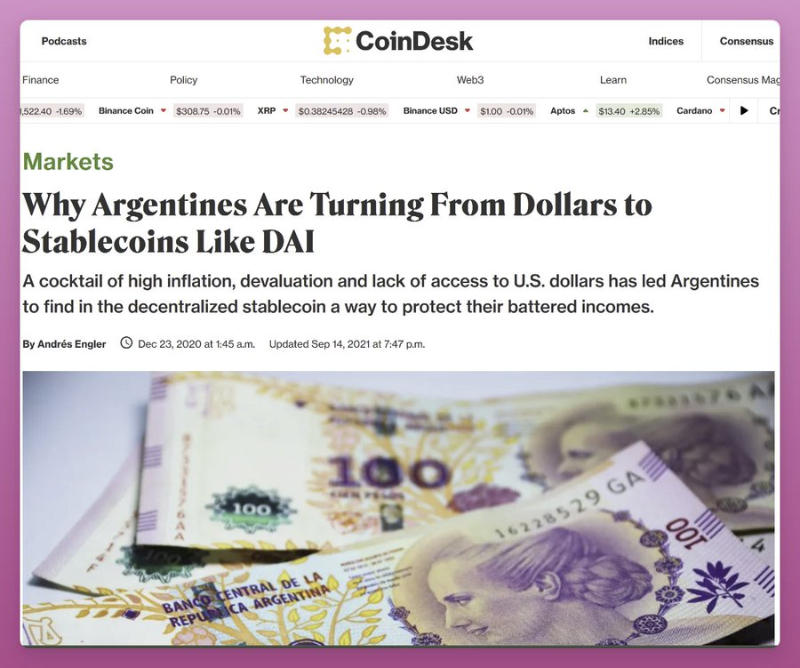
The same concept of monetary premium applies to centralized stablecoins. The premium depends on adoption, regulatory compliance, liquidity, and trust.
Now, the SEC’s allegations against BUSD are eroding BUSD’s monetary premium, benefiting USDC and USDT—but primarily DeFi stablecoins.
You can think of this premium as analogous to the U.S. dollar’s premium over other global currencies. It stems from reserve currency status, political stability, military and economic strength, and deep financial markets. It involves multiple factors and takes time to build.
$UST had very low monetary premium—it wasn’t used as a “safe haven” from crypto volatility, but rather as a risk asset to earn 20% APY on Anchor.
That said, DeFi stablecoins like FRAX and LUSD are building their own monetary premiums and catching up to DAI.
While they may appear interchangeable, each serves a distinct purpose. Maker has shifted focus toward generating revenue from RWAs where regulation permits.
Yet, its ultimate goal remains a bias-free world currency backed by decentralized, physically resilient collateral.
Liquity (LUSD) shares the same mission: to become the “most decentralized stablecoin resistant to all forms of censorship.” However, it achieves this with minimal governance, no exposure to RWAs, using only ETH as collateral, and maintaining a strict dollar peg (unlike DAI).
Due to its design and immutable smart contracts, LUSD is unlikely to surpass DAI in market cap. However, for those concerned about centralization and censorship risks, it serves as a niche stablecoin while still maintaining its dollar peg.
Frax takes a different strategy.
In an interview with Blockworks, S. Kazemian stated that dollar-pegged stablecoins won't evade regulation through "fake or real decentralization." Frax has even applied for a Federal Reserve master account to get as close as possible to the Fed.
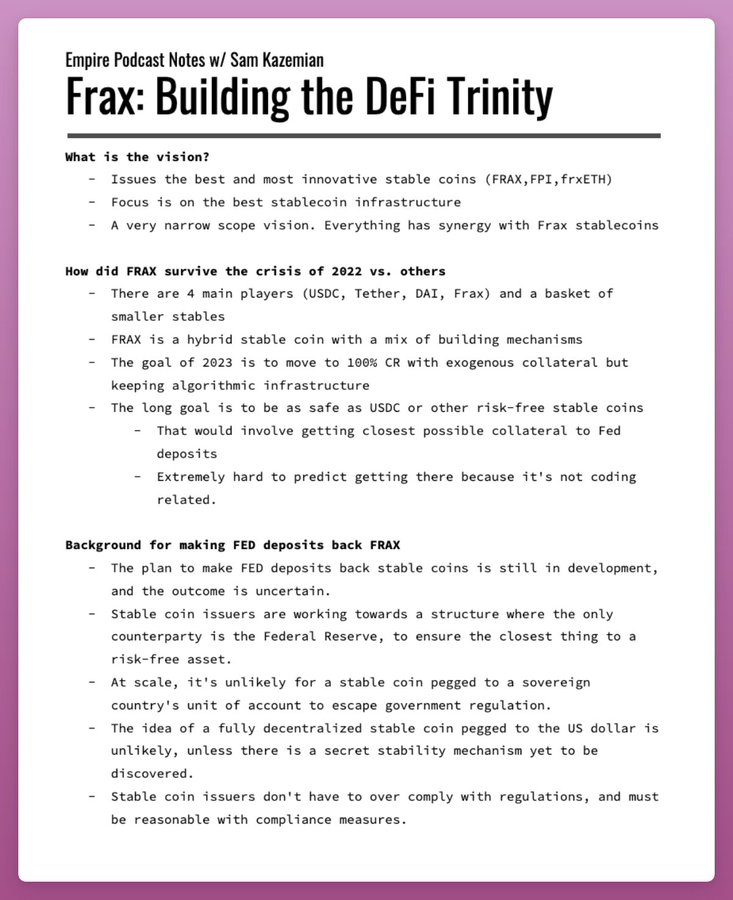
A Federal Reserve master account would allow holding USD and transacting directly with the Fed, making FRAX the closest thing to risk-free digital dollars.
This would enable FRAX to eliminate reliance on USDC as collateral and scale to hundreds of billions in market cap.
But FRAX isn’t there yet—it lacks the monetary premium of DAI. Currently, FRAX is primarily used to extract yield within its cleverly designed flywheel ecosystem.
In contrast, most DAI supply sits in wallets to hedge against market volatility and preserve value.
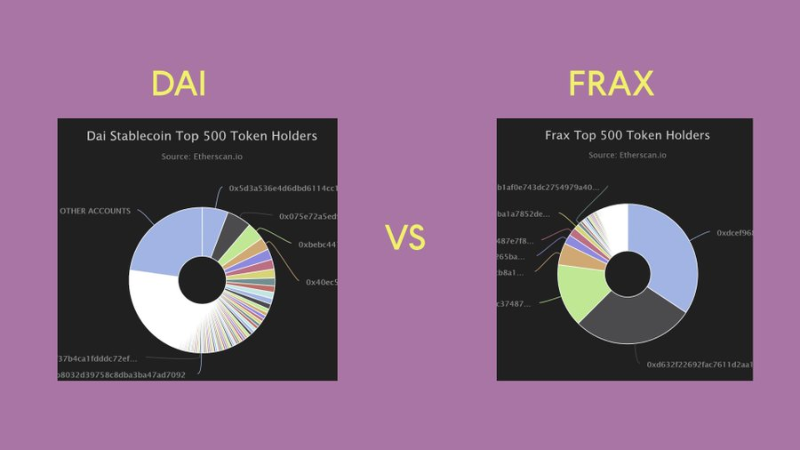
Frax’s focus on yield and efficiency maximization sets it apart.
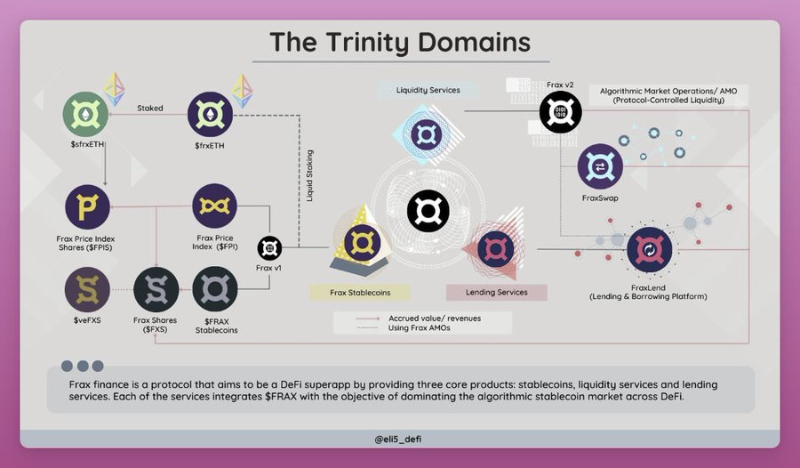
Frax has built an entire "DeFi Trinity" ecosystem centered around FRAX:
- Fraxswap
- Fraxlend
- Fraxferry (bridge)
- frxETH
Each component is designed to strengthen FRAX’s utility.
Synthetix’s sUSD is also pragmatically used, tightly integrated within its own DeFi ecosystem:
- Kwenta – Exchange
- Lyra – Options
- Polynomial – Structured vaults
- Thales – Binary options
sUSD’s adoption depends on the growth of its DeFi products, but its monetary premium remains low.
Interestingly, Maker aims to build its own DeFi ecosystem similar to Frax. Maker is developing a lending protocol and a synthetic LSD—EtherDAI—to create more utility and demand for DAI.
My initial thought was that Spark Protocol is a direct competitor to Maker and a countermove to $GHO. But that doesn’t mean Maker and Aave can’t cooperate in the future. In fact, I believe cooperation yields the best outcome for both. Let me explain.
Everything Frax builds is focused on enhancing the capabilities of the FRAX stablecoin. Likewise, Maker’s new protocols will boost DAI’s utility. For Maker, DAI as a bias-free world currency is the ultimate mission, and new protocols are being developed to achieve it.
However, Aave’s mission is different: it aims to become the leading money market protocol, and $GHO is merely a tool to achieve that goal.
In short: DAI is the mission, Spark Protocol is the tool. For Aave, the money market is the mission, $GHO is the tool.
Venus’s stablecoin $VAI is a perfect example. It powers a successful lending protocol on BNB Chain with $855 million in TVL.
At its peak market cap of $250 million, $VAI was larger than FRAX—now it trades below peg at $0.94, with only $60K in 24-hour volume.
$VAI isn’t Venus’s priority—the lending protocol itself is the mission. Still, $VAI helped Venus grow into what it is today.
Regardless, if founders truly embrace this mindset, all stablecoins can coexist—and even support each other’s growth. Supporting DAI on Aave means the protocol can mint more $GHO, and $GHO could also be supported on Spark Protocol.
The same logic applies to Curve’s crvUSD. Curve is the backbone of spot liquidity in DeFi, and crvUSD will enhance the protocol’s capital efficiency. Therefore, crvUSD isn’t a threat to FRAX or DAI—it could actually increase spot liquidity for all DeFi stablecoins.
Thus, I’m bullish because they offer unique differentiation. They recognize regulation matters but approach it differently:
DAI and LUSD aim to become censorship-resistant, while Frax seeks proximity to the Federal Reserve.
Although GHO and crvUSD may seem to intensify competition, their focus is improving the underlying protocols. They can all collaborate in unique ways, strengthening each other.
Moreover, as regulators turn their attention to us, cooperation is more critical than ever.
Join TechFlow official community to stay tuned
Telegram:https://t.me/TechFlowDaily
X (Twitter):https://x.com/TechFlowPost
X (Twitter) EN:https://x.com/BlockFlow_News
 Ignas | DeFi Research