The Most Comprehensive Analysis of the Metaverse Concept! Why Does the Metaverse Develop on Blockchain?
TechFlow Selected TechFlow Selected
The Most Comprehensive Analysis of the Metaverse Concept! Why Does the Metaverse Develop on Blockchain?
As the underlying infrastructure of the metaverse, blockchain technology should accelerate its development in cross-chain operations, sector expansion, and project collaboration, injecting strong momentum into the metaverse future of the Web3 era.
 Navigating Web3 tides with focused insights
The metaverse, the latest buzzword of the Web3 era, emerged into the spotlight in 2021 alongside other trending concepts like NFTs and DAOs. The term originated in the 1992 science fiction novel *Snow Crash*, which depicted a vast virtual reality world where people interacted through digital avatars, competing to elevate their status—an imaginative vision of a futuristic world far ahead of its time.
Today, as the concept of the metaverse intertwines with blockchain technology, industries such as virtual environments and social live streaming are gradually evolving. The metaverse has become the "holy grail" for creating breakout products in the next generation of the internet. Today, let’s dive into the metaverse, explore its inseparable relationship with blockchain, and see how metaverse projects on blockchain have taken off!
What Is the Metaverse?
When we hear the word "metaverse," we might imagine an alternate digital world and living space. In fact, there is no single authoritative definition of the metaverse within academia. Generally, we can approach the concept from two perspectives:
In terms of spatiotemporality, the metaverse is a digitally virtual space but one that exists in real time;
In terms of authenticity, the metaverse contains both digitized replicas of the real world and creations from purely virtual realms.
More precisely, the metaverse resembles a rebirth of a classic idea—materialized through emerging technologies such as extended reality (XR), blockchain, cloud computing, and digital twins. A true metaverse isn’t a standalone entity, but rather a convergence of multiple technologies—a synthesis of modern information systems. As the next evolutionary stage of the internet and a new benchmark, the metaverse integrates technological concepts including 5G, cloud computing, artificial intelligence, virtual reality, and blockchain, collectively shaping a brand-new future digital environment.
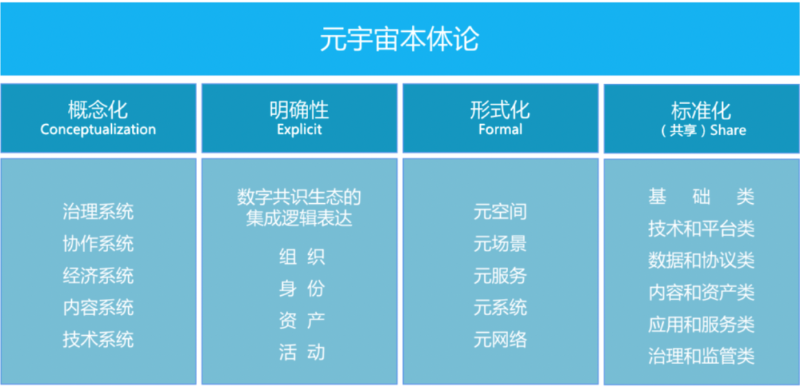
The metaverse consists of many components. Below are its foundational elements:
Internet: a decentralized network of computers.
Open media standards: including text, images, audio, video, 3D objects, 3D scenes and geometry, vectors, sequences, and programs that generate or combine any of these content types.
Open programming language standards: including HTML, JavaScript, WebAssembly, WebXR, WebGPU Shader Language, etc.
Extended Reality (XR) hardware: such as smart glasses, haptic devices, and omnidirectional treadmills.
Decentralized ledgers and smart contract platforms (e.g., blockchain): enabling transparent, permissionless, and censorship-resistant transactions—forming a crucial foundation for ownership economies and supporting the metaverse as a viable public good.
Among these components, blockchain holds a pivotal role, continuously fueling the development of the metaverse with its inherent technological advantages.
Blockchain: The Technological Foundation of the Metaverse
We've mentioned that the metaverse integrates various emerging tech concepts, including blockchain. But what exactly is the relationship between the metaverse and blockchain? The metaverse is a trusted digital value-interaction network built upon the technical architecture and operational mechanisms of Web3—a new digital ecosystem centered around blockchain. Therefore, we can view blockchain technology as the foundational layer of the metaverse. Its advantages—efficiency, stability, transparency, and rule-based operations—provide the bedrock upon which the metaverse is built, serving as a key enabler for concrete metaverse projects. Blockchain uses cryptographic techniques to sequentially append consensus-confirmed blocks into a distributed ledger, possessing technical, financial, and social attributes. These three attributes serve as core drivers for the healthy development of the metaverse, playing irreplaceable roles.
- From a technical standpoint, underlying platforms such as BaaS, cross-chain protocols, privacy computing, identity authentication, and distributed storage and computing provide infrastructure for decentralized applications across finance, manufacturing, education, energy, and other industries.
- From a financial perspective, DeFi, NFTs, and xFi explore digital financial service models through extensive practical experimentation.
- From a social angle, DAO models offer new paradigms for collaboration in digital environments.
The emergence of the metaverse represents an inevitable evolution of blockchain's technological, financial, and social attributes. It provides tools for privacy protection and identity verification within the metaverse, establishes digital pathways for financial transaction models, sets norms for new forms of social interaction, and drives the formation of a blockchain-centered Web3 digital ecosystem.

Metaverse Projects on Blockchain
Talking about the metaverse may seem abstract. Looking at popular metaverse projects that have emerged in recent years makes the vision more tangible and inspiring. Let’s now explore some notable "metaverse" initiatives on major public blockchains.
Flow
Developed by Dapper Labs—the team behind popular blockchain games like CryptoKitties and NBA Top Shot—Flow is a blockchain platform specifically designed for gaming, attracting numerous partners with its fast and low-cost transaction capabilities. Both Flow and Dapper Labs have claimed 108 plots of land on the metaverse project Matrix World, to establish virtual headquarters and leverage the metaverse concept to develop new ventures.
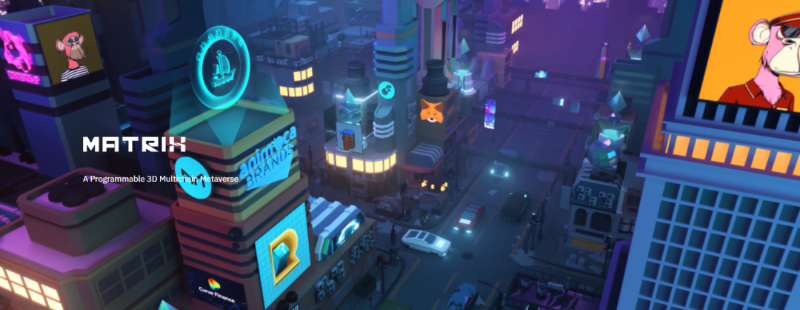
Matrix World features programmability, multi-chain connectivity, and an open-world structure, allowing users to interact with immersive 3D applications running simultaneously on different blockchains. This includes, but is not limited to, building 3D architectures, hosting virtual meetings, displaying NFTs, and advanced functions such as creating and hosting 3D DApps using Matrix’s built-in creation services and computing resources.
Rangers Protocol
Incubated by blockchain game publisher MixMarvel, Rangers Protocol integrates cross-chain functionality, NFTs, and EVM compatibility, aiming to enable frictionless interactions between DApps and assets across multiple chains (already supporting Ethereum, BSC, and Tron). It serves as a foundational blockchain architecture for the metaverse. As a high-performance chain cluster enabling EVM-based cross-chain contract interoperability, Rangers Protocol supports all entrepreneurs looking to explore the blockchain world.
A key advantage of Rangers Protocol lies in its high performance, security, and stability. Users receive real-time execution results for transactions on the Rangers Protocol without waiting for block confirmations. Moreover, its frictionless interaction capability is crucial for metaverse development, enabling complex operations such as extracting data, assets, or smart contracts from different blockchains.
Litentry
Litentry is a decentralized identity aggregator, featuring a blockchain built on Substrate and a distributed decentralized identity (DID) verification network. It aims to provide decentralized, verifiable identity aggregation services for DID applications. In August this year, Litentry launched My Crypto Profile, a metaverse identity application that allows users to link their Ethereum identities with Twitter accounts to showcase their NFT collections on Twitter. The app has also partnered with metaverse projects like The Sandbox. My Crypto Profile is a Web3 identity tool by Litentry that enables users to connect their crypto addresses with social media identities to prove account ownership. The MCP Genesis NFT is an original NFT collection issued by My Crypto Profile, exclusive to the first 500 early adopters.
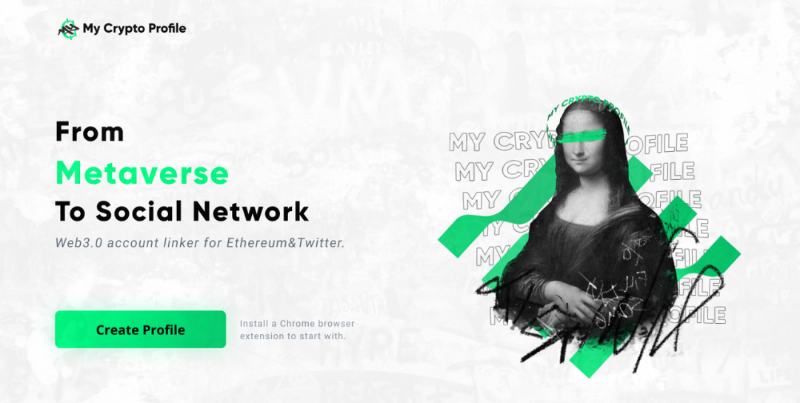
My Crypto Profile's technical vision is to use verified identity aggregation to provide social connection credentials for the development of the metaverse, building a multifunctional Web3 social platform and a repository for NFT art collections. By enabling cross-chain social interactions, it enriches Web3 social experiences, allowing users to freely and flexibly engage in digital social life.
The Future of the Metaverse:
Multi-Chain Integration and Cross-Project Collaboration
While we marvel at how blockchain technology and the metaverse are being creatively combined in thriving projects, we must also consider whether blockchain could pose certain obstacles to monetizing the metaverse concept—and whether we should proactively mitigate potential risks. In today’s multi-chain landscape, with increasing competition among public blockchains, different platforms are actively expanding their metaverse offerings while engaging in a new round of “user base battles” targeting both tech enthusiasts and everyday users. Although encryption and decentralized computing help break down barriers between platforms and enable cross-chain operations, true interoperability between different metaverse projects remains unrealized. Recently, Decentraland emerged as a new 3D virtual space in the metaverse. Within this 3D world, users enjoy various mini-games and earn numerous NFT rewards. However, further development of Decentraland faces limitations—individual platforms cannot simultaneously benefit from the strengths of multiple blockchains. Just as you can't explore the Decentraland world from within The Sandbox, nor can you run a Unity-created game using Unreal Engine. We envision a vibrant multiverse and hope the metaverse will lead us into a truly intelligent, free, and efficiently collaborative digital life. Yet the foundation of the metaverse lies in shared data, shared computing power, and shared bandwidth. Only by gathering sparks of innovation can we ignite the full brilliance of the metaverse. A true multiverse requires a unified universal system. Therefore, as the underlying infrastructure of the metaverse, blockchain technology must accelerate its progress in cross-chain operations, sector expansion, and project collaboration to power the arrival of the Web3-era metaverse.
References:
Blockchain Technology and the Metaverse
Does the Metaverse Need Blockchain Technology?
Metaverse Travel Guide – How Blockchain Builds Metaverse Infrastructure: Understand the Relationship Between the Metaverse and Blockchain in One Article
https://juejin.cn/post/7055516578934161439
From Blockchain to the Metaverse
https://juejin.cn/post/7021834661449957413
Li Ming: The Metaverse, a Web3 Digital Ecosystem Centered on Blockchain
https://juejin.cn/post/7055551072219168799
Join TechFlow official community to stay tuned
Telegram:https://t.me/TechFlowDaily
X (Twitter):https://x.com/TechFlowPost
X (Twitter) EN:https://x.com/BlockFlow_News
 @OurTinTinLand