Comparison and Analysis of Poker-Based GameFi Games
TechFlow Selected TechFlow Selected
Comparison and Analysis of Poker-Based GameFi Games
Texas Hold'em—the most suitable game for blockchain gaming.
 Navigating Web3 tides with focused insights
WLabs Editor's Note: Texas Hold'em has always been considered by W Labs as the most suitable game for blockchain gaming—easy to learn, highly strategic, and with a broad audience. With well-designed economic models, this type of blockchain game can avoid death spirals and truly break the curse. Huige (Brother Hui) provides a brief overview of current crypto-integrated Texas Hold’em projects—fellow enthusiasts, let’s learn together. His personal Twitter is: @kevinxhxhxh.
Recently, I’ve seen a series of Web3 Texas Hold’em games emerging, and I’ve written two research analysis articles on them. As a player, I’m very excited. Today’s article will focus on what kind of gaming experience GameFi + Texas Hold’em can actually bring us.
1. Background of Texas Hold’em
First, a quick introduction to Texas Hold’em, full name Texas Hold’em Poker. It is a player-versus-player card game. Each table requires at least 2 players and up to 22, though typically 2–10 players participate.
Texas Hold’em uses a standard 52-card deck without jokers. At the beginning, each player receives two face-down “hole cards.” Then, the dealer reveals five community cards face-up in stages. After all betting rounds (three in total, with betting in each), if no winner is determined, the game proceeds to the “showdown” phase, where remaining players reveal their hole cards, and the best five-card hand wins. Hand rankings are shown below:
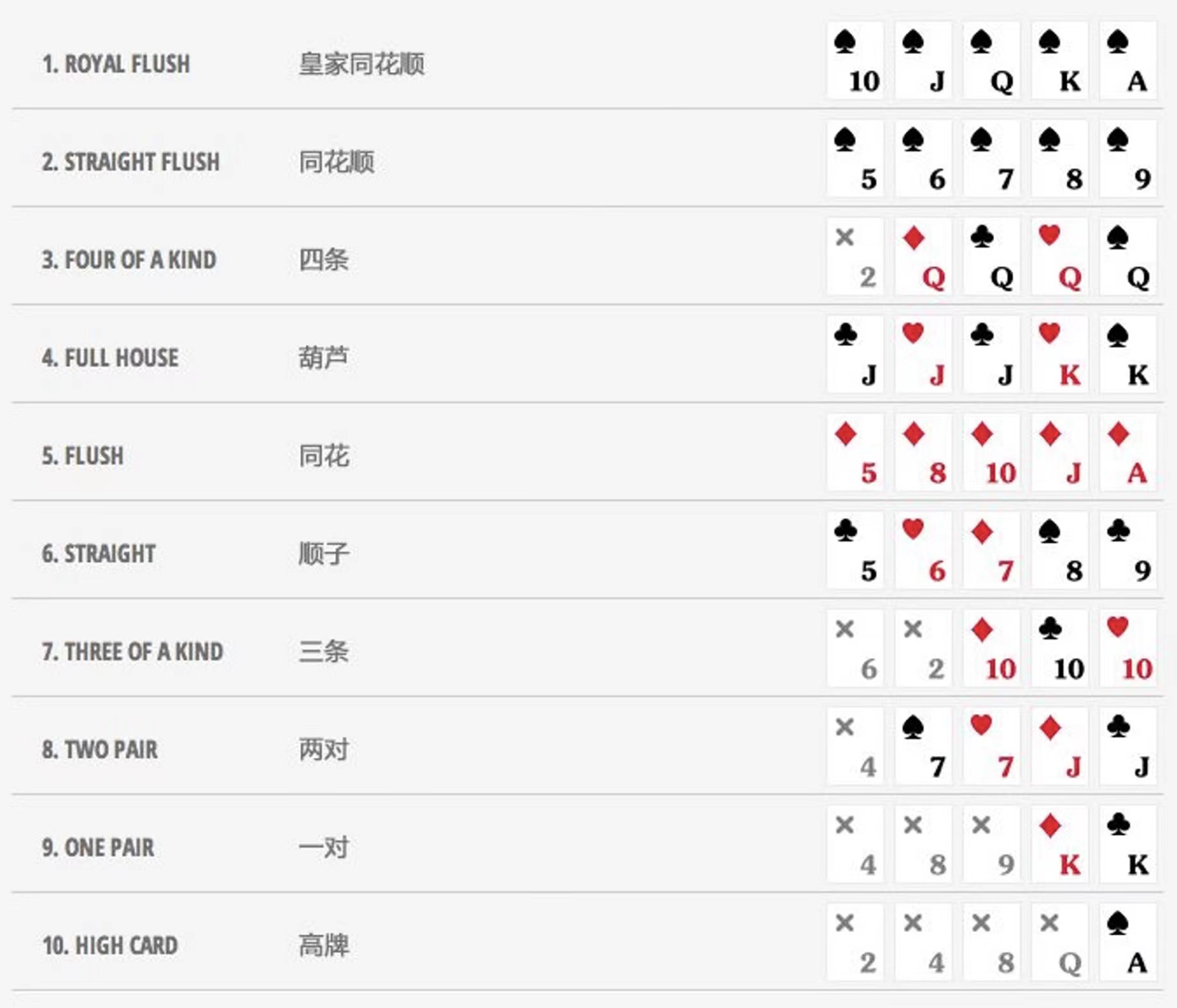
As you can see, the rules are relatively simple—essentially, players compare the best five-card combination made from their hole cards and the community cards. However, it’s also highly complex, as every decision involves probability and psychology. You can win either by having a stronger hand or by bluffing your way past opponents with better cards. There’s extensive tactical depth involved. Annual poker tournaments attract many players with large prize pools—for example, the WSOP top prize exceeds $10 million.
High stakes, unique strategic depth, and entertainment value draw a wide player base. Research estimates that about 60 million people—6.8% of adults—regularly play Texas Hold’em. Moreover, due to the global lockdowns during the COVID-19 pandemic, many players could no longer organize games through offline clubs, which accelerated the growth of online poker.
In online Texas Hold’em, over 50 platforms reportedly generate monthly revenues exceeding 10 million RMB, with market leader “WSOP” reaching up to 60 million RMB in revenue, demonstrating its strong monetization potential. The entire online Texas Hold’em market is estimated at $500 million.
2. Pain Points in Current Games
Despite its global popularity, there are several product pain points that need addressing.
Players who have used online Texas Hold’em platforms often find depositing and withdrawing funds cumbersome. Deposits require multiple verification steps and sometimes involve foreign exchange transfers, taking 2–3 business days. Withdrawals are even more problematic—each platform requires strict KYC procedures, and even after completing KYC, users may still be unable to withdraw their winnings or face high processing fees.
Additionally, nearly all players question the fairness of card dealing. Whether the dealing is truly random remains a major topic of discussion. Unlikely events—such as pocket Aces losing to 2-7 offsuit—happen frequently. In MTT (Multi-Table Tournament) bubble phases, short stacks often feel unfairly targeted by the system. While most platforms don’t intentionally cheat, they lack a way to prove their integrity to players.
Recreational players struggle to profit. In traditional games, players engage in zero-sum competition while also paying rake fees. This skews profits toward skilled players, who earn substantial returns funded largely by recreational players. If this trend intensifies, recreational players may gradually leave, ultimately leaving even skilled players unable to profit.
3. Blockchain-Based Solutions
Using blockchain for deposits and withdrawals means all transactions occur on-chain, and the game’s contract wallet cannot block any withdrawal. Transaction speed then depends only on blockchain confirmation times—eliminating concerns about platforms delaying KYC approvals or slow bank transfers. Of course, users must first learn basic operations of decentralized wallets.
Card dealing and shuffling can also leverage blockchain technology to generate verifiable random numbers, ensuring transparency and immutability. This not only addresses user distrust but also gives platforms a credible way to prove fairness.
Recreational players can also earn rewards. Beyond entertainment, they contribute valuable traffic to the platform. By using metrics like playtime and number of hands played as proof-of-activity, recreational players can earn a portion of rewards under predefined game rules (typically detailed in project whitepapers)—revenue that would otherwise go entirely to the platform in Web2 games.
Motivated by these solutions, several new games have emerged, each tackling these issues to varying degrees—examples include Coinpoker, W3poker, and NUTSDAO.
Coinpoker was one of the earliest blockchain-based gaming platforms. Its format resembles other Web2 products but adds cryptocurrency deposits/withdrawals and verifiable card dealing/shuffling—an impressive vision at a time when GameFi wasn’t yet conceptualized.
The other two projects are reimagining Texas Hold’em through GameFi principles—I’ll cover them in detail in my full report.
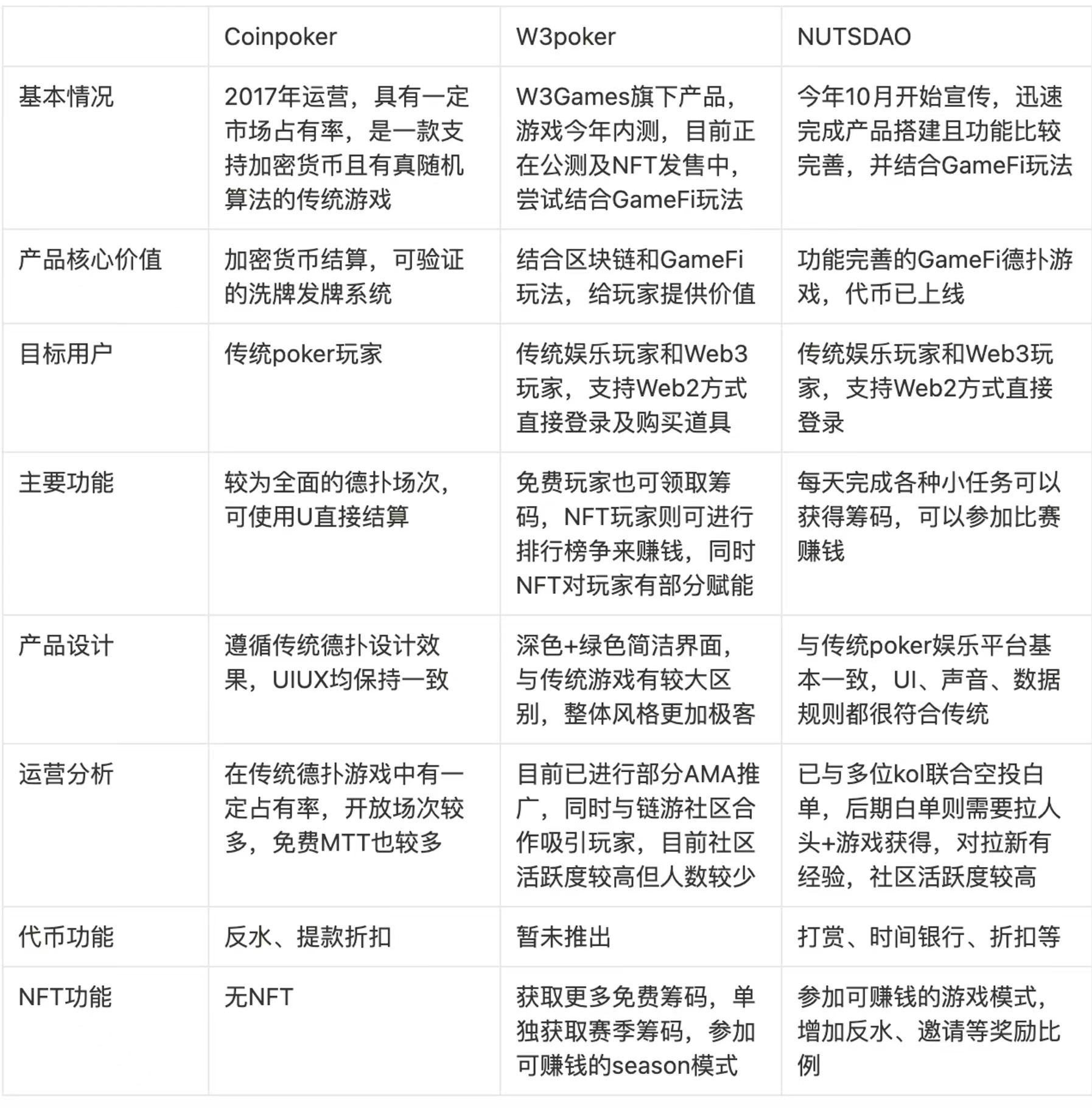
Next, I’ll briefly compare these three games.
4. Product Comparison
5. Integration with NFTs?
In traditional gaming token platforms, players can obtain tokens through various means—limited-time claims, daily logins, rewards based on number of hands played, free MTT entries, etc.—providing new players with multiple entry points and improving retention. Adding achievement systems, premium tournaments, and leaderboards further enhances engagement. What additional functionality could NFTs bring?
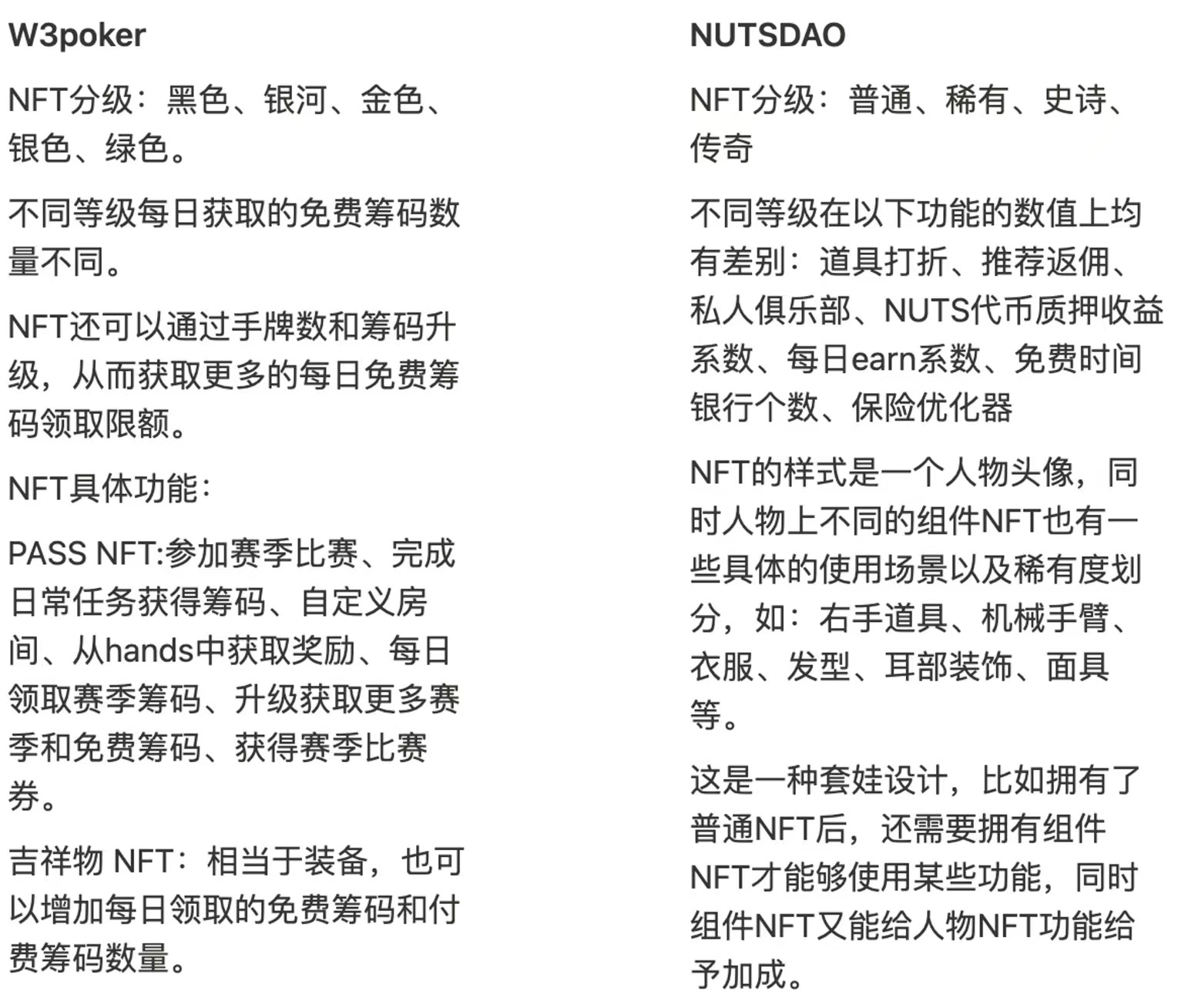
As shown, both games use NFTs to provide in-game ecosystem bonuses, allowing NFT holders—especially those with rarer NFTs—to earn higher returns. While this operational model works in Web2 poker, adding NFT utility makes it distinct. In traditional poker, big spenders only gain chip advantages; in GameFi, a high-rarity NFT grants advantages across multiple functions and features. However, it’s important to note that none of these benefits affect actual gameplay outcomes—this, I believe, should remain a boundary for Texas Hold’em. No matter how much it evolves, game rules must not change based on NFT ownership.
Based on these two projects, NFT utility appears better suited for gaming token platforms rather than traditional cash-table poker games.
As GameFi projects, they naturally require their own tokens. Currently, both NUTSDAO and Coinpoker have native tokens, but their use cases are limited, and there’s no clear sustainable consumption mechanism yet. This is a broader topic, which I plan to explore further in future research.
Conclusion
This article analyzed Texas Hold’em gameplay, market size, project comparisons, and NFT functionalities. It’s clear this is a market full of potential, with different projects promoting the game in their own ways. We look forward to seeing a Texas Hold’em GameFi project achieve long-term sustainable success.
Reposting is welcome. Original content is hard—please credit “W Labs, Melon Field Lab” as the source.
Melon Field Lab website: http://www.wlabsdao.com/
Melon Field Lab Discord: https://discord.gg/wggdao
Melon Field Lab Twitter: https://twitter.com/GuaTianGuaTian
Melon Field Lab Long-form Research on Mirror: https://mirror.xyz/iamwgg.eth
Melon Field Lab on Medium: https://guatianwgg.medium.com/
Join TechFlow official community to stay tuned
Telegram:https://t.me/TechFlowDaily
X (Twitter):https://x.com/TechFlowPost
X (Twitter) EN:https://x.com/BlockFlow_News
 瓜田实验室W Labs