








Interview with Vitalik: In 10 Years, zk-STARKs Will Be as Important as Blockchain
TechFlow Selected TechFlow Selected
Interview with Vitalik: In 10 Years, zk-STARKs Will Be as Important as Blockchain
I hope to see widespread public demand for cryptocurrency and non-financial blockchain applications, driven by on-chain usage rather than Binance accounts.
 Navigating Web3 tides with focused insights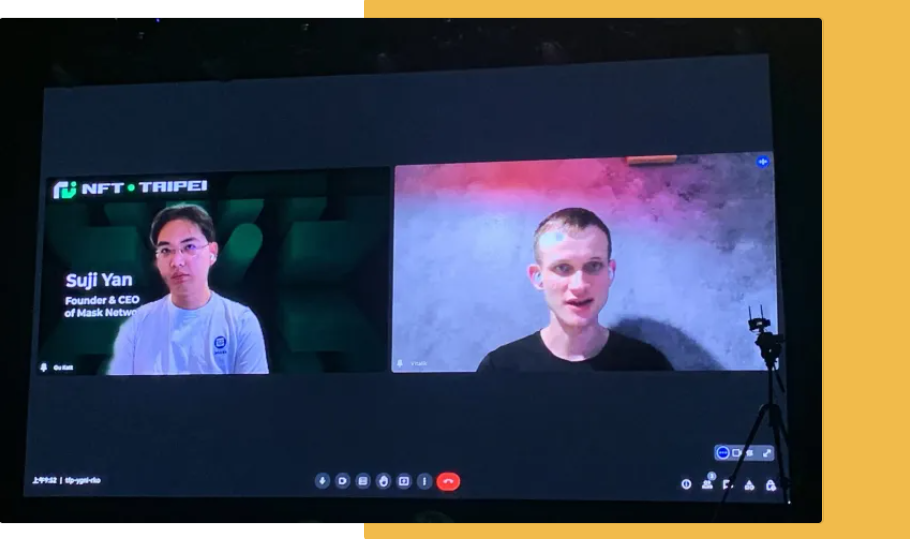
By Perry
Following the Taipei Blockchain Week, NFT Taipei kicked off today at the San-Chuang Living Park. The event’s opening session featured a fireside chat between Ethereum co-founder Vitalik Buterin and Mask Network founder Suji Yan, discussing topics including zero-knowledge proof (ZK) technology, the FTX collapse, and the future of Ethereum.
Betting on zk-STARK Technology
During the conversation, Vitalik stated that zk-STARK technology will become as important as blockchain over the next 10 to 20 years. As a powerful privacy-enhancing technology, it can not only solve problems in blockchain applications but also enhance security for users of centralized systems.
Although blockchain offers openness, censorship resistance, and adherence to developer-defined rules, it sacrifices scalability and privacy. However, with zk-STARK, both shortcomings can be effectively addressed.
Regarding how zk-STARK addresses privacy, Vitalik noted that it depends on the application—each use case is different. On scalability, however, as zk-EVM technology continues to advance, transaction verification will no longer be limited to Ethereum blocks, significantly improving scalability.
Reducing Gas Fees
Although Ethereum gas fees are considerably lower than they were a year ago, they remain a burden for many users. Vitalik attributed this to scalability issues. After The Merge, Ethereum has entered the Surge phase, with the goal of enhancing the entire network's scalability through Layer 2 solutions.
Vitalik believes that Layer 2 teams will receive more attention next year. Progress in both zk-EVM and Optimistic Rollup technologies will further reduce gas fees.
Thoughts on the FTX Collapse
On the phenomenon of many Taiwanese FTX victims, Vitalik said that what succeeds in the crypto industry must be practical and true to the values of cryptocurrency. While some believe centralized systems are more efficient and that decentralization exists merely to evade regulation, the FTX collapse revealed a failure to protect users. Openness and transparency in systems are essential to prevent user deception.
"FTX’s failure burned countless users’ assets, but Uniswap has operated flawlessly for four years, and MakerDAO has also performed very well over the past four years." Vitalik remarked.
However, Vitalik acknowledged that in Latin America, many people use Binance out of practical necessity—conducting instant transfers without worrying about losing their wallets (since centralized exchanges can help users recover access). Still, rather than relying on centralized exchanges or hardware wallets, Vitalik prefers “social recovery wallets” to maintain both wallet security and decentralization.
Note: A social recovery wallet allows users to designate trusted contacts or devices as guardians. If the user loses control of their wallet, guardians can sign special transactions to help restore access.
Hopes for the Future of the Blockchain Industry
At the end of the talk, an audience member asked Vitalik: if he were invited back to NFT Taipei three years from now, what kind of progress in the global blockchain industry would make him happy?
Vitalik responded:
"In 2025, I hope to see mainstream adoption of cryptocurrencies and non-financial blockchain applications—used directly on-chain, not through Binance accounts."
Vitalik also hopes people will use blockchain technology because of its intrinsic value—such as transferring assets, using DAOs as organizational and communication tools, and adopting soulbound tokens and POAPs.
Join TechFlow official community to stay tuned
Telegram:https://t.me/TechFlowDaily
X (Twitter):https://x.com/TechFlowPost
X (Twitter) EN:https://x.com/BlockFlow_News






